Kirjojen hintavertailu – 12 903 725 kirjaa ja 27 kauppaa

Kirjailija

Xavier Richet

Kirjat ja teokset yhdessä paikassa: 11 kirjaa, julkaisuja vuosilta 1989–2025, suosituimpiin kuuluu Présences économiques chinoises en Méditerranée. Vertaile teosten hintoja ja tarkista saatavuus suomalaisista kirjakaupoista.

11 kirjaa

Kirjojen julkaisuvuodet: 1989–2025.

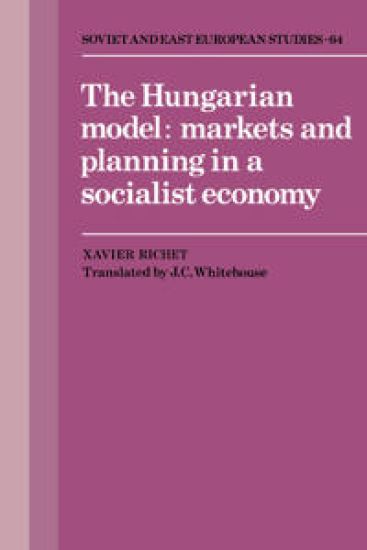
The Hungarian Model

The Hungarian Model

Xavier Richet

Cambridge University Press
2008
pokkari
This book provides an exceptionally thorough treatment of the Hungarian economy and its experience of economic reform. Within a wider discussion of the appliance and success of Soviet-type economies (STEs), the author investigates the decentralizing measures and market mechanisms which have been progressively introduced and considers the limits on and limitations of the Hungarian economic model. The reforms adopted since 1968, known initially as the New Economic Mechanism, were intended to build a system of market socialism combining micro-economic efficiency, indirect regulation and socialist ethical principles. However, the predicted improvements in the economy still have not fully materialized: living standards have begun to drop, output is sluggish and hard currency trade and payments have been a real difficulty. Indeed, change in the country's leadership is perhaps a recognition of the need for a clearer direction in the field of social and economic reform. This English version of Xavier Richet's French original provides much insight into what has gone wrong in Hungary and also suggests ways future pitfalls might be avoided.

Foreign Direct Investment in Central Eastern Europe: Case Studies of Firms in Transition
This work presents twelve case studies of foreign direct investment in Bulgaria, the Czech Republic, and Slovenia. The studies include major firms such as Skoda and Danone, as well as smaller ventures, and cover the same sectors for each country, thereby permitting useful comparisons and assessments of: the role of country, sector, technology, and firm-specific characteristics in determining the pattern and nature of foreign direct investment; the potential implications of FDI for the competitiveness of the investing firms; the impact of infusions of capital investments, technology, and managerial resources for the host economies; and the policy implications for host countries and relevant international institutions.
The Hungarian Model

The Hungarian Model

Xavier Richet

Cambridge University Press
1989
sidottu
This book provides an exceptionally thorough treatment of the Hungarian economy and its experience of economic reform over the last twenty years. Within a wider discussion of the appliance and success of Soviet-type economies (STEs), the author investigates the decentralising measures and market mechanisms which have been progressively introduced and considers the limits on and limitations of the present Hungarian economic model. The reforms adopted since 1968, known initially as the New Economic Mechanism, were intended to build a system of market socialism combining micro-economic efficiency, indirect regulation and socialist ethical principles. However, the predicted improvements in the economy still have not fully materialised: living standards have recently begun to drop, output is sluggish and hard currency trade and payments have been a real difficulty. Indeed, the recent change in the country’s leadership is perhaps a recognition of the need for a clearer direction in the field of social and economic reform. This timely English version of Xavier Richet’s French original provides much insight into what has gone wrong in Hungary and also suggests ways future pitfalls might be avoided.