Kirjojen hintavertailu – 12 859 828 kirjaa ja 27 kauppaa
Kirjailija
Xiangyu Shao
Kirjat ja teokset yhdessä paikassa: 4 kirjaa, julkaisuja vuosilta 2022–2025, suosituimpiin kuuluu Fractional-Order Sliding Mode Control: Methodologies and Applications. Vertaile teosten hintoja ja tarkista saatavuus suomalaisista kirjakaupoista.
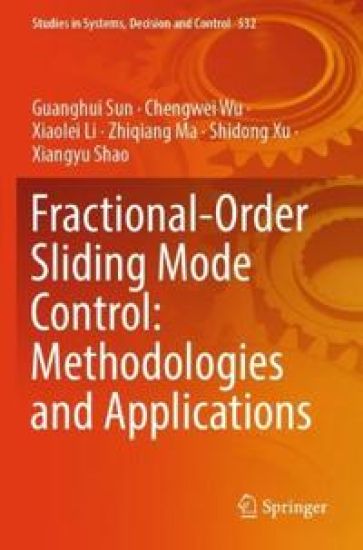
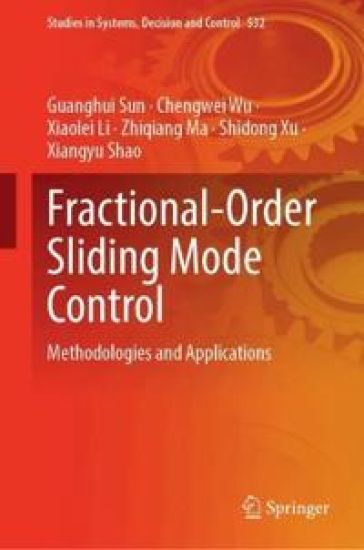
This book delves deep into fractional-order control and fractional-order sliding mode techniques, addressing key challenges in the control design of linear motor systems and control for the deployment of space tethered systems. Innovative strategies such as adaptive fractional-order sliding mode control and fractional-order fuzzy sliding mode control schemes are devised to enhance system performance. Divided into three parts, it covers a brief view of fractional-order control strength in modeling and control, fractional-order sliding mode control of linear motor systems, and fractional-order sliding mode control for the deployment of space tethered systems. Each chapter offers valuable insights and solutions. Simulations and experiments validate the efficacy of these approaches, making this book essential for researchers, engineers, and practitioners in control systems and aerospace engineering.
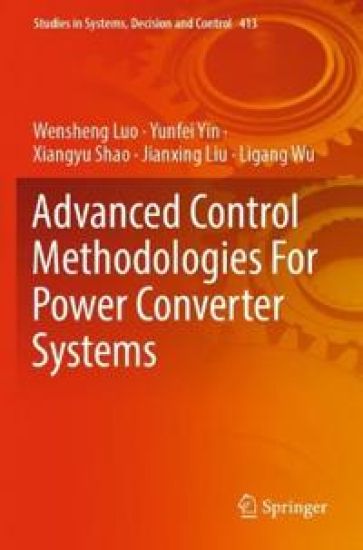
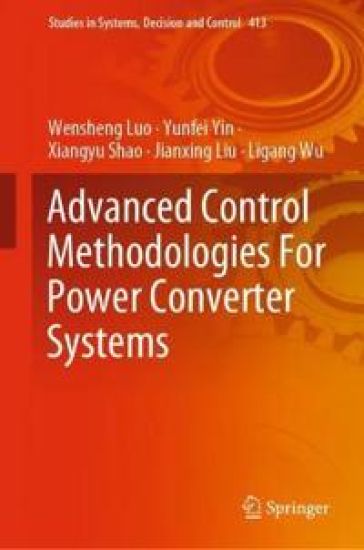
This book aims to present some advanced control methodologies for power converters. Power electronic converters have become indispensable devices for plenty of industrial applications over the last decades. Composed by controllable power switches, they can be controlled by effective strategies to achieve desirable transient response and steady-state performance, to ensure the stability, reliability and safety of the system. The most popular control strategy of power converters is the linear proportional–integral–derivative series control which is adopted as industry standard. However, when there exist parameter changes, nonlinearities and load disturbances in the system, the performance of the controller will be significantly degraded. To overcome this problem, many advanced control methodologies and techniques have been developed to improve the converter performance. This book presents the research work on some advanced control methodologies for several types of power converters, including three-phase two-level AC/DC power converter, three-phase NPC AC/DC power converter, and DC/DC buck converter. The effectiveness and advantage of the proposed control strategies are verified via simulations and experiments. The content of this book can be divided into two parts. The first part focuses on disturbance observer-based control methods for power converters under investigation. The second part investigates intelligent control methods. These methodologies provide a framework for controller design, observer design, stability and performance analysis for the considered power converter systems.
This book aims to present some advanced control methodologies for power converters. Power electronic converters have become indispensable devices for plenty of industrial applications over the last decades. Composed by controllable power switches, they can be controlled by effective strategies to achieve desirable transient response and steady-state performance, to ensure the stability, reliability and safety of the system. The most popular control strategy of power converters is the linear proportional–integral–derivative series control which is adopted as industry standard. However, when there exist parameter changes, nonlinearities and load disturbances in the system, the performance of the controller will be significantly degraded. To overcome this problem, many advanced control methodologies and techniques have been developed to improve the converter performance. This book presents the research work on some advanced control methodologies for several types of power converters, including three-phase two-level AC/DC power converter, three-phase NPC AC/DC power converter, and DC/DC buck converter. The effectiveness and advantage of the proposed control strategies are verified via simulations and experiments. The content of this book can be divided into two parts. The first part focuses on disturbance observer-based control methods for power converters under investigation. The second part investigates intelligent control methods. These methodologies provide a framework for controller design, observer design, stability and performance analysis for the considered power converter systems.