Kirjojen hintavertailu – 12 903 725 kirjaa ja 27 kauppaa

Kirjailija

YangQuan Chen

Kirjat ja teokset yhdessä paikassa: 33 kirjaa, julkaisuja vuosilta 1999–2026, suosituimpiin kuuluu Fractional-Order Singular Systems. Vertaile teosten hintoja ja tarkista saatavuus suomalaisista kirjakaupoista.

33 kirjaa

Kirjojen julkaisuvuodet: 1999–2026.

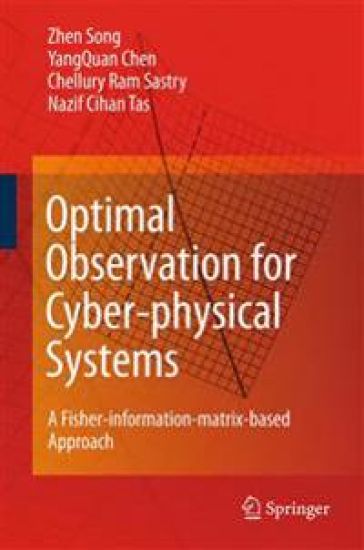
Optimal Observation for Cyber-physical Systems

Optimal Observation for Cyber-physical Systems

Zhen Song; YangQuan Chen; Chellury R. Sastry; Nazif C. Tas

Springer London Ltd
2014
nidottu
"Optimal Observation for Cyber-physical Systems" addresses the challenge, fundamental to the design of wireless sensor networks (WSNs), presented by the obligatory trade-off between precise estimates and system constraints. A unified theoretical framework, based on the well-established theory of optimal experimental design and providing consistent solutions to problems hitherto requiring a variety of approaches, is put forward to solve a large class of optimal observation problems. The Fisher information matrix plays a key role in this framework and makes it feasible to provide analytical solutions to some complex and important questions which could not be answered in the past. Readers with an applied background in WSN implementation will find all the understanding of the key theory of optimal experimental design they need within this book. The use of multiple examples to illustrate the theoretical parts of the book brings the subject into sharper focus than would an abstract theoretical disquisition.
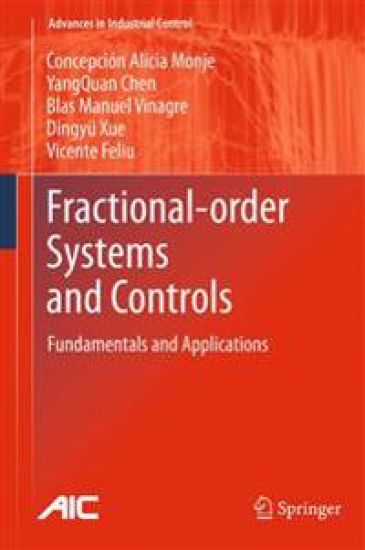
Fractional-order Systems and Controls

Fractional-order Systems and Controls

Concepción A. Monje; YangQuan Chen; Blas M. Vinagre; Dingyu Xue; Vicente Feliu-Batlle

Springer London Ltd
2014
nidottu
Fractional-order Systems and Controls details the use of fractional calculus in the description and modeling of systems, and in a range of control design and practical applications. It is largely self-contained, covering the fundamentals of fractional calculus together with some analytical and numerical techniques and providing MATLAB® codes for the simulation of fractional-order control (FOC) systems. Many different FOC schemes are presented for control and dynamic systems problems. Practical material relating to a wide variety of applications is also provided. All the control schemes and applications are presented in the monograph with either system simulation results or real experimental results, or both. Fractional-order Systems and Controls provides readers with a basic understanding of FOC concepts and methods, so they can extend their use of FOC in other industrial system applications, thereby expanding their range of disciplines by exploiting this versatile new set of control techniques.
Modeling, Analysis And Design Of Control Systems In Matlab And Simulink

Modeling, Analysis And Design Of Control Systems In Matlab And Simulink

Yangquan Chen; Dingyu Xue

World Scientific Publishing Co Pte Ltd
2014
sidottu
MATLAB and Simulink are now being used extensively in not only academia as a teaching aid, a learning aid and a research tool but also industry for modeling, analysis, design and rapid prototyping. As a response, Modeling, Analysis and Design of Control Systems in MATLAB and Simulink emphasizes on practical use of and problem solving in MATLAB and Simulink following the so-called MAD (modeling, analysis and design) notion. Readers can not only learn the control concepts and problem solving methods but also coding skills by following the numerous inline MATLAB scripts, functions, reproducible examples as well as chapter-end Problems. The book service website contains Solution Manual, 1,000 plus teaching/learning PPTs, and all related codes used in the book for reproducing the examples. Modeling, Analysis and Design of Control Systems in MATLAB and Simulink has 12 chapters organized in 5 parts: Foundation, Modeling, Analysis, Design and Rapid Prototyping. Each chapter ends with Problems section. This book can be used as a reference text in the introductory control course for undergraduates in all engineering schools. The coverage of topics is broad, yet balanced, and it should provide a solid foundation for the subsequent control engineering practice in both industry and research institutes. This book will be a good desktop reference for control engineers and many codes and tools in this book may be directly applicable in real world problem solving.
Optimal Mobile Sensing and Actuation Policies in Cyber-physical Systems

Optimal Mobile Sensing and Actuation Policies in Cyber-physical Systems

Christophe Tricaud; YangQuan Chen

Springer London Ltd
2013
nidottu
A successful cyber-physical system, a complex interweaving of hardware and software with some part of the physical environment, depends on proper identification of the, often pre-existing, physical element. A bespoke “cyber” part of the system may then be designed from scratch. Optimal Mobile Sensing and Actuation Strategies in Cyber-physical Systems focuses on distributed-parameter systems the dynamics of which can be modelled with partial differential equations. These are very challenging to observe, their states and inputs being distributed throughout a spatial domain. Consequently, systematic approaches to the optimization of sensor location have to be devised for parameter estimation. The text begins by reviewing the field of cyber-physical systems and introducing background notions of distributed parameter systems and optimal observation theory. New research problems are then defined within this framework. Two important problems considered are optimal mobile sensor trajectory planning and the accuracy effects and allocation of remote sensors. These are followed up with a solution to the problem of optimal robust estimation. Actuation policies are then introduced into the framework with the purpose of improving estimation and optimizing the trajectories of both sensors and actuators simultaneously. The large number of illustrations within the text will assist the reader to visualize the application of the methods proposed. A group of similar examples are used throughout the book to help the reader assimilate the material more easily. The monograph concentrates on the use of methods for which a cyber-physical-systems infrastructure is required. The methods are computationally heavy and require mobile sensors and actuators with communications abilities. Application examples cover fields from environmental science to national security so that readers are encouraged to link the ideas of cyber-physical systems with their own research.
Distributed-Order Dynamic Systems

Distributed-Order Dynamic Systems

Zhuang Jiao; YangQuan Chen; Igor Podlubny

Springer London Ltd
2012
nidottu
Distributed-order differential equations, a generalization of fractional calculus, are of increasing importance in many fields of science and engineering from the behaviour of complex dielectric media to the modelling of nonlinear systems. This Brief will broaden the toolbox available to researchers interested in modeling, analysis, control and filtering. It contains contextual material outlining the progression from integer-order, through fractional-order to distributed-order systems. Stability issues are addressed with graphical and numerical results highlighting the fundamental differences between constant-, integer-, and distributed-order treatments. The power of the distributed-order model is demonstrated with work on the stability of noncommensurate-order linear time-invariant systems. Generic applications of the distributed-order operator follow: signal processing and viscoelastic damping of a mass–spring set up. A new general approach to discretization of distributed-order derivatives and integrals is described. The Brief is rounded out with a consideration of likely future research and applications and with a number of MATLAB® codes to reduce repetitive coding tasks and encourage new workers in distributed-order systems.
Fractional Processes and Fractional-Order Signal Processing

Fractional Processes and Fractional-Order Signal Processing

Hu Sheng; YangQuan Chen; TianShuang Qiu

Springer London Ltd
2011
sidottu
Fractional processes are widely found in science, technology and engineering systems. In Fractional Processes and Fractional-order Signal Processing, some complex random signals, characterized by the presence of a heavy-tailed distribution or non-negligible dependence between distant observations (local and long memory), are introduced and examined from the ‘fractional’ perspective using simulation, fractional-order modeling and filtering and realization of fractional-order systems. These fractional-order signal processing (FOSP) techniques are based on fractional calculus, the fractional Fourier transform and fractional lower-order moments. Fractional Processes and Fractional-order Signal Processing: presents fractional processes of fixed, variable and distributed order studied as the output of fractional-order differential systems; introduces FOSP techniques and the fractional signals and fractional systems point of view; details real-world-application examples of FOSP techniques to demonstrate their utility; and provides important background material on Mittag–Leffler functions, the use of numerical inverse Laplace transform algorithms and supporting MATLAB® codes together with a helpful survey of relevant webpages. Readers will be able to use the techniques presented to re-examine their signals and signal-processing methods. This text offers an extended toolbox for complex signals from diverse fields in science and engineering. It will give academic researchers and practitioners a novel insight into the complex random signals characterized by fractional properties, and some powerful tools to analyze those signals.
Optimal Mobile Sensing and Actuation Policies in Cyber-physical Systems

Optimal Mobile Sensing and Actuation Policies in Cyber-physical Systems

Christophe Tricaud; YangQuan Chen

Springer London Ltd
2011
sidottu
A successful cyber-physical system, a complex interweaving of hardware and software with some part of the physical environment, depends on proper identification of the, often pre-existing, physical element. A bespoke “cyber” part of the system may then be designed from scratch. Optimal Mobile Sensing and Actuation Strategies in Cyber-physical Systems focuses on distributed-parameter systems the dynamics of which can be modelled with partial differential equations. These are very challenging to observe, their states and inputs being distributed throughout a spatial domain. Consequently, systematic approaches to the optimization of sensor location have to be devised for parameter estimation. The text begins by reviewing the field of cyber-physical systems and introducing background notions of distributed parameter systems and optimal observation theory. New research problems are then defined within this framework. Two important problems considered are optimal mobile sensor trajectory planning and the accuracy effects and allocation of remote sensors. These are followed up with a solution to the problem of optimal robust estimation. Actuation policies are then introduced into the framework with the purpose of improving estimation and optimizing the trajectories of both sensors and actuators simultaneously. The large number of illustrations within the text will assist the reader to visualize the application of the methods proposed. A group of similar examples are used throughout the book to help the reader assimilate the material more easily. The monograph concentrates on the use of methods for which a cyber-physical-systems infrastructure is required. The methods are computationally heavy and require mobile sensors and actuators with communications abilities. Application examples cover fields from environmental science to national security so that readers are encouraged to link the ideas of cyber-physical systems with their own research.
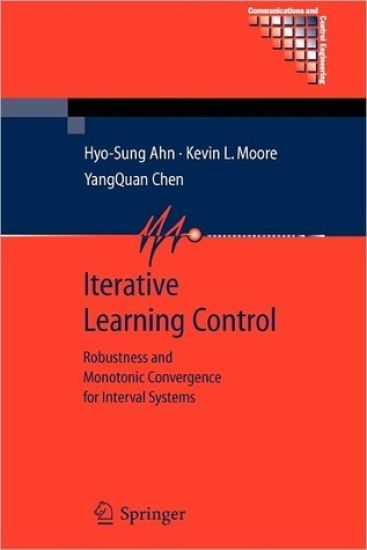
Iterative Learning Control

Iterative Learning Control

Hyo-Sung Ahn; Kevin L. Moore; YangQuan Chen

Springer London Ltd
2010
nidottu
This monograph studies the design of robust, monotonically-convergent it- ative learning controllers for discrete-time systems. Iterative learning control (ILC) is well-recognized as an e?cient method that o?ers signi?cant p- formance improvement for systems that operate in an iterative or repetitive fashion (e. g. , robot arms in manufacturing or batch processes in an industrial setting). Though the fundamentals of ILC design have been well-addressed in the literature, two key problems have been the subject of continuing - search activity. First, many ILC design strategies assume nominal knowledge of the system to be controlled. Only recently has a comprehensive approach to robust ILC analysis and design been established to handle the situation where the plant model is uncertain. Second, it is well-known that many ILC algorithms do not produce monotonic convergence, though in applications monotonic convergencecan be essential. This monograph addresses these two keyproblems by providingauni?ed analysisanddesignframeworkforrobust, monotonically-convergent ILC. The particular approach used throughout is to consider ILC design in the iteration domain, rather than in the time domain. Using a lifting technique, the two-dimensionalILC system, whichhas dynamics in both the time and - erationdomains,istransformedintoaone-dimensionalsystem,withdynamics only in the iteration domain. The so-called super-vector framework resulting from this transformation is used to analyze both robustness and monotonic convergence for typical uncertainty models, including parametric interval - certainties, frequency-like uncertainty in the iteration domain, and iterati- domain stochastic uncertainty.
Fractional-order Systems and Controls

Fractional-order Systems and Controls

Concepción A. Monje; YangQuan Chen; Blas M. Vinagre; Dingyu Xue; Vicente Feliu-Batlle

Springer London Ltd
2010
sidottu
Fractional-order Systems and Controls details the use of fractional calculus in the description and modeling of systems, and in a range of control design and practical applications. It is largely self-contained, covering the fundamentals of fractional calculus together with some analytical and numerical techniques and providing MATLAB® codes for the simulation of fractional-order control (FOC) systems. Many different FOC schemes are presented for control and dynamic systems problems. Practical material relating to a wide variety of applications is also provided. All the control schemes and applications are presented in the monograph with either system simulation results or real experimental results, or both. Fractional-order Systems and Controls provides readers with a basic understanding of FOC concepts and methods, so they can extend their use of FOC in other industrial system applications, thereby expanding their range of disciplines by exploiting this versatile new set of control techniques.
Optimal Observation for Cyber-physical Systems

Optimal Observation for Cyber-physical Systems

Zhen Song; YangQuan Chen; Chellury R. Sastry; Nazif C. Tas

Springer London Ltd
2009
sidottu
"Optimal Observation for Cyber-physical Systems" addresses the challenge, fundamental to the design of wireless sensor networks (WSNs), presented by the obligatory trade-off between precise estimates and system constraints. A unified theoretical framework, based on the well-established theory of optimal experimental design and providing consistent solutions to problems hitherto requiring a variety of approaches, is put forward to solve a large class of optimal observation problems. The Fisher information matrix plays a key role in this framework and makes it feasible to provide analytical solutions to some complex and important questions which could not be answered in the past. Readers with an applied background in WSN implementation will find all the understanding of the key theory of optimal experimental design they need within this book. The use of multiple examples to illustrate the theoretical parts of the book brings the subject into sharper focus than would an abstract theoretical disquisition.
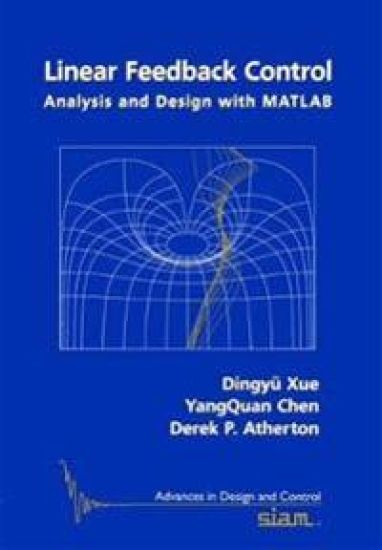
Linear Feedback Control

Linear Feedback Control

Dingyu Xue; Yangquan Chen; Derek P. Atherton

Society for Industrial Applied Mathematics,U.S.
2009
pokkari
Discusses analysis and design techniques for linear feedback control systems using MATLAB(R) software. By reducing the mathematics, increasing MATLAB working examples, and inserting short scripts and plots within the text, the authors have created a resource suitable for almost any type of user. For beginners, the book provides an efficient entrance into the field; for readers who have already had a first course in control, the text helps bridge the gap between control theory and the use of MATLAB for control systems; for practicing engineers, it serves as a handy reference. The book begins with a summary of the properties of linear systems and addresses modeling and model reduction issues. In the subsequent chapters on analysis, the authors introduce time domain, complex plane, and frequency domain techniques. Their coverage of design includes discussions on model-based controller designs, PID controllers, and robust control designs. A unique aspect of the book is its inclusion of a chapter on fractional-order controllers, which are useful in control engineering practice. Especially useful for self-study, Linear Feedback Control uses the MATLAB companion package CtrlLAB, which allows readers to learn quickly while simply clicking through options with a mouse. Each chapter ends with a set of problems to help readers strengthen their understanding of the material. All example scripts within the book, as well as the CtrlLAB package, are freely downloadable from MATLAB Central.
Iterative Learning Control

Iterative Learning Control

Hyo-Sung Ahn; Kevin L. Moore; YangQuan Chen

Springer London Ltd
2007
sidottu
This monograph studies the design of robust, monotonically-convergent it- ative learning controllers for discrete-time systems. Iterative learning control (ILC) is well-recognized as an e?cient method that o?ers signi?cant p- formance improvement for systems that operate in an iterative or repetitive fashion (e. g. , robot arms in manufacturing or batch processes in an industrial setting). Though the fundamentals of ILC design have been well-addressed in the literature, two key problems have been the subject of continuing - search activity. First, many ILC design strategies assume nominal knowledge of the system to be controlled. Only recently has a comprehensive approach to robust ILC analysis and design been established to handle the situation where the plant model is uncertain. Second, it is well-known that many ILC algorithms do not produce monotonic convergence, though in applications monotonic convergencecan be essential. This monograph addresses these two keyproblems by providingauni?ed analysisanddesignframeworkforrobust, monotonically-convergent ILC. The particular approach used throughout is to consider ILC design in the iteration domain, rather than in the time domain. Using a lifting technique, the two-dimensionalILC system, whichhas dynamics in both the time and - erationdomains,istransformedintoaone-dimensionalsystem,withdynamics only in the iteration domain. The so-called super-vector framework resulting from this transformation is used to analyze both robustness and monotonic convergence for typical uncertainty models, including parametric interval - certainties, frequency-like uncertainty in the iteration domain, and iterati- domain stochastic uncertainty.
Iterative Learning Control

Iterative Learning Control

Yangquan Chen; Changyun Wen

Springer London Ltd
1999
nidottu
This book provides readers with a comprehensive coverage of iterative learning control. The book can be used as a text or reference for a course at graduate level and is also suitable for self-study and for industry-oriented courses of continuing education. Ranging from aerodynamic curve identification robotics to functional neuromuscular stimulation, Iterative Learning Control (ILC), started in the early 80s, is found to have wide applications in practice. Generally, a system under control may have uncertainties in its dynamic model and its environment. One attractive point in ILC lies in the utilisation of the system repetitiveness to reduce such uncertainties and in turn to improve the control performance by operating the system repeatedly. This monograph emphasises both theoretical and practical aspects of ILC. It provides some recent developments in ILC convergence and robustness analysis. The book also considers issues in ILC design. Several practical applications are presented to illustrate the effectiveness of ILC. The applied examples provided in this monograph are particularly beneficial to readers who wish to capitalise the system repetitiveness to improve system control performance.