Kirjojen hintavertailu – 12 903 725 kirjaa ja 27 kauppaa

Kirjailija

Yingjie Guo

Kirjat ja teokset yhdessä paikassa: 5 kirjaa, julkaisuja vuosilta 2003–2022, suosituimpiin kuuluu Class and the Communist Party of China, 1978-2021. Vertaile teosten hintoja ja tarkista saatavuus suomalaisista kirjakaupoista.

5 kirjaa

Kirjojen julkaisuvuodet: 2003–2022.

Class and the Communist Party of China, 1978-2021

Class and the Communist Party of China, 1978-2021

Marc Blecher; David S G Goodman; Yingjie Guo; Jean-Louis Rocca; Beibei Tang

TAYLOR FRANCIS LTD
2022
nidottu
By examining the changing political economy in China through detailed studies of the peasantry, workers, middle classes, and the dominant class, this volume reveals the Communist Party of China’s (CCP’s) impact on social change in China between 1978 and 2021. This book explores in depth the CCP’s programme of reform and openness that had a dramatic impact on China’s socio-economic trajectory following the death of Mao Zedong and the end of the Cultural Revolution. It also goes on to chart the acceptance of Market Socialism, highlighting the resulting emergence of a larger middle class, while also appreciating the profound consequences this created for workers and peasants. Additionally, this volume examines the development of the dominant class which remains a defining feature of China’s political economy and the Party-state. Providing an in-depth analysis of class as understood by the CCP in conjunction with sociological interpretations of socio-economic and socio-political change, this study will be of interest to students and scholars of Chinese Politics, Chinese History, Asian Politics, and Asian studies.
Class and the Communist Party of China, 1978-2021

Class and the Communist Party of China, 1978-2021

Marc Blecher; David S G Goodman; Yingjie Guo; Jean-Louis Rocca; Beibei Tang

TAYLOR FRANCIS LTD
2022
sidottu
By examining the changing political economy in China through detailed studies of the peasantry, workers, middle classes, and the dominant class, this volume reveals the Communist Party of China’s (CCP’s) impact on social change in China between 1978 and 2021. This book explores in depth the CCP’s programme of reform and openness that had a dramatic impact on China’s socio-economic trajectory following the death of Mao Zedong and the end of the Cultural Revolution. It also goes on to chart the acceptance of Market Socialism, highlighting the resulting emergence of a larger middle class, while also appreciating the profound consequences this created for workers and peasants. Additionally, this volume examines the development of the dominant class which remains a defining feature of China’s political economy and the Party-state. Providing an in-depth analysis of class as understood by the CCP in conjunction with sociological interpretations of socio-economic and socio-political change, this study will be of interest to students and scholars of Chinese Politics, Chinese History, Asian Politics, and Asian studies.
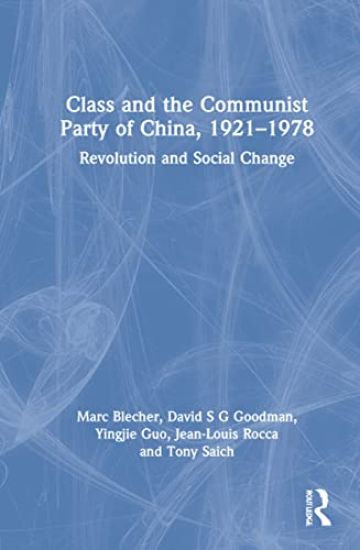
Class and the Communist Party of China, 1921-1978

Class and the Communist Party of China, 1921-1978

Marc Blecher; David S G Goodman; Yingjie Guo; Jean-Louis Rocca; Tony Saich

TAYLOR FRANCIS LTD
2022
sidottu
Examining the interaction between the Communist Party of China (CCP) and specific social categories (including peasants, workers, the middle classes, and the dominant class), with a focus on class and class discourse, this volume analyses the CCP’s impact on social change in China between 1921 and 1978. By exploring the CCP’s evolving discourse of class, this book demonstrates that, while class has retained its centrality, its meaning has been re-articulated from an ideological-political tool to a less meaningful signifier, though always used instrumentality. By examining the impact of the CCP’s policies and discourse surrounding class, it also reveals how its own policies since 1921 have shaped the CCP’s current (2021) perspectives on class and stratification. This volume, through an analysis of economic, political, and cultural inequalities in Chinese society even after 1949, also reveals the emergence of a diverse and often overlooked middle class in Chinese society during the 1950s. Delivering a detailed analysis of how the CCP has developed its practical approaches to class and mobilization, this study will be of interest to students and scholars of Chinese politics, Chinese history, Asian politics, and Asian studies.
Class and the Communist Party of China, 1921-1978

Class and the Communist Party of China, 1921-1978

Marc Blecher; David S G Goodman; Yingjie Guo; Jean-Louis Rocca; Tony Saich

TAYLOR FRANCIS LTD
2022
nidottu
Examining the interaction between the Communist Party of China (CCP) and specific social categories (including peasants, workers, the middle classes, and the dominant class), with a focus on class and class discourse, this volume analyses the CCP’s impact on social change in China between 1921 and 1978. By exploring the CCP’s evolving discourse of class, this book demonstrates that, while class has retained its centrality, its meaning has been re-articulated from an ideological-political tool to a less meaningful signifier, though always used instrumentality. By examining the impact of the CCP’s policies and discourse surrounding class, it also reveals how its own policies since 1921 have shaped the CCP’s current (2021) perspectives on class and stratification. This volume, through an analysis of economic, political, and cultural inequalities in Chinese society even after 1949, also reveals the emergence of a diverse and often overlooked middle class in Chinese society during the 1950s. Delivering a detailed analysis of how the CCP has developed its practical approaches to class and mobilization, this study will be of interest to students and scholars of Chinese politics, Chinese history, Asian politics, and Asian studies.
Cultural Nationalism in Contemporary China
In the vast majority of literature on 'Chinese nationalism' the distinction between nation and state is rarely made, consequently nationalism usually appears as loyalty to the state rather than identification with the nation. Yet, since 1989, both the official configuration of the nation and the state's monopolized right to name the nation have come under rigorous challenge. Cultural Nationalism in Contemporary China relocates the discussion of nationalism to within a more contemporary framework which explores the disjunction between the people and the state and the relationship of each to the nation. With its challenging exploration of one of the most neglected aspects of identity in China, this book should appeal to Asianists, China watchers and all of those with an interest in cultural and sociological phenomena in East Asia.