Kirjojen hintavertailu – 12 903 724 kirjaa ja 27 kauppaa

Kirjailija

Yingyan Zhang

Kirjat ja teokset yhdessä paikassa: 3 kirjaa, julkaisuja vuosilta 2009–2017, suosituimpiin kuuluu Carbon Nanotubes and Nanosensors. Vertaile teosten hintoja ja tarkista saatavuus suomalaisista kirjakaupoista.

3 kirjaa

Kirjojen julkaisuvuodet: 2009–2017.

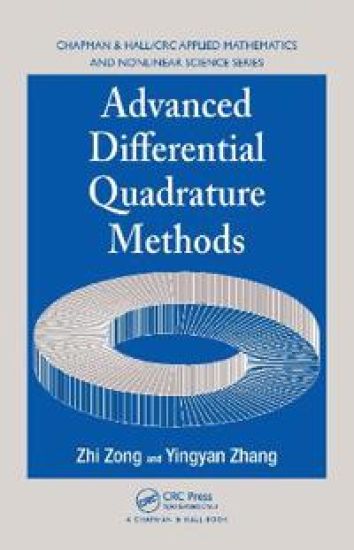
Advanced Differential Quadrature Methods

Advanced Differential Quadrature Methods

Zhi Zong; Yingyan Zhang

CRC Press
2017
nidottu
Modern Tools to Perform Numerical DifferentiationThe original direct differential quadrature (DQ) method has been known to fail for problems with strong nonlinearity and material discontinuity as well as for problems involving singularity, irregularity, and multiple scales. But now researchers in applied mathematics, computational mechanics, and engineering have developed a range of innovative DQ-based methods to overcome these shortcomings. Advanced Differential Quadrature Methods explores new DQ methods and uses these methods to solve problems beyond the capabilities of the direct DQ method. After a basic introduction to the direct DQ method, the book presents a number of DQ methods, including complex DQ, triangular DQ, multi-scale DQ, variable order DQ, multi-domain DQ, and localized DQ. It also provides a mathematical compendium that summarizes Gauss elimination, the Runge–Kutta method, complex analysis, and more. The final chapter contains three codes written in the FORTRAN language, enabling readers to quickly acquire hands-on experience with DQ methods. Focusing on leading-edge DQ methods, this book helps readers understand the majority of journal papers on the subject. In addition to gaining insight into the dynamic changes that have recently occurred in the field, readers will quickly master the use of DQ methods to solve complex problems.
Carbon Nanotubes and Nanosensors

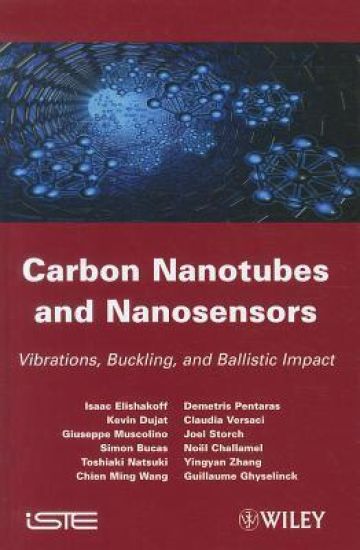
Carbon Nanotubes and Nanosensors

Isaac Elishakoff; Kevin Dujat; Giuseppe Muscolino; Simon Bucas; Toshiaki Natsuki; Chien Ming Wang; Demetris Pentaras; Claudia Versaci; Joel Storch; Noël Challamel; Yingyan Zhang; Guillaume Ghyselinck

ISTE Ltd and John Wiley Sons Inc
2012
sidottu
The main properties that make carbon nanotubes (CNTs) a promising technology for many future applications are: extremely high strength, low mass density, linear elastic behavior, almost perfect geometrical structure, and nanometer scale structure. Also, CNTs can conduct electricity better than copper and transmit heat better than diamonds. Therefore, they are bound to find a wide, and possibly revolutionary use in all fields of engineering. The interest in CNTs and their potential use in a wide range of commercial applications; such as nanoelectronics, quantum wire interconnects, field emission devices, composites, chemical sensors, biosensors, detectors, etc.; have rapidly increased in the last two decades. However, the performance of any CNT-based nanostructure is dependent on the mechanical properties of constituent CNTs. Therefore, it is crucial to know the mechanical behavior of individual CNTs such as their vibration frequencies, buckling loads, and deformations under different loadings. This title is dedicated to the vibration, buckling and impact behavior of CNTs, along with theory for carbon nanosensors, like the Bubnov-Galerkin and the Petrov-Galerkin methods, the Bresse-Timoshenko and the Donnell shell theory.
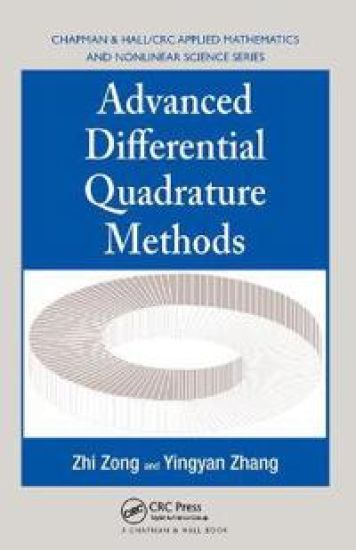
Advanced Differential Quadrature Methods

Advanced Differential Quadrature Methods

Zhi Zong; Yingyan Zhang

Chapman Hall/CRC
2009
sidottu
Modern Tools to Perform Numerical DifferentiationThe original direct differential quadrature (DQ) method has been known to fail for problems with strong nonlinearity and material discontinuity as well as for problems involving singularity, irregularity, and multiple scales. But now researchers in applied mathematics, computational mechanics, and engineering have developed a range of innovative DQ-based methods to overcome these shortcomings. Advanced Differential Quadrature Methods explores new DQ methods and uses these methods to solve problems beyond the capabilities of the direct DQ method. After a basic introduction to the direct DQ method, the book presents a number of DQ methods, including complex DQ, triangular DQ, multi-scale DQ, variable order DQ, multi-domain DQ, and localized DQ. It also provides a mathematical compendium that summarizes Gauss elimination, the Runge–Kutta method, complex analysis, and more. The final chapter contains three codes written in the FORTRAN language, enabling readers to quickly acquire hands-on experience with DQ methods. Focusing on leading-edge DQ methods, this book helps readers understand the majority of journal papers on the subject. In addition to gaining insight into the dynamic changes that have recently occurred in the field, readers will quickly master the use of DQ methods to solve complex problems.