
Kirjailija
Yonique Campbell
Kirjat ja teokset yhdessä paikassa: 5 kirjaa, julkaisuja vuosilta 2019–2026, suosituimpiin kuuluu Island Challenges. Vertaile teosten hintoja ja tarkista saatavuus suomalaisista kirjakaupoista.
5 kirjaa
Kirjojen julkaisuvuodet: 2019–2026.
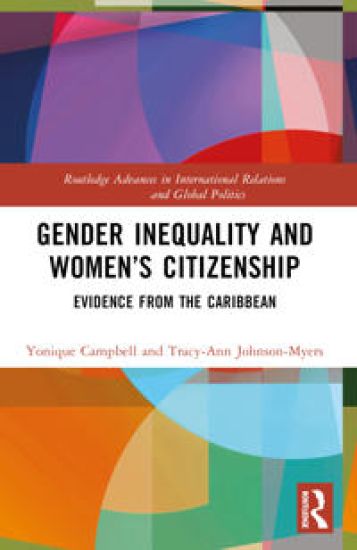
Gender Inequality and Women’s Citizenship
Yonique Campbell; Tracy-Ann Johnson-Myers
TAYLOR FRANCIS LTD
2025
nidottu
Gender Inequality and Women’s Citizenship combines cases across Barbados, Guyana, Jamaica and Trinidad and Tobago to highlight the range of systemic inequalities that impact women in the Anglo-Caribbean. Using empirical and secondary data and drawing on feminist theoretical insights, Yonique Campbell and Tracy-Ann Johnson-Myers examine a range of pertinent and intersecting social, political and economic challenges facing women in the Anglo-Caribbean. The issues explored include gender-based violence, barriers to women in politics, the effects of COVID-19 on women, and debates around the illegality of abortion rights and failure to protect the health of women by allowing them to exercise autonomy over their bodies. They raise questions about systemic inequalities resulting from patriarchal gender relations, heteronormativity, women's social and economic status, and state inaction. This book is unique in its interdisciplinary analysis of gender inequality in the Anglo-Caribbean, mapping the intersection of women’s multiple identities and positionalities to determine the obstacles they encounter. It will be of interest to scholars and researchers of International Relations, Caribbean Studies, Gender and Sexuality Studies, Development Studies, Sociology and Anthropology.
Gender Inequality and Women’s Citizenship
Yonique Campbell; Tracy-Ann Johnson-Myers
TAYLOR FRANCIS LTD
2023
sidottu
Gender Inequality and Women’s Citizenship combines cases across Barbados, Guyana, Jamaica and Trinidad and Tobago to highlight the range of systemic inequalities that impact women in the Anglo-Caribbean. Using empirical and secondary data and drawing on feminist theoretical insights, Yonique Campbell and Tracy-Ann Johnson-Myers examine a range of pertinent and intersecting social, political and economic challenges facing women in the Anglo-Caribbean. The issues explored include gender-based violence, barriers to women in politics, the effects of COVID-19 on women, and debates around the illegality of abortion rights and failure to protect the health of women by allowing them to exercise autonomy over their bodies. They raise questions about systemic inequalities resulting from patriarchal gender relations, heteronormativity, women's social and economic status, and state inaction. This book is unique in its interdisciplinary analysis of gender inequality in the Anglo-Caribbean, mapping the intersection of women’s multiple identities and positionalities to determine the obstacles they encounter. It will be of interest to scholars and researchers of International Relations, Caribbean Studies, Gender and Sexuality Studies, Development Studies, Sociology and Anthropology.
This book critically explores the impact of national security, violence and state power on citizenship rights and experiences in Latin America and the Caribbean. Drawing on cross-country analyses and fieldwork conducted in two “garrisons,” a middle-class community and among policy elites in Jamaica—where high levels of violence, in(security) and transnational organized crime are transforming state power —the author argues that dominant responses to security have wider implications for citizenship. The security practices of the state often result in criminalization, police abuse, violation of the rights of the urban poor and increased securitization of garrison spaces. As the tension between national security and citizenship increases, there is a centrality of the local as a site where citizenship is (re)defined, mediated, interpreted, performed and given meaning. While there is a dominant security discourse which focuses on state security, individuals at the local level articulate their own narratives which reflect lived-experiences and the particularities of socio-political milieu.
This book critically explores the impact of national security, violence and state power on citizenship rights and experiences in Latin America and the Caribbean. Drawing on cross-country analyses and fieldwork conducted in two “garrisons,” a middle-class community and among policy elites in Jamaica—where high levels of violence, in(security) and transnational organized crime are transforming state power —the author argues that dominant responses to security have wider implications for citizenship. The security practices of the state often result in criminalization, police abuse, violation of the rights of the urban poor and increased securitization of garrison spaces. As the tension between national security and citizenship increases, there is a centrality of the local as a site where citizenship is (re)defined, mediated, interpreted, performed and given meaning. While there is a dominant security discourse which focuses on state security, individuals at the local level articulate their own narratives which reflect lived-experiences and the particularities of socio-political milieu.