Kirjojen hintavertailu – 12 859 828 kirjaa ja 27 kauppaa

Kirjailija

Yosef Kaplan

Kirjat ja teokset yhdessä paikassa: 5 kirjaa, julkaisuja vuosilta 2004–2020, suosituimpiin kuuluu Eros, Family and Community. Vertaile teosten hintoja ja tarkista saatavuus suomalaisista kirjakaupoista.

5 kirjaa

Kirjojen julkaisuvuodet: 2004–2020.

Blood and Boundaries – The Limits of Religious and Racial Exclusion in Early Modern Latin America
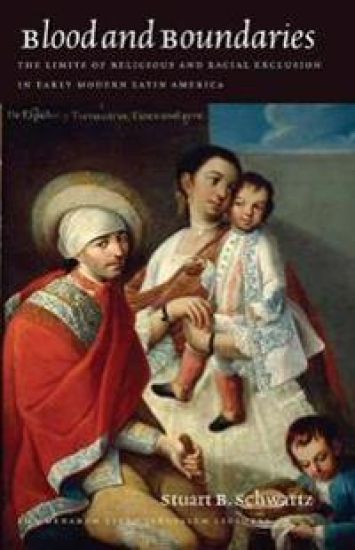
In Blood and Boundaries, Stuart B. Schwartz takes us to late medieval Latin America to show how Spain and Portugal’s policies of exclusion and discrimination based on religious origins and genealogy were transferred to their colonies in Latin America. Rather than concentrating on the three principal divisions of colonial society—Indians, Europeans, and people of African origins—as is common in studies of these colonial societies, Schwartz examines the three minority groups of moriscos, conversos, and mestizos. Muslim and Jewish converts and their descendants, he shows, posed a special problem for colonial society: they were feared and distrusted as peoples considered ethnically distinct, but at the same time their conversion to Christianity seemed to violate stable social categories and identities. This led to the creation of “cleanliness of blood” regulations that explicitly discriminated against converts. Eventually, Schwartz shows, those regulations were extended to control the subject indigenous and enslaved African populations, and over time, applied to the growing numbers of mestizos, peoples of mixed ethnic origins. Despite the efforts of civil and church and state institutions to regulate, denigrate, and exclude, members of these affected groups often found legal and practical means to ignore, circumvent, or challenge the efforts to categorize and exclude them, creating in the process the dynamic societies of Latin America that emerged in the nineteenth century.
Blood and Boundaries – The Limits of Religious and Racial Exclusion in Early Modern Latin America
In Blood and Boundaries, Stuart B. Schwartz takes us to late medieval Latin America to show how Spain and Portugal’s policies of exclusion and discrimination based on religious origins and genealogy were transferred to their colonies in Latin America. Rather than concentrating on the three principal divisions of colonial society—Indians, Europeans, and people of African origins—as is common in studies of these colonial societies, Schwartz examines the three minority groups of moriscos, conversos, and mestizos. Muslim and Jewish converts and their descendants, he shows, posed a special problem for colonial society: they were feared and distrusted as peoples considered ethnically distinct, but at the same time their conversion to Christianity seemed to violate stable social categories and identities. This led to the creation of “cleanliness of blood” regulations that explicitly discriminated against converts. Eventually, Schwartz shows, those regulations were extended to control the subject indigenous and enslaved African populations, and over time, applied to the growing numbers of mestizos, peoples of mixed ethnic origins. Despite the efforts of civil and church and state institutions to regulate, denigrate, and exclude, members of these affected groups often found legal and practical means to ignore, circumvent, or challenge the efforts to categorize and exclude them, creating in the process the dynamic societies of Latin America that emerged in the nineteenth century.
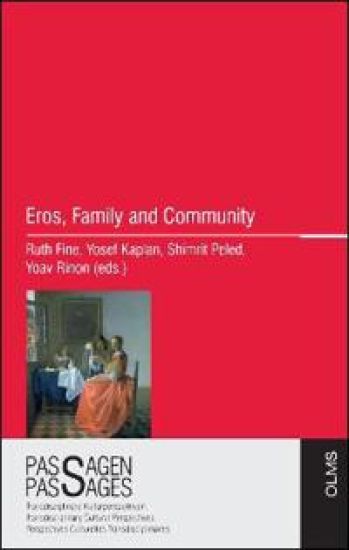
Eros, Family and Community

Eros, Family and Community

Ruth Fine; Yosef Kaplan; Shimrit Peled; Yoav Rinon

Georg Olms Verlag AG
2018
nidottu
This collection of articles deals with the notion of Eros from a broad range of historical, literary and cultural perspectives. One of the primary aims of the collection is to comprehend both the power and the problematic aspects of Eros and its contribution to the formation of family and community. Considering the concept of Eros textually and theoretically, the variety of topics raised reflects the different disciplines of the authors as well as their interdisciplinary approach. Special emphasis was given to the historical aspect of Eros, its temporal location and contextualization. Ruth Fine is Salomon and Victoria Cohen Professor of Iberian and Latin American Studies at the Hebrew University of Jerusalem. Her recent publications include Lo converso: orden imaginario y realidad en la cultura espanola (with M. Guillemont and J. D. Vila) (Madrid/ Frankfurt 2013) and Reescrituras biblicas cervantinas (Madrid/Frankfurt, 2014). Yosef Kaplan is the Bernard Cherrick Emeritus Professor of Jewish History at the Hebrew University of Jerusalem. His most recent publications include The Religious Cultures of Dutch Jewry (with Dan Michman, Leiden-Boston 2017) and Early Modern Religious and Ethnic Communities in Exile (Cambridge 2017). Shimrit Peled is a Lecturer at the Department of Hebrew Literature at the Hebrew University of Jerusalem. Among her publications: The Israeli sovereign: discourse and the novel 1967-1973 (Jerusalem, 2014), "Constructing Sexual Feminine Subjectivity in Victoria by Sami Michael" (Jerusalem, 2014). Yoav Rinon is a Renee Lang professor in the Department of Comparative Literature and the Department of Classics at the Hebrew University of Jerusalem. His publications include: Sadian Reflections (Madison, 2005), Homer and the Dual Model of the Tragic (Ann Arbor, 2008), a verse translation of and commentary (with Luisa Ferretti-Cuomo) on Dante's Inferno (Jerusalem, 2013), and The Crisis in the Humanities (Tel Aviv, 2014).
The Faith of Remembrance

The Faith of Remembrance

Nathan Wachtel; Yosef Kaplan

University of Pennsylvania Press
2013
sidottu
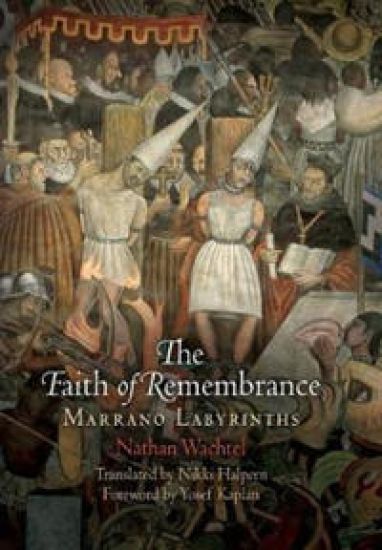
In a series of intimate and searing portraits, Nathan Wachtel traces the journeys of the seventeenth- and eighteenth-century Marranos-Spanish and Portuguese Jews who were forcibly converted to Catholicism but secretly retained their own faith. Fleeing persecution in their Iberian homeland, some sought refuge in the Americas, where they established transcontinental networks linking the New World to the Old. The Marranos-at once Jewish and Christian, outsiders and insiders-nurtured their hidden beliefs within their new communities, participating in the economic development of the early Americas while still adhering to some of the rituals and customs of their ancestors. In a testament to the partial assimilation of these new arrivals, their faith became ever more syncretic, mixing elements of Judaism with Christian practice and theology. In many cases, the combination was fatal. Wachtel relies on inquisitorial archives of trials and executions to chronicle legal and religious prosecutions for heresy. From the humble Jean Vicente to the fabulously wealthy slave trafficker Manuel Bautista Perez, from the untutored Theresa Paes de Jesus to the learned Francisco Maldonado de Silva, each unforgettable figure offers a chilling reminder of the reach of the Inquisition. Sensitive to the lingering tensions within the Marrano communities, Wachtel joins the concerns of an anthropologist to his skills as a historian, and in a stunning authorial move, he demonstrates that the faith of remembrance remains alive today in the towns of rural Brazil.
From Christianity to Judaism

From Christianity to Judaism

Yosef Kaplan

The Littman Library of Jewish Civilization
2004
pokkari
Isaac Orobio de Castro, a crypto-Jew from Portugal, was one of the most prominent intellectual figures of the Sephardi Diaspora in the seventeenth century. After studying medicine and theology in Spain, and having pursued a distinguished medical career, he was arrested by the Spanish Inquisition for practising Judaism, tortured, tired, and imprisoned. He subsequently emigrated to France and became a professor of medicine at the University of Toulouse before openly professing his Judaism and going to Amsterdam where he joined the thriving Portuguese Jewish community. Amsterdam was then a city of great cultural creativity and religious pluralism where Orobio found open to him the world of religious thinkers and learned scholars. In this atmosphere he flourished and became an outstanding spokesman and apologist for the Jewish community. He engaged in controversy with Juan de Prado and Baruch Spinoza, who were both excommunicated by the Portuguese Jewish community, as well as with Christian theologians of various sects and denominations, including Philip van Limborch. This fascinating biography of Orobio sheds light on the complex life of a unique Jewish community of former Christians who had openly returned to Judaism. It focuses on the particular dilemmas of the converts, their attempts to establish boundaries between their Christian past and their new identity, their internal conflicts, and their ability to create new forms of Jewish life and expression.