Kirjojen hintavertailu – 12 903 725 kirjaa ja 27 kauppaa

Kirjailija

Yoshiro Miwa

Kirjat ja teokset yhdessä paikassa: 5 kirjaa, julkaisuja vuosilta 1996–2015, suosituimpiin kuuluu Japan's Economic Planning and Mobilization in Wartime, 1930s–1940s. Vertaile teosten hintoja ja tarkista saatavuus suomalaisista kirjakaupoista.

5 kirjaa

Kirjojen julkaisuvuodet: 1996–2015.

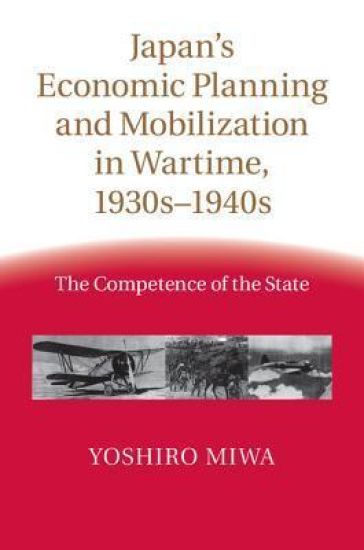
Japan's Economic Planning and Mobilization in Wartime, 1930s–1940s
Although most economists maintain a mistrust of a government's goals when it intervenes in an economy, many continue to trust its actual ability. They retain, in other words, a faith in state competence. For this faith, they adduce no evidence. Sharing little skepticism about the government's ability, they continue to expect the best of governmental intervention. To study government competence in World War II Japan offers an intriguing laboratory. In this book, Yoshiro Miwa shows that the Japanese government did not conduct requisite planning for the war by any means. It made its choices on an ad hoc basis and the war itself quickly became a dead end. That the government planned for the war incompetently casts doubts on the accounts of Japanese government leadership more generally.
State Competence and Economic Growth in Japan
Yoshiro Miwa asks whether a state can correct market failures and in particular critically analyses the performance of the Japanese economy as a result of state intervention within it. In order to examine the capacity of the state to promote growth, Miwa examines the Japanese machine tool industry, the government's role in promoting this sector and government efforts to achieve growth in small and medium sized enterprises in Japan.
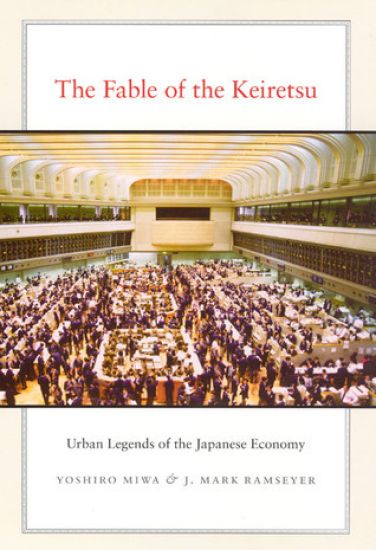
The Fable of the Keiretsu

The Fable of the Keiretsu

Yoshiro Miwa; J. Mark Ramseyer

University of Chicago Press
2006
sidottu
For Western economists and journalists, the most distinctive facet of the post-war Japanese business world has been the keiretsu, or the insular business alliances among powerful corporations. Within keiretsu groups, argue these observers, firms preferentially trade, lend money, take and receive technical and financial assistance, and cement their ties through cross-shareholding agreements. In "The Fable of the Keiretsu", Yoshiro Miwa and J. Mark Ramseyer demonstrate that all this talk is really just urban legend. In their insightful analysis, the authors show that the very idea of the keiretsu was created and propagated by Marxist scholars in post-war Japan. Western scholars merely repatriated the legend to show the culturally contingent nature of modern economic analysis. Laying waste to the notion of keiretsu, the authors debunk several related "facts" as well: that Japanese firms maintain special arrangements with a "main bank," that firms are systematically poorly managed, and that the Japanese government guided post-war growth. In demolishing these long-held assumptions, they offer one of the few reliable chronicles of the realities of Japanese business.
State Competence and Economic Growth in Japan
Yoshiro Miwa asks whether a state can correct market failures and in particular critically analyses the performance of the Japanese economy as a result of state intervention within it. In order to examine the capacity of the state to promote growth, Miwa examines the Japanese machine tool industry, the government's role in promoting this sector and government efforts to achieve growth in small and medium sized enterprises in Japan.
Firms and Industrial Organization in Japan

Firms and Industrial Organization in Japan

Yoshiro Miwa

New York University Press
1996
sidottu
The great successes of the Japanese economy have often been attributed to differences in the Japanese economic system. Employing an exhaustive investigation of the roles of the government and banks, firms and networks, and workers and managers, Yoshiro Miwa illustrates that the standard principles of economics explain the dominant patterns of Japanese economic phenomena. Debunking many long-held myths, Miwa deftly propels readers to a fuller, more accurate understanding of the Japanese economy.