Kirjojen hintavertailu – 12 903 725 kirjaa ja 27 kauppaa

Kirjailija

Youcef Soufi

Kirjat ja teokset yhdessä paikassa: 3 kirjaa, julkaisuja vuosilta 2020–2025, suosituimpiin kuuluu Homegrown Radicals. Vertaile teosten hintoja ja tarkista saatavuus suomalaisista kirjakaupoista.

3 kirjaa

Kirjojen julkaisuvuodet: 2020–2025.

Homegrown Radicals

Homegrown Radicals

Youcef Soufi

NEW YORK UNIVERSITY PRESS
2025
sidottu
The powerful story of how the War on Terror created the conditions for the emergence of a novel theory of jihad On March 7th, 2007, three Muslim university students left their small city on the Canadian Prairies, seemingly without a trace. In the ensuing months, their disappearance raised fears among Canadian and US security agencies that the men had become "radicalized," posing a grave threat to national security. From presidential briefings and targeted drone assassinations to a politically charged trial in a Brooklyn courtroom, the men's story sheds new light not only on the figure of the "radical," but also on the "moderate" Muslim, represented by a community forever changed by the men's departure. Homegrown Radicals offers a case study of the complex entanglements of the radical and moderate Muslim in post-9/11 North America. Youcef Soufi brings these figures together in uneasy tension, providing insight into how state violence has inextricably tied them together. Focusing on the radicalization of the three Muslim students, the book traces the general sense of affective injury among North American Muslims over the loss of Muslim life in Western military campaigns overseas. In this context, a new theory of jihad rooted in a Muslim utopian imagination emerged, marking a significant rupture with premodern Islamic thought. The three "radicals" were among thousands of Anglophone Muslims who found this new theory compelling as both a diagnosis and a solution to the violence unleashed in the War on Terror. The book examines how and why this theory resonated, as well as its consequences for the men's families, friends, and Muslim community. Homegrown Radicals highlights how post-9/11 Islamophobia has operated through the conceptual blurring of the line between "moderate" and "radical" Muslims, and asks what alternative forms of solidarity may transcend the violent boundaries of the nation-state.
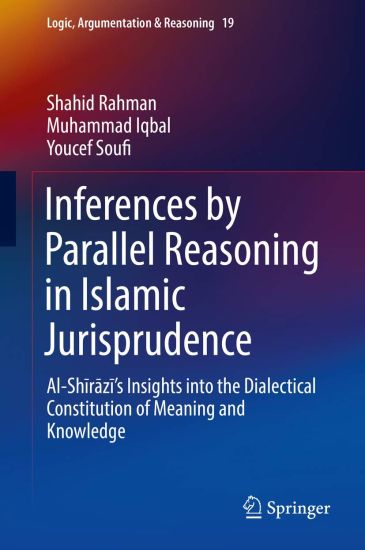
Inferences by Parallel Reasoning in Islamic Jurisprudence

Inferences by Parallel Reasoning in Islamic Jurisprudence

Shahid Rahman; Muhammad Iqbal; Youcef Soufi

Springer Nature Switzerland AG
2021
nidottu
This monograph proposes a new (dialogical) way of studying the different forms of correlational inference, known in the Islamic jurisprudence as qiyas. According to the authors’ view, qiyas represents an innovative and sophisticated form of dialectical reasoning that not only provides new epistemological insights into legal argumentation in general (including legal reasoning in Common and Civil Law) but also furnishes a fine-grained pattern for parallel reasoning which can be deployed in a wide range of problem-solving contexts and does not seem to reduce to the standard forms of analogical reasoning studied in contemporary philosophy of science and argumentation theory. After an overview of the emergence of qiyas and of the work of al-Shirazi penned by Soufi Youcef, the authors discuss al-Shirazi’s classification of correlational inferences of the occasioning factor (qiyas al-'illa). The second part of the volume deliberates on the system of correlational inferences by indication and resemblance (qiyas al-dalala, qiyas al-shabah). The third part develops the main theoretical background of the authors’ work, namely, the dialogical approach to Martin-Löf's Constructive Type Theory. The authors present this in a general form and independently of adaptations deployed in parts I and II. Part III also includes an appendix on the relevant notions of Constructive Type Theory, which has been extracted from an overview written by Ansten Klev. The book concludes with some brief remarks on contemporary approaches to analogy in Common and Civil Law and also to parallel reasoning in general.
Inferences by Parallel Reasoning in Islamic Jurisprudence

Inferences by Parallel Reasoning in Islamic Jurisprudence

Shahid Rahman; Muhammad Iqbal; Youcef Soufi

Springer Nature Switzerland AG
2020
sidottu
This monograph proposes a new (dialogical) way of studying the different forms of correlational inference, known in the Islamic jurisprudence as qiyas. According to the authors’ view, qiyas represents an innovative and sophisticated form of dialectical reasoning that not only provides new epistemological insights into legal argumentation in general (including legal reasoning in Common and Civil Law) but also furnishes a fine-grained pattern for parallel reasoning which can be deployed in a wide range of problem-solving contexts and does not seem to reduce to the standard forms of analogical reasoning studied in contemporary philosophy of science and argumentation theory. After an overview of the emergence of qiyas and of the work of al-Shirazi penned by Soufi Youcef, the authors discuss al-Shirazi’s classification of correlational inferences of the occasioning factor (qiyas al-'illa). The second part of the volume deliberates on the system of correlational inferences by indication and resemblance (qiyas al-dalala, qiyas al-shabah). The third part develops the main theoretical background of the authors’ work, namely, the dialogical approach to Martin-Löf's Constructive Type Theory. The authors present this in a general form and independently of adaptations deployed in parts I and II. Part III also includes an appendix on the relevant notions of Constructive Type Theory, which has been extracted from an overview written by Ansten Klev. The book concludes with some brief remarks on contemporary approaches to analogy in Common and Civil Law and also to parallel reasoning in general.