Kirjojen hintavertailu – 12 859 829 kirjaa ja 27 kauppaa

Kirjailija

Yucheng Dong

Kirjat ja teokset yhdessä paikassa: 6 kirjaa, julkaisuja vuosilta 2015–2025, suosituimpiin kuuluu Social Network DeGroot Model. Vertaile teosten hintoja ja tarkista saatavuus suomalaisista kirjakaupoista.

6 kirjaa

Kirjojen julkaisuvuodet: 2015–2025.

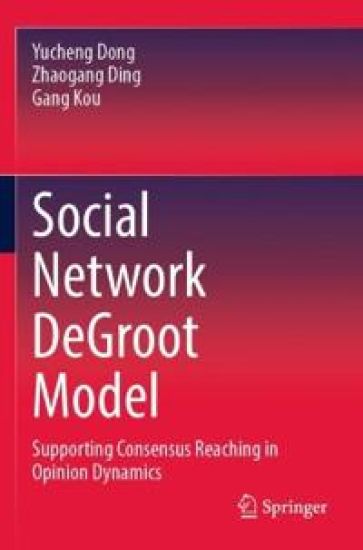
Social Network DeGroot Model

Social Network DeGroot Model

Yucheng Dong; Zhaogang Ding; Gang Kou

SPRINGER VERLAG, SINGAPORE
2025
nidottu
This book investigates the DeGroot model in social network contexts, and proposes the social network DeGroot (SNDG) model. Specifically, this book focuses on two core research problems in the SNDG model: (i) Social network structures to reach a stable state (consensus, polarization, or fragmentation); and (ii) the convergence rate to reach a stable state. Furthermore, the authors generalize the SNDG model in an uncertain context, showing the effects of interval opinions on the SNDG model. In this book, the authors also discuss the applications of the SNDG model to support group decision making, including consensus reaching through adding minimum interactions, trust relationships manipulations, and risk control issues in the social network. Apart from theoretical analysis, detailed experimental simulations with real and random data will be applied to validate our research. This book is the first to connect opinion dynamics, social network and group decision making. The resultsreported can help us understand the evolution of public opinions in social network contexts and provide new tools to support consensus reaching in group decision making.
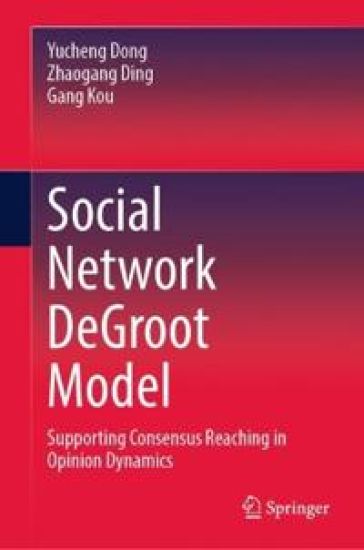
Social Network DeGroot Model

Social Network DeGroot Model

Yucheng Dong; Zhaogang Ding; Gang Kou

SPRINGER VERLAG, SINGAPORE
2024
sidottu
This book investigates the DeGroot model in social network contexts, and proposes the social network DeGroot (SNDG) model. Specifically, this book focuses on two core research problems in the SNDG model: (i) Social network structures to reach a stable state (consensus, polarization, or fragmentation); and (ii) the convergence rate to reach a stable state. Furthermore, the authors generalize the SNDG model in an uncertain context, showing the effects of interval opinions on the SNDG model. In this book, the authors also discuss the applications of the SNDG model to support group decision making, including consensus reaching through adding minimum interactions, trust relationships manipulations, and risk control issues in the social network. Apart from theoretical analysis, detailed experimental simulations with real and random data will be applied to validate our research. This book is the first to connect opinion dynamics, social network and group decision making. The resultsreported can help us understand the evolution of public opinions in social network contexts and provide new tools to support consensus reaching in group decision making.
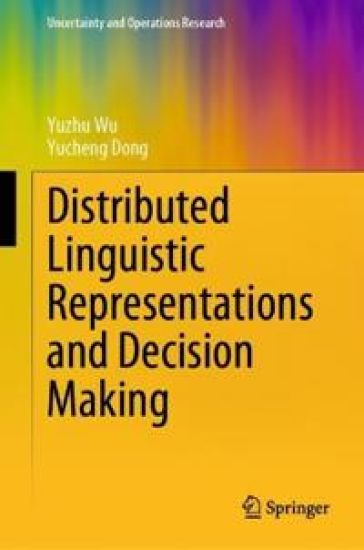
Distributed Linguistic Representations and Decision Making

Distributed Linguistic Representations and Decision Making

Yuzhu Wu; Yucheng Dong

Springer Nature Switzerland AG
2025
sidottu
This book provides a comprehensive perspective on the development of distributed linguistic representations in decision making, including the taxonomy of existing distributed linguistic representations, the key elements, and the classifications. It systematically investigates the formation of distributed linguistic representations and the methodology for the distributed linguistic information transformations and unifications, as well as the fusion and consensus reaching. This book studies the distributed linguistic information in MADM and the PIS-based applications of distributed linguistic information processing in decision making. Distributed linguistic representations are powerful tools for modelling the uncertainty and complexity of preference information in linguistic decision making. This book is written for researchers and postgraduates interested in linguistic decision making. Readers will find out lots of clear cues for distributed linguistic representations and distributed linguistic methodology to support decision making.
Linguistic Decision Making

Linguistic Decision Making

Yucheng Dong; Jiuping Xu

Springer Verlag, Singapore
2019
sidottu
This book proposes a novel CWW model to personalize individual semantics in linguistic decision making, based on two new concepts: numerical scale and consistency-driven methodology. The numerical scale model provides a unified framework to connect different linguistic symbolic computational models for CWW, and the consistency-driven methodology customizes individuals’ semantics to support linguistic group decision making by setting personalized numerical scales. The book is a valuable resource for researchers and postgraduates who are interested in CWW in linguistic decision making.
Consensus Building in Group Decision Making

Consensus Building in Group Decision Making

Yucheng Dong; Jiuping Xu

Springer Verlag, Singapore
2016
nidottu
This book is intended for researchers and postgraduates who are interested in the consensus reaching process in group decision-making problems. It puts forward new optimization-based decision support approaches to help decision-makers find roadmaps to consensus with minimum adjustments. Simulation experiments and comparison analysis are subsequently conducted to assess the validity of the proposal. After reading this book, readers will possess a number of valuable tools for building consensus with minimum adjustments in the context of group decision-making. Further, the proposed approach can effectively reduce costs in consensus building.?
Consensus Building in Group Decision Making

Consensus Building in Group Decision Making

Yucheng Dong; Jiuping Xu

Springer Verlag, Singapore
2015
sidottu
This book is intended for researchers and postgraduates who are interested in the consensus reaching process in group decision-making problems. It puts forward new optimization-based decision support approaches to help decision-makers find roadmaps to consensus with minimum adjustments. Simulation experiments and comparison analysis are subsequently conducted to assess the validity of the proposal. After reading this book, readers will possess a number of valuable tools for building consensus with minimum adjustments in the context of group decision-making. Further, the proposed approach can effectively reduce costs in consensus building.?