Kirjojen hintavertailu – 12 903 725 kirjaa ja 27 kauppaa

Kirjailija

Yuval Shany

Kirjat ja teokset yhdessä paikassa: 7 kirjaa, julkaisuja vuosilta 2003–2016, suosituimpiin kuuluu Assessing the Effectiveness of International Courts. Vertaile teosten hintoja ja tarkista saatavuus suomalaisista kirjakaupoista.

7 kirjaa

Kirjojen julkaisuvuodet: 2003–2016.

Assessing the Effectiveness of International Courts

Assessing the Effectiveness of International Courts

Yuval Shany

Oxford University Press
2016
nidottu
Are international courts effective tools for international governance? Do they fulfill the expectations that led to their creation and empowerment? Why do some courts appear to be more effective than others, and do so such appearances reflect reality? Could their results have been produced by other mechanisms? This book evaluates the effectiveness of international courts and tribunals by comparing their stated goals to the actual outcomes they achieve. Using a theoretical model borrowed from social science, the book assesses their effectiveness by analysing key empirical data. Its first part is dedicated to theory and methodology, laying out the effectiveness model, explaining its different components, its promise and limits, and discussing the measurement challenges it faces. The second part analyses the role that indicators such as jurisdiction, judicial independence, legitimacy, and compliance play in achieving effectiveness. Part three applies the effectiveness model to the International Court of Justice, the WTO dispute settlement mechanisms (panels and Appellate Body), the International Criminal Court, the European Court of Human Rights, and the European Court of Justice, reflecting the diversity of the field of international adjudication. Given the recent proliferation of international courts and tribunals, this book makes an important contribution towards understanding and measuring the value that these institutions provide.

Assessing the Effectiveness of International Courts

Assessing the Effectiveness of International Courts

Yuval Shany

Oxford University Press
2014
sidottu
Are international courts effective tools for international governance? Do they fulfill the expectations that led to their creation and empowerment? Why do some courts appear to be more effective than others, and do so such appearances reflect reality? Could their results have been produced by other mechanisms? This book evaluates the effectiveness of international courts and tribunals by comparing their stated goals to the actual outcomes they achieve. Using a theoretical model borrowed from social science, the book assesses their effectiveness by analysing key empirical data. Its first part is dedicated to theory and methodology, laying out the effectiveness model, explaining its different components, its promise and limits, and discussing the measurement challenges it faces. The second part analyses the role that indicators such as jurisdiction, judicial independence, legitimacy, and compliance play in achieving effectiveness. Part three applies the effectiveness model to the International Court of Justice, the WTO dispute settlement mechanisms (panels and Appellate Body), the International Criminal Tribunals for Rwanda and Yugoslavia, the European Court of Human Rights, and the European Court of Justice, reflecting the diversity of the field of international adjudication. Given the recent proliferation of international courts and tribunals, this book makes an important contribution towards understanding and measuring the value that these institutions provide.
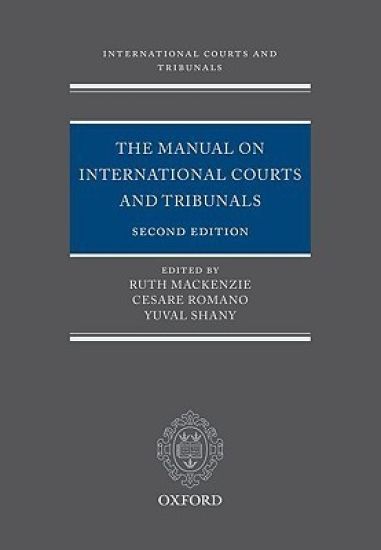
The Manual on International Courts and Tribunals

The Manual on International Courts and Tribunals

Ruth MacKenzie; Cesare Romano; Yuval Shany; Philippe Sands

Oxford University Press
2010
sidottu
The dramatic rise in the number of international courts and tribunals and the expansion of their legal powers has been one of the most significant developments in international law of the late 20th century. The emergence of an international judiciary provided international law with a stronger than ever law enforcement apparatus, and facilitated the transformation of many aspects of international relations from being power-based to being law-based. The first edition of the Manual on International Courts and Tribunals, published in 1999, was the first book to survey systematically this new institutional landscape, by describing in an accessible and uniformly structured manner the legal powers and operating procedures of all major international judicial and quasi-judicial bodies. In doing so, it laid the groundwork for comparative study and research of the law and practice of international courts and tribunals - an emerging field of international legal research, which has already spurred a series of publications, conferences and academic courses. This second edition updates the first edition by describing the many legal changes that have taken place in the last decade, including important reforms in the laws and procedures of many international courts and tribunals, relevant developments in their increasingly rich jurisprudence and the creation of new judicial fora. Moreover, it assesses the overall record of these judicial bodies. The data and legal analysis offered in the book provide both practitioners and academics with an important basis of knowledge that will help them better understand the details of international adjudication and its context.
Regulating Jurisdictional Relations Between National and International Courts
This book seeks to investigate the growing jurisdictional interaction between national and international courts ie: their parallel involvement in the same or related disputes in the light of competing theoretical, ideological and methodological discourses on the nature of the relationship and the means to regulate it. In particular, it aims to explore what, if any, rules of international law could, or perhaps should govern such interactions, and regulate forum selection or multiple proceedings involving national and international courts. In addition, the book explores the standards of review employed by international courts vis-à-vis the decisions of their domestic counterparts and vice versa. It posits that the regulation of such interactions ultimately depends on the selection of the overarching paradigm that governs the relations between national and international courts (hierarchical as opposed to non-hierarchical and disintegrative or integrative conceptual frameworks). Following academic discussion of the problems and solutions pertaining to the interaction between national and international courts, the book considers the potential applicability of several jurisdiction-regulating measures to jurisdictional interactions between national and international courts. These include rules on forum selection and rules designed to regulate multiple proceedings (e.g., lis alibi pendens and res judicata), utilization of comity based measures and doctrines, such as discretionary stay or dismissal of proceedings and margin of appreciation judicial review, and examination of the prohibition against abuse of rights. This segment of the book strives to provide lawyers and academics with a 'tool kit' of measures which could be employed in cases involving jurisdictional interactions between national and international courts.
Regulating Jurisdictional Relations Between National and International Courts
This book seeks to investigate the growing jurisdictional interaction between national and international courts ie: their parallel involvement in the same or related disputes in the light of competing theoretical, ideological and methodological discourses on the nature of the relationship and the means to regulate it. In particular, it aims to explore what, if any, rules of international law could, or perhaps should govern such interactions, and regulate forum selection or multiple proceedings involving national and international courts. In addition, the book explores the standards of review employed by international courts vis-à-vis the decisions of their domestic counterparts and vice versa. It posits that the regulation of such interactions ultimately depends on the selection of the overarching paradigm that governs the relations between national and international courts (hierarchical as opposed to non-hierarchical and disintegrative or integrative conceptual frameworks). Following academic discussion of the problems and solutions pertaining to the interaction between national and international courts, the book considers the potential applicability of several jurisdiction-regulating measures to jurisdictional interactions between national and international courts. These include rules on forum selection and rules designed to regulate multiple proceedings (e.g. lis alibi pendens and res judicata), utilization of comity- based measures and doctrines, such as discretionary stay or dismissal of proceedings and margin of appreciation judicial review, and examination of the prohibition against abuse of rights. This segment of the book strives to provide lawyers and academics with a 'tool kit' of measures which could be employed in cases involving jurisdictional interactions between national and international courts.
The Competing Jurisdictions of International Courts and Tribunals
Recent years have witnessed a sharp increase in the number of international courts and tribunals (WTO, NAFTA, ITLOS, ICC, etc.) and greater willingness on the part of states and other international actors to subject themselves to the compulsory jurisdiction of international adjudicative mechanisms. However, because of the uncoordinated nature of these developments, overlaps between the jurisdictional ambits of the different judicial bodies might occur, i.e., the same dispute could fall under the jurisdiction of more than one forum. This raises both theoretical and practical issues of coordination between the various jurisdictions. The purpose of this book is to explore the implications of jurisdictional competition and to identify standards that may alleviate problems associated with the phenomenon, which arguably threatens the unity of international law. The first part of the book examines the jurisdictional ambits of the principal international courts and tribunals and delineates areas of overlap between their respective jurisdictions. There follows a discussion of some of the potential systematic and practical problems that arise out of jurisdictional competition (such as forum shopping and multiple proceedings) and a consideration of the expediency of mitigating them. The book concludes by identifying existing rules of international law, which govern inter-jurisdictional competition, and by considering the desirability of introducing additional norms and arrangements.
The Competing Jurisdictions of International Courts and Tribunals
Recent years have witnessed a sharp increase in the number of international courts and tribunals (e.g., WTO, NAFTA, ITLOS, ICC, etc.) and greater willingness on the part of states and other international actors to subject themselves to the compulsory jurisdiction of international adjudicative mechanisms. However, because of the uncoordinated nature of these developments, overlaps between the jurisdictional ambits of the different judicial bodies might occur - i.e., the same dispute could fall under the jurisdiction of more than one forum. This raises both theoretical and practical issues of coordinating between the various jurisdictions. The purpose of this book is to explore the implications of jurisdictional competition and to identify standards that may alleviate problems associated with the phenomenon, which arguably threatens the unity of international law. The first part of the book examines the jurisdictional ambits of the principal international courts and tribunals and delineates areas of overlap between their respective jurisdictions. Them follows a discussion of some of the potential systematic and practical problems that arise out of jurisdictional competition (e.g., forum shopping and multiple proceedings) and considers the expediency of mitigating them. It concludes by identifying existing rules of international law, which govern inter-jurisdictional competition, and considering the desirability of introducing additional norms and arrangements.