Kirjojen hintavertailu – 12 903 725 kirjaa ja 27 kauppaa

Kirjailija

Yves Le Jan

Kirjat ja teokset yhdessä paikassa: 6 kirjaa, julkaisuja vuosilta 2010–2025, suosituimpiin kuuluu Random Walks and Physical Fields. Vertaile teosten hintoja ja tarkista saatavuus suomalaisista kirjakaupoista.

6 kirjaa

Kirjojen julkaisuvuodet: 2010–2025.

Random Walks and Physical Fields

Random Walks and Physical Fields

Yves Le Jan

Springer International Publishing AG
2025
nidottu
This book presents fundamental relations between random walks on graphs and field theories of mathematical physics. Such relations have been explored for several decades and remain a rapidly developing research area in probability theory. The main objects of study include Markov loops, spanning forests, random holonomies, and covers, and the purpose of the book is to investigate their relations to Bose fields, Fermi fields, and gauge fields. The book starts with a review of some basic notions of Markovian potential theory in the simple context of a finite or countable graph, followed by several chapters dedicated to the study of loop ensembles and related statistical physical models. Then, spanning trees and Fermi fields are introduced and related to loop ensembles. Next, the focus turns to topological properties of loops and graphs, with the introduction of connections on a graph, loop holonomies, and Yang-Mills measure. Among the main results presented is an intertwining relation between merge-and-split generators on loop ensembles and Casimir operators on connections, and the key reflection positivity property for the fields under consideration. Aimed at researchers and graduate students in probability and mathematical physics, this concise monograph is essentially self-contained. Familiarity with basic notions of probability, Poisson point processes, and discrete Markov chains are assumed of the reader.​
Random Walks and Physical Fields

Random Walks and Physical Fields

Yves Le Jan

Springer International Publishing AG
2024
sidottu
This book presents fundamental relations between random walks on graphs and field theories of mathematical physics. Such relations have been explored for several decades and remain a rapidly developing research area in probability theory. The main objects of study include Markov loops, spanning forests, random holonomies, and covers, and the purpose of the book is to investigate their relations to Bose fields, Fermi fields, and gauge fields. The book starts with a review of some basic notions of Markovian potential theory in the simple context of a finite or countable graph, followed by several chapters dedicated to the study of loop ensembles and related statistical physical models. Then, spanning trees and Fermi fields are introduced and related to loop ensembles. Next, the focus turns to topological properties of loops and graphs, with the introduction of connections on a graph, loop holonomies, and Yang–Mills measure. Among the main results presented is an intertwining relation between merge-and-split generators on loop ensembles and Casimir operators on connections, and the key reflection positivity property for the fields under consideration. Aimed at researchers and graduate students in probability and mathematical physics, this concise monograph is essentially self-contained. Familiarity with basic notions of probability, Poisson point processes, and discrete Markov chains are assumed of the reader.?
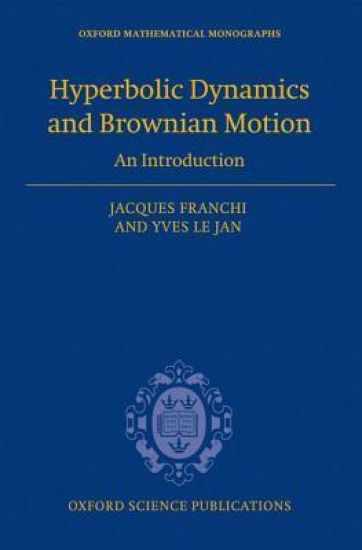
Hyperbolic Dynamics and Brownian Motion

Hyperbolic Dynamics and Brownian Motion

Jacques Franchi; Yves Le Jan

Oxford University Press
2012
sidottu
Hyperbolic Dynamics and Brownian Motion illustrates the interplay between distinct domains of mathematics. There is no assumption that the reader is a specialist in any of these domains: only basic knowledge of linear algebra, calculus and probability theory is required. The content can be summarized in three ways: Firstly, this book provides an introduction to hyperbolic geometry, based on the Lorentz group. The Lorentz group plays, in relativistic space-time, a role analogue to the rotations in Euclidean space. The hyperbolic geometry is the geometry of the unit pseudo-sphere. The boundary of the hyperbolic space is defined as the set of light rays. Special attention is given to the geodesic and horocyclic flows. Hyperbolic geometry is presented via special relativity to benefit from the physical intuition. Secondly, this book introduces basic notions of stochastic analysis: the Wiener process, Itô's stochastic integral, and calculus. This introduction allows study in linear stochastic differential equations on groups of matrices. In this way the spherical and hyperbolic Brownian motions, diffusions on the stable leaves, and the relativistic diffusion are constructed. Thirdly, quotients of the hyperbolic space under a discrete group of isometries are introduced. In this framework some elements of hyperbolic dynamics are presented, as the ergodicity of the geodesic and horocyclic flows. This book culminates with an analysis of the chaotic behaviour of the geodesic flow, performed using stochastic analysis methods. This main result is known as Sinai's central limit theorem.
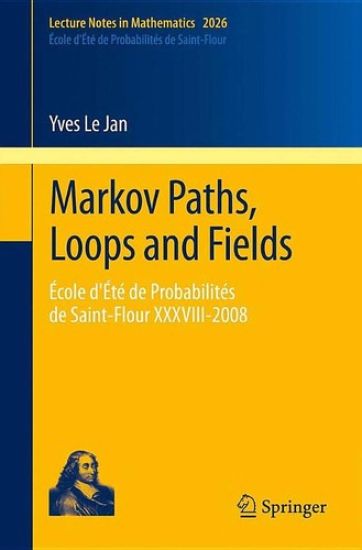
Markov Paths, Loops and Fields

Markov Paths, Loops and Fields

Yves Le Jan

Springer-Verlag Berlin and Heidelberg GmbH Co. K
2011
nidottu
The purpose of these notes is to explore some simple relations between Markovian path and loop measures, the Poissonian ensembles of loops they determine, their occupation fields, uniform spanning trees, determinants, and Gaussian Markov fields such as the fre field. These relations are first studied in complete generality for the finite discrete setting, then partly generalized to specific examples in infinite and continuous spaces.
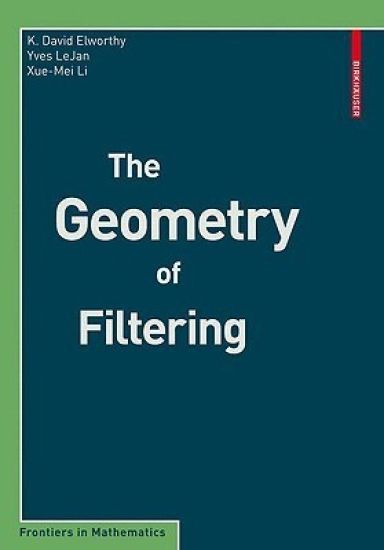
The Geometry of Filtering

The Geometry of Filtering

K. David Elworthy; Yves Le Jan; Xue-Mei Li

Birkhauser Verlag AG
2010
nidottu
Filtering is the science of nding the law of a process given a partial observation of it. The main objects we study here are di usion processes. These are naturally associated with second-order linear di erential operators which are semi-elliptic and so introduce a possibly degenerate Riemannian structure on the state space. In fact, much of what we discuss is simply about two such operators intertwined by a smooth map, the \projection from the state space to the observations space", and does not involve any stochastic analysis. From the point of view of stochastic processes, our purpose is to present and to study the underlying geometric structure which allows us to perform the ltering in a Markovian framework with the resulting conditional law being that of a Markov process which is time inhomogeneous in general. This geometry is determined by the symbol of the operator on the state space which projects to a symbol on the observation space. The projectible symbol induces a (possibly non-linear and partially de ned) connection which lifts the observation process to the state space and gives a decomposition of the operator on the state space and of the noise. As is standard we can recover the classical ltering theory in which the observations are not usually Markovian by application of the Girsanov- Maruyama-Cameron-Martin Theorem. This structure we have is examined in relation to a number of geometrical topics.