
Kirjojen hintavertailu – 12 859 829 kirjaa ja 27 kauppaa

Kirjailija

Yves Weinand

Kirjat ja teokset yhdessä paikassa: 3 kirjaa, julkaisuja vuodelta 2021, suosituimpiin kuuluu The IBOIS Notebooks–Vol. 1. Vertaile teosten hintoja ja tarkista saatavuus suomalaisista kirjakaupoista.

3 kirjaa

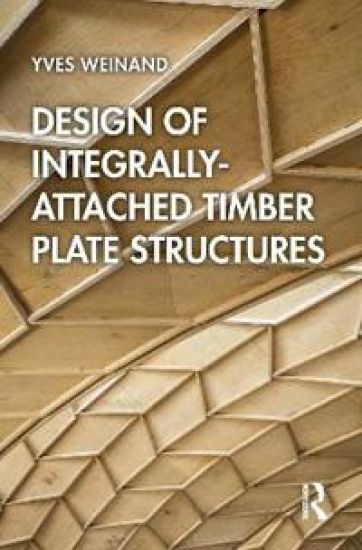
Design of Integrally-Attached Timber Plate Structures
Design of Integrally-Attached Timber Plate Structures outlines a new design methodology for digitally fabricated spatial timber plate structures, presented with examples from recent construction projects. It proposes an innovative and sustainable design methodology, algorithmic geometry processing, structural optimization, and digital fabrication; technology transfer and construction are formulated and widely discussed. The methodology relies on integral mechanical attachment whereby the connection between timber plates is established solely through geometric manipulation, without additional connectors, such as nails, screws, dowels, adhesives, or welding. The transdisciplinary design framework for spatial timber plate structures brings together digital architecture, computer science, and structural engineering, covering parametric modeling and architectural computational design, geometry exploration, the digital fabrication assembly of engineered timber panels, numerical simulations, mechanical characterization, design optimization, and performance improvement. The method is demonstrated through different prototypes, physical models, and three build examples, focusing specifically on the design of the timber-plate roof structure of 23 large span arches called the Annen Headquarters in Luxembourg. This is useful for the architecture, engineering, and construction (AEC) sector and shows how new structural optimization processes can be reinvented through geometrical adaptions to control global and local geometries of complex structures. This text is ideal for structural engineering professionals and architects in both industry and academia, and construction companies.
Design of Integrally-Attached Timber Plate Structures
Design of Integrally-Attached Timber Plate Structures outlines a new design methodology for digitally fabricated spatial timber plate structures, presented with examples from recent construction projects. It proposes an innovative and sustainable design methodology, algorithmic geometry processing, structural optimization, and digital fabrication; technology transfer and construction are formulated and widely discussed. The methodology relies on integral mechanical attachment whereby the connection between timber plates is established solely through geometric manipulation, without additional connectors, such as nails, screws, dowels, adhesives, or welding. The transdisciplinary design framework for spatial timber plate structures brings together digital architecture, computer science, and structural engineering, covering parametric modeling and architectural computational design, geometry exploration, the digital fabrication assembly of engineered timber panels, numerical simulations, mechanical characterization, design optimization, and performance improvement. The method is demonstrated through different prototypes, physical models, and three build examples, focusing specifically on the design of the timber-plate roof structure of 23 large span arches called the Annen Headquarters in Luxembourg. This is useful for the architecture, engineering, and construction (AEC) sector and shows how new structural optimization processes can be reinvented through geometrical adaptions to control global and local geometries of complex structures. This text is ideal for structural engineering professionals and architects in both industry and academia, and construction companies.
The IBOIS Notebooks–Vol. 1

The IBOIS Notebooks–Vol. 1

Yves Weinand; Christophe Catsaros; Françoise Fromonot; Stéphane Berthier

Presses Polytechniques et Universitaires Romandes
2021
nidottu
A thorough and interdisciplinary look at the many aspects of wood construction over the past three hundred years. The IBOIS Notebooks offer a societal, ecological, cultural, and political look at wood construction. Through the work and critical analyses of authors from various disciplines, these notebooks reveal the structuring, sometimes contradictory, and often underestimated role of timber construction in the architectural evolution of the last three centuries. This biannual editorial project, led by Christophe Catsaros, philosopher, journalist, and architecture critic, and Yves Weinand, architect-engineer and director of the Wood Construction Laboratory (IBOIS) at École polytechnique fédérale de Lausanne (EPFL), draws the outlines of an original and transdisciplinary account. Going beyond the established distinction between the humanities and applied sciences, the notebooks offer alternative relationships for innovative wood construction. Behind this original and cross-disciplinary panorama—where researchers, builders, and historians question the potential of a material—is the ambition of a radical change, as evidenced both by the research and the achievements of the EPFL’s Wood Construction Laboratory.