Kirjojen hintavertailu – 12 903 729 kirjaa ja 27 kauppaa

Kirjailija

Yvonna S. Lincoln

Kirjat ja teokset yhdessä paikassa: 8 kirjaa, julkaisuja vuosilta 1985–2019, suosituimpiin kuuluu The Constructivist Credo. Vertaile teosten hintoja ja tarkista saatavuus suomalaisista kirjakaupoista.

Nimi esiintyy myös muodoissa: Yvonna S Lincoln

8 kirjaa

Kirjojen julkaisuvuodet: 1985–2019.

Employing Critical Qualitative Inquiry to Mount Non-Violent Resistance

Employing Critical Qualitative Inquiry to Mount Non-Violent Resistance

Yvonna S. Lincoln; Gaile S. Cannella

Stylus Publishing
2019
nidottu
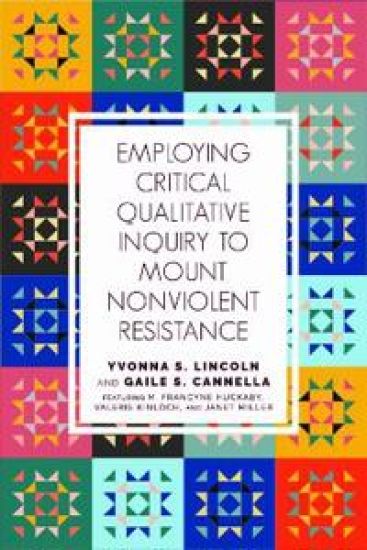
Employing Critical Qualitative Inquiry to Mount Non-Violent Resistance engages researchers with the notion of Critical Qualitative Inquiry (CQI) as a direct practice of resistance. First, the authors define CQI and its criticisms; provide an in-depth examination of the contemporary neoliberal, capitalist patriarchal condition as requiring immediate resistance within research locations; and discuss the theories/perspectives that have been historically and are contemporarily useful for challenging forms of domination. Specific examples of CQI as resistance in response to a particular neoliberal, patriarchal, whitelash event are then provided by a range of contributing authors. Finally, Lincoln and Cannella address future research practices focusing on how we make present and useful the historical scholarship, actions, and struggles of those who have come before; how we use emergent perspectives to construct new ways to challenge sexism, racism, and other forms of injustice that continue to harm and destroy; and actions that can emerge through research that lead to transformation more broadly toward a more just world.
Employing Critical Qualitative Inquiry to Mount Non-Violent Resistance

Employing Critical Qualitative Inquiry to Mount Non-Violent Resistance

Yvonna S. Lincoln; Gaile S. Cannella

Stylus Publishing
2019
sidottu
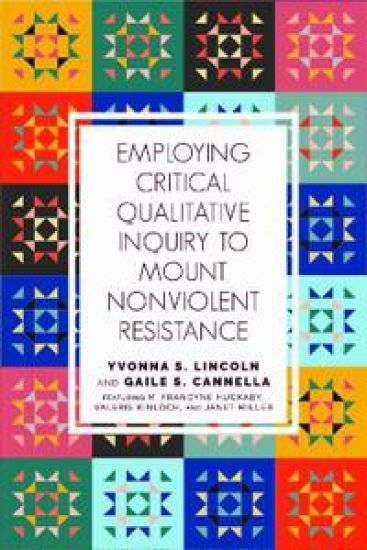
Employing Critical Qualitative Inquiry to Mount Non-Violent Resistance engages researchers with the notion of Critical Qualitative Inquiry (CQI) as a direct practice of resistance. First, the authors define CQI and its criticisms; provide an in-depth examination of the contemporary neoliberal, capitalist patriarchal condition as requiring immediate resistance within research locations; and discuss the theories/perspectives that have been historically and are contemporarily useful for challenging forms of domination. Specific examples of CQI as resistance in response to a particular neoliberal, patriarchal, whitelash event are then provided by a range of contributing authors. Finally, Lincoln and Cannella address future research practices focusing on how we make present and useful the historical scholarship, actions, and struggles of those who have come before; how we use emergent perspectives to construct new ways to challenge sexism, racism, and other forms of injustice that continue to harm and destroy; and actions that can emerge through research that lead to transformation more broadly toward a more just world.
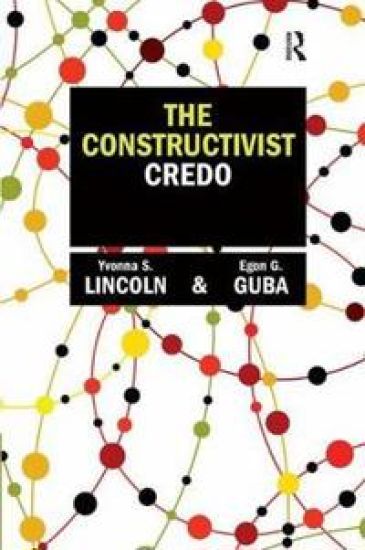
The Constructivist Credo

The Constructivist Credo

Yvonna S Lincoln; Egon G Guba

Left Coast Press Inc
2013
nidottu
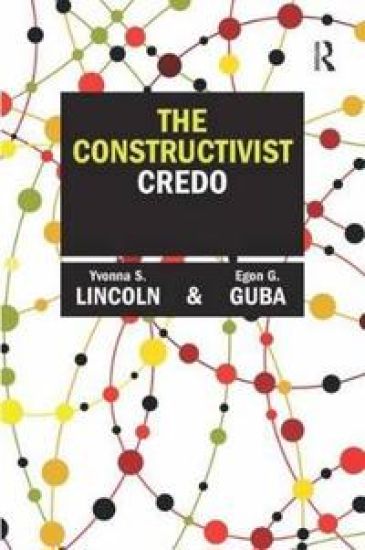
The Constructivist Credo is a set of foundational principles for those wishing to conduct social science research within the constructivist paradigm. They were distilled by Yvonna Lincoln and Egon Guba from their many writings on this topic and are provided in the form of 150 propositional statements. After Guba’s death in 2008, the Credo was completed by Lincoln and is presented here. In addition to the key principles of constructivist thought, the volume also contains an introduction to constructivism, an intellectual biography and complete bibliography of Guba’s work, and a case study using constructivism, showing how the paradigm can be applied to a research study.
The Constructivist Credo

The Constructivist Credo

Yvonna S Lincoln; Egon G Guba

Left Coast Press Inc
2013
sidottu
The Constructivist Credo is a set of foundational principles for those wishing to conduct social science research within the constructivist paradigm. They were distilled by Yvonna Lincoln and Egon Guba from their many writings on this topic and are provided in the form of 150 propositional statements. After Guba’s death in 2008, the Credo was completed by Lincoln and is presented here. In addition to the key principles of constructivist thought, the volume also contains an introduction to constructivism, an intellectual biography and complete bibliography of Guba’s work, and a case study using constructivism, showing how the paradigm can be applied to a research study.
The Qualitative Inquiry Reader

The Qualitative Inquiry Reader

Norman K. Denzin; Yvonna S. Lincoln

SAGE Publications Inc
2002
sidottu
New from award winning editors Norman K. Denzin and Yvonna S. Lincoln, The Qualitative Inquiry Reader offers the best of the popular SAGE journal, Qualitative Inquiry. These collected works aim to introduce the necessary critical framework that will allow scholars and students scholars to interpret cutting edge work in the field of qualitative inquiry. By providing this framework, readers will then be able to use this work as it applies to critical political and moral discourses. Features: The book includes examples from across the behavioral and social sciences Reader is divided into five sections: Reflexive Ethnography, Autoethnography, Poetics, Performance Narratives, Assessing the Text These sections reflect the ways in which contemporary researchers have implemented the narrative turn in their writing Contains cutting-edge work by top scholars in the field Introduces students and scholars to what's new in the field of qualitative inquiry
The Qualitative Inquiry Reader

The Qualitative Inquiry Reader

Norman K. Denzin; Yvonna S. Lincoln

SAGE Publications Inc
2002
nidottu
New from award winning editors Norman K. Denzin and Yvonna S. Lincoln, The Qualitative Inquiry Reader offers the best of the popular SAGE journal, Qualitative Inquiry. These collected works aim to introduce the necessary critical framework that will allow scholars and students scholars to interpret cutting edge work in the field of qualitative inquiry. By providing this framework, readers will then be able to use this work as it applies to critical political and moral discourses. Features: The book includes examples from across the behavioral and social sciences Reader is divided into five sections: Reflexive Ethnography, Autoethnography, Poetics, Performance Narratives, Assessing the Text These sections reflect the ways in which contemporary researchers have implemented the narrative turn in their writing Contains cutting-edge work by top scholars in the field Introduces students and scholars to what's new in the field of qualitative inquiry
Fourth Generation Evaluation

Fourth Generation Evaluation

Egon G. Guba; Yvonna S. Lincoln

SAGE Publications Inc
1989
sidottu
"In Fourth Generation Evaluation, Guba and Lincoln present a strong, unequivocal argument for the epistemological, methodological, and ethical superiority of their refined constructivist inquiry paradigm for the political and practical demands of program evaluation." --Jennifer Greene, Cornell University "I would warmly recommend it as stimulating and challenging reading." --Systems Practice "I consider Fourth Generation Evaluation to be an exceptionally daring and insightful book. It has done more than most books to further loosen the grip of liberal, instrumental ''common sense'' (i.e., ideology) that has constricted the field of evaluation for the past 30 years. The book's idealism is energizing and must only be matched, as the authors certainly know, by yet more hard-headed analysis. Its radical ambitions are inspiring if not always apparently achievable. However, fair is fair: radical ends demand radical means." --Evaluation Practice Fourth Generation Evaluation represents a monumental shift in evaluation practice. Guba and Lincoln point to the inherent problems faced by previous generations of evaluators--politics, ethical dilemmas, imperfections and gaps, inconclusive deductions--and lay the blame for failure and nonutilization at the feet of the unquestioned reliance on the scientific/positivist paradigm of research. Fourth Generation Evaluation, a more informed and sophisticated approach, moves beyond science to include the myriad human, political, social, cultural, and contextual elements that are involved. Based upon relativism, a unity between knower and known, and a subjective epistemology, the authors show how fourth generation evaluation unites the evaluator and the stakeholders in an interaction that creates the product of the evaluation. Differing from previously existing generations, this new approach moves evaluation to a new level, whose key dynamic is negotiation. The constructivist paradigm is espoused by the authors and shown to offer multiple advantages, including empowerment and enfranchisement of stakeholders, as well as an action orientation that defines a course to be followed. Not merely a treatise on evaluation theory, Guba and Lincoln also comprehensively describe the differences between the positivist and constructivist paradigms of research, and provide a practical plan of the steps and processes in conducting a fourth generation evaluation. This is a book that no evaluator can afford to ignore and an important advance in the study of applied research.
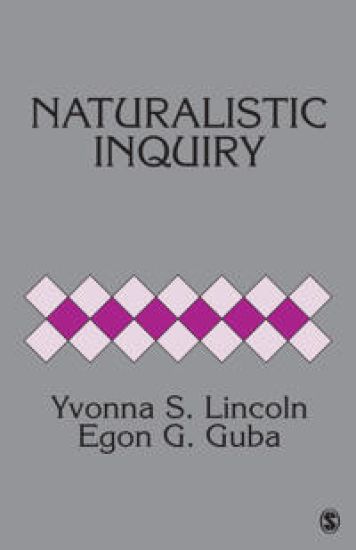
Naturalistic Inquiry

Naturalistic Inquiry

Yvonna S. Lincoln; Egon G. Guba

SAGE Publications Inc
1985
sidottu
Showing how science is limited by its dominant mode of investigation, Lincoln and Guba propose an alternative paradigm—a "naturalistic" rather than "rationalistic" method of inquiry—in which the investigator avoids manipulating research outcomes. A "paradigm shift" is under way in many fields, they contend, and go on to describe the different assumptions of the two approaches regarding the nature of reality, subject-object interaction, the possibility of generalization, the concept of causality, and the role of values. The authors also offer guidance for research in the field (where, they say, naturalistic inquiry always takes place). Useful tips are given, for example, on "designing" a study as it unfolds, establishing "trustworthiness," and writing a case report. This book helps researchers "both to understand and to do naturalistic inquiry." Of particular interest to educational researchers, it is valuable for all social scientists involved with questions of qualitative and quantitative methodology.