Kirjojen hintavertailu – 12 903 724 kirjaa ja 27 kauppaa

Kirjailija

Zagros Madjd-Sadjadi

Kirjat ja teokset yhdessä paikassa: 3 kirjaa, julkaisuja vuosilta 2007–2015, suosituimpiin kuuluu The Economics of Crime. Vertaile teosten hintoja ja tarkista saatavuus suomalaisista kirjakaupoista.

3 kirjaa

Kirjojen julkaisuvuodet: 2007–2015.

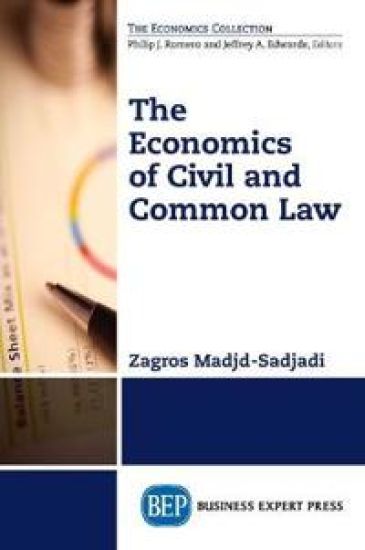
The Economics of Civil and Common Law

The Economics of Civil and Common Law

Zagros Madjd-Sadjadi

Business Expert Press
2015
nidottu
Law is supposed to encourage innovation, morality, and conformity with societal expectations, yet it may provides perverse incentives causing individuals, or even the State, to act in discordant, inefficient, and even immoral ways. This book will explore the inefficiencies that are created that serve to deny individuals work and shelter in a haphazard and capricious manner. The author examines property rights, including eminent domain, that lets the State take property away with seemingly arbitrary compensation to the owner. Individuals must understand both civil law, codified by statutes, and common law, enshrined in precedential judicial decisions. This book is written for economists and non-economists and has an extensive glossary of economic, political and legal terms. Two items that are not formally treated in other economics of law textbooks are the legal organization of businesses and tax law from an economics perspective.

The Economics of Crime

The Economics of Crime

Zagros Madjd-Sadjadi

Business Expert Press
2013
nidottu
Too often students in economics emerge with a clear grasp of theory, but precious little ability to apply that theory, especially in the area of microeconomics. They are left with a model that they believe is relevant solely to market mechanisms, when it is in fact suited for inquiry into all avenues of rational choice. At the same time, there is a uniform belief that criminals are plagued by psychological, physiological, or sociological deficiencies that can be remedied only through incarceration or institutionalization. Neither formulation is satisfactory as an exemplar to the general population about how they should be thinking about crime. Workers, employers and managers alike have a stake in effective public policy designed to reduce criminality. According to the Institute for People with Criminal Records, approximately 3% of the US population will be in jail or prison for at least one day during any given year, and nearly 30% of the population has a criminal record. Yet, having a criminal record often serves as a bar to employment and leads individuals who have paid their debts to society on a pathway to recidivism. Thus everyone, from managers in companies considering whether to bar felons from employment to individual voters considering felony disenfranchisement laws, needs to understand how rational criminals act and think. This book will attempt to guide readers to such an understanding. By understanding how incentive mechanisms affect criminal behavior, business managers may use this information either to reduce criminal activity in their own enterprises or to understand how unethical business decisions affect the wider society. As we always do in such circumstances, we must make sacrifices to balance the competing interests.
Modern State Intervention in the Era of Globalisation

Modern State Intervention in the Era of Globalisation

Nikolaos Karagiannis; Zagros Madjd-Sadjadi

Edward Elgar Publishing Ltd
2007
sidottu
The authors of this book argue that in order to meet the challenges of globalisation and promote their own economic welfare, governments need strong policy instruments that will enable them to take up a strategic role in selected policy arenas. They illustrate how this retooling of policymaking requires a rethinking of the form of government intervention and, especially, an emphasis on its modern developmental role. The book begins with chapters exploring theoretical issues such as: economic and political aspects of the state, the impact of government expenditure, the case for and against free trade, and neoclassical and Keynesian approaches to public finance. Succeeding chapters examine fiscal policy, development problems in the European Community, and the success of Japan, South Korea, Taiwan, Singapore and Hong Kong. The final chapters present the Developmental State argument not only as a coherent theory but more importantly as a realistic development policy framework. This will be an important reference text for students and scholars of public sector economics, public finance, East Asian studies, development studies and governance. Policymakers will also find the in-depth discussions a valuable tool.