Kirjailija
Zane Grey
Kirjat ja teokset yhdessä paikassa: 1 156 kirjaa, julkaisuja vuosilta 1924–2026, suosituimpiin kuuluu U.S.S. Cairo The Story of a Civil War Gunboat Comprising a Narrative of Her Wartime Adventures by Virgil Carrington Jones, and an Account of Her Raising in 1964 by Harold L. Peterson (Edition1). Vertaile teosten hintoja ja tarkista saatavuus suomalaisista kirjakaupoista.
1 156 kirjaa
Kirjojen julkaisuvuodet: 1924–2026.
The Ohio River trilogy by author Zane concludes with this novel, which is named The Last Trail. The American Revolution and the immediate post-revolutionary era are covered by this trilogy. During this time, eastern pioneers crossed the Allegany Mountains on their way to the west, where they settled in the basin of the Ohio River. These new arrivals must clear Indians, outlaw gangs, and renegades from their towns. In this particular tale, the safety of this fledgling town is in danger from a group of horse thieves and kidnappers of women. This narrative will provide you with a glimpse into the frontier age when people were moving to the west coast to establish new lives. The plot will exhaust you because there are too many characters involved and since each chapter was horribly repetitive and moved like the car in front of you who perpetually drives the speed limit before speeding up for a moment and then slowing down again.
American sportsmen don't need an introduction to Buffalo Jones. He spent almost his whole life pursuing wild animals after being born on the Illinois prairie sixty-two years ago. It has been a chase that has been driven by a single passion-almost an obsession-to catch alive rather than to kill that has given it an unwavering vigor and unbreakable purpose. Every well-known wild animal that is native to western North America has been captured and had its will broken by him. He found killing disgusting. Even though he detested the sight of a sporting rifle, he had little choice but to feed the caravans traveling the plains with buffalo meat for years due to needing it. When he finally realized that the noble creatures would eventually go extinct, he shattered his rifle over a wagon wheel and resolved to safeguard the species. He toiled for ten years, hunting down, seizing, and domesticating buffalo; for this, the West made him famous and gave him the moniker Preserver of the American Bison. Buffalo Jones steadily moved westward as civilization encroached on the plains; today, he resides on a remote plateau bordered by the desert on the north rim of the Grand Canyon in Arizona. His buffalo remain as free as ever on the undulating plains, grazing alongside mustangs and deer.
In 1914, Zane Grey released the Western book, The Lone Star Ranger. The Texas Rangers, a well-known group of incredibly skilled law enforcement officials, are several of the key characters in the book, which is set in the Lone Star State of Texas. It recounts the life of Buck Duane, an individual who turns into an outlaw before earning the respect of the authorities. The Texas Ranger John Hughes received a dedication in the book. The book has a plot summary that starts with Buck The son of a well-known bandit, Duane. Even though an outlaw isn't always a criminal, it's still awful if the Rangers label him as one because it means he's being chased. After defending himself by killing a man, Duane is forced to "go on the dodge." Duane shows up at a criminal's lair, still abhorring the idea of being an outlaw. Even worse, he spends years being haunted by all the men he kills. He meets a kidnapped, attractive young woman at the bandit hideout and wants to set her free. In the second section of the book, Duane enlists with the Rangers in order to assist in purging the frontier of significant cattle rustlers.
This book is a historical literature and full of adventure. Glenn Killbourne and his fiancee Carley Burch find a strange test of their love in the mountains and canyons of Arizona. This book is a reproduction of an important historical work.
The Vanishing American is said to arguably be one of his greatest works. It tells the story of the love between Nophaie, a young Native American (or American Indian) man and his love for and with a woman by the name of Marian Warner. It was first published as a serial in the 1922 run of the Ladies Home Journal, a periodical that had over a couple million subscribers at the time. In 1925, it was then published as a novel and adapted for the screen, a cast that included Geronimo's grandson in a supporting role... (Tiffany Apan)
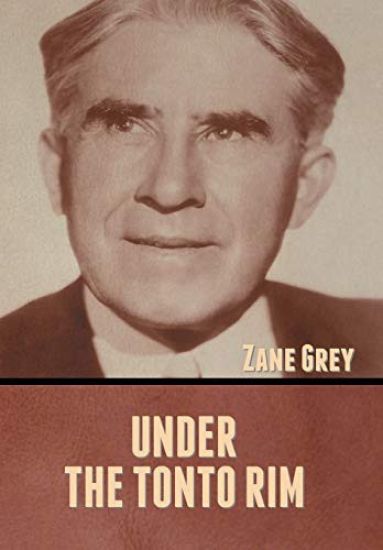
Under the Tonto Rim is a Western novel by Zane Grey first published in book form by Harper & Brothers in 1926. Prior to publication of the book the story had been serialized in 1925 as "The Bee Hunter" in Ladies' Home Journal (Feb-May 1925). The book tells the story of a young lady, Lucy Watson, the daughter of a saloon-keeper. After her father's death Lucy takes a newly created position as Welfare Instructor among a community of backwoods people in Arizona. The New York Times describes the book as "frequently filmed", The 1928 silent version was directed by Herman C. Raymaker and starred Richard Arlen and Mary Brian. (wikipedia.org)