Kirjojen hintavertailu – 12 859 828 kirjaa ja 27 kauppaa

Kirjailija

Zbigniew Michalewicz

Kirjat ja teokset yhdessä paikassa: 9 kirjaa, julkaisuja vuosilta 1996–2021, suosituimpiin kuuluu How to Solve It: Modern Heuristics. Vertaile teosten hintoja ja tarkista saatavuus suomalaisista kirjakaupoista.

9 kirjaa

Kirjojen julkaisuvuodet: 1996–2021.

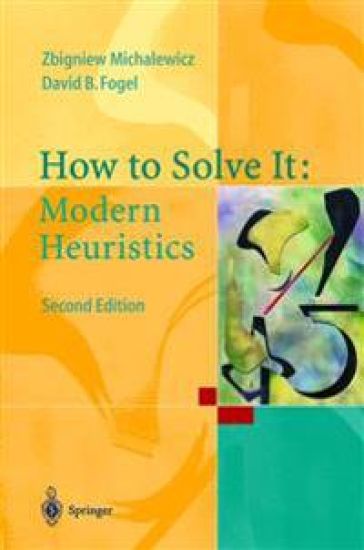
How to Solve It: Modern Heuristics

How to Solve It: Modern Heuristics

Zbigniew Michalewicz; David B. Fogel

Springer-Verlag Berlin and Heidelberg GmbH Co. K
2010
nidottu
No pleasure lasts long unless there is variety in it. Publilius Syrus, Moral Sayings We've been very fortunate to receive fantastic feedback from our readers during the last four years, since the first edition of How to Solve It: Modern Heuristics was published in 1999. It's heartening to know that so many people appreciated the book and, even more importantly, were using the book to help them solve their problems. One professor, who published a review of the book, said that his students had given the best course reviews he'd seen in 15 years when using our text. There can be hardly any better praise, except to add that one of the book reviews published in a SIAM journal received the best review award as well. We greatly appreciate your kind words and personal comments that you sent, including the few cases where you found some typographical or other errors. Thank you all for this wonderful support.
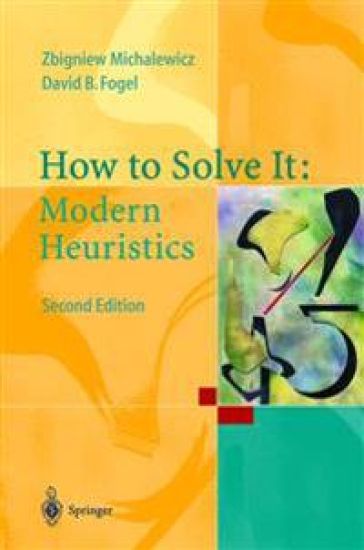
How to Solve It: Modern Heuristics

How to Solve It: Modern Heuristics

Zbigniew Michalewicz; David B. Fogel

Springer-Verlag Berlin and Heidelberg GmbH Co. K
2004
sidottu
No pleasure lasts long unless there is variety in it. Publilius Syrus, Moral Sayings We've been very fortunate to receive fantastic feedback from our readers during the last four years, since the first edition of How to Solve It: Modern Heuristics was published in 1999. It's heartening to know that so many people appreciated the book and, even more importantly, were using the book to help them solve their problems. One professor, who published a review of the book, said that his students had given the best course reviews he'd seen in 15 years when using our text. There can be hardly any better praise, except to add that one of the book reviews published in a SIAM journal received the best review award as well. We greatly appreciate your kind words and personal comments that you sent, including the few cases where you found some typographical or other errors. Thank you all for this wonderful support.

The Rise of Artificial Intelligence

The Rise of Artificial Intelligence

Zbigniew Michalewicz; Leonardo Arantes; Matt Michalewicz

Hybrid Publishers
2021
sidottu
Few terms have captured our imagination in recent times like "Artificial Intelligence," and it now seems that everyone "knows" about AI; that everyone has an opinion. And yet, few people actually understand what Artificial Intelligence is and isn't, where the field came from and where it's heading, and how the technology can be harnessed to generate commercial outcomes. Written for the modern-day business manager, this book examines Artificial Intelligence from the perspective of decision-making, because the quality of the decisions we make defines the quality of the future we create for ourselves and our organizations. In the same way that calculators have improved our ability to make better decisions-followed by spreadsheets, reporting tools, and countless other software applications-Artificial Intelligence is fast becoming the latest "calculator" to assist us, and one that happens to be particularly well-suited for the speed, noise, and complexity of the modern world... Internationally renowned new technologies expert, Dr Zbigniew Michalewicz has published over 200 articles and 15 books on the subjects of business intelligence, predictive data mining, and optimisation. Leonardo Arantes is a dynamic sales and marketing professional, with a reputation for using creative problem-solving to take products to market and deliver on customer needs. Matt Michalewicz has more than 20 years of experience in starting and running high-growth tech companies, especially in the areas of machine learning, predictive analytics, and decision optimisation.
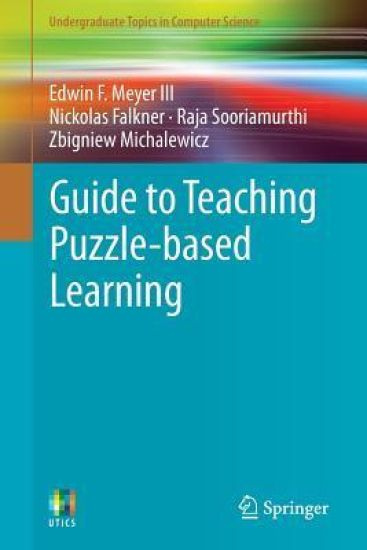
Guide to Teaching Puzzle-based Learning

Guide to Teaching Puzzle-based Learning

Edwin F. Meyer III; Nickolas Falkner; Raja Sooriamurthi; Zbigniew Michalewicz

Springer London Ltd
2014
nidottu
This book provides insights drawn from the authors’ extensive experience in teaching Puzzle-based Learning. Practical advice is provided for teachers and lecturers evaluating a range of different formats for varying class sizes. Features: suggests numerous entertaining puzzles designed to motivate students to think about framing and solving unstructured problems; discusses models for student engagement, setting up puzzle clubs, hosting a puzzle competition, and warm-up activities; presents an overview of effective teaching approaches used in Puzzle-based Learning, covering a variety of class activities, assignment settings and assessment strategies; examines the issues involved in framing a problem and reviews a range of problem-solving strategies; contains tips for teachers and notes on common student pitfalls throughout the text; provides a collection of puzzle sets for use during a Puzzle-based Learning event, including puzzles that require probabilistic reasoning, and logic and geometry puzzles.
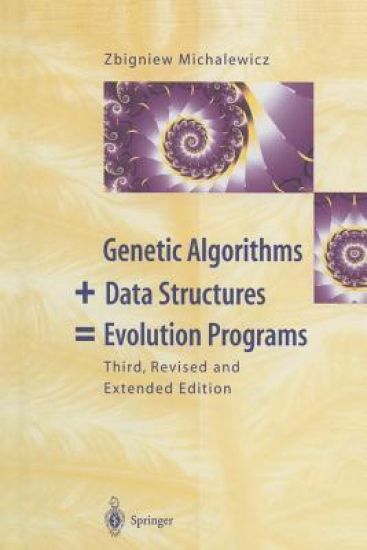
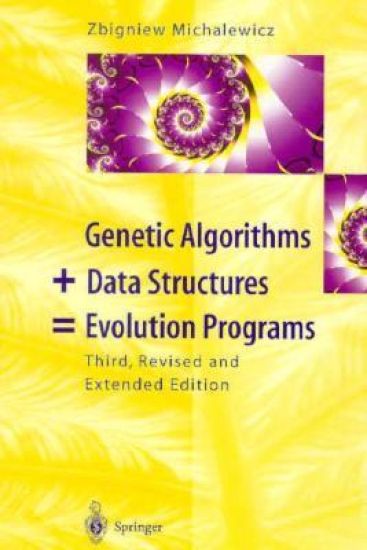
Genetic Algorithms + Data Structures = Evolution Programs

Genetic Algorithms + Data Structures = Evolution Programs

Zbigniew Michalewicz

Springer-Verlag Berlin and Heidelberg GmbH Co. K
2011
nidottu
Genetic algorithms are founded upon the principle of evolution, i.e., survival of the fittest. Hence evolution programming techniques, based on genetic algorithms, are applicable to many hard optimization problems, such as optimization of functions with linear and nonlinear constraints, the traveling salesman problem, and problems of scheduling, partitioning, and control. The importance of these techniques is still growing, since evolution programs are parallel in nature, and parallelism is one of the most promising directions in computer science. The book is self-contained and the only prerequisite is basic undergraduate mathematics. This third edition has been substantially revised and extended by three new chapters and by additional appendices containing working material to cover recent developments and a change in the perception of evolutionary computation.
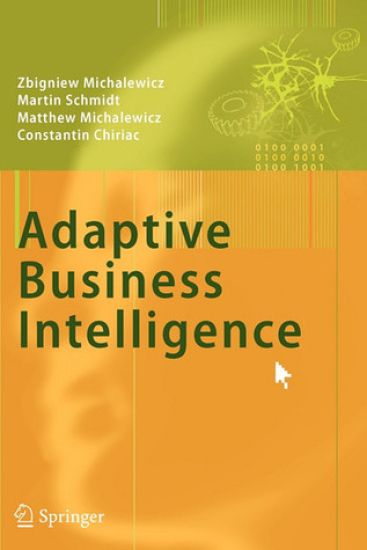
Adaptive Business Intelligence

Adaptive Business Intelligence

Zbigniew Michalewicz; Martin Schmidt; Matthew Michalewicz; Constantin Chiriac

Springer-Verlag Berlin and Heidelberg GmbH Co. K
2010
nidottu
In the modern information era, managers must recognize the competitive opportunities represented by decision-support tools. Adaptive business intelligence systems combine prediction and optimization techniques to assist decision makers in complex, rapidly changing environments. These systems address the fundamental questions: What is likely to happen in the future? And what is the best decision right now? Adaptive Business Intelligence includes elements of data mining, predictive modeling, forecasting, optimization, and adaptability. The authors have considerable academic research backgrounds in artificial intelligence and related fields, combined with years of practical consulting experience in businesses and industries worldwide. In this book they explain the science and application of numerous prediction and optimization techniques, as well as how these concepts can be used to develop adaptive systems. The techniques covered include linear regression, time-series forecasting, decision trees and tables, artificial neural networks, genetic programming, fuzzy systems, genetic algorithms, simulated annealing, tabu search, ant systems, and agent-based modeling. This book is suitable for business and IT managers who make decisions in complex industrial and service environments, nonspecialists who want to understand the science behind better predictions and decisions, and students and researchers who need a quick introduction to this field.
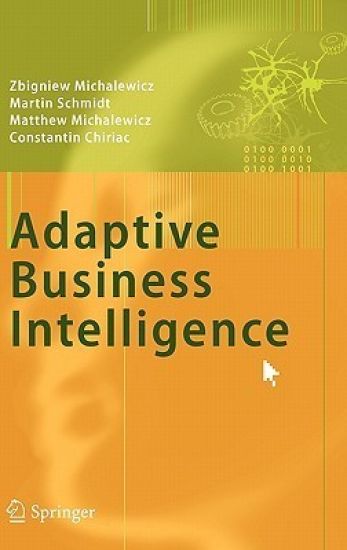
Adaptive Business Intelligence

Adaptive Business Intelligence

Zbigniew Michalewicz; Martin Schmidt; Matthew Michalewicz; Constantin Chiriac

Springer-Verlag Berlin and Heidelberg GmbH Co. K
2006
sidottu

Halvin toimitettuna 71,00 €

In the modern information era, managers must recognize the competitive opportunities represented by decision-support tools. Adaptive business intelligence systems combine prediction and optimization techniques to assist decision makers in complex, rapidly changing environments. These systems address the fundamental questions: What is likely to happen in the future? And what is the best decision right now? Adaptive Business Intelligence includes elements of data mining, predictive modeling, forecasting, optimization, and adaptability. The authors have considerable academic research backgrounds in artificial intelligence and related fields, combined with years of practical consulting experience in businesses and industries worldwide. In this book they explain the science and application of numerous prediction and optimization techniques, as well as how these concepts can be used to develop adaptive systems. The techniques covered include linear regression, time-series forecasting, decision trees and tables, artificial neural networks, genetic programming, fuzzy systems, genetic algorithms, simulated annealing, tabu search, ant systems, and agent-based modeling. This book is suitable for business and IT managers who make decisions in complex industrial and service environments, nonspecialists who want to understand the science behind better predictions and decisions, and students and researchers who need a quick introduction to this field.
Genetic Algorithms + Data Structures = Evolution Programs

Genetic Algorithms + Data Structures = Evolution Programs

Zbigniew Michalewicz

Springer-Verlag Berlin and Heidelberg GmbH Co. K
1996
sidottu
Genetic algorithms are founded upon the principle of evolution, i.e., survival of the fittest. Hence evolution programming techniques, based on genetic algorithms, are applicable to many hard optimization problems, such as optimization of functions with linear and nonlinear constraints, the traveling salesman problem, and problems of scheduling, partitioning, and control. The importance of these techniques is still growing, since evolution programs are parallel in nature, and parallelism is one of the most promising directions in computer science. The book is self-contained and the only prerequisite is basic undergraduate mathematics. This third edition has been substantially revised and extended by three new chapters and by additional appendices containing working material to cover recent developments and a change in the perception of evolutionary computation.