Kirjojen hintavertailu – 12 859 828 kirjaa ja 27 kauppaa

Kirjailija

Zhu Han

Kirjat ja teokset yhdessä paikassa: 31 kirjaa, julkaisuja vuosilta 2008–2025, suosituimpiin kuuluu Sublinear Algorithms for Big Data Applications. Vertaile teosten hintoja ja tarkista saatavuus suomalaisista kirjakaupoista.

31 kirjaa

Kirjojen julkaisuvuodet: 2008–2025.

Hypergraph Theory in Wireless Communication Networks

Hypergraph Theory in Wireless Communication Networks

Hongliang Zhang; Lingyang Song; Zhu Han; Yingjun Zhang

Springer International Publishing AG
2017
nidottu
This brief focuses on introducing a novel mathematical framework, referred as hypergraph theory, to model and solve the multiple interferer scenarios for future wireless communication networks. First, in Chap. 1, the authors introduce the basic preliminaries of hypergraph theory in general, and develop two hypergraph based polynomial algorithms, i.e., hypergraph coloring and hypergraph clustering. Then, in Chaps. 2 and 3, the authors present two emerging applications of hypergraph coloring and hypergraph clustering in Device-to-Device (D2D) underlay communication networks, respectively, in order to show the advantages of hypergraph theory compared with the traditional graph theory. Finally, in Chap. 4, the authors discuss the limitations of using hypergraph theory in future wireless networks and briefly present some other potential applications. This brief introduces the state-of-the-art research on the hypergraph theory and its applications in wireless communications. Anefficient framework is provided for the researchers, professionals and advanced level students who are interested in the radio resource allocation in the heterogeneous networks to solve the resource allocation and interference management problems.
Matching Theory for Wireless Networks

Matching Theory for Wireless Networks

Zhu Han; Yunan Gu; Walid Saad

Springer International Publishing AG
2017
sidottu
This book provides the fundamental knowledge of the classical matching theory problems. It builds up the bridge between the matching theory and the 5G wireless communication resource allocation problems. The potentials and challenges of implementing the semi-distributive matching theory framework into the wireless resource allocations are analyzed both theoretically and through implementation examples. Academics, researchers, engineers, and so on, who are interested in efficient distributive wireless resource allocation solutions, will find this book to be an exceptional resource.
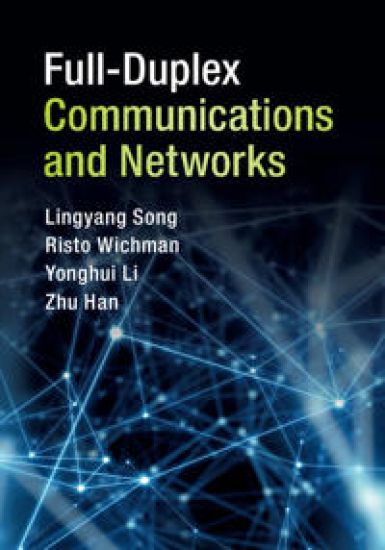
Full-Duplex Communications and Networks

Full-Duplex Communications and Networks

Lingyang Song; Risto Wichman; Yonghui Li; Zhu Han

Cambridge University Press
2017
sidottu
Learn about the key technologies and understand the state of the art in research for full-duplex communication networks and systems with this comprehensive and interdisciplinary guide. Incorporating physical, MAC, network, and application layer perspectives, it explains the fundamental theories on which full-duplex communications are built, and lays out the techniques needed for network design, analysis and optimization. Techniques covered in detail include self-interference cancellation and signal processing algorithms, physical layer algorithms, methods for efficient resource allocation, and game theory. Potential applications and networking schemes are discussed, including full-duplex cognitive radio networks, cooperative networks, and heterogeneous networks. The first book to focus exclusively on full-duplex communications, this is an indispensable reference for both researchers and practitioners designing the next generation of wireless networks.
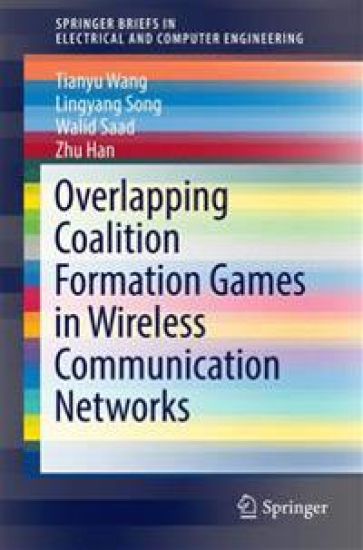
Overlapping Coalition Formation Games in Wireless Communication Networks

Overlapping Coalition Formation Games in Wireless Communication Networks

Tianyu Wang; Lingyang Song; Walid Saad; Zhu Han

Springer International Publishing AG
2016
nidottu
This brief introduces overlapping coalition formation games (OCF games), a novel mathematical framework from cooperative game theory that can be used to model, design and analyze cooperative scenarios in future wireless communication networks. The concepts of OCF games are explained, and several algorithmic aspects are studied. In addition, several major application scenarios are discussed. These applications are drawn from a variety of fields that include radio resource allocation in dense wireless networks, cooperative spectrum sensing for cognitive radio networks, and resource management for crowd sourcing. For each application, the use of OCF games is discussed in detail in order to show how this framework can be used to solve relevant wireless networking problems. Overlapping Coalition Formation Games in Wireless Communication Networks provides researchers, students and practitioners with a concise overview of existing works in this emerging area,exploring the relevant fundamental theories, key techniques, and significant applications.
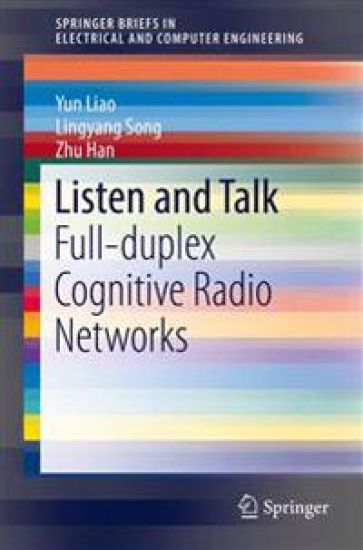
Listen and Talk

Listen and Talk

Yun Liao; Lingyang Song; Zhu Han

Springer International Publishing AG
2016
nidottu
This brief focuses on the use of full-duplex radio in cognitive radio networks, presenting a novel spectrum sharing protocol that allows the secondary users to simultaneously sense and access the vacant spectrum. This protocol, called “Listen-and-talk” (LAT), is evaluated by both mathematical analysis and computer simulations in comparison with other existing protocols, including the listen-before-talk protocol. In addition to LAT-based signal processing and resource allocation, the brief discusses techniques such as spectrum sensing and dynamic spectrum access. The brief proposes LAT as a suitable access scheme for cognitive radio networks, which can support the quality-of-service requirements of these high priority applications. Fundamental theories and key techniques of cognitive radio networks are also covered. Listen and Talk: Full-duplex Cognitive Radio Networks is designed for researchers, developers, and professionals involved in cognitive radio networks. Advanced-level students studying signal processing or simulations will also find the content helpful since it moves beyond traditional cognitive radio networks into future applications for the technology.
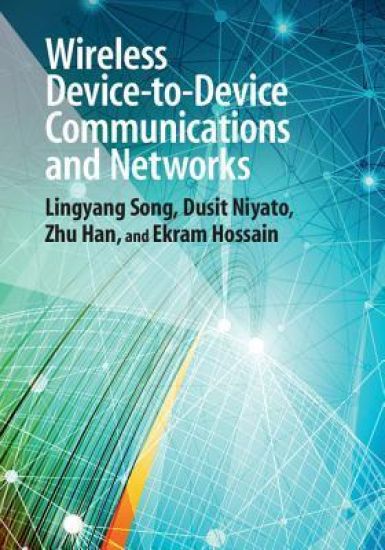
Wireless Device-to-Device Communications and Networks

Wireless Device-to-Device Communications and Networks

Lingyang Song; Dusit Niyato; Zhu Han; Ekram Hossain

Cambridge University Press
2015
sidottu
Covering the fundamental theory together with the state of the art in research and development, this practical guide provides the techniques needed to design, analyze, and optimize device-to-device (D2D) communications in wireless networking. With an ever-increasing demand for higher data rate wireless access, D2D communication is set to become a key feature supported by next generation cellular networks. This book introduces D2D-based wireless communications from the physical, MAC, network, and application layer perspectives, providing all the key background information before moving on to discuss real-world applications as well as potential future developments. Key topics are discussed in detail, such as dynamic resource sharing (for example of spectrum and power) between cellular and ad hoc D2D communications to accommodate larger volumes of traffic and provide better service to users. Readers will understand the practical challenges of resource management, optimization, security, standardization, and network topology, and learn how the design principles are applied in practice.
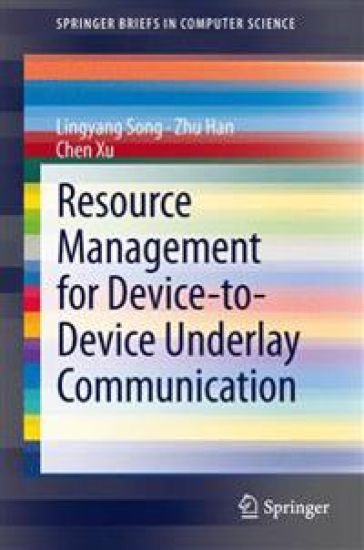
Resource Management for Device-to-Device Underlay Communication

Resource Management for Device-to-Device Underlay Communication

Lingyang Song; Zhu Han; Chen Xu

Springer-Verlag New York Inc.
2013
nidottu
Device-to-Device (D2D) communication will become a key feature supported by next generation cellular networks, a topic of enormous importance to modern communication. Currently, D2D serves as an underlay to the cellular network as a means to increase spectral efficiency. Although D2D communication brings large benefits in terms of system capacity, it also causes interference as well as increased computation complexity to cellular networks as a result of spectrum sharing. Thus, efficient resource management must be performed to guarantee a target performance level of cellular communication. This brief presents the state-of-the-art research on resource management for D2D communication underlaying cellular networks. Those who work with D2D communication will use this book’s information to help ensure their work is as efficient as possible. Along with the survey of existing work, this book also includes the fundamental theories, key techniques, and applications.
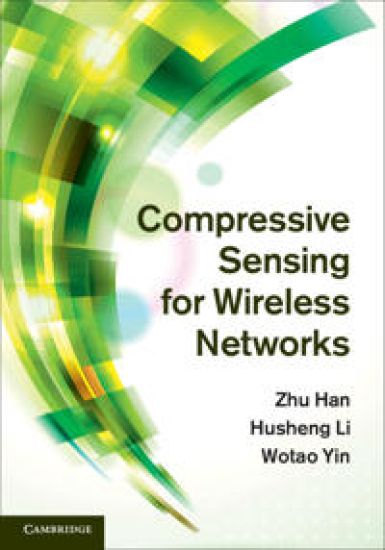
Compressive Sensing for Wireless Networks

Compressive Sensing for Wireless Networks

Zhu Han; Husheng Li; Wotao Yin

Cambridge University Press
2013
sidottu
Compressive sensing is a new signal processing paradigm that aims to encode sparse signals by using far lower sampling rates than those in the traditional Nyquist approach. It helps acquire, store, fuse and process large data sets efficiently and accurately. This method, which links data acquisition, compression, dimensionality reduction and optimization, has attracted significant attention from researchers and engineers in various areas. This comprehensive reference develops a unified view on how to incorporate efficiently the idea of compressive sensing over assorted wireless network scenarios, interweaving concepts from signal processing, optimization, information theory, communications and networking to address the issues in question from an engineering perspective. It enables students, researchers and communications engineers to develop a working knowledge of compressive sensing, including background on the basics of compressive sensing theory, an understanding of its benefits and limitations, and the skills needed to take advantage of compressive sensing in wireless networks.
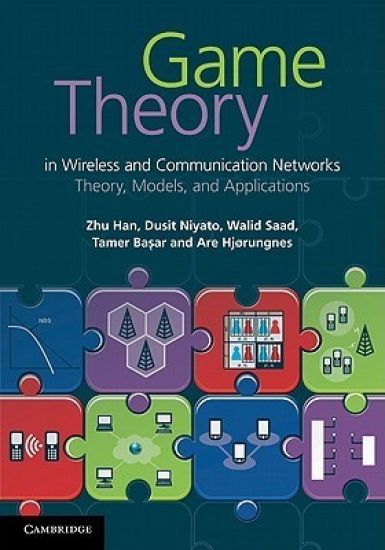
Game Theory in Wireless and Communication Networks

Game Theory in Wireless and Communication Networks

Zhu Han; Dusit Niyato; Walid Saad; Tamer Basar; Are Hjørungnes

Cambridge University Press
2011
sidottu
This unified treatment of game theory focuses on finding state-of-the-art solutions to issues surrounding the next generation of wireless and communications networks. Future networks will rely on autonomous and distributed architectures to improve the efficiency and flexibility of mobile applications, and game theory provides the ideal framework for designing efficient and robust distributed algorithms. This book enables readers to develop a solid understanding of game theory, its applications and its use as an effective tool for addressing wireless communication and networking problems. The key results and tools of game theory are covered, as are various real-world technologies including 3G networks, wireless LANs, sensor networks, dynamic spectrum access and cognitive networks. The book also covers a wide range of techniques for modeling, designing and analysing communication networks using game theory, as well as state-of-the-art distributed design techniques. This is an ideal resource for communications engineers, researchers, and graduate and undergraduate students.
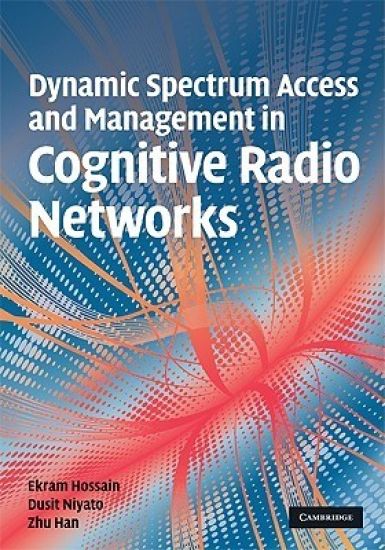
Dynamic Spectrum Access and Management in Cognitive Radio Networks

Dynamic Spectrum Access and Management in Cognitive Radio Networks

Ekram Hossain; Dusit Niyato; Zhu Han

Cambridge University Press
2009
sidottu
Are you involved in designing the next generation of wireless networks? With spectrum becoming an ever scarcer resource, it is critical that new systems utilize all available frequency bands as efficiently as possible. The revolutionary technology presented in this book will be at the cutting edge of future wireless communications. Dynamic Spectrum Access and Management in Cognitive Radio Networks provides you with an all-inclusive introduction to this emerging technology, outlining the fundamentals of cognitive radio-based wireless communication and networking, spectrum sharing models, and the requirements for dynamic spectrum access. In addition to the different techniques and their applications in designing dynamic spectrum access methods, you'll also find state-of-the-art dynamic spectrum access schemes, including classifications of the different schemes and the technical details of each scheme. This is a perfect introduction for graduate students and researchers, as well as a useful self-study guide for practitioners.
Resource Allocation for Wireless Networks

Resource Allocation for Wireless Networks

Zhu Han; K. J. Ray Liu

Cambridge University Press
2008
sidottu
Do you need to improve wireless system performance? Learn how to maximise the efficient use of resources with this systematic and authoritative account of wireless resource management. Basic concepts, optimization tools and techniques, and application examples, are thoroughly described and analysed, providing a unified framework for cross-layer optimization of wireless networks. State-of-the-art research topics and emerging applications, including dynamic resource allocation, cooperative networks, ad hoc/personal area networks, UWB, and antenna array processing, are examined in depth. If you are involved in the design and development of wireless networks, as a researcher, graduate student or professional engineer, this is a must-have guide to getting the best possible performance from your network.