Kirjojen hintavertailu – 12 859 828 kirjaa ja 27 kauppaa

Kirjailija

Zohar Manna

Kirjat ja teokset yhdessä paikassa: 7 kirjaa, julkaisuja vuosilta 1980–2012, suosituimpiin kuuluu The Calculus of Computation. Vertaile teosten hintoja ja tarkista saatavuus suomalaisista kirjakaupoista.

7 kirjaa

Kirjojen julkaisuvuodet: 1980–2012.

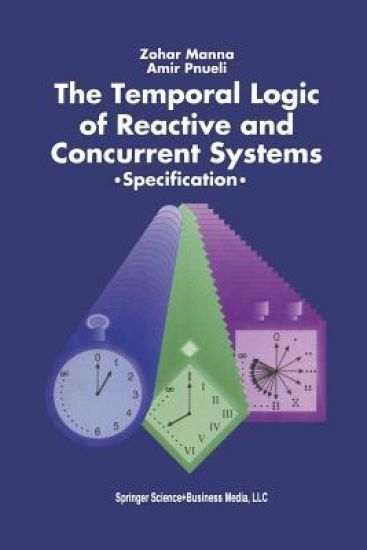
The Temporal Logic of Reactive and Concurrent Systems

The Temporal Logic of Reactive and Concurrent Systems

Zohar Manna; Amir Pnueli

Springer-Verlag New York Inc.
2012
nidottu
Reactive systems are computing systems which are interactive, such as real-time systems, operating systems, concurrent systems, control systems, etc. They are among the most difficult computing systems to program. Temporal logic is a formal tool/language which yields excellent results in specifying reactive systems. This volume, the first of two, subtitled Specification, has a self-contained introduction to temporal logic and, more important, an introduction to the computational model for reactive programs, developed by Zohar Manna and Amir Pnueli of Stanford University and the Weizmann Institute of Science, Israel, respectively.
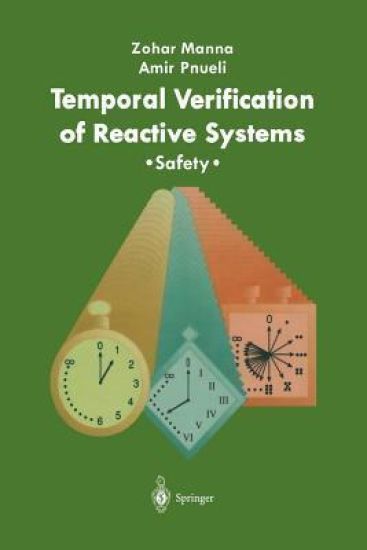
Temporal Verification of Reactive Systems

Temporal Verification of Reactive Systems

Zohar Manna; Amir Pnueli

Springer-Verlag New York Inc.
2012
nidottu
This book is about the verification of reactive systems. A reactive system is a system that maintains an ongoing interaction with its environment, as opposed to computing some final value on termination. The family of reactive systems includes many classes of programs whose correct and reliable construction is con­ sidered to be particularly challenging, including concurrent programs, embedded and process control programs, and operating systems. Typical examples of such systems are an air traffic control system, programs controlling mechanical devices such as a train, or perpetually ongoing processes such as a nuclear reactor. With the expanding use of computers in safety-critical areas, where failure is potentially disastrous, correctness is crucial. This has led to the introduction of formal verification techniques, which give both users and designers of software and hardware systems greater confidence that the systems they build meet the desired specifications. Framework The approach promoted in this book is based on the use of temporal logic for specifying properties of reactive systems, and develops an extensive verification methodology for proving that a system meets its temporal specification. Reactive programs must be specified in terms of their ongoing behavior, and temporal logic provides an expressive and natural language for specifying this behavior. Our framework for specifying and verifying temporal properties of reactive systems is based on the following four components: 1. A computational model to describe the behavior of reactive systems. The model adopted in this book is that of a Fair Transition System (FTS).
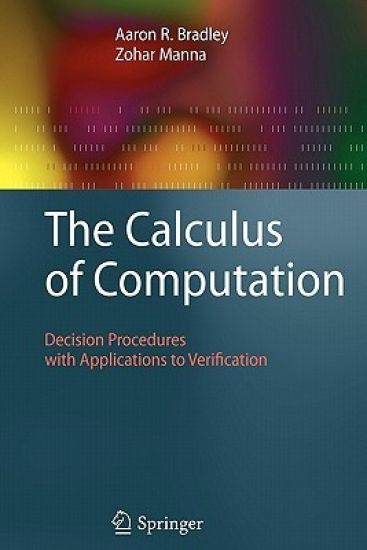
The Calculus of Computation

The Calculus of Computation

Aaron R. Bradley; Zohar Manna

Springer-Verlag Berlin and Heidelberg GmbH Co. K
2010
nidottu
Computational logic is a fast-growing field with applications in artificial intelligence, constraint solving, and the design and verification of software and hardware systems. Written with graduate and advanced undergraduate students in mind, this textbook introduces computational logic from the foundations of first-order logic to state-of-the-art decision procedures for arithmetic, data structures, and combination theories. This textbook also presents a logical approach to engineering correct software. The increasing ubiquity of computers makes implementing correct systems more important than ever. Verification exercises develop the reader's facility in specifying and verifying software using logic. The treatment of verification concludes with an introduction to the static analysis of software, an important component of modern verification systems. For readers interested in learning more about computational logic, decision procedures, verification, and other areas of formal methods, the final chapter outlines courses of further study.
The Calculus of Computation

The Calculus of Computation

Aaron R. Bradley; Zohar Manna

Springer-Verlag Berlin and Heidelberg GmbH Co. K
2007
sidottu
Computational logic is a fast-growing field with applications in artificial intelligence, constraint solving, and the design and verification of software and hardware systems. Written with graduate and advanced undergraduate students in mind, this textbook introduces computational logic from the foundations of first-order logic to state-of-the-art decision procedures for arithmetic, data structures, and combination theories. This textbook also presents a logical approach to engineering correct software. The increasing ubiquity of computers makes implementing correct systems more important than ever. Verification exercises develop the reader's facility in specifying and verifying software using logic. The treatment of verification concludes with an introduction to the static analysis of software, an important component of modern verification systems. For readers interested in learning more about computational logic, decision procedures, verification, and other areas of formal methods, the final chapter outlines courses of further study.
Temporal Verification of Reactive Systems

Temporal Verification of Reactive Systems

Zohar Manna; Amir Pnueli

Springer-Verlag New York Inc.
1995
sidottu
This book is about the verification of reactive systems. A reactive system is a system that maintains an ongoing interaction with its environment, as opposed to computing some final value on termination. The family of reactive systems includes many classes of programs whose correct and reliable construction is con­ sidered to be particularly challenging, including concurrent programs, embedded and process control programs, and operating systems. Typical examples of such systems are an air traffic control system, programs controlling mechanical devices such as a train, or perpetually ongoing processes such as a nuclear reactor. With the expanding use of computers in safety-critical areas, where failure is potentially disastrous, correctness is crucial. This has led to the introduction of formal verification techniques, which give both users and designers of software and hardware systems greater confidence that the systems they build meet the desired specifications. Framework The approach promoted in this book is based on the use of temporal logic for specifying properties of reactive systems, and develops an extensive verification methodology for proving that a system meets its temporal specification. Reactive programs must be specified in terms of their ongoing behavior, and temporal logic provides an expressive and natural language for specifying this behavior. Our framework for specifying and verifying temporal properties of reactive systems is based on the following four components: 1. A computational model to describe the behavior of reactive systems. The model adopted in this book is that of a Fair Transition System (FTS).
The Temporal Logic of Reactive and Concurrent Systems

The Temporal Logic of Reactive and Concurrent Systems

Zohar Manna; Amir Pnueli

Springer-Verlag New York Inc.
1991
sidottu
Reactive systems are computing systems which are interactive, such as real-time systems, operating systems, concurrent systems, control systems, etc. They are among the most difficult computing systems to program. Temporal logic is a formal tool/language which yields excellent results in specifying reactive systems. This volume, the first of two, subtitled Specification, has a self-contained introduction to temporal logic and, more important, an introduction to the computational model for reactive programs, developed by Zohar Manna and Amir Pnueli of Stanford University and the Weizmann Institute of Science, Israel, respectively.
Lectures on the Logic of Computer Programming

Lectures on the Logic of Computer Programming

Zohar Manna

Society for Industrial Applied Mathematics,U.S.
1980
pokkari
This monograph deals with aspects of the computer programming process that involve techniques derived from mathematical logic. The author focuses on proving that a given program produces the intended result whenever it halts, that a given program will eventually halt, that a given program is partially correct and terminates, and that a system of rewriting rules always halts. Also, the author describes the intermediate behavior of a given program, and discusses constructing a program to meet a given specification.