
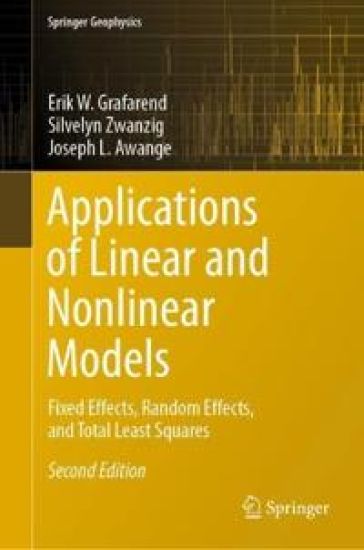
Applications of Linear and Nonlinear Models – hinnat ja saatavuus
Fixed Effects, Random Effects, and Total Least Squares
Kirjafiili on kirjojen hintavertailu. Löydä halvin hinta 27 kirjakaupasta. Hintavertailu koskee ISBN-tunnusta 9783030945978 (sidottu).
Muut painokset ja formaatit
Kirjan kuvaus
This book provides numerous examples of linear and nonlinear model applications. Here, we present a nearly complete treatment of the Grand Universe of linear and weakly nonlinear regression models within the first 8 chapters. Our point of… Näytä koko kuvaus Piilota kuvaus
This book provides numerous examples of linear and nonlinear model applications. Here, we present a nearly complete treatment of the Grand Universe of linear and weakly nonlinear regression models within the first 8 chapters. Our point of view is both an algebraic view and a stochastic one. For example, there is an equivalent lemma between a best, linear uniformly unbiased estimation (BLUUE) in a Gauss–Markov model and a least squares solution (LESS) in a system of linear equations. While BLUUE is a stochastic regression model, LESS is an algebraic solution. In the first six chapters, we concentrate on underdetermined and overdetermined linear systems as well as systems with a datum defect. We review estimators/algebraic solutions of type MINOLESS, BLIMBE, BLUMBE, BLUUE, BIQUE, BLE, BIQUE, and total least squares. The highlight is the simultaneous determination of the first moment and the second central moment of a probability distribution in an inhomogeneous multilinear estimationby the so-called E-D correspondence as well as its Bayes design. In addition, we discuss continuous networks versus discrete networks, use of Grassmann–Plucker coordinates, criterion matrices of type Taylor–Karman as well as FUZZY sets. Chapter seven is a speciality in the treatment of an overjet. This second edition adds three new chapters:(1) Chapter on integer least squares that covers (i) model for positioning as a mixed integer linear model which includes integer parameters. (ii) The general integer least squares problem is formulated, and the optimality of the least squares solution is shown. (iii) The relation to the closest vector problem is considered, and the notion of reduced lattice basis is introduced. (iv) The famous LLL algorithm for generating a Lovasz reduced basis is explained.(2) Bayes methods that covers (i) general principle of Bayesian modeling. Explain the notion of prior distribution and posterior distribution. Choose the pragmatic approach for exploring the advantages of iterative Bayesian calculations and hierarchical modeling. (ii) Present the Bayes methods for linear models with normal distributed errors, including noninformative priors, conjugate priors, normal gamma distributions and (iii) short outview to modern application of Bayesian modeling. Useful in case of nonlinear models or linear models with no normal distribution: Monte Carlo (MC), Markov chain Monte Carlo (MCMC), approximative Bayesian computation (ABC) methods.(3) Error-in-variables models, which cover: (i) Introduce the error-in-variables (EIV) model, discuss the difference to least squares estimators (LSE), (ii) calculate the total least squares (TLS) estimator. Summarize the properties of TLS, (iii) explain the idea of simulation extrapolation (SIMEX) estimators, (iv) introduce the symmetrized SIMEX (SYMEX) estimator and its relation to TLS, and (v) short outview to nonlinear EIV models. The chapter onalgebraic solution of nonlinear system of equations has also been updated in line with the new emerging field of hybrid numeric-symbolic solutions to systems of nonlinear equations, ermined system of nonlinear equations on curved manifolds. The von Mises–Fisher distribution is characteristic for circular or (hyper) spherical data. Our last chapter is devoted to probabilistic regression, the special Gauss–Markov model with random effects leading to estimators of type BLIP and VIP including Bayesian estimation. A great part of the work is presented in four appendices. Appendix A is a treatment, of tensor algebra, namely linear algebra, matrix algebra, and multilinear algebra. Appendix B is devoted to sampling distributions and their use in terms of confidence intervals and confidence regions. Appendix C reviews the elementary notions of statistics, namely random events and stochastic processes. Appendix D introduces the basics of Groebner basis algebra, its careful definition, the Buchberger algorithm, especially the C. F. Gauss combinatorial algorithm.
Kirjan tiedot
Vertaa kirjan ”Applications of Linear and Nonlinear Models” hintoja
Vertaa tuotteen hintaa ja arvioitua kokonaishintaa toimitettuna. Kaikki hinnat koskevat ISBN-tunnusta 9783030945978.
Hintoja ei päivitetty automaattisesti. Voit hakea ajantasaiset hinnat painamalla Hae hinnat.

Booky

Suomalainen

Kansallinen Kirjakauppa

Prisma

Finlandia Kirja

Fantasiapelit

Vinhan kirjakauppa

CDON

Kustantamo S&S

Kennys.ie

Kristillinenkirjakauppa.fi

Sacrum

Adlibris

BookOutlet.fi

Kirja.fi

Rosebud
Tälle kirjalle ei ole tällä hetkellä vahvistettua hintaa. Tarkista tilanne myöhemmin uudelleen.
Hintoja ei ole vielä päivitetty.
Hälytys tallennettu!
Ilmoitamme, kun hinta laskee.
Saat sähköpostin, kun hinta laskee asettamaasi rajaan tai sen alle.
Applications of Linear and Nonlinear Models – hintahistoria
Seuraamme kirjan Applications of Linear and Nonlinear Models hintakehitystä kirjakaupoissa. Taulukosta näet viime kuukausien alimmat hinnat.
Alin hinta kauppoittain
Kunkin kaupan alin hinta viimeisten 90 päivän aikana.
Hintahistoriaa ei ole vielä kerätty tälle kirjalle.
Hinnat ilman toimituskuluja.