Kirjojen hintavertailu – 12 903 725 kirjaa ja 27 kauppaa

Kirjailija

Erik W. Grafarend

Kirjat ja teokset yhdessä paikassa: 5 kirjaa, julkaisuja vuosilta 2014–2023, suosituimpiin kuuluu Map Projections. Vertaile teosten hintoja ja tarkista saatavuus suomalaisista kirjakaupoista.

5 kirjaa

Kirjojen julkaisuvuodet: 2014–2023.

Applications of Linear and Nonlinear Models

Applications of Linear and Nonlinear Models

Erik W. Grafarend; Silvelyn Zwanzig; Joseph L. Awange

Springer Nature Switzerland AG
2023
nidottu
This book provides numerous examples of linear and nonlinear model applications. Here, we present a nearly complete treatment of the Grand Universe of linear and weakly nonlinear regression models within the first 8 chapters. Our point of view is both an algebraic view and a stochastic one. For example, there is an equivalent lemma between a best, linear uniformly unbiased estimation (BLUUE) in a Gauss–Markov model and a least squares solution (LESS) in a system of linear equations. While BLUUE is a stochastic regression model, LESS is an algebraic solution. In the first six chapters, we concentrate on underdetermined and overdetermined linear systems as well as systems with a datum defect. We review estimators/algebraic solutions of type MINOLESS, BLIMBE, BLUMBE, BLUUE, BIQUE, BLE, BIQUE, and total least squares. The highlight is the simultaneous determination of the first moment and the second central moment of a probability distribution in an inhomogeneous multilinear estimationby the so-called E-D correspondence as well as its Bayes design. In addition, we discuss continuous networks versus discrete networks, use of Grassmann–Plucker coordinates, criterion matrices of type Taylor–Karman as well as FUZZY sets. Chapter seven is a speciality in the treatment of an overjet. This second edition adds three new chapters:(1) Chapter on integer least squares that covers (i) model for positioning as a mixed integer linear model which includes integer parameters. (ii) The general integer least squares problem is formulated, and the optimality of the least squares solution is shown. (iii) The relation to the closest vector problem is considered, and the notion of reduced lattice basis is introduced. (iv) The famous LLL algorithm for generating a Lovasz reduced basis is explained.(2) Bayes methods that covers (i) general principle of Bayesian modeling. Explain the notion of prior distribution and posterior distribution. Choose the pragmatic approach for exploring the advantages of iterative Bayesian calculations and hierarchical modeling. (ii) Present the Bayes methods for linear models with normal distributed errors, including noninformative priors, conjugate priors, normal gamma distributions and (iii) short outview to modern application of Bayesian modeling. Useful in case of nonlinear models or linear models with no normal distribution: Monte Carlo (MC), Markov chain Monte Carlo (MCMC), approximative Bayesian computation (ABC) methods.(3) Error-in-variables models, which cover: (i) Introduce the error-in-variables (EIV) model, discuss the difference to least squares estimators (LSE), (ii) calculate the total least squares (TLS) estimator. Summarize the properties of TLS, (iii) explain the idea of simulation extrapolation (SIMEX) estimators, (iv) introduce the symmetrized SIMEX (SYMEX) estimator and its relation to TLS, and (v) short outview to nonlinear EIV models. The chapter onalgebraic solution of nonlinear system of equations has also been updated in line with the new emerging field of hybrid numeric-symbolic solutions to systems of nonlinear equations, ermined system of nonlinear equations on curved manifolds. The von Mises–Fisher distribution is characteristic for circular or (hyper) spherical data. Our last chapter is devoted to probabilistic regression, the special Gauss–Markov model with random effects leading to estimators of type BLIP and VIP including Bayesian estimation. A great part of the work is presented in four appendices. Appendix A is a treatment, of tensor algebra, namely linear algebra, matrix algebra, and multilinear algebra. Appendix B is devoted to sampling distributions and their use in terms of confidence intervals and confidence regions. Appendix C reviews the elementary notions of statistics, namely random events and stochastic processes. Appendix D introduces the basics of Groebner basis algebra, its careful definition, the Buchberger algorithm, especially the C. F. Gauss combinatorial algorithm.
Applications of Linear and Nonlinear Models

Applications of Linear and Nonlinear Models

Erik W. Grafarend; Silvelyn Zwanzig; Joseph L. Awange

Springer Nature Switzerland AG
2022
sidottu
This book provides numerous examples of linear and nonlinear model applications. Here, we present a nearly complete treatment of the Grand Universe of linear and weakly nonlinear regression models within the first 8 chapters. Our point of view is both an algebraic view and a stochastic one. For example, there is an equivalent lemma between a best, linear uniformly unbiased estimation (BLUUE) in a Gauss–Markov model and a least squares solution (LESS) in a system of linear equations. While BLUUE is a stochastic regression model, LESS is an algebraic solution. In the first six chapters, we concentrate on underdetermined and overdetermined linear systems as well as systems with a datum defect. We review estimators/algebraic solutions of type MINOLESS, BLIMBE, BLUMBE, BLUUE, BIQUE, BLE, BIQUE, and total least squares. The highlight is the simultaneous determination of the first moment and the second central moment of a probability distribution in an inhomogeneous multilinear estimationby the so-called E-D correspondence as well as its Bayes design. In addition, we discuss continuous networks versus discrete networks, use of Grassmann–Plucker coordinates, criterion matrices of type Taylor–Karman as well as FUZZY sets. Chapter seven is a speciality in the treatment of an overjet. This second edition adds three new chapters:(1) Chapter on integer least squares that covers (i) model for positioning as a mixed integer linear model which includes integer parameters. (ii) The general integer least squares problem is formulated, and the optimality of the least squares solution is shown. (iii) The relation to the closest vector problem is considered, and the notion of reduced lattice basis is introduced. (iv) The famous LLL algorithm for generating a Lovasz reduced basis is explained.(2) Bayes methods that covers (i) general principle of Bayesian modeling. Explain the notion of prior distribution and posterior distribution. Choose the pragmatic approach for exploring the advantages of iterative Bayesian calculations and hierarchical modeling. (ii) Present the Bayes methods for linear models with normal distributed errors, including noninformative priors, conjugate priors, normal gamma distributions and (iii) short outview to modern application of Bayesian modeling. Useful in case of nonlinear models or linear models with no normal distribution: Monte Carlo (MC), Markov chain Monte Carlo (MCMC), approximative Bayesian computation (ABC) methods.(3) Error-in-variables models, which cover: (i) Introduce the error-in-variables (EIV) model, discuss the difference to least squares estimators (LSE), (ii) calculate the total least squares (TLS) estimator. Summarize the properties of TLS, (iii) explain the idea of simulation extrapolation (SIMEX) estimators, (iv) introduce the symmetrized SIMEX (SYMEX) estimator and its relation to TLS, and (v) short outview to nonlinear EIV models. The chapter onalgebraic solution of nonlinear system of equations has also been updated in line with the new emerging field of hybrid numeric-symbolic solutions to systems of nonlinear equations, ermined system of nonlinear equations on curved manifolds. The von Mises–Fisher distribution is characteristic for circular or (hyper) spherical data. Our last chapter is devoted to probabilistic regression, the special Gauss–Markov model with random effects leading to estimators of type BLIP and VIP including Bayesian estimation. A great part of the work is presented in four appendices. Appendix A is a treatment, of tensor algebra, namely linear algebra, matrix algebra, and multilinear algebra. Appendix B is devoted to sampling distributions and their use in terms of confidence intervals and confidence regions. Appendix C reviews the elementary notions of statistics, namely random events and stochastic processes. Appendix D introduces the basics of Groebner basis algebra, its careful definition, the Buchberger algorithm, especially the C. F. Gauss combinatorial algorithm.
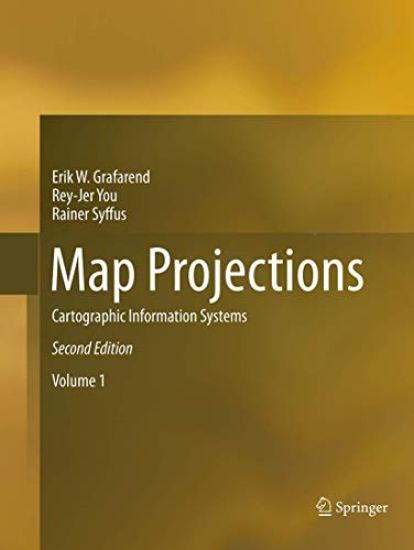
Map Projections

Map Projections

Erik W. Grafarend; Rey-Jer You; Rainer Syffus

Springer-Verlag Berlin and Heidelberg GmbH Co. K
2017
nidottu
In the context of Geographical Information Systems (GIS) the book offers a timely review of Map Projections. The first chapters are of foundational type. We introduce the mapping from a left Riemann manifold to a right one specified as conformal, equiaerial and equidistant, perspective and geodetic. In particular, the mapping from a Riemann manifold to a Euclidean manifold ("plane") and the design of various coordinate systems are reviewed . A speciality is the treatment of surfaces of Gaussian curvature zero. The largest part is devoted to the mapping the sphere and the ellipsoid-of-revolution to tangential plane, cylinder and cone (pseudo-cone) using the polar aspect, transverse as well as oblique aspect. Various Geodetic Mappings as well as the Datum Problem are reviewed. In the first extension we introduce optimal map projections by variational calculus for the sphere, respectively the ellipsoid generating harmonic maps. The second extension reviews alternative maps for structures , namely torus (pneu), hyperboloid (cooling tower), paraboloid (parabolic mirror), onion shape (church tower) as well as clothoid (Hight Speed Railways) used in Project Surveying. Third, we present the Datum Transformation described by the Conformal Group C10 (3) in a threedimensional Euclidean space , a ten parameter conformal transformation. It leaves infinitesimal angles and distance ratios equivariant. Numerical examples from classical and new map projections as well as twelve appendices document the Wonderful World of Map Projections.
Algebraic Geodesy and Geoinformatics

Algebraic Geodesy and Geoinformatics

Joseph L. Awange; Erik W. Grafarend; Béla Paláncz; Piroska Zaletnyik

Springer-Verlag Berlin and Heidelberg GmbH Co. K
2014
nidottu
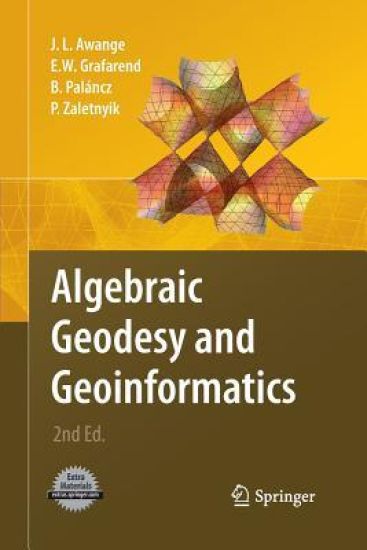
While preparing and teaching ‘Introduction to Geodesy I and II’ to undergraduate students at Stuttgart University, we noticed a gap which motivated the writing of the present book: Almost every topic that we taught required some skills in algebra, and in particular, computer algebra! From positioning to transformation problems inherent in geodesy and geoinformatics, knowledge of algebra and application of computer algebra software were required. In preparing this book therefore, we have attempted to put together basic concepts of abstract algebra which underpin the techniques for solving algebraic problems. Algebraic computational algorithms useful for solving problems which require exact solutions to nonlinear systems of equations are presented and tested on various problems. Though the present book focuses mainly on the two ?elds, the concepts and techniques presented herein are nonetheless applicable to other ?elds where algebraic computational problems might be encountered. In Engineering for example, network densi?cation and robotics apply resection and intersection techniques which require algebraic solutions. Solution of nonlinear systems of equations is an indispensable task in almost all geosciences such as geodesy, geoinformatics, geophysics (just to mention but a few) as well as robotics. These equations which require exact solutions underpin the operations of ranging, resection, intersection and other techniques that are normally used. Examples of problems that require exact solutions include; • three-dimensional resection problem for determining positions and orientation of sensors, e. g. , camera, theodolites, robots, scanners etc.
Map Projections

Map Projections

Erik W. Grafarend; Rey-Jer You; Rainer Syffus

Springer-Verlag Berlin and Heidelberg GmbH Co. K
2014
sidottu
In the context of Geographical Information Systems (GIS) the book offers a timely review of Map Projections. The first chapters are of foundational type. We introduce the mapping from a left Riemann manifold to a right one specified as conformal, equiaerial and equidistant, perspective and geodetic. In particular, the mapping from a Riemann manifold to a Euclidean manifold ("plane") and the design of various coordinate systems are reviewed . A speciality is the treatment of surfaces of Gaussian curvature zero. The largest part is devoted to the mapping the sphere and the ellipsoid-of-revolution to tangential plane, cylinder and cone (pseudo-cone) using the polar aspect, transverse as well as oblique aspect. Various Geodetic Mappings as well as the Datum Problem are reviewed. In the first extension we introduce optimal map projections by variational calculus for the sphere, respectively the ellipsoid generating harmonic maps. The second extension reviews alternative maps for structures , namely torus (pneu), hyperboloid (cooling tower), paraboloid (parabolic mirror), onion shape (church tower) as well as clothoid (Hight Speed Railways) used in Project Surveying. Third, we present the Datum Transformation described by the Conformal Group C10 (3) in a threedimensional Euclidean space , a ten parameter conformal transformation. It leaves infinitesimal angles and distance ratios equivariant. Numerical examples from classical and new map projections as well as twelve appendices document the Wonderful World of Map Projections.