
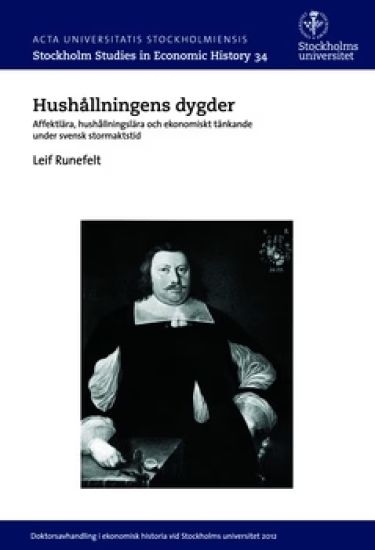
Hushållningens dygder : affektlära, hushållningslära och ekonomiskt tänkande under svensk stormaktstid – hinnat ja saatavuus
Kirjafiili on kirjojen hintavertailu. Löydä halvin hinta 27 kirjakaupasta. Hintavertailu koskee ISBN-tunnusta 9789176098615 (nidottu).
Kirjan kuvaus
A basic assumption in the thesis is that every economic as well as political and ethical doctrine contains a conception of man, and, thus, that this conception needs to be scrutinised in order to achieve deeper understanding of the… Näytä koko kuvaus Piilota kuvaus
A basic assumption in the thesis is that every economic as well as political and ethical doctrine contains a conception of man, and, thus, that this conception needs to be scrutinised in order to achieve deeper understanding of the doctrine. The purposes of the thesis is (1) to account for conceptions of man within the rarely studied Swedish seventeenth-century economic thought, (2) to examine how conceptions of man and of society influence and shape this thought, and (3) to do this from a synchronous approach, by which emphasis is laid on economic thought as an integral part of the intellectual culture of the epoch. In chapter 2 is explored the conception of man as expressed in economic thought. Man is conceived as selfish and irrational. In chapter 3, this conception is explained as it is placed within a wider context, the most common psychological theory of the epoch, the theory of the passions, which is thoroughly examined. Chapter 4 consists of an analysis of the theory of householding, as it was expressed in the literature of the epoch. It is shown that this theory, not focused on by earlier research, to a large extent is a part of ethics and a prolongation of the theory of passions. The householder or "house-father" is obliged to control his own as well as the other household-member's passions, and to maintain the hierarchical order within the household. Chapters 5 to 8 deal with the central areas within economic thought. These areas are domestic production and trade (ch. 5), the sumptuary laws and attitudes towards luxury (ch. 6), the use of the concept of free trade (ch. 7) and the issues of idleness and employment (ch. 8). It is shown that the king or government is viewed as the "house-father" of the realm, and that the core of the theory of the passions, the taming of the passions through reason and virtue, is vital also within economic thought, in which four virtues were central: justice, diligence, temperance and frugality; the same virtues as in the theory of householding.
Kirjan tiedot
Vertaa kirjan ”Hushållningens dygder : affektlära, hushållningslära och ekonomiskt tänkande under svensk stormaktstid” hintoja
Vertaa tuotteen hintaa ja arvioitua kokonaishintaa toimitettuna. Kaikki hinnat koskevat ISBN-tunnusta 9789176098615.
Hintoja ei päivitetty automaattisesti. Voit hakea ajantasaiset hinnat painamalla Hae hinnat.

Booky

Suomalainen

Kansallinen Kirjakauppa

Prisma

Finlandia Kirja

Fantasiapelit

Vinhan kirjakauppa

CDON

Kustantamo S&S

Kennys.ie

Kristillinenkirjakauppa.fi

Sacrum

Adlibris

BookOutlet.fi

Kirja.fi

Rosebud
Tälle kirjalle ei ole tällä hetkellä vahvistettua hintaa. Tarkista tilanne myöhemmin uudelleen.
Hintoja ei ole vielä päivitetty.
Hälytys tallennettu!
Ilmoitamme, kun hinta laskee.
Saat sähköpostin, kun hinta laskee asettamaasi rajaan tai sen alle.
Hushållningens dygder : affektlära, hushållningslära och ekonomiskt tänkande under svensk stormaktstid – hintahistoria
Seuraamme kirjan Hushållningens dygder : affektlära, hushållningslära och ekonomiskt tänkande under svensk stormaktstid hintakehitystä kirjakaupoissa. Taulukosta näet viime kuukausien alimmat hinnat.
Alin hinta kauppoittain
Kunkin kaupan alin hinta viimeisten 90 päivän aikana.
Hintahistoriaa ei ole vielä kerätty tälle kirjalle.
Hinnat ilman toimituskuluja.