Kirjailija
Albert Einstein
Kirjat ja teokset yhdessä paikassa: 251 kirjaa, julkaisuja vuosilta 1916–2026, suosituimpiin kuuluu New Evidence of the Militarization of America. Vertaile teosten hintoja ja tarkista saatavuus suomalaisista kirjakaupoista.
251 kirjaa
Kirjojen julkaisuvuodet: 1916–2026.
After completing the final version of his general theory of relativity in November 1915, Albert Einstein wrote a book about relativity for a popular audience. His intention was "to give an exact insight into the theory of relativity to those readers who, from a general scientific and philosophical point of view, are interested in the theory, but who are not conversant with the mathematical apparatus of theoretical physics." The book remains one of the most lucid explanations of the special and general theories ever written. In the early 1920s alone, it was translated into ten languages, and fifteen editions in the original German appeared over the course of Einstein's lifetime. This new edition of Einstein's celebrated book features an authoritative English translation of the text along with an introduction and a reading companion by Hanoch Gutfreund and Jurgen Renn that examines the evolution of Einstein's thinking and casts his ideas in a broader present-day context. A special chapter explores the history of and the stories behind the early foreign-language editions in light of the reception of relativity in different countries. This edition also includes a survey of the introductions from those editions, covers from selected early editions, a letter from Walther Rathenau to Einstein discussing the book, and a revealing sample from Einstein's handwritten manuscript. Published on the hundredth anniversary of general relativity, this handsome edition of Einstein's famous book places the work in historical and intellectual context while providing invaluable insight into one of the greatest scientific minds of all time.
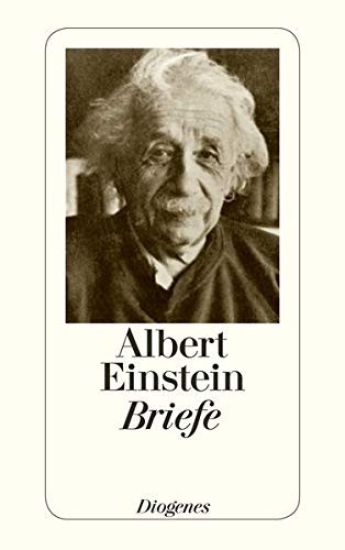
Albert Einstein war nicht nur der größte Wissenschaftler seiner Zeit, sondern auch der berühmteste. Mehr noch: er beantwortete Briefe. Und diese Kombination macht das vorliegende Buch möglich. Es ist keine Biografie und erklärt nicht Einsteins Ideen. Es hat keine Kapitel, keine Inhaltsübersicht, kein Register und, auf den ersten Blick, keinen zugrundeliegenden Plan und keine Gliederung. Es besteht zum größten Teil aus Zitaten aus bisher unveröffentlichten Briefen und Zeugnissen, die Einstein ohne Gedanken an eine Publikation schrieb. Dennoch sind sie wunderbar lesbar, unterhaltsam und eindrücklich und zeigen Einstein neben dem Wissenschaftler und Menschen als grandiosen Briefeschreiber, der selbstironisch meinte: "Wenn alle Leute so lebten wie ich, wahrlich, die Romanschriftstellerei wäre dann niemals auf die Welt gekommen."
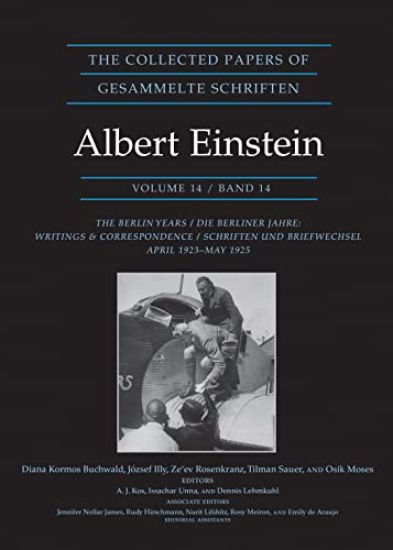
The Collected Papers of Albert Einstein, Volume 14
Albert Einstein
Princeton University Press
2015
sidottu
The more than one thousand letters and several dozen writings included in this volume cover the years immediately before the final formulation of new quantum mechanics. The discovery of the Compton effect in 1923 vindicates Einstein's light quantum hypothesis. Niels Bohr still criticizes Einstein's conception of light quanta and advances an alternative theory, but Walther Bothe and Hans Geiger perform a difficult experiment that decides in favor of Einstein's theory. At the same time, Satyendranath Bose sends a new quantum theoretical derivation of Planck's law to Einstein and he discovers what is now known as Bose-Einstein condensation. Einstein attempts to reformulate a unified theory of the gravitational and electromagnetic fields. In early November 1923, Einstein flees overnight to the Netherlands in the wake of threats on his life and anti-Semitic rioting in Berlin. He rejoins the International Committee on Intellectual Cooperation in June 1924, and supports the idea of a European union. He joins the board of governors of Hebrew University, which opens in April 1925, and celebrates the event in Buenos Aires while on a seven-week lecture tour of Argentina, Uruguay, and Brazil. During this period, he delivers lectures, meets with heads of state, visits major institutions, and attends receptions hosted by the local Jewish and German communities. He has a serious, but short-lived, falling out with his son Hans Albert and his first wife Mileva Maric-Einstein over how to invest part of the Nobel Prize money and he rescues his sister Maja and her husband from debt on their house. Einstein has a fourteen-month romantic relationship with his secretary, Betty Neumann, which he ends in October 1924.
The Collected Papers of Albert Einstein, Volume 14 (English)
Albert Einstein
Princeton University Press
2015
pokkari
In the almost one hundred writings and more than one thousand letters included in this volume, Einstein is revealed yet again as the consummate puzzler of myriad scientific problems as well as the invested participant in social and political engagements. He continues to explore the light quantum, whose reality is confirmed by new experiments, and to attempt to formulate a unified theory of gravitation and electromagnetism. He travels to South America, where he lectures widely on relativity, rejoins the International Committee on Intellectual Cooperation, and supports the idea of a European union. Einstein has a fourteen-month romantic relationship with his secretary, Betty Neumann, which ends in October 1924.
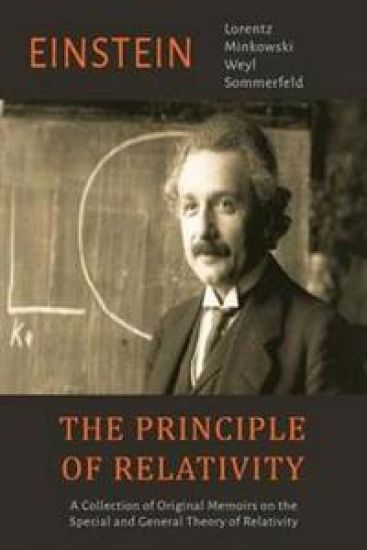
The Principle of Relativity
Albert Einstein; H a Lorentz; H Minkowski
Martino Fine Books
2015
pokkari
Relativity: the Special and General Theory
Albert Einstein
Createspace Independent Publishing Platform
2015
nidottu
Halvin toimitettuna 14,10 €
The Meaning of Relativity: Including the Relativistic Theory of the Non-Symmetric Field - Fifth Edition
Albert Einstein
PRINCETON UNIVERSITY PRESS
2014
nidottu
In 1921, five years after the appearance of his comprehensive paper on general relativity and twelve years before he left Europe permanently to join the Institute for Advanced Study, Albert Einstein visited Princeton University, where he delivered the Stafford Little Lectures for that year. These four lectures constituted an overview of his then-controversial theory of relativity. Princeton University Press made the lectures available under the title The Meaning of Relativity, the first book by Einstein to be produced by an American publisher. As subsequent editions were brought out by the Press, Einstein included new material amplifying the theory. A revised version of the appendix "Relativistic Theory of the Non-Symmetric Field," added to the posthumous edition of 1956, was Einstein's last scientific paper.
Relativity: The Special and General Theory
Albert Einstein
Createspace Independent Publishing Platform
2014
nidottu
The theory of relativity, or simply relativity in physics, usually encompasses two theories by Albert Einstein: special relativity and general relativity. (The word relativity can also be used in the context of an older theory, that of Galilean invariance.) Concepts introduced by the theories of relativity include: Measurements of various quantities are relative to the velocities of observers. In particular, space contracts and time dilates. Spacetime: space and time should be considered together and in relation to each other. The speed of light is nonetheless invariant, the same for all observers. The term "theory of relativity" was based on the expression "relative theory" (German: Relativtheorie) used in 1906 by Max Planck, who emphasized how the theory uses the principle of relativity. In the discussion section of the same paper Alfred Bucherer used for the first time the expression "theory of relativity" (German: Relativit tstheorie)
Inside the Mind of Albert Einstein
Albert Einstein; Daniel Willey
Createspace Independent Publishing Platform
2014
nidottu
Albert Einstein has been hailed as one of the greatest minds to ever exist on our planet. He was a German-born theoretical physicist. He developed the general theory of relativity, one of the two pillars of modern physics. He received the 1921 Nobel Prize in Physics for "his services to theoretical physics, and especially for his discovery of the law of the photoelectric effect. Einstein was visiting the United States when Adolf Hitler came to power and did not go back to Germany, where he had been a professor. This book contains a collection of his thoughts, teachings, & quotes.
Relativity: The Special and General Theory
Albert Einstein
Createspace Independent Publishing Platform
2014
nidottu
Relativity: The Special and General Theory
Albert Einstein
Createspace Independent Publishing Platform
2014
nidottu
Relativity: The Special and the General Theory began as a short paper and was eventually published as a book written by Albert Einstein with the aim of giving: . . . an exact insight into the theory of relativity to those readers who, from a general scientific and philosophical point of view, are interested in the theory, but who are not conversant with the mathematical apparatus of theoretical physics. - from the Preface It was first published in German in 1916 and later translated into English in 1920. It is divided into 3 parts, the first dealing with special relativity, the second dealing with general relativity and the third dealing with considerations on the universe as a whole. There have been many versions published since the original in 1916, the latest in December, 2011. The work has been labeled by whom?] unique in that it gives readers an insight into the thought processes of one of the greatest minds of the 20th century.
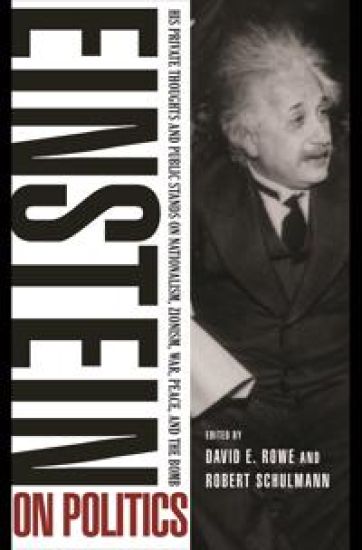
The most famous scientist of the twentieth century, Albert Einstein was also one of the century's most outspoken political activists. Deeply engaged with the events of his tumultuous times, from the two world wars and the Holocaust, to the atomic bomb and the Cold War, to the effort to establish a Jewish homeland, Einstein was a remarkably prolific political writer, someone who took courageous and often unpopular stands against nationalism, militarism, anti-Semitism, racism, and McCarthyism. In Einstein on Politics, leading Einstein scholars David Rowe and Robert Schulmann gather Einstein's most important public and private political writings and put them into historical context. The book reveals a little-known Einstein--not the ineffectual and naive idealist of popular imagination, but a principled, shrewd pragmatist whose stands on political issues reflected the depth of his humanity. Nothing encapsulates Einstein's profound involvement in twentieth-century politics like the atomic bomb. Here we read the former militant pacifist's 1939 letter to President Franklin D. Roosevelt warning that Germany might try to develop an atomic bomb. But the book also documents how Einstein tried to explain this action to Japanese pacifists after the United States used atomic weapons to destroy Hiroshima and Nagasaki, events that spurred Einstein to call for international control of nuclear technology. A vivid firsthand view of how one of the twentieth century's greatest minds responded to the greatest political challenges of his day, Einstein on Politics will forever change our picture of Einstein's public activism and private motivations.
Albert Einstein, The Human Side
Albert Einstein; Ze’ev Rosenkranz
Princeton University Press
2013
pokkari
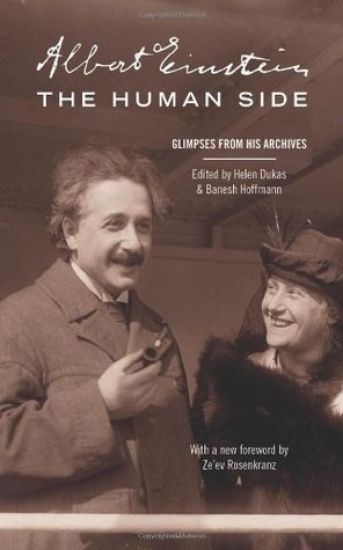
Modesty, humor, compassion, and wisdom are the traits most evident in this illuminating selection of personal papers from the Albert Einstein Archives. The illustrious physicist wrote as thoughtfully to an Ohio fifth-grader, distressed by her discovery that scientists classify humans as animals, as to a Colorado banker who asked whether Einstein believed in a personal God. Witty rhymes, an exchange with Queen Elizabeth of Belgium about fine music, and expressions of his devotion to Zionism are but some of the highlights found in this warm and enriching book.
Spinoza: Portrait of a Spiritual Hero
Rudolf Kayser; Albert Einstein
Literary Licensing, LLC
2013
nidottu
Spinoza: Portrait of a Spiritual Hero
Rudolf Kayser; Albert Einstein
Literary Licensing, LLC
2013
sidottu
The Ultimate Quotable Einstein
Albert Einstein; Freeman Dyson
Princeton University Press
2013
pokkari
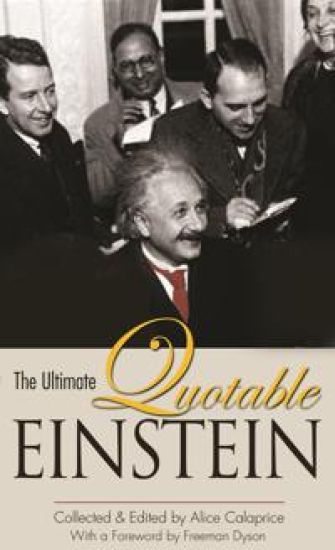
This is the definitive edition of the hugely popular collection of Einstein quotations that has sold tens of thousands of copies worldwide and been translated into twenty-five languages. The Ultimate Quotable Einstein features roughly 1,600 quotes in all. This paperback edition includes sections unique to the ultimate collection--"On and to Children," "On Race and Prejudice," and "Einstein's Verses: A Small Selection"--as well as a chronology of Einstein's life and accomplishments, Freeman Dyson's authoritative foreword, and commentary and descriptive source notes by Alice Calaprice.
Time magazine's "Man of the Century", Albert Einstein is the founder of modern physics and his theory of relativity is the most important scientific idea of the modern era. In this short book, Einstein explains, using the minimum of mathematical terms, the basic ideas and principles of the theory that has shaped the world we live in today. Unsurpassed by any subsequent books on relativity, this remains the most popular and useful exposition of Einstein's immense contribution to human knowledge. With a new foreword by Derek Raine.