Kirjojen hintavertailu – 12 859 826 kirjaa ja 27 kauppaa

Kirjailija

Albert Einstein

Kirjat ja teokset yhdessä paikassa: 251 kirjaa, julkaisuja vuosilta 1916–2026, suosituimpiin kuuluu New Evidence of the Militarization of America. Vertaile teosten hintoja ja tarkista saatavuus suomalaisista kirjakaupoista.

251 kirjaa

Kirjojen julkaisuvuodet: 1916–2026.

New Evidence of the Militarization of America

New Evidence of the Militarization of America

Pearl S. Buck; Louis Bromfield; Albert Einstein

Literary Licensing, LLC
2013
sidottu
""New Evidence of the Militarization of America"" by Pearl S. Buck is a book that explores the growing trend of militarization in the United States. The author provides evidence of the increasing use of military force by the government, including the expansion of military bases, the development of new weapons, and the growing presence of military personnel in domestic law enforcement. Buck argues that this trend is a threat to American democracy and civil liberties, and calls for greater public awareness and action to address the issue. The book is well-researched and provides a comprehensive analysis of the topic, drawing on a range of sources and perspectives. It is a timely and important contribution to the ongoing debate about the role of the military in American society. Additional Authors Include W. J. Millor, Victor Reuther, Ray Lyman Wilbur And Others. This scarce antiquarian book is a facsimile reprint of the old original and may contain some imperfections such as library marks and notations. Because we believe this work is culturally important, we have made it available as part of our commitment for protecting, preserving, and promoting the world's literature in affordable, high quality, modern editions, that are true to their original work.

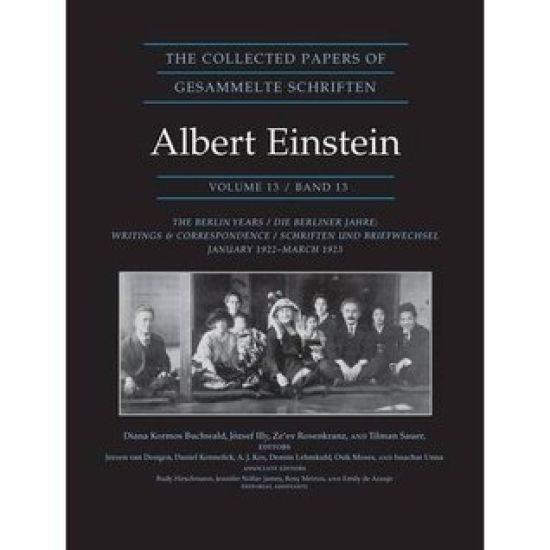
The Collected Papers of Albert Einstein, Volume 13

The Collected Papers of Albert Einstein, Volume 13

Albert Einstein

Princeton University Press
2012
sidottu
In April 1922, we find Einstein lecturing in Paris, engaged in reestablishing ties among scientists in former enemy nations. Meanwhile, back in Berlin, political tensions are rising. In June, the brutal murder of his friend, Germany's foreign minister, Walther Rathenau, heavily affects Einstein who, for a while, fears for his own safety and briefly contemplates leaving Berlin and abandoning academic life altogether. When only a few months later it is announced that he will be awarded the Nobel Prize, after more than a decade of nominations, Einstein is on a steamer heading from Europe to Japan. As we learn in this volume, although he knew in advance of the coming prize, he nevertheless embarked on his longest voyage yet. His travel diary, published here for the first time, recounts in poetic prose the hectic schedule on land, the contemplative rest at sea, and his musings on science, philosophy, and art during his first encounter with the Far East, Palestine, and Spain. Einstein's work and intense scientific exchanges--with N. Bohr, P. Ehrenfest, A. Sommerfeld, M. Born, and others--during these fifteen months result in remarkable publications and intellectual developments. A paper written with Ehrenfest shows with uncompromising clarity that the outcome of the recent Stern-Gerlach experiment could not be explained by either classical or quantum theory. In a similar vein, he analyzes the phenomenon of superconductivity. Clearly among the leading quantum theorists, he focuses on its conceptual bases, tirelessly proposing crucial experiments that could decide between classical and quantum physics. We also see foundational interests develop in his concerns with a unified field theory of electromagnetism and gravitation. A translation of selected non-English texts included in Volume 13 is available in paperback at http://press.princeton.edu/titles/9874.html
The Collected Papers of Albert Einstein, Volume 13

The Collected Papers of Albert Einstein, Volume 13

Albert Einstein

Princeton University Press
2012
pokkari
A translation of selected non-English texts included in Volume 13 is available in paperback. Since this supplementary paperback includes only select portions of Volume 13, it is not recommended for purchase without the main volume. Every document in The Collected Papers of Albert Einstein appears in the language in which it was written, and this supplementary paperback volume presents the English translations of select portions of non-English materials in Volume 13. This translation does not include notes or annotation of the documentary volume and is not intended for use without the original language documentary edition which provides the extensive editorial commentary necessary for a full historical and scientific understanding of the documents.
Über die spezielle und die allgemeine Relativitätstheorie

Über die spezielle und die allgemeine Relativitätstheorie

Albert Einstein

Springer-Verlag Berlin and Heidelberg GmbH Co. K
2012
nidottu
„Das vorliegende Büchlein soll solchen eine möglichst exakte Einsicht in die Relativitätstheorie vermitteln, die sich vom allgemein wissenschaftlichen, philosophischen Standpunkt für die Theorie interessieren, ohne den mathematischen Apparat der theoretischen Physik zu beherrschen. Die Lektüre setzt etwa Maturitätsbildung und - trotz der Kürze des Büchleins - ziemlich viel Geduld und Willenskraft beim Leser voraus. Der Verfasser hat sich die größte Mühe gegeben, die Hauptgedanken möglichst deutlich und einfach vorzubringen, im ganzen in solcher Reihenfolge und in solchem Zusammenhange, wie sie tatsächlich entstanden sind. Im Interesse der Deutlichkeit erschien es mir unvermeidlich, mich oft zu wiederholen, ohne auf die Eleganz der Darstellung die geringste Rücksicht zu nehmen; ich hielt mich gewissenhaft an die Vorschrift des genialen Theoretikers L. Boltzmann, man solle die Eleganz Sache der Schneider und Schuster sein lassen.“ Albert Einstein (Aus dem Vorwort)
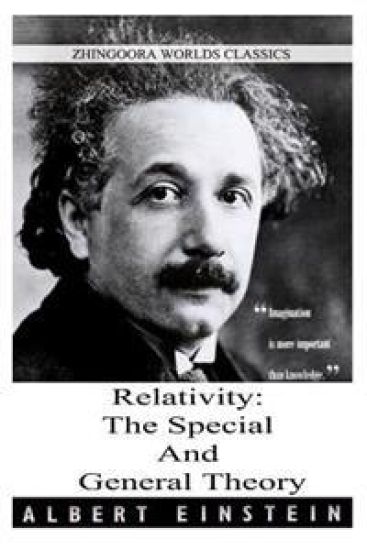
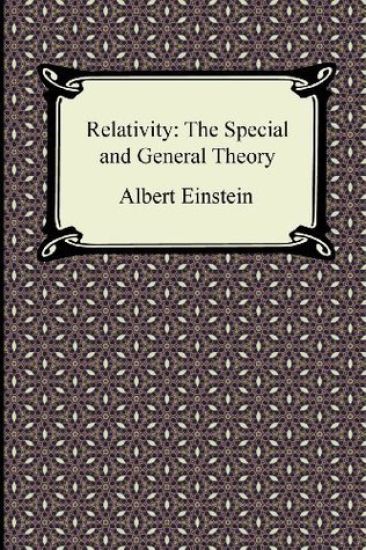
Relativity: The Special And General Theory

Relativity: The Special And General Theory

Albert Einstein

Createspace Independent Publishing Platform
2012
nidottu
CONTENTS Preface Part I: The Special Theory of Relativity 01. Physical Meaning of Geometrical Propositions 02. The System of Co-ordinates 03. Space and Time in Classical Mechanics 04. The Galileian System of Co-ordinates 05. The Principle of Relativity (in the Restricted Sense) 06. The Theorem of the Addition of Velocities employed in Classical Mechanics 07. The Apparent Incompatability of the Law of Propagation of Light with the Principle of Relativity 08. On the Idea of Time in Physics 09. The Relativity of Simultaneity 10. On the Relativity of the Conception of Distance 11. The Lorentz Transformation 12. The Behaviour of Measuring-Rods and Clocks in Motion 13. Theorem of the Addition of Velocities. The Experiment of Fizeau 14. The Hueristic Value of the Theory of Relativity 15. General Results of the Theory 16. Expereince and the Special Theory of Relativity 17. Minkowski's Four-dimensial Space Part II: The General Theory of Relativity 18. Special and General Principle of Relativity 19. The Gravitational Field 20. The Equality of Inertial and Gravitational Mass as an Argument for the General Postulate of Relativity 21. In What Respects are the Foundations of Classical Mechanics and of the Special Theory of Relativity Unsatisfactory? 22. A Few Inferences from the General Principle of Relativity 23. Behaviour of Clocks and Measuring-Rods on a Rotating Body of Reference 24. Euclidean and non-Euclidean Continuum 25. Gaussian Co-ordinates 26. The Space-Time Continuum of the Speical Theory of Relativity Considered as a Euclidean Continuum 27. The Space-Time Continuum of the General Theory of Relativity is Not a Eculidean Continuum 28. Exact Formulation of the General Principle of Relativity 29. The Solution of the Problem of Gravitation on the Basis of the General Principle of Relativity Part III: Considerations on the Universe as a Whole 30. Cosmological Difficulties of Netwon's Theory 31. The Possibility of a "Finite" and yet "Unbounded" Universe 32. The Structure of Space According to the General Theory of Relativity Appendices: 01. Simple Derivation of the Lorentz Transformation (sup. ch. 11) 02. Minkowski's Four-Dimensional Space ("World") (sup. ch 17) 03. The Experimental Confirmation of the General Theory of Relativity 04. The Structure of Space According to the General Theory of Relativity (sup. ch 32) 05. Relativity and the Problem of Space
Relativity: A Richer Truth

Relativity: A Richer Truth

Philipp Frank; Albert Einstein

Literary Licensing, LLC
2012
sidottu
Relativity: A Richer Truth is a book written by Philipp Frank that explores the fundamental principles of Albert Einstein's theory of relativity. The book is a comprehensive guide that delves into the history and development of the theory, explaining the complex concepts and ideas in a clear and concise manner. The book is divided into two parts, with the first part focusing on the historical background of relativity and the second part delving into the mathematical and physical principles that underlie the theory. The author provides a detailed account of Einstein's life and work, tracing the evolution of his ideas and the scientific and philosophical debates that surrounded them. The second part of the book explores the mathematical and physical principles that form the foundation of relativity. The author explains the concepts of space-time, the equivalence principle, and the nature of gravity, among others, in a way that is accessible to readers with no prior knowledge of physics. In addition to providing a clear and comprehensive introduction to relativity, the book also highlights the broader implications of the theory for our understanding of the universe and our place within it. The author discusses the philosophical and cultural implications of relativity, exploring its impact on our concepts of time, space, and reality. Overall, Relativity: A Richer Truth is an engaging and informative book that offers readers a deeper understanding of one of the most important scientific theories of the modern era. It is a must-read for anyone interested in the history of science, physics, or the philosophical implications of relativity. This scarce antiquarian book is a facsimile reprint of the old original and may contain some imperfections such as library marks and notations. Because we believe this work is culturally important, we have made it available as part of our commitment for protecting, preserving, and promoting the world's literature in affordable, high quality, modern editions, that are true to their original work.