Kirjojen hintavertailu – 12 859 819 kirjaa ja 27 kauppaa

Kirjailija

Alexander J. Zaslavski

Kirjat ja teokset yhdessä paikassa: 49 kirjaa, julkaisuja vuosilta 2005–2026, suosituimpiin kuuluu Fixed Point Problems With Infinitely Many Operators. Vertaile teosten hintoja ja tarkista saatavuus suomalaisista kirjakaupoista.

Nimi esiintyy myös muodoissa: Alexander J Zaslavski

49 kirjaa

Kirjojen julkaisuvuodet: 2005–2026.

Solutions of Fixed Point Problems with Computational Errors

Solutions of Fixed Point Problems with Computational Errors

Alexander J. Zaslavski

Springer International Publishing AG
2025
nidottu
The book is devoted to the study of approximate solutions of fixed point problems in the presence of computational errors. It begins with a study of approximate solutions of star-shaped feasibility problems in the presence of perturbations. The goal is to show the convergence of algorithms, which are known as important tools for solving convex feasibility problems and common fixed point problems. The text also presents studies of algorithms based on unions of nonexpansive maps, inconsistent convex feasibility problems, and split common fixed point problems. A number of algorithms are considered for solving convex feasibility problems and common fixed point problems. The book will be of interest for researchers and engineers working in optimization, numerical analysis, and fixed point theory. It also can be useful in preparation courses for graduate students. The main feature of the book which appeals specifically to this audience is the study of the influence of computational errorsfor several important algorithms used for nonconvex feasibility problems.
The Krasnoselskii-Mann Method for Common Fixed Point Problems

The Krasnoselskii-Mann Method for Common Fixed Point Problems

Alexander J. Zaslavski

Springer International Publishing AG
2025
nidottu
This book delves into the intricate world of fixed point theory, focusing on the Krasnoselskii-Mann method to tackle common fixed point problems within a finite family of quasi-nonexpansive mappings in hyperbolic metric spaces. By exploring various iterative algorithms, including the Cimmino algorithm and dynamic string-averaging methods, this volume offers a comprehensive study of convergence and approximate solutions amidst computational errors. Key concepts such as W-hyperbolic spaces, convex combinations, and set-valued inclusions are meticulously examined. The author presents a detailed analysis of iterative methods, highlighting their effectiveness in solving complex fixed-point problems. Readers will encounter critical discussions on the behavior of exact and inexact iterates, the role of computational errors, and innovative approaches like remotest set control. This book invites readers to engage with challenging questions about convergence and solution accuracy in mathematical spaces. Ideal for researchers and scholars in mathematics and related fields, this book provides valuable insights into advanced iterative methods for solving fixed-point problems. Whether you are a mathematician specializing in nonlinear analysis or an academic exploring optimization theory, this volume is an essential resource for understanding the latest developments in fixed point theory.
Approximate Fixed Points of Nonexpansive Mappings

Approximate Fixed Points of Nonexpansive Mappings

Alexander J. Zaslavski

Springer International Publishing AG
2024
sidottu
Fixed point theory of nonlinear operators has been a rapidly growing area of research and plays an important role in the study of variational inequalities, monotone operators, feasibility problems, and optimization theory, to name just several. This book discusses iteration processes associated with a given nonlinear mapping which generate its approximate fixed point and in some cases converge to a fixed point of the mapping. Various classes of nonlinear single-valued and set-valued mappings are considered along with iteration processes under the presence of computational errors. Of particular interest to mathematicians working in fixed point theory and nonlinear analysis, the added value for the reader are the solutions presented to a number of difficult problems in the fixed point theory which have important applications.
Turnpike Phenomenon in Metric Spaces

Turnpike Phenomenon in Metric Spaces

Alexander J. Zaslavski

Springer International Publishing AG
2024
nidottu
This book is devoted to the study of the turnpike phenomenon arising in optimal control theory. Special focus is placed on Turnpike results, in sufficient and necessary conditions for the turnpike phenomenon and in its stability under small perturbations of objective functions. The most important feature of this book is that it develops a large, general class of optimal control problems in metric space. Additional value is in the provision of solutions to a number of difficult and interesting problems in optimal control theory in metric spaces. Mathematicians working in optimal control, optimization, and experts in applications of optimal control to economics and engineering, will find this book particularly useful. All main results obtained in the book are new. The monograph contains nine chapters. Chapter 1 is an introduction. Chapter 2 discusses Banach space valued functions, set-valued mappings in infinite dimensional spaces, and related continuous-time dynamical systems. Some convergence results are obtained. In Chapter 3, a discrete-time dynamical system with a Lyapunov function in a metric space induced by a set-valued mapping, is studied. Chapter 4 is devoted to the study of a class of continuous-time dynamical systems, an analog of the class of discrete-time dynamical systems considered in Chapter 3. Chapter 5 develops a turnpike theory for a class of general dynamical systems in a metric space with a Lyapunov function. Chapter 6 contains a study of the turnpike phenomenon for discrete-time nonautonomous problems on subintervals of half-axis in metric spaces, which are not necessarily compact. Chapter 7 contains preliminaries which are needed in order to study turnpike properties of infinite-dimensional optimal control problems. In Chapter 8, sufficient and necessary conditions for the turnpike phenomenon for continuous-time optimal control problems on subintervals of the half-axis in metric spaces, is established. In Chapter 9, the examination continues of the turnpike phenomenon for the continuous-time optimal control problems on subintervals of half-axis in metric spaces discussed in Chapter 8.
Solutions of Fixed Point Problems with Computational Errors

Solutions of Fixed Point Problems with Computational Errors

Alexander J. Zaslavski

Springer International Publishing AG
2024
sidottu
The book is devoted to the study of approximate solutions of fixed point problems in the presence of computational errors. It begins with a study of approximate solutions of star-shaped feasibility problems in the presence of perturbations. The goal is to show the convergence of algorithms, which are known as important tools for solving convex feasibility problems and common fixed point problems. The text also presents studies of algorithms based on unions of nonexpansive maps, inconsistent convex feasibility problems, and split common fixed point problems. A number of algorithms are considered for solving convex feasibility problems and common fixed point problems. The book will be of interest for researchers and engineers working in optimization, numerical analysis, and fixed point theory. It also can be useful in preparation courses for graduate students. The main feature of the book which appeals specifically to this audience is the study of the influence of computational errorsfor several important algorithms used for nonconvex feasibility problems.
Optimal Control Problems Arising in Mathematical Economics

Optimal Control Problems Arising in Mathematical Economics

Alexander J. Zaslavski

SPRINGER VERLAG, SINGAPORE
2023
nidottu
This book is devoted to the study of two large classes of discrete-time optimal control problems arising in mathematical economics. Nonautonomous optimal control problems of the first class are determined by a sequence of objective functions and sequence of constraint maps. They correspond to a general model of economic growth. We are interested in turnpike properties of approximate solutions and in the stability of the turnpike phenomenon under small perturbations of objective functions and constraint maps. The second class of autonomous optimal control problems corresponds to another general class of models of economic dynamics which includes the Robinson–Solow–Srinivasan model as a particular case. In Chap. 1 we discuss turnpike properties for a large class of discrete-time optimal control problems studied in the literature and for the Robinson–Solow–Srinivasan model. In Chap. 2 we introduce the first class of optimal control problems and study its turnpike property. This class of problems is also discussed in Chaps. 3–6. In Chap. 3 we study the stability of the turnpike phenomenon under small perturbations of the objective functions. Analogous results for problems with discounting are considered in Chap. 4. In Chap. 5 we study the stability of the turnpike phenomenon under small perturbations of the objective functions and the constraint maps. Analogous results for problems with discounting are established in Chap. 6. The results of Chaps. 5 and 6 are new. The second class of problems is studied in Chaps. 7–9. In Chap. 7 we study the turnpike properties. The stability of the turnpike phenomenon under small perturbations of the objective functions is established in Chap. 8. In Chap. 9 we establish the stability of the turnpike phenomenon under small perturbations of the objective functions and the constraint maps. The results of Chaps. 8 and 9 are new. In Chap. 10 we study optimal control problems related to a model of knowledge-based endogenous economic growth and show the existence of trajectories of unbounded economic growth and provide estimates for the growth rate.
Turnpike Phenomenon in Metric Spaces

Turnpike Phenomenon in Metric Spaces

Alexander J. Zaslavski

Springer International Publishing AG
2023
sidottu
This book is devoted to the study of the turnpike phenomenon arising in optimal control theory. Special focus is placed on Turnpike results, in sufficient and necessary conditions for the turnpike phenomenon and in its stability under small perturbations of objective functions. The most important feature of this book is that it develops a large, general class of optimal control problems in metric space. Additional value is in the provision of solutions to a number of difficult and interesting problems in optimal control theory in metric spaces. Mathematicians working in optimal control, optimization, and experts in applications of optimal control to economics and engineering, will find this book particularly useful. All main results obtained in the book are new. The monograph contains nine chapters. Chapter 1 is an introduction. Chapter 2 discusses Banach space valued functions, set-valued mappings in infinite dimensional spaces, and related continuous-time dynamical systems. Some convergence results are obtained. In Chapter 3, a discrete-time dynamical system with a Lyapunov function in a metric space induced by a set-valued mapping, is studied. Chapter 4 is devoted to the study of a class of continuous-time dynamical systems, an analog of the class of discrete-time dynamical systems considered in Chapter 3. Chapter 5 develops a turnpike theory for a class of general dynamical systems in a metric space with a Lyapunov function. Chapter 6 contains a study of the turnpike phenomenon for discrete-time nonautonomous problems on subintervals of half-axis in metric spaces, which are not necessarily compact. Chapter 7 contains preliminaries which are needed in order to study turnpike properties of infinite-dimensional optimal control problems. In Chapter 8, sufficient and necessary conditions for the turnpike phenomenon for continuous-time optimal control problems on subintervals of the half-axis in metric spaces, is established. In Chapter 9, the examination continues of the turnpike phenomenon for the continuous-time optimal control problems on subintervals of half-axis in metric spaces discussed in Chapter 8.
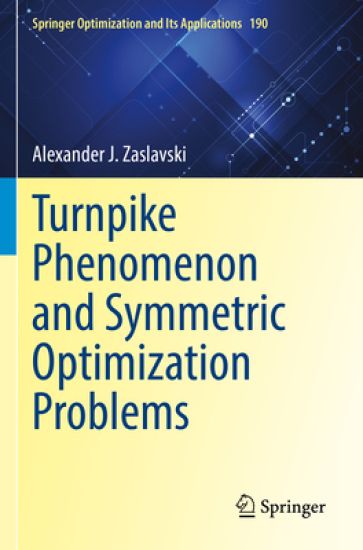
Turnpike Phenomenon and Symmetric Optimization  Problems

Turnpike Phenomenon and Symmetric Optimization Problems

Alexander J. Zaslavski

Springer Nature Switzerland AG
2023
nidottu
Written by a leading expert in turnpike phenomenon, this book is devoted to the study of symmetric optimization, variational and optimal control problems in infinite dimensional spaces and turnpike properties of their approximate solutions. The book presents a systematic and comprehensive study of general classes of problems in optimization, calculus of variations, and optimal control with symmetric structures from the viewpoint of the turnpike phenomenon. The author establishes generic existence and well-posedness results for optimization problems and individual (not generic) turnpike results for variational and optimal control problems. Rich in impressive theoretical results, the author presents applications to crystallography and discrete dispersive dynamical systems which have prototypes in economic growth theory. This book will be useful for researchers interested in optimal control, calculus of variations turnpike theory and their applications, suchas mathematicians, mathematical economists, and researchers in crystallography, to name just a few.
Optimization in Banach Spaces

Optimization in Banach Spaces

Alexander J. Zaslavski

Springer International Publishing AG
2022
nidottu
The book is devoted to the study of constrained minimization problems on closed and convex sets in Banach spaces with a Frechet differentiable objective function. Such problems are well studied in a finite-dimensional space and in an infinite-dimensional Hilbert space. When the space is Hilbert there are many algorithms for solving optimization problems including the gradient projection algorithm which is one of the most important tools in the optimization theory, nonlinear analysis and their applications. An optimization problem is described by an objective function and a set of feasible points. For the gradient projection algorithm each iteration consists of two steps. The first step is a calculation of a gradient of the objective function while in the second one we calculate a projection on the feasible set. In each of these two steps there is a computational error. In our recent research we show that the gradient projection algorithm generates a good approximate solution, if all the computational errors are bounded from above by a small positive constant. It should be mentioned that the properties of a Hilbert space play an important role. When we consider an optimization problem in a general Banach space the situation becomes more difficult and less understood. On the other hand such problems arise in the approximation theory. The book is of interest for mathematicians working in optimization. It also can be useful in preparation courses for graduate students. The main feature of the book which appeals specifically to this audience is the study of algorithms for convex and nonconvex minimization problems in a general Banach space. The book is of interest for experts in applications of optimization to the approximation theory. In this book the goal is to obtain a good approximate solution of the constrained optimization problem in a general Banach space under the presence of computational errors. It is shown that the algorithm generates a good approximate solution, if the sequence of computational errors is bounded from above by a small constant. The book consists of four chapters. In the first we discuss several algorithms which are studied in the book and prove a convergence result for an unconstrained problem which is a prototype of our results for the constrained problem. In Chapter 2 we analyze convex optimization problems. Nonconvex optimization problems are studied in Chapter 3. In Chapter 4 we study continuous algorithms for minimization problems under the presence of computational errors. The algorithm generates a good approximate solution, if the sequence of computational errors is bounded from above by a small constant. The book consists of four chapters. In the first we discuss several algorithms which are studied in the book and prove a convergence result for an unconstrained problemwhich is a prototype of our results for the constrained problem. In Chapter 2 we analyze convex optimization problems. Nonconvex optimization problems are studied in Chapter 3. In Chapter 4 we study continuous algorithms for minimization problems under the presence of computational errors.
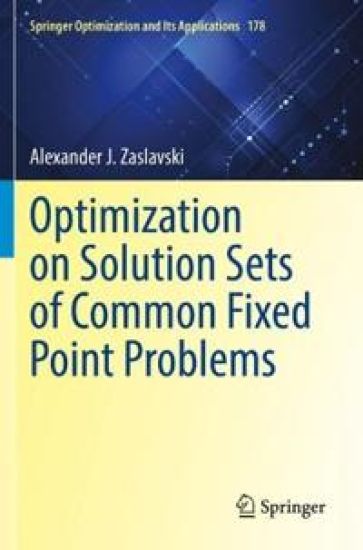
Optimization on Solution Sets of Common Fixed Point Problems

Optimization on Solution Sets of Common Fixed Point Problems

Alexander J. Zaslavski

Springer Nature Switzerland AG
2022
nidottu
This book is devoted to a detailed study of the subgradient projection method and its variants for convex optimization problems over the solution sets of common fixed point problems and convex feasibility problems. These optimization problems are investigated to determine good solutions obtained by different versions of the subgradient projection algorithm in the presence of sufficiently small computational errors. The use of selected algorithms is highlighted including the Cimmino type subgradient, the iterative subgradient, and the dynamic string-averaging subgradient. All results presented are new. Optimization problems where the underlying constraints are the solution sets of other problems, frequently occur in applied mathematics. The reader should not miss the section in Chapter 1 which considers some examples arising in the real world applications. The problems discussed have an important impact in optimization theory as well. The book will be useful for researches interested in the optimization theory and its applications.
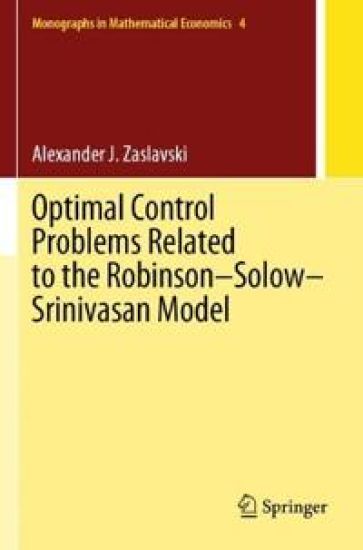
Optimal Control Problems Related to the Robinson–Solow–Srinivasan Model
This book is devoted to the study of classes of optimal control problems arising in economic growth theory, related to the Robinson–Solow–Srinivasan (RSS) model. The model was introduced in the 1960s by economists Joan Robinson, Robert Solow, and Thirukodikaval Nilakanta Srinivasan and was further studied by Robinson, Nobuo Okishio, and Joseph Stiglitz. Since then, the study of the RSS model has become an important element of economic dynamics. In this book, two large general classes of optimal control problems, both of them containing the RSS model as a particular case, are presented for study. For these two classes, a turnpike theory is developed and the existence of solutions to the corresponding infinite horizon optimal control problems is established. The book contains 9 chapters. Chapter 1 discusses turnpike properties for some optimal control problems that are known in the literature, including problems corresponding to the RSS model. The first class of optimal control problems is studied in Chaps. 2–6. In Chap. 2, infinite horizon optimal control problems with nonautonomous optimality criteria are considered. The utility functions, which determine the optimality criterion, are nonconcave. This class of models contains the RSS model as a particular case. The stability of the turnpike phenomenon of the one-dimensional nonautonomous concave RSS model is analyzed in Chap. 3. The following chapter takes up the study of a class of autonomous nonconcave optimal control problems, a subclass of problems considered in Chap. 2. The equivalence of the turnpike property and the asymptotic turnpike property, as well as the stability of the turnpike phenomenon, is established. Turnpike conditions and the stability of the turnpike phenomenon for nonautonomous problems are examined in Chap. 5, with Chap. 6 devoted to the study of the turnpike properties for the one-dimensional nonautonomous nonconcave RSS model. The utility functions, which determine the optimality criterion, are nonconcave. The class of RSS models is identified with a complete metric space of utility functions. Using the Baire category approach, the turnpike phenomenon is shown to hold for most of the models. Chapter 7 begins the study of the second large class of autonomous optimal control problems, and turnpike conditions are established. The stability of the turnpike phenomenon for this class of problems is investigated further in Chaps. 8 and 9.

Optimal Control Problems Arising in Mathematical Economics

Optimal Control Problems Arising in Mathematical Economics

Alexander J. Zaslavski

SPRINGER VERLAG, SINGAPORE
2022
sidottu
This book is devoted to the study of two large classes of discrete-time optimal control problems arising in mathematical economics. Nonautonomous optimal control problems of the first class are determined by a sequence of objective functions and sequence of constraint maps. They correspond to a general model of economic growth. We are interested in turnpike properties of approximate solutions and in the stability of the turnpike phenomenon under small perturbations of objective functions and constraint maps. The second class of autonomous optimal control problems corresponds to another general class of models of economic dynamics which includes the Robinson–Solow–Srinivasan model as a particular case. In Chap. 1 we discuss turnpike properties for a large class of discrete-time optimal control problems studied in the literature and for the Robinson–Solow–Srinivasan model. In Chap. 2 we introduce the first class of optimal control problems and study its turnpike property. This class of problems is also discussed in Chaps. 3–6. In Chap. 3 we study the stability of the turnpike phenomenon under small perturbations of the objective functions. Analogous results for problems with discounting are considered in Chap. 4. In Chap. 5 we study the stability of the turnpike phenomenon under small perturbations of the objective functions and the constraint maps. Analogous results for problems with discounting are established in Chap. 6. The results of Chaps. 5 and 6 are new. The second class of problems is studied in Chaps. 7–9. In Chap. 7 we study the turnpike properties. The stability of the turnpike phenomenon under small perturbations of the objective functions is established in Chap. 8. In Chap. 9 we establish the stability of the turnpike phenomenon under small perturbations of the objective functions and the constraint maps. The results of Chaps. 8 and 9 are new. In Chap. 10 we study optimal control problems related to a model of knowledge-based endogenous economic growth and show the existence of trajectories of unbounded economic growth and provide estimates for the growth rate.
Turnpike Phenomenon and Symmetric Optimization  Problems

Turnpike Phenomenon and Symmetric Optimization Problems

Alexander J. Zaslavski

Springer Nature Switzerland AG
2022
sidottu
Written by a leading expert in turnpike phenomenon, this book is devoted to the study of symmetric optimization, variational and optimal control problems in infinite dimensional spaces and turnpike properties of their approximate solutions. The book presents a systematic and comprehensive study of general classes of problems in optimization, calculus of variations, and optimal control with symmetric structures from the viewpoint of the turnpike phenomenon. The author establishes generic existence and well-posedness results for optimization problems and individual (not generic) turnpike results for variational and optimal control problems. Rich in impressive theoretical results, the author presents applications to crystallography and discrete dispersive dynamical systems which have prototypes in economic growth theory. This book will be useful for researchers interested in optimal control, calculus of variations turnpike theory and their applications, suchas mathematicians, mathematical economists, and researchers in crystallography, to name just a few.
Turnpike Theory for the Robinson–Solow–Srinivasan Model

Turnpike Theory for the Robinson–Solow–Srinivasan Model

Alexander J. Zaslavski

Springer Nature Switzerland AG
2022
nidottu
This book is devoted to the study of a class of optimal control problems arising in mathematical economics, related to the Robinson–Solow–Srinivasan (RSS) model. It will be useful for researches interested in the turnpike theory, infinite horizon optimal control and their applications, and mathematical economists. The RSS is a well-known model of economic dynamics that was introduced in the 1960s and as many other models of economic dynamics, the RSS model is determined by an objective function (a utility function) and a set-valued mapping (a technology map). The set-valued map generates a dynamical system whose trajectories are under consideration and the objective function determines an optimality criterion. The goal is to find optimal trajectories of the dynamical system, using the optimality criterion. Chapter 1 discusses turnpike properties for some classes of discrete time optimal control problems. Chapter 2 present the description of the RSS model and discuss its basic properties. Infinite horizon optimal control problems, related to the RSS model are studied in Chapter 3. Turnpike properties for the RSS model are analyzed in Chapter 4. Chapter 5 studies infinite horizon optimal control problems related to the RSS model with a nonconcave utility function. Chapter 6 focuses on infinite horizon optimal control problems with nonautonomous optimality criterions. Chapter 7 contains turnpike results for a class of discrete-time optimal control problems. Chapter 8 discusses the RSS model and compares different optimality criterions. Chapter 9 is devoted to the study of the turnpike properties for the RSS model. In Chapter 10 the one-dimensional autonomous RSS model is considered and the continuous time RSS model is studied in Chapter 11.
Optimization on Solution Sets of Common Fixed Point Problems

Optimization on Solution Sets of Common Fixed Point Problems

Alexander J. Zaslavski

Springer Nature Switzerland AG
2021
sidottu
This book is devoted to a detailed study of the subgradient projection method and its variants for convex optimization problems over the solution sets of common fixed point problems and convex feasibility problems. These optimization problems are investigated to determine good solutions obtained by different versions of the subgradient projection algorithm in the presence of sufficiently small computational errors. The use of selected algorithms is highlighted including the Cimmino type subgradient, the iterative subgradient, and the dynamic string-averaging subgradient. All results presented are new. Optimization problems where the underlying constraints are the solution sets of other problems, frequently occur in applied mathematics. The reader should not miss the section in Chapter 1 which considers some examples arising in the real world applications. The problems discussed have an important impact in optimization theory as well. The book will be useful for researches interested in the optimization theory and its applications.
Optimal Control Problems Related to the Robinson–Solow–Srinivasan Model
This book is devoted to the study of classes of optimal control problems arising in economic growth theory, related to the Robinson–Solow–Srinivasan (RSS) model. The model was introduced in the 1960s by economists Joan Robinson, Robert Solow, and Thirukodikaval Nilakanta Srinivasan and was further studied by Robinson, Nobuo Okishio, and Joseph Stiglitz. Since then, the study of the RSS model has become an important element of economic dynamics. In this book, two large general classes of optimal control problems, both of them containing the RSS model as a particular case, are presented for study. For these two classes, a turnpike theory is developed and the existence of solutions to the corresponding infinite horizon optimal control problems is established. The book contains 9 chapters. Chapter 1 discusses turnpike properties for some optimal control problems that are known in the literature, including problems corresponding to the RSS model. The first class of optimal control problems is studied in Chaps. 2–6. In Chap. 2, infinite horizon optimal control problems with nonautonomous optimality criteria are considered. The utility functions, which determine the optimality criterion, are nonconcave. This class of models contains the RSS model as a particular case. The stability of the turnpike phenomenon of the one-dimensional nonautonomous concave RSS model is analyzed in Chap. 3. The following chapter takes up the study of a class of autonomous nonconcave optimal control problems, a subclass of problems considered in Chap. 2. The equivalence of the turnpike property and the asymptotic turnpike property, as well as the stability of the turnpike phenomenon, is established. Turnpike conditions and the stability of the turnpike phenomenon for nonautonomous problems are examined in Chap. 5, with Chap. 6 devoted to the study of the turnpike properties for the one-dimensional nonautonomous nonconcave RSS model. The utility functions, which determine the optimality criterion, are nonconcave. The class of RSS models is identified with a complete metric space of utility functions. Using the Baire category approach, the turnpike phenomenon is shown to hold for most of the models. Chapter 7 begins the study of the second large class of autonomous optimal control problems, and turnpike conditions are established. The stability of the turnpike phenomenon for this class of problems is investigated further in Chaps. 8 and 9.
Convex Optimization with Computational Errors

Convex Optimization with Computational Errors

Alexander J. Zaslavski

Springer Nature Switzerland AG
2021
nidottu
The book is devoted to the study of approximate solutions of optimization problems in the presence of computational errors. It contains a number of results on the convergence behavior of algorithms in a Hilbert space, which are known as important tools for solving optimization problems. The research presented in the book is the continuation and the further development of the author's (c) 2016 book Numerical Optimization with Computational Errors, Springer 2016. Both books study the algorithms taking into account computational errors which are always present in practice. The main goal is, for a known computational error, to find out what an approximate solution can be obtained and how many iterates one needs for this. The main difference between this new book and the 2016 book is that in this present book the discussion takes into consideration the fact that for every algorithm, its iteration consists of several steps and that computational errors for different steps are generally, different. This fact, which was not taken into account in the previous book, is indeed important in practice. For example, the subgradient projection algorithm consists of two steps. The first step is a calculation of a subgradient of the objective function while in the second one we calculate a projection on the feasible set. In each of these two steps there is a computational error and these two computational errors are different in general. It may happen that the feasible set is simple and the objective function is complicated. As a result, the computational error, made when one calculates the projection, is essentially smaller than the computational error of the calculation of the subgradient. Clearly, an opposite case is possible too. Another feature of this book is a study of a number of important algorithms which appeared recently in the literature and which are not discussed in the previous book. This monograph contains 12 chapters. Chapter 1 is an introduction. In Chapter 2 we study the subgradient projection algorithm for minimization of convex and nonsmooth functions. We generalize the results of [NOCE] and establish results which has no prototype in [NOCE]. In Chapter 3 we analyze the mirror descent algorithm for minimization of convex and nonsmooth functions, under the presence of computational errors. For this algorithm each iteration consists of two steps. The first step is a calculation of a subgradient of the objective function while in the second one we solve an auxiliary minimization problem on the set of feasible points. In each of these two steps there is a computational error. We generalize the results of [NOCE] and establish results which has no prototype in [NOCE]. In Chapter 4 we analyze the projected gradient algorithm with a smooth objective function under the presence of computational errors. In Chapter 5 we consider an algorithm, which is an extension of the projection gradient algorithm used for solving linear inverse problems arising in signal/image processing. In Chapter 6 we study continuous subgradient method and continuous subgradient projection algorithm for minimization of convex nonsmooth functions and for computing the saddle points of convex-concave functions, under the presence of computational errors. All the results of this chapter has no prototype in [NOCE]. In Chapters 7-12 we analyze several algorithms under the presence of computational errors which were not considered in [NOCE]. Again, each step of an iteration has a computational errors and we take into account that these errors are, in general, different. An optimization problems with a composite objective function is studied in Chapter 7. A zero-sum game with two-players is considered in Chapter 8. A predicted decrease approximation-based method is used in Chapter 9 for constrained convex optimization. Chapter 10 is devoted tominimization of quasiconvex functions. Minimization of sharp weakly convex functions is discussed in Chapter 11. Chapter 12 is devoted to a generalized projected subgradient method for minimization of a convex function over a set which is not necessarily convex. The book is of interest for researchers and engineers working in optimization. It also can be useful in preparation courses for graduate students. The main feature of the book which appeals specifically to this audience is the study of the influence of computational errors for several important optimization algorithms. The book is of interest for experts in applications of optimization to engineering and economics.
Turnpike Theory for the Robinson–Solow–Srinivasan Model

Turnpike Theory for the Robinson–Solow–Srinivasan Model

Alexander J. Zaslavski

Springer Nature Switzerland AG
2021
sidottu
This book is devoted to the study of a class of optimal control problems arising in mathematical economics, related to the Robinson–Solow–Srinivasan (RSS) model. It will be useful for researches interested in the turnpike theory, infinite horizon optimal control and their applications, and mathematical economists. The RSS is a well-known model of economic dynamics that was introduced in the 1960s and as many other models of economic dynamics, the RSS model is determined by an objective function (a utility function) and a set-valued mapping (a technology map). The set-valued map generates a dynamical system whose trajectories are under consideration and the objective function determines an optimality criterion. The goal is to find optimal trajectories of the dynamical system, using the optimality criterion. Chapter 1 discusses turnpike properties for some classes of discrete time optimal control problems. Chapter 2 present the description of the RSS model and discuss its basic properties. Infinite horizon optimal control problems, related to the RSS model are studied in Chapter 3. Turnpike properties for the RSS model are analyzed in Chapter 4. Chapter 5 studies infinite horizon optimal control problems related to the RSS model with a nonconcave utility function. Chapter 6 focuses on infinite horizon optimal control problems with nonautonomous optimality criterions. Chapter 7 contains turnpike results for a class of discrete-time optimal control problems. Chapter 8 discusses the RSS model and compares different optimality criterions. Chapter 9 is devoted to the study of the turnpike properties for the RSS model. In Chapter 10 the one-dimensional autonomous RSS model is considered and the continuous time RSS model is studied in Chapter 11.