

Kirjailija
Amitav Ghosh
Kirjat ja teokset yhdessä paikassa: 78 kirjaa, julkaisuja vuosilta 1994–2027, suosituimpiin kuuluu Ghost-Eye. Vertaile teosten hintoja ja tarkista saatavuus suomalaisista kirjakaupoista.
78 kirjaa
Kirjojen julkaisuvuodet: 1994–2027.
Named a Best Book of Fall by Vulture and Chicago Review of Books From the award-winning author of the bestselling epic Ibis trilogy comes a globetrotting, folkloric adventure novel about family and heritage Bundook. Gun. A common word, but one that turns Deen Datta's world upside down. A dealer of rare books, Deen is used to a quiet life spent indoors, but as his once-solid beliefs begin to shift, he is forced to set out on an extraordinary journey; one that takes him from India to Los Angeles and Venice via a tangled route through the memories and experiences of those he meets along the way. There is Piya, a fellow Bengali-American who sets his journey in motion; Tipu, an entrepreneurial young man who opens Deen's eyes to the realities of growing up in today's world; Rafi, with his desperate attempt to help someone in need; and Cinta, an old friend who provides the missing link in the story they are all a part of. It is a journey that will upend everything he thought he knew about himself, about the Bengali legends of his childhood, and about the world around him. Amitav Ghosh's Gun Island is a beautifully realized novel that effortlessly spans space and time. It is the story of a world on the brink, of increasing displacement and unstoppable transition. But it is also a story of hope, of a man whose faith in the world and the future is restored by two remarkable women.
A spellbinding, globe-trotting novel by the bestselling author of the Ibis trilogy
Bundook. Vapen. Ett vanligt ord, men ett som vänder upp och ner på Dean Dattas liv. Han tvingas överge sitt stillsamma liv i New York som handlare i sällsynta böcker och ge sig ut på en resa utöver det vanliga; en resa som tar honom från Indien till Los Angeles och Venedig. Öarna är berättelsen om en värld på randen till katastrof, om allt större folkförflyttningar och om ostoppbar förändring. Men det är också en berättelse om hopp, kärlek och tilltro till framtiden. "Rafflande samtidsroman", DN. "En av årets riktigt stora överraskningar", Kulturnytt. Amitav Ghosh är en flerfaldigt prisbelönad författare. Han har bland annat tidigare skrivit den hyllade Ibis-trilogin, "Ett hav av vallmo", "En flod av rök" och "En våg av eld".

The Great Derangement: Climate Change and the Unthinkable
Amitav Ghosh
Blackstone Publishing
2020
mp3 cd-levyllä
Are we deranged? The acclaimed Indian novelist Amitav Ghosh argues that future generations may well think so. How else to explain our imaginative failure in the face of global warming? In his first major book of nonfiction since In an Antique Land, Ghosh examines our inability--at the level of literature, history, and politics--to grasp the scale and violence of climate change. The extreme nature of today's climate events, Ghosh asserts, make them peculiarly resistant to contemporary modes of thinking and imagining. This is particularly true of serious literary fiction: hundred-year storms and freakish tornadoes simply feel too improbable for the novel; they are automatically consigned to other genres. In the writing of history, too, the climate crisis has sometimes led to gross simplifications; Ghosh shows that the history of the carbon economy is a tangled global story with many contradictory and counterintuitive elements. Ghosh ends by suggesting that politics, much like literature, has become a matter of personal moral reckoning rather than an arena of collective action. But to limit fiction and politics to individual moral adventure comes at a great cost. The climate crisis asks us to imagine other forms of human existence--a task to which fiction, Ghosh argues, is the best suited of all cultural forms. His book serves as a great writer's summons to confront the most urgent task of our time.
From the award-winning author of the bestselling epic Ibis trilogy comes a globetrotting, folkloric adventure novel about family and heritage. Bundook. Gun. A common word, but one that turns Deen Datta's world upside down. A dealer of rare books, Deen is used to a quiet life spent indoors, but as his once-solid beliefs begin to shift, he is forced to set out on an extraordinary journey; one that takes him from India to Los Angeles and Venice via a tangled route through the memories and experiences of those he meets along the way. There is Piya, a fellow Bengali-American who sets his journey in motion; Tipu, an entrepreneurial young man who opens Deen's eyes to the realities of growing up in today's world; Rafi, with his desperate attempt to help someone in need; and Cinta, an old friend who provides the missing link in the story they are all a part of. It is a journey that will upend everything he thought he knew about himself, about the Bengali legends of his childhood, and about the world around him. Amitav Ghosh's Gun Island is a beautifully realized novel that effortlessly spans space and time. It is the story of a world on the brink, of increasing displacement and unstoppable transition. But it is also a story of hope, of a man whose faith in the world and the future is restored by two remarkable women.






The International Bestseller from the Man Booker Prize shortlisted author'An absorbing story of a world in transition' JM Coetzee'A Doctor Zhivago for the Far East' The Independent

The Great Derangement
Amitav Ghosh
University of Chicago Press
2017
nidottu
Halvin toimitettuna 20,70 €
Are we deranged? The acclaimed Indian novelist Amitav Ghosh argues that future generations may well think so. How else to explain our imaginative failure in the face of global warming? In his first major book of nonfiction since In an Antique Land, Ghosh examines our inability--at the level of literature, history, and politics--to grasp the scale and violence of climate change. The extreme nature of today's climate events, Ghosh asserts, make them peculiarly resistant to contemporary modes of thinking and imagining. This is particularly true of serious literary fiction: hundred-year storms and freakish tornadoes simply feel too improbable for the novel; they are automatically consigned to other genres. In the writing of history, too, the climate crisis has sometimes led to gross simplifications; Ghosh shows that the history of the carbon economy is a tangled global story with many contradictory and counterintuitive elements. Ghosh ends by suggesting that politics, much like literature, has become a matter of personal moral reckoning rather than an arena of collective action. But to limit fiction and politics to individual moral adventure comes at a great cost. The climate crisis asks us to imagine other forms of human existence--a task to which fiction, Ghosh argues, is the best suited of all cultural forms. His book serves as a great writer's summons to confront the most urgent task of our time.

A profound and absorbing saga from the Internationally Bestselling and Man Booker Prize shortlisted author'Amitav Ghosh is such a fascinating and seductive writer... I cannot think of another contemporary writer with whom it would be this thrilling to go so far, so fast' The Times

A Christian Science Monitor Best Fiction Book of the YearA Guardian Best Book of the YearA San Francisco Chronicle Best Book of the Year The stunningly vibrant final novel in the bestselling Ibis Trilogy from Amitav Ghosh, Flood of Fire. It is 1839 and China has embargoed the trade of opium, yet too much is at stake in the lucrative business and the British Foreign Secretary has ordered the colonial government in India to assemble an expeditionary force for an attack to reinstate the trade. Among those consigned is Kesri Singh, a soldier in the army of the East India Company. He makes his way eastward on the Hind, a transport ship that will carry him from Bengal to Hong Kong. Along the way, many characters from the Ibis Trilogy come aboard, including Zachary Reid, a young American speculator in opium futures, and Shireen, the widow of an opium merchant whose mysterious death in China has compelled her to seek out his lost son. The Hind docks in Hong Kong just as war breaks out and opium is "pouring into the market like monsoon flood." From Bombay to Calcutta, from naval engagements to the decks of a hospital ship, among embezzlement, profiteering, and espionage, Amitav Ghosh's Flood of Fire charts a breathless course through the culminating moment of the British opium trade and vexed colonial history.
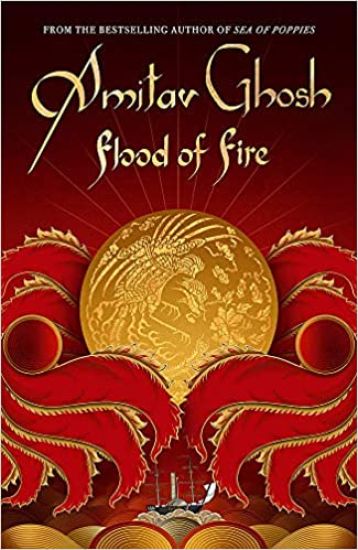
The thrilling climax to the Ibis trilogy that began with the phenomenal Booker-shortlisted Sea of Poppies. It is 1839 and tension has been rapidly mounting between China and British India following the crackdown on opium smuggling by Beijing. With no resolution in sight, the colonial government declares war. One of the vessels requisitioned for the attack, the Hind, travels eastwards from Bengal to China, sailing into the midst of the First Opium War. The turbulent voyage brings together a diverse group of travellers, each with their own agenda to pursue. Among them is Kesri Singh, a sepoy in the East India Company who leads a company of Indian sepoys; Zachary Reid, an impoverished young sailor searching for his lost love, and Shireen Modi, a determined widow en route to China to reclaim her opium-trader husband's wealth and reputation. Flood of Fire follows a varied cast of characters from India to China, through the outbreak of the First Opium War and China's devastating defeat, to Britain's seizure of Hong Kong. Flood of Fire is a thrillingly realised and richly populated novel, imbued with a wealth of historical detail, suffused with the magic of place and plotted with verve. It is a beautiful novel in its own right, and a compelling conclusion to an epic and sweeping story - it is nothing short of a masterpiece.

The stunningly vibrant final novel in the bestselling Ibis Trilogy It is 1839 and China has embargoed the trade of opium, yet too much is at stake in the lucrative business and the British Foreign Secretary has ordered the colonial government in India to assemble an expeditionary force for an attack to reinstate the trade. Among those consigned is Kesri Singh, a soldier in the army of the East India Company. He makes his way eastward on the "Hind," a transport ship that will carry him from Bengal to Hong Kong. Along the way, many characters from the Ibis Trilogy come aboard, including Zachary Reid, a young American speculator in opium futures, and Shireen, the widow of an opium merchant whose mysterious death in China has compelled her to seek out his lost son. The "Hind" docks in Hong Kong just as war breaks out and opium "pours into the market like monsoon flood." From Bombay to Calcutta, from naval engagements to the decks of a hospital ship, among embezzlement, profiteering, and espionage, Amitav Ghosh charts a breathless course through the culminating moment of the British opium trade and vexed colonial history. With all the verve of the first two novels in the trilogy, "Flood of Fire" completes Ghosh s unprecedented reenvisioning of the nineteenth-century war on drugs. With remarkable historic vision and a vibrant cast of characters, Ghosh brings the Opium Wars to bear on the contemporary moment with the storytelling that has charmed readers around the world."

A portrayal of the unique and vibrant city of Calcutta, shown in an intriguing array of captivating and visually arresting photographs Photographer Laura McPhee, noted for her stunning large-scale landscapes and portraits of the people who live and work in them, has been traveling to eastern India for over a decade. There she has devoted her perceptive vision to picturing layers of history, culture, religion, and class as they appear in private heritage homes and public markets, in lively street festivals, and in the faces of city dwellers in Calcutta (also known as Kolkata). This exquisitely produced book features a selection of McPhee’s works made in and around India’s former capital. Here we glimpse courtyards, living spaces, temples, and altars as both vestiges of the past and elements of contemporary urban existence. McPhee’s images sensitively penetrate the surface to show the blurred boundaries between social classes, the blending of public and private life, and the resonance between India and other parts of the world. Also included are a foreword by Amitav Ghosh on the historical divisions inherent in the city’s culture and on the nature of McPhee’s work, and an essay by art historian Romita Ray on the ways McPhee captures and distills the remnants of colonial Calcutta in her photographs of the contemporary city.

A New York Times Book Review Editors' ChoiceA Washington Post Notable Fiction Book of YearA NPR Best Book of the Year In Amitav Ghosh's Sea of Poppies, the Ibis began its treacherous journey across the Indian Ocean, bound for the cane fields of Mauritius with a cargo of indentured servants. Now, in River of Smoke, the former slave ship flounders in the Bay of Bengal, caught in the midst of a deadly cyclone. The storm also threatens the clipper ship Anahita, groaning with the largest consignment of opium ever to leave India for Canton. Meanwhile, the Redruth, a nursery ship, carries horticulturists determined to track down the priceless botanical treasures of China. All will converge in Canton's Fanqui-town, or Foreign Enclave, a powder keg awaiting a spark to ignite the Opium Wars. A spectacular adventure, but also a bold indictment of global avarice, River of Smoke is a consuming historical novel with powerful contemporary resonance.
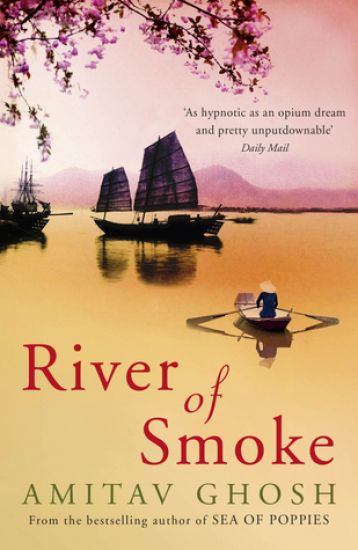
'As hypnotic as an opium dream and pretty unputdownable' Daily MailIn September 1838 a storm blows up on the Indian Ocean and the Ibis, a ship carrying a consignment of convicts and indentured laborers from Calcutta to Mauritius, is caught up in the whirlwind. When the seas settle, five men have disappeared - two lascars, two convicts and one of the passengers. Did the same storm upend the fortunes of those aboard the Anahita, an opium carrier heading towards Canton? And what fate befell those aboard the Redruth, a sturdy two-masted brig heading East out of Cornwall? Was it the storm that altered their course or were the destinies of these passengers at the mercy of even more powerful forces? On the grand scale of an historical epic, River of Smoke follows its storm-tossed characters to the crowded harbors of China. There, despite efforts of the emperor to stop them, ships from Europe and India exchange their cargoes of opium for boxes of tea, silk, porcelain and silver. Among them are Bahram Modi, a wealthy Parsi opium merchant out of Bombay, his estranged half-Chinese son Ah Fatt, the orphaned Paulette and a motley collection of others whose pursuit of romance, riches and a legendary rare flower have thrown together. All struggle to cope with their losses - and for some, unimaginable freedoms - in the alleys and crowded waterways of 19th century Canton. As transporting and mesmerizing as an opiate induced dream, River of Smoke will soon be heralded as a masterpiece of twenty-first century literature.