Kirjojen hintavertailu – 12 903 724 kirjaa ja 27 kauppaa

Kirjailija

Anil Kumar Singh

Kirjat ja teokset yhdessä paikassa: 46 kirjaa, julkaisuja vuosilta 2006–2025, suosituimpiin kuuluu Estudios sobre la bioeficacia de los herbicidas de postemergencia en el maíz rabi. Vertaile teosten hintoja ja tarkista saatavuus suomalaisista kirjakaupoista.

Nimi esiintyy myös muodoissa: Anil Kumar Singh

46 kirjaa

Kirjojen julkaisuvuodet: 2006–2025.

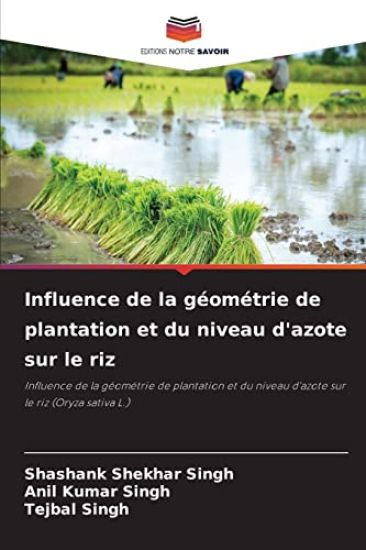
Influence de la géométrie de plantation et du niveau d'azote sur le riz

Influence de la géométrie de plantation et du niveau d'azote sur le riz

Shashank Shekhar Singh; Anil Kumar Singh; Tejbal Singh

Editions Notre Savoir
2021
pokkari
Une exp rience de terrain a t men e sur le sujet intitul "Influence de la g om trie de plantation et du niveau d'azote sur le riz (Oryza sativa L.)" pendant deux saisons kharif cons cutives de 2017 et 2018 la ferme de recherche agronomique, Narendra Deva University of Agriculture and Technology, Narendra Nagar (Kumarganj), Ayodhya (U. P.) L'exp rience tait compos e de seize combinaisons de traitement, savoir quatre g om tries de plantation et quatre niveaux d'azote dans un plan de parcelles divis es. Quatre g om tries de plantation, savoir 15x10 cm, 15x15 cm, 20x10 cm et 20x15 cm, ont t conserv es dans les parcelles principales et quatre niveaux d'azote, savoir 0 kg N/ha, 60 kg/N ha, 120 kg N/ha et 180 kg/N ha, dans les parcelles secondaires. L'exp rience a t r p t e trois fois. Selon les besoins des semis, les graines de la vari t de riz NDR-359 ont t utilis es selon le traitement de la g om trie de plantation. La culture a t uniform ment fertilis e avec 60 kg P2O5, 40 kg K2O et de l'azote selon les traitements. Les r sultats r v lent que la g om trie de plantation de 20 10cm a t jug e appropri e pour des attributs de rendement plus lev s et le rendement du riz. L'application de 120 kg d'azote/ha a t jug e appropri e pour une production plus lev e de riz. L'effet d'interaction entre la g om trie de plantation et le niveau d'azote a t trouv significatif sur le grain et la paille.
Influência da geometria de plantio e do nível de nitrogênio no arroz

Influência da geometria de plantio e do nível de nitrogênio no arroz

Shashank Shekhar Singh; Anil Kumar Singh; Tejbal Singh

Edicoes Nosso Conhecimento
2021
pokkari
Um experimento de campo foi conduzido sobre o tema "Influ ncia da geometria de plantio e n vel de nitrog nio no arroz (Oryza sativa L.)" durante duas esta es kharif consecutivas de 2017 e 2018 na Fazenda de Pesquisa Agron mica, Universidade de Agricultura e Tecnologia Narendra Deva, Narendra Nagar (Kumarganj), Ayodhya (U. P.) O experimento foi composto de dezesseis combina es de tratamento, ou seja, quatro geometrias de plantio e quatro n veis de nitrog nio no desenho de parcelas divididas. Quatro geometrias de plantio i.e. 15x10 cm, 15x15 cm, 20x10 cm e 20x15 cm foram mantidos em parcelas principais e quatro n veis de nitrog nio i.e. 0 kg N/ha, 60 kg/N ha, 120 kg N/ha e 180 kg/N ha foram mantidos em sub-parcelas. A experi ncia foi replicada tr s vezes. Como por exig ncia de pl ntulas, as sementes NDR-359 variedade de arroz foram usadas como por tratamento de geometria de plantio. A cultura foi uniformemente fertilizada com 60 kg P2O5, 40 kg K2O e nitrog nio como por tratamento. Os resultados revelam que a geometria de plantio de 20 10cm foi encontrada adequada para maiores atributos de rendimento e produ o de arroz. A aplica o de 120 kg de nitrog nio/ha foi considerada adequada para uma maior produ o de arroz. O efeito de intera o entre a geometria do plantio e o n vel de nitrog nio foi significativo nos gr os e na palha yi
Einfluss von Pflanzgeometrie und Stickstoffgehalt auf Reis

Einfluss von Pflanzgeometrie und Stickstoffgehalt auf Reis

Shashank Shekhar Singh; Anil Kumar Singh; Tejbal Singh

Verlag Unser Wissen
2021
pokkari
Ein Feldversuch mit dem Titel "Einfluss der Pflanzgeometrie und des Stickstoffgehalts auf Reis (Oryza sativa L.)" wurde in zwei aufeinanderfolgenden Erntesaisons 2017 und 2018 auf der Agronomy Research Farm, Narendra Deva University of Agriculture and Technology, Narendra Nagar (Kumarganj), Ayodhya (U. P.) durchgef hrt. Der Versuch umfasste sechzehn Behandlungskombinationen, n mlich vier Pflanzgeometrien und vier Stickstoffgehalte in einem Split-Plot-Design. Vier Pflanzgeometrien, d.h. 15x10 cm, 15x15 cm, 20x10 cm und 20x15 cm, wurden in den Hauptparzellen und vier Stickstoffgehalte, d.h. 0 kg N/ha, 60 kg/N ha, 120 kg N/ha und 180 kg/N ha, in den Unterparzellen verwendet. Der Versuch wurde dreimal wiederholt. Je nach Bedarf an Setzlingen wurde Saatgut der Reissorte NDR-359 je nach Behandlung der Pflanzgeometrie verwendet. Die Ernte wurde gleichm ig mit 60 kg P2O5, 40 kg K2O und Stickstoff je nach Behandlung ged ngt. Die Ergebnisse zeigen, dass eine Pflanzgeometrie von 20 10 cm f r h here Ertragsattribute und Ertr ge von Reis geeignet war. Die Ausbringung von 120 kg Stickstoff/ha erwies sich als geeignet f r eine h here Produktion von Reis. Der Interaktionseffekt zwischen der Pflanzgeometrie und dem Stickstoffgehalt erwies sich als signifikant f r den Korn- und Strohertrag.
Effect of Different Date of Transplanting on Growth and Yield of Rice

Effect of Different Date of Transplanting on Growth and Yield of Rice

Shashank Shekher Singh; Anil Kumar Singh; Tejbal Singh

Lap Lambert Academic Publishing
2021
pokkari
The field experiment entitled "Effect of different date of transplanting on growth and yield of rice (Oryza sativa L.) varieties" was conducted at Agronomy Research Farm of Narendra Deva University of Agriculture & Technology, Narendra Nagar (Kumarganj), Faizabad, Uttar Pradesh during Kharif season of 2015 with an objective to find out suitable date of transplanting of rice, the treatment consisted of three transplanting date (15 July, 25 July and 5 August) and three varieties (Sarju-52, NDR-359 and Swarna) there were 9 treatment combinations. The values of growth contributing characters viz. plant height (cm), number of tillers, dry matter accumulation, leaf area index and yield attributes like number of panicles m-2, length of panicle (cm), number of panicle-1, grain weight panicle-1, grain and straw yield (q ha-1) were increasing significantly with 15 July date of transplanting followed by 25 July date of transplanting and significantly superior with 5 August date of transplanting.
Influence of planting geometry and nitrogen level on rice

Influence of planting geometry and nitrogen level on rice

Shashank Shekhar Singh; Anil Kumar Singh; Tejbal Singh

Lap Lambert Academic Publishing
2021
pokkari
A field experiment was conducted on the topic entitled "Influence of planting geometry and nitrogen level on rice (Oryza sativa L.)" during two consecutive kharif seasons of 2017 and 2018 at Agronomy Research Farm, Narendra Deva University of Agriculture and Technology, Narendra Nagar (Kumarganj), Ayodhya (U. P.) Experiment was comprised with sixteen treatment combinations viz. four planting geometry and four nitrogen levels in split plot design. Four planting geometry i.e. 15x10 cm, 15x15 cm, 20x10 cm and 20x15 cm were kept in main plots and four nitrogen levels i.e. 0 kg N/ha, 60 kg/N ha, 120 kg N/ha and 180 kg/N ha were kept in sub plots. The experiment was replicated three times. As per requirement of seedlings, seeds NDR-359 variety of rice was used as per treatment of planting geometry Crop was uniformly fertilized with 60 kg P2O5, 40 kg K2O and nitrogen as per treatments. Results reveal that planting geometry of 20 10cm was found suitable for higher yield attributes and yield of rice. Application of 120 kg nitrogen/ha was found suitable for higher production of rice.
Textbook of Floriculture and Landscaping

Textbook of Floriculture and Landscaping

Anil Kumar Singh; Anjana Sisodia

New India Publishing Agency- Nipa
2020
nidottu
The historical record of India reveals that flowers and gardens held a significant and valuable place in the countrys cultural and artistic heritage, as evidenced by paintings, murals, and coins. These artifacts demonstrate the close relationship between floriculture and the daily life and culture of the Indian people. The book provides up-to-date information that aligns with the current horticulture syllabuses of both ICAR and SAU, catering to the needs of students pursuing B. Sc. (Ag.), B. Sc. (Hort.), and M. Sc. (Ag.) degrees in Horticulture. The content is presented in a clear and concise manner to ensure easy comprehension by readers, making the book an all-encompassing resource for topics related to floriculture and landscaping.
Immune Functions and Metabolic Status of Growing Buffalo Calves

Immune Functions and Metabolic Status of Growing Buffalo Calves

Anil Kumar Singh; Sujata Pandita

LAP Lambert Academic Publishing
2019
pokkari
Buffaloes are the backbone of the Indian dairy industry, where they contribute about 54.5% of the total milk production (Economic survey, Govt. of India 2008- 2009). Though anatomically the buffaloes are very similar to cattle, they are physiologically different in many aspects including early embryonic loss and high neonatal mortality (Banerjee, 1998) causing a heavy drain on economics of livestock production. A survey of 28 livestock farms spread in 14 states of the country depicted mortality rate of 27.03% in calves, 7.49% in young stock and 5.13% in adult bull (Rathore, 1998). Acharya (1988) reported 29.1% and 38.85% mortality in cattle and buffalo calves up to 3 months of age respectively. Ramakrishna (2007) reported higher mortality rates (51.8%) in buffalo calves below one month of age in Andhra Pradesh. Thus, higher neonatal morbidity and mortality are the major cause of economic loss in livestock production.
Enhancing Pulses Production

Enhancing Pulses Production

Babooji Gangwar; Anil Kumar Singh

New India Publishing Agency
2014
nidottu
This book is aimed at raising awareness among planners, policymakers, and local agricultural development officials of the need to devise region-specific strategies for increasing pulses production. By integrating these strategies into existing farming systems and utilizing available technological resources, it is possible to enhance pulses production. Additionally, this book offers valuable information and technological options for all stakeholders to achieve the target of increased pulses production in the near future.
Enhancing Pulses Production

Enhancing Pulses Production

Babuji Gangwar; Anil Kumar Singh

New India Publishing Agency
2014
sidottu
This book is aimed at raising awareness among planners, policymakers, and local agricultural development officials of the need to devise region-specific strategies for increasing pulses production. By integrating these strategies into existing farming systems and utilizing available technological resources, it is possible to enhance pulses production. Additionally, this book offers valuable information and technological options for all stakeholders to achieve the target of increased pulses production in the near future.
Breeding and Biotechnology of Flowers: Vol. 01

Breeding and Biotechnology of Flowers: Vol. 01

Anil Kumar Singh

New India Publishing Agency
2014
sidottu
Floriculture is a rapidly expanding sector of commercial agriculture that boasts numerous highly profitable crops. Unlike other crops, the cultivation of flowers is considered a more practical endeavor. Every day, the introduction of new varieties and colors in ornamental flower crops inspires curiosity about their breeding technologies. The creation of diversity in both new and domesticated flower crops by public and private sector breeders has sparked a fascination with breeding techniques. Students studying the breeding and biotechnology of flowers need a strong foundation of knowledge. Therefore, the book has been designed in an easily accessible format to ensure that anyone can understand it without becoming bored. It covers all aspects of breeding, including the fundamental objectives, various breeding methods, methodologies for improving specific crops, stress resistance, quality improvement, mutagenesis, genetic engineering, and biotechnology. The book is intended to provide a comprehensive understanding of these topics without overwhelming the reader.
Breeding and Biotechnology of Flowers: Vol. 02

Breeding and Biotechnology of Flowers: Vol. 02

Anil Kumar Singh

New India Publishing Agency
2014
sidottu
Flowers are an invaluable gift that enhances the beauty of nature with its diverse colors and contributes to human well-being. Ornamental plants play a crucial role in providing environmental security for immediate living surroundings, which led to the initiation of extensive research in floriculture, particularly on crop plants. This book elucidates the application of genetics and breeding in flower crops, covering a broad range of aspects. The breeding techniques primarily focus on accelerating the production of superior and stable lines in self-pollinating crops. Breeders employ various methods, such as wide hybridization, tissue culture, and mutagenesis, to generate new alleles and broaden the available genetic resources. Molecular markers are used to assist breeders through marker-assisted selection and to identify quantitative trait loci for traits of interest. This book aims to provide readers with an accessible understanding of the breeding process and its objectives, different breeding methods, methodology for improving specific crops, stress resistance, quality improvement, mutagenesis, molecular breeding, and genetic engineering.
Breeding and Biotechnology of Flowers: Vol. 02

Breeding and Biotechnology of Flowers: Vol. 02

Anil Kumar Singh

New India Publishing Agency
2014
nidottu
Flowers are an invaluable gift that enrich the natural world with their diverse colors and promote human well-being. Ornamental plants provide environmental security for immediate living areas, which is why extensive research on floriculture began early on. This book will vividly illustrate the applications of genetics and breeding in flower crops, covering a broad range of topics. Breeding techniques aim to accelerate the production of premium and stable lines in self-pollinating crops. Breeders employ a variety of methods, such as wide hybridization, tissue culture, and mutagenesis, to generate new alleles and expand available genetic resources. Molecular markers are used to assist breeders through marker-assisted selection and to identify quantitative trait loci for desired traits. This book presents the principles of breeding in an accessible way to readers. It is designed to address all aspects of breeding, including its fundamental objectives, various breeding methods, methodologies for improving specific crops, stress resistance, quality improvement, mutagenesis, molecular breeding, and genetic engineering.
Breeding and Biotechnology of Flowers: Vol. 01

Breeding and Biotechnology of Flowers: Vol. 01

Anil Kumar Singh

New India Publishing Agency
2014
nidottu
Floriculture, a rapidly expanding commercial agriculture sector worldwide, boasts numerous highly lucrative crops. Unlike other crops, the cultivation of flowers is a more practical endeavor. Every day, the introduction of new varieties and colors in ornamental flower crops not only captivates us but also motivates us to explore breeding technologies further. The creation of a diverse range of both new and domesticated flower crops by both public and private sector flower breeders has sparked a fascination for its breeding technology. Students studying the breeding and biotechnology of flowers require a solid foundation of knowledge. Therefore, this book has been designed to present the information in the simplest form, allowing anyone to easily understand it without losing interest. It covers all aspects of breeding, including its basic objectives, various breeding methods, methodology for improving specific crops, stress resistance, quality improvement, mutagenesis, genetic engineering, and biotechnology.