Kirjojen hintavertailu – 12 903 724 kirjaa ja 27 kauppaa

Kirjailija

Anil Kumar Singh

Kirjat ja teokset yhdessä paikassa: 46 kirjaa, julkaisuja vuosilta 2006–2025, suosituimpiin kuuluu Estudios sobre la bioeficacia de los herbicidas de postemergencia en el maíz rabi. Vertaile teosten hintoja ja tarkista saatavuus suomalaisista kirjakaupoista.

Nimi esiintyy myös muodoissa: Anil Kumar Singh

46 kirjaa

Kirjojen julkaisuvuodet: 2006–2025.

Solving the Pulses Crisis

Solving the Pulses Crisis

Anil Kumar Singh

New India Publishing Agency
2013
nidottu
The publication is organized into two main sections. The first section addresses national concerns, technologies, and tactics, while the second section addresses crop-related issues and technologies. The first segment comprises of 13 chapters. The first three chapters address pulses-related national concerns, technologies, and strategies, including the NEH region. Chapter IV discusses crop diversification with a focus on pulses. Chapter V examines pulses production under an organic system. Chapters VI and VII explore the use of legumes as a nutrient supplement and tillage and crop establishment, respectively. Chapter VIII covers water management in pulses, while Chapter IX focuses on integrated nutrient management. Chapters X and XI discuss weed and pest management, respectively. Chapter XII discusses post-harvest and value-added issues, while Chapter XIII explores trade-related policy issues. The second section addresses crop-related issues, strategies, and technologies. Chapter XIV focuses on pigeonpea, while Chapter XV explores issues related to greengram and black gram. Chapters XVI to XIX examine chickpea, lentil, field pea, and lathyrus, while Chapter XX focuses on the prospects and issues related to guar. Finally, Chapter XXI discusses the issues and technologies related to arid legumes, with a particular emphasis on mothbean, cowpea, and horsegram in arid regions. The publication aims to serve as a valuable reference and guide for addressing pulses-related issues in India and achieving food production targets in the future.
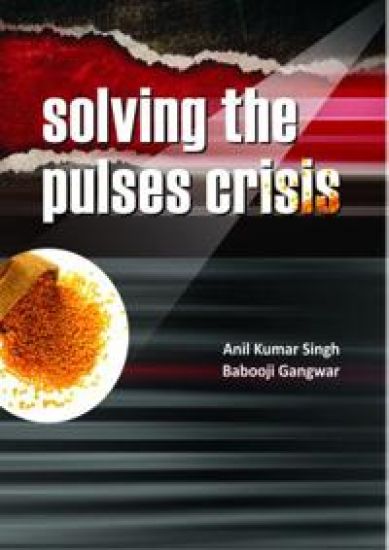
Solving the Pulses Crisis

Solving the Pulses Crisis

Anil Kumar Singh

New India Publishing Agency
2013
sidottu
The publication is organized into two main sections. The first section addresses national concerns, technologies, and tactics, while the second section addresses crop-related issues and technologies. The first segment comprises of 13 chapters. The first three chapters address pulses-related national concerns, technologies, and strategies, including the NEH region. Chapter IV discusses crop diversification with a focus on pulses. Chapter V examines pulses production under an organic system. Chapters VI and VII explore the use of legumes as a nutrient supplement and tillage and crop establishment, respectively. Chapter VIII covers water management in pulses, while Chapter IX focuses on integrated nutrient management. Chapters X and XI discuss weed and pest management, respectively. Chapter XII discusses post-harvest and value-added issues, while Chapter XIII explores trade-related policy issues. The second section addresses crop-related issues, strategies, and technologies. Chapter XIV focuses on pigeonpea, while Chapter XV explores issues related to greengram and black gram. Chapters XVI to XIX examine chickpea, lentil, field pea, and lathyrus, while Chapter XX focuses on the prospects and issues related to guar. Finally, Chapter XXI discusses the issues and technologies related to arid legumes, with a particular emphasis on mothbean, cowpea, and horsegram in arid regions. The publication aims to serve as a valuable reference and guide for addressing pulses-related issues in India and achieving food production targets in the future.
Flower Crops

Flower Crops

Anil Kumar Singh

New India Publishing Agency
2006
sidottu
Flower cultivation, which was once a task primarily undertaken by gardeners, has today evolved into a thriving business. In India, flower crops have become a significant source of income due to their high economic value, and they play a vital role in our rich cultural heritage. To enhance the productivity, quality, and export potential of floricultural crops, concerted efforts are being made across the country. As trends continue to evolve and demand for innovative products grows, it is essential to stay informed about new potential crops with novel varieties and improved production technologies. The global interest in floriculture has prompted agricultural universities and colleges to incorporate this emerging field into their curriculum. The book Flower Crops: Cultivation and Management is a comprehensive compilation of recent advances in floriculture by the author. It provides detailed information on the practices and challenges associated with growing flower crops, along with an extensive description of various crops and their potential varieties.
Flower Crops

Flower Crops

Anil Kumar Singh

New India Publishing Agency
2006
nidottu
Flower cultivation, once a pastime for gardeners, has evolved into a lucrative business. In India, where floriculture is a vital part of our cultural and heritage, flower crops have become a significant source of income. To enhance the productivity, quality, and export potential of various floricultural crops, concerted efforts are being made across the country. As trends change and there is a constant demand for innovative products, it is crucial to stay informed about new potential crops with novel varieties and improved production methods. The growing global interest in floriculture has also led to agricultural universities and colleges incorporating it into their curriculum. The book, Flower Crops: Cultivation and Management, is an excellent collection of recent advances in floriculture, compiled by the author. It provides detailed information on the cultivation practices and challenges involved in growing flower crops, as well as comprehensive descriptions of the crops and potential varieties.