
Kirjailija
Annie Besant
Kirjat ja teokset yhdessä paikassa: 481 kirjaa, julkaisuja vuosilta 1887–2026, suosituimpiin kuuluu May a Christian Believe in Reincarnation?. Vertaile teosten hintoja ja tarkista saatavuus suomalaisista kirjakaupoista.
Nimi esiintyy myös muodoissa: Annie Bésant
481 kirjaa
Kirjojen julkaisuvuodet: 1887–2026.
Explore the hidden dimensions of faith with Annie Besant's "Esoteric Christianity, or The Lesser Mysteries." This profound work delves into the mystical and spiritual undercurrents of Christian thought, offering a unique perspective on religious experience. Besant, a prominent figure in spiritualism and occultism, explores esoteric interpretations of Christian teachings. "Esoteric Christianity" examines the lesser mysteries, seeking to illuminate the deeper, symbolic meanings embedded within traditional Christian narratives. This book appeals to those interested in Christian mysticism and its connections to broader spiritual and occult traditions. A significant contribution to the study of religious miscellanea, this exploration of Christianity offers an alternative lens through which to view faith and spirituality. Discover the insights contained within this meticulously prepared print republication of a timeless classic. This work has been selected by scholars as being culturally important, and is part of the knowledge base of civilization as we know it. This work is in the public domain in the United States of America, and possibly other nations. Within the United States, you may freely copy and distribute this work, as no entity (individual or corporate) has a copyright on the body of the work. Scholars believe, and we concur, that this work is important enough to be preserved, reproduced, and made generally available to the public. We appreciate your support of the preservation process, and thank you for being an important part of keeping this knowledge alive and relevant.
Explore the hidden dimensions of faith with Annie Besant's "Esoteric Christianity, or The Lesser Mysteries." This profound work delves into the mystical and spiritual undercurrents of Christian thought, offering a unique perspective on religious experience. Besant, a prominent figure in spiritualism and occultism, explores esoteric interpretations of Christian teachings. "Esoteric Christianity" examines the lesser mysteries, seeking to illuminate the deeper, symbolic meanings embedded within traditional Christian narratives. This book appeals to those interested in Christian mysticism and its connections to broader spiritual and occult traditions. A significant contribution to the study of religious miscellanea, this exploration of Christianity offers an alternative lens through which to view faith and spirituality. Discover the insights contained within this meticulously prepared print republication of a timeless classic. This work has been selected by scholars as being culturally important, and is part of the knowledge base of civilization as we know it. This work is in the public domain in the United States of America, and possibly other nations. Within the United States, you may freely copy and distribute this work, as no entity (individual or corporate) has a copyright on the body of the work. Scholars believe, and we concur, that this work is important enough to be preserved, reproduced, and made generally available to the public. We appreciate your support of the preservation process, and thank you for being an important part of keeping this knowledge alive and relevant.

Now of Great Britain, I ask: What is her place in the Plan? Great Britain has a possibility before her, and a power of accomplishing that possibility, which are not so great in any other Nation in the world. I will tell you exactly what I mean. When I was here in 1919 it was just in the crash of the Russian Revolution, and I ventured to say to a great body of Trade Unionists and working men that Britain was the one country in the world, I believed, where by training and self-discipline and the power of combination in the unions, and the learning in the unions of discipline, there was good hope that this tremendous transformation might be made without revolution or violence. Things are not as hopeful to-day as they were then; and largely because the sense of duty, and of discipline and loyalty to leaders is lacking; these things have broken down very much amongst those who were the most splendid examples of them a few years ago; and that because a class is taking the place of the Nation and the power of the class-what they are pleased to call 44the dictation of the proletariat-is striving to compel the Nation. There is no class, autocratic or democratic or proletariat or monarchic, that has the right to dictate to the Nation and say what it should do. It is not because they are many that they have the right to kill Liberty. Not because they are strong and can starve the Nation into submission have they the right to tyrannise. I protested against it when employers tried to starve the workmen into breaking unionism; and I protest against it as much to-day, when the strong by numbers try to starve the country, because they are engaged in quarrels with their employers. I believe it is possible that these dangers can be overcome, and I want to put to you as my last point that the tendencies everywhere are not only towards Union within the Nation, but of Union of larger and larger Nations as we go on in evolution. In the past those larger Unions have always been made by military force, by power, by trampling on the weaker Nations and incorporating them with the stronger by annexation of other peoples' countries. That they call annexation rather than robbery, because it is a prettier word and covers over what really has occurred. They have been made by aggressive war, which is murder on a vaster scale, which is the outcome of hatred, and therefore destructive and demoralising; and by diplomacy, which is too often only a many-syllabled word for untruth and intrigue

"The human body is constantly undergoing a process of decay and of reconstruction. First builded into the etheric form in the womb of the mother, it is built up continually by the insetting of fresh materials. With every moment tiny molecules are passing away from it; with every moment tiny molecules are streaming into it. The outgoing stream is scattered over the environment, and helps to rebuild bodies of all kinds in the mineral, vegetable, animal, and human kingdoms, the physical basis of all these being one and the same. Annie Besant"
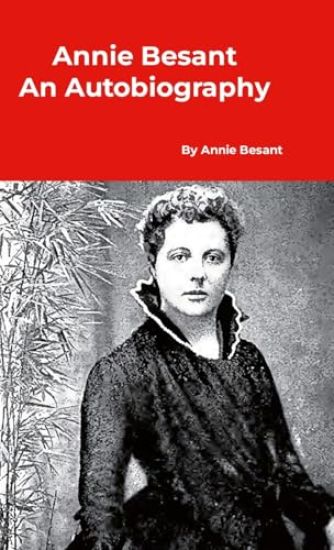
IT is a difficult thing to tell the story of a life, and yet more difficult when that life is one's own. At the best, the telling has a savour of vanity, and the only excuse for the proceeding is that the life, being an average one, reflects many others, and in troublous times like ours may give the experience of many rather than of one. And so the autobiographer does his work because he thinks that, at the cost of some unpleasantness to himself, he may throw light on some of the typical problems that are vexing the souls of his contemporaries, and perchance may stretch out a helping hand to some brother who is struggling in the darkness, and so bring him cheer when despair has him in its grip. Since all of us, men and women of this restless and eager generation-surrounded by forces we dimly see but cannot as yet understand, discontented with old ideas and half afraid of new, greedy for the material results of the knowledge brought us by Science but looking askance at her agnosticism as regards the soul, fearful of superstition but still more fearful of atheism, turning from the husks of outgrown creeds but filled with desperate hunger for spiritual ideals-since all of us have the same anxieties, the same griefs, the same yearning hopes, the same passionate desire for knowledge, it may well be that the story of one may help all, and that the tale of one should that went out alone into the darkness and on the other side found light, that struggled through the Storm and on the other side found Peace, may bring some ray of light and of peace into the darkness and the storm of other lives.

THE four lectures printed in this volume were delivered to the delegates and members of the Theosophical Society, assembled for the Annual Convention at Adyar, Madras, on December 27th, 28th, 29th, 30th, 1893. They were intended to show the value of the teachings of H. P. Blavatsky as a guide to the obscurer meanings of the Hind Sacred books, and so to vindicate at once the usefulness of the Theosophical and the Hind doctrines. They were intended also to show the identity of these doctrines, and to prove that any one who believes the Theosophical teachings must accept those of the Vedas and the Pur nas on fundamental matters. That Theosophy is a fragment of the Brahma Vidy of pre-Vaidic days, that the Shruti are the best exoteric presentment of Brahma Vidy , that the Pur nas were intended to give to the class excluded from the study of the Vedas the spiritual truths contained in the latter in a concrete form easy of assimilation-such were the ideas which sought expression in these lectures.
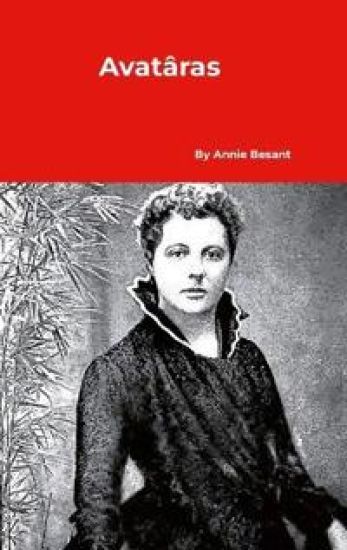
I propose in order to simplify this great subject to divide it under certain heads. I propose first to remind you of the two great divisions recognised by all who have thought on the subject; then to take up especially, for this morning, the question, "What is an Avat ra?" To-morrow we shall put and strive to answer, partly at least, the question, "Who is the source of Avat ras?" Then later we shall take up special Avat ras both of the kosmos and of human races. Thus I hope to place before you a clear, definite succession of ideas on this great subject, not asking you to believe them because I speak them, not asking you to accept them because I utter them. Your reason is the bar to which every truth must come which is true for you; and you err deeply, almost fatally, if you let the voice of authority impose itself where you do not answer to the speaking. Every truth is only true to you as you see it, and as it illuminates the mind; and truth however true is not yet truth for you, unless your heart opens out to receive it, as the flower opens out its heart to receive the rays of the morning sun.
AMONG the many illuminating gifts to the western world, conveyed to it by the medium of the Theosophical Society, that of the knowledge of karma comes, perhaps, next in importance to that of reincarnation. It removes human thought and desire from the region of arbitrary happenings to the realm of law, and thus places man's future under his own control in proportion to the amount of his knowledge. The main conception of karma: "As a man soweth, so shall he also reap," is easy to grasp. But the application of this to daily life in detail, the method of its working and its far-reaching consequences-these are the difficulties which become more bewildering to the student as his knowledge increases. The principles on which any natural science is based are, for the most part, readily intelligible to people of fair intelligence and ordinary education; but as the student passes from principles to practice, from outline to details, he discovers that difficulties press upon him, and if he would wholly master his subject he finds himself compelled to become a specialist, and to devote long periods to the unraveling of the tangles which confront him. So is it also with this science of karma; the student cannot remain always in the domain of generalities; he must study the subdivisions of the primary law, must seek to apply it in all the circumstances of life, must learn how far it binds and how freedom becomes possible. He must learn to see in karma a universal law of nature, and learn also, as in face of nature as a whole, that conquest of and rule over her can only be gained by obedience
Every thought of man upon being evolved passes into the inner world, and becomes an active entity by associating itself, coalescing we might term it, with an elemental-that is to say, with one of the semi-intelligent forces of the kingdoms. It survives as an active intelligence-a creature of the mind's begetting-for a longer or shorter period proportionate with the original intensity of the cerebral action which generated it. Thus, a good thought is perpetuated as an active, beneficent power, an evil one as a maleficent demon. And so man is continually peopling his current in space with a world of his own, crowded with the offspring of his fancies, desires, impulses and passions; a current which reacts upon any sensitive or nervous organisation which comes in contact with it, in proportion to its dynamic intensity. The Buddhist calls it his "Skandha;" the Hindu gives it the name of "Karma." The Adept evolves these shapes consciously; other men throw them off unconsciously.
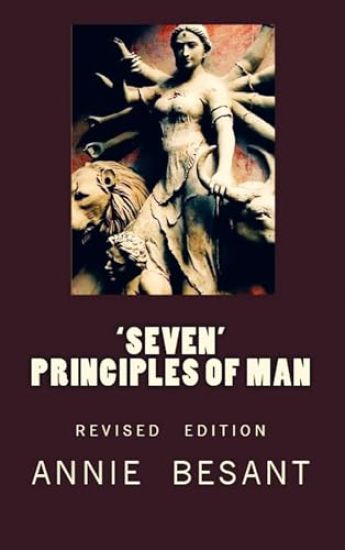

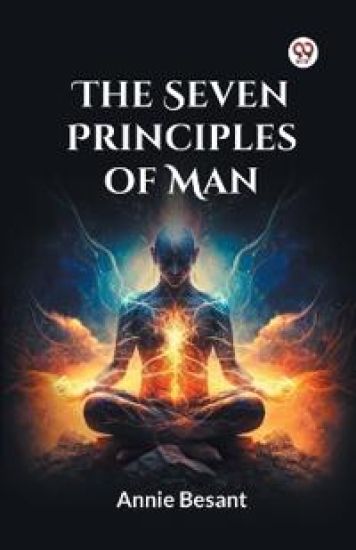
The Seven Principles Of Man explores the concept that human nature is sevenfold, with each principle representing a different aspect of an individual's being. The book discusses how to view man not just as a physical entity but as a spiritual being, highlighting the importance of understanding these principles for personal growth. The highest aspect of humanity is the Spirit, or True Self, which is a divine spark, universally shared by all. This divine aspect of man strives for individuality and seeks to reflect the divine perfection, evolving into a likeness of its creator. To achieve this, the Spirit is clothed in various "garments" or sheaths, each corresponding to a different region of the universe, through which it gains experience and knowledge. These sheaths are the subtle bodies, each serving a distinct purpose, enabling the Spirit to interact with different realms of existence, thereby unfolding latent potential into active power. The book emphasizes the importance of understanding these principles as the foundation of self-realization and spiritual evolution, offering readers a pathway to deeper knowledge of themselves and the universe.

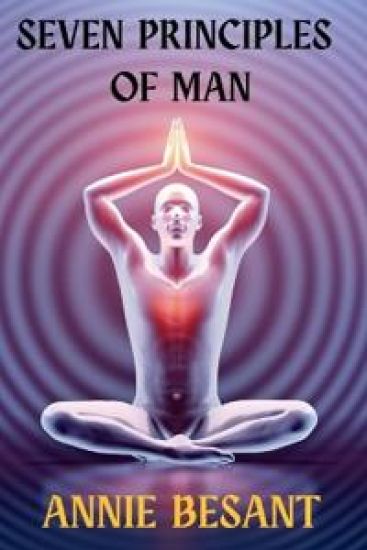
Annie Wood Besant (1847-1933) was a prominent Theosophist, women's rights activist, writer, and orator. She was born in London into a middle-class family of Irish origin. She fought for the causes she thought were right, starting with freedom of thought, women's rights, secularism (she was a leading member of the National Secular Society), birth control, Fabian socialism, and workers' rights. Soon, she was earning a small weekly wage by writing a column for the National Reformer, the newspaper of the National Secular Society. She was also one of the leading figures in Theosophy.

NEW PRINT WITH PROFESSIONAL TYPE-SET IN CONTRAST TO SCANNED PRINTS OFFERED BY OTHERS Occult Chemistry: Clairvoyant Observations On The Chemical Elements, Revised Edition Edited By A. P. Sinnett This book is a result of an effort made by us towards making a contribution to the preservation and repair of original classic literature. In an attempt to preserve, improve and recreate the original content, we have worked towards: 1. Type-setting & Reformatting: The complete work has been re-designed via professional layout, formatting and type-setting tools to re-create the same edition with rich typography, graphics, high quality images, and table elements, giving our readers the feel of holding a fresh and newly reprinted and/or revised edition, as opposed to other scanned & printed (Optical Character Recognition - OCR) reproductions. 2. Correction of imperfections: As the work was re-created from the scratch, therefore, it was vetted to rectify certain conventional norms with regard to typographical mistakes, hyphenations, punctuations, blurred images, missing content/pages, and/or other related subject matters, upon our consideration. Every attempt was made to rectify the imperfections related to omitted constructs in the original edition via other references. However, a few of such imperfections which could not be rectified due to intentional\unintentional omission of content in the original edition, were inherited and preserved from the original work to maintain the authenticity and construct, relevant to the work.
Discover the profound insights of Annie Besant in "Christianity: Its Evidences, Its Origin, Its Morality, Its History," a timeless exploration of one of the world's most influential religions. This captivating work delves into the roots and evolution of Christianity, examining its moral teachings and historical journey with a critical yet respectful lens. Out of print for decades, this masterpiece has been lovingly republished by Alpha Editions, offering both current and future generations the opportunity to engage with Besant's thought-provoking analysis. More than just a book, this is a collector's edition that invites readers to question, reflect, and deepen their understanding of Christianity's enduring impact on society. Don't miss the chance to own a piece of intellectual history that continues to resonate in today's world.