Kirjojen hintavertailu – 12 859 827 kirjaa ja 27 kauppaa
Kirjailija
Anthony Trollope
Kirjat ja teokset yhdessä paikassa: 2 344 kirjaa, julkaisuja vuosilta 1974–2026, suosituimpiin kuuluu Autobiography Of Anthony Trollope. Vertaile teosten hintoja ja tarkista saatavuus suomalaisista kirjakaupoista.
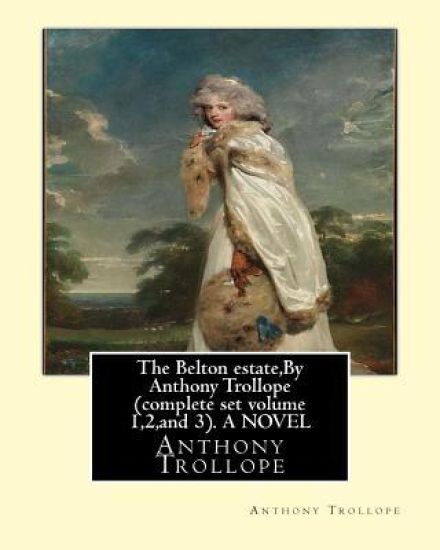
The Belton estate, By Anthony Trollope complete set volume 1,2, and 3. The Belton Estate is a novel by Anthony Trollope, written in 1865. The novel concerns itself with a young woman who has accepted one of two suitors, then discovered that he was unworthy of her love. It was the first novel published in the Fortnightly Review. Clara Amedroz is the only surviving child of the elderly squire of Belton Castle in Somersetshire. At twenty-five, she is old for an unmarried woman. Her father's income and savings have been dissipated to pay for the extravagances of her brother, who subsequently committed suicide. Since her father has no living sons, his estate, which is entailed, will pass upon his death to a distant cousin, Will Belton. Despite her poor prospects, she has two eligible suitors. Within four days of making her acquaintance, Will Belton proposes marriage to her. Belton is warm-hearted, kind, and generous, and these qualities make a strong impression on Clara. However, she believes herself in love with Captain Frederic Aylmer, although he has given no clear signs of feeling that way toward her. Aylmer is impeccable in his manners, smooth, urbane, well-read, and a member of Parliament; compared to him, Belton is awkward and unpolished. Clara rejects Belton's offer, urging him to regard her as a sister. Not long thereafter, Aylmer proposes to her, and she eagerly accepts. However, her happiness is short-lived. Her new fianc proves shallow and cold, more concerned with his own comfort than with her happiness. Moreover, he expects her to subject herself to his domineering mother. Mr. Amedroz dies; and although Belton offers to allow Clara to remain at Belton Castle, she goes to live with the Aylmer family in Yorkshire. Lady Aylmer, who wants her son to marry money or a title, exerts herself to make Clara miserable there; and Captain Aylmer offers no support to his betrothed. For Clara, the final straw comes when Lady Aylmer demands that she sever her ties with a friend. Mrs. Askerton, Lady Aylmer has learned, left an abusive drunken husband in India and lived with Colonel Askerton for several years before the death of her husband freed her to marry him. Clara is duly appalled by her friend's past immorality, but cannot bring herself to cast off someone who has come to depend on her friendship. Pressed relentlessly on the subject by Lady Aylmer, she declares an end to her engagement and returns to Somersetshire, where she accepts the hospitality of the Askertons. Will Belton has never ceased to show his love for Clara, and she realises that he is worthy of her love. However, she believes that it would be wrong to transfer her affection from one man to another. Only after Mrs. Askerton and Will's sister Mary Belton persuade her that it would be unjust to withhold her affection from Will can she bring herself to put aside her scruples and accept him. Marital bliss ensues. The Belton Estate was written shortly after Can You Forgive Her?, and the two novels have a principal theme in common: a woman trying to decide between two suitors, neither ineligible but both differing greatly in their desirable and undesirable qualities. A theme in this novel, not uncommon among other Victorian authors but unusual in Trollope's work, is what John Halperin calls "mediated desire": the desirability of a thing increasing with the difficulty of obtaining it. When Captain Aylmer proposes to Clara, she responds with an enthusiastic affirmative; and this leads him to question the value of his acquisition: What is there that any man desires, -any man or any woman, -that does not lose half its value when it is found to be easy of access and easy of possession? Wine is valued by its price, not its flavour. Open your doors freely to Jones and Smith, and Jones and Smith will not care to enter them. Shut your doors obdurately against the same gentlemen, and they will use all their little diplomacy to effect an entrance. ...
The Small House at Allington is the fifth novel in Anthony Trollope's series known as the "Chronicles of Barsetshire", first published in 1864. It enjoyed a revival in popularity in the early 1990s when the British prime minister, John Major, declared it as his favourite book. The Small House at Allington concerns the Dale family, who live in the "Small House", a dower house intended for the widowed mother (Dowager) of the owner of the estate. The landowner, in this instance, is the bachelor Squire of Allington, Christopher Dale. Dale's mother having died, he has allocated the Small House, rent free, to his widowed sister-in-law and her daughters Isabella ("Bell") and Lilian ("Lily"). Lily has for a long time been secretly loved by John Eames, a junior clerk at the Income Tax Office, while Bell is in love with the local doctor, James Crofts. The handsome and personable, somewhat mercenary Adolphus Crosbie is introduced into the circle by the squire's nephew, Bernard Dale. Adolphus rashly proposes marriage to portionless Lily, who accepts him, to the dismay of John Eames. Crosbie soon jilts her in favour of Lady Alexandrina de Courcy, whose family is in a position to further his career. Lily meets her misfortune with patience, and remains single, continuing to reject Eames, though retaining his faithful friendship. Bell marries Dr Crofts, after refusing an offer of marriage from her cousin Bernard. As with all of Trollope's novels, this one contains many sub-plots and numerous minor characters. Plantagenet Palliser (of the "Palliser" series) makes his first appearance, as he contemplates a dalliance with Griselda Grantly, the now-married Lady Dumbello, daughter of the Archdeacon introduced earlier in the Chronicles of Barsetshire. Sir John Everett Millais, 1st Baronet, (8 June 1829 - 13 August 1896) was an English painter and illustrator.
Ralph the Heir is a novel by Anthony Trollope, originally published in 1871. Although Trollope described it as "one of the worst novels I have written", it was well received by contemporary critics. More recently, readers have found it noteworthy for its account of a corrupt Parliamentary election, an account based closely on Trollope's own experience as a candidate. The title character is Ralph Newton, the nephew of Squire Gregory Newton of Newton Priory. The squire has never married; he has an illegitimate son, also named Ralph Newton, whom he loves dearly. However, the estate is entailed, and after his death will go to his nephew Ralph; he cannot leave it to his natural son. Ralph the heir is a spendthrift, and has run himself deep into debt. There are two ways in which he can extricate himself: by raising money on his future interest in the Newton estate, or by marrying Polly Neefit, the daughter of a wealthy breeches-maker who is one of his major creditors. Neither choice is a good one for him: the first might lead to the estate's being seized by his creditors upon the old squire's death; the second would mean allying himself to a family of a much lower social class, thus putting his own social standing at risk. The squire, anxious to obtain full possession of the estate so that he can pass it to his son, offers to buy the heir's reversion. Ralph vacillates, hesitatingly proposes to and is rejected twice by Polly Neefit, and eventually accepts his uncle's offer. However, before the transaction can be completed, the squire is killed in a hunting accident and his nephew comes into full possession of the property and its large income. Now safe from his creditors, the new squire is nevertheless harassed by Polly Neefit's father, who threatens him with legal action and embarrassing publicity if he does not continue seeking his daughter's hand. The matter is eventually resolved by Polly, who accepts the oft-repeated proposals of Ontario Moggs, son of a prosperous bootmaker, and induces her father to consent to the marriage despite his preference for the squire. In the meantime, Ralph the squire has proposed to and been rejected by Mary Bonner, the beautiful niece and ward of Sir Thomas Underwood; soon after this, she accepts an offer of marriage from the illegitimate Ralph. The novel also describes a Parliamentary election in the fictional borough of Percycross, in which Sir Thomas, a Conservative, and Moggs, a Radical, are two of the four candidates for the two available seats. Both are eager that the election be conducted fairly and honestly. The other two candidates, one a Conservative and one a Liberal, are the incumbents; they see nothing wrong with the buying and selling of votes that has been traditional at Percycross. Sir Thomas and his fellow Conservative win the election, but it is annulled on petition, and the borough is disfranchised by Parliament because of its pervasive corruption.
Trollope's only Australian novel, Harry Heathcote of Gangoil deals with the problems facing a young sheepfarmer, or 'squatter' (modelled after Trollope's son Frederic) in outback Australia. Using conventions of the Christmas story established by Dickens in the late 1840s, the novel shows Harry Heathcote thwarting the envious ex-convict neighbors who harbor his disgruntled former employees and who attempt to set fire to his pastures. Trollope draws heavily on his knowledge of the social and economic conditions of bush life acquired during a year-long visit to Australia in 1871-2. Anthony Trollope (24 April 1815 - 6 December 1882) was one of the most successful, prolific and respected English novelists of the Victorian era. Among his best-loved works is a series of novels collectively known as the Chronicles of Barsetshire, which revolves around the imaginary county of Barsetshire. He also wrote perceptive novels on political, social, and gender issues, and on other topical matters. Thomas Anthony Trollope, Anthony's father, was a barrister. Though a clever and well-educated man and a Fellow of New College, Oxford, he failed at the bar due to his bad temper. In addition, his ventures into farming proved unprofitable, and he lost an expected inheritance when an elderly childless uncle a] remarried and had children. As a son of landed gentry, he wanted his sons to be raised as gentlemen and to attend Oxford or Cambridge. Anthony Trollope suffered much misery in his boyhood owing to the disparity between the privileged background of his parents and their comparatively small means. Born in London, Anthony attended Harrow School as a free day pupil for three years from the age of seven because his father's farm, b] acquired for that reason, lay in that neighbourhood. After a spell at a private school at Sunbury, he followed his father and two older brothers to Winchester College, where he remained for three years. He returned to Harrow as a day-boy to reduce the cost of his education. Trollope had some very miserable experiences at these two public schools. They ranked as two of the most lite schools in England, but Trollope had no money and no friends, and was bullied a great deal. At the age of twelve, he fantasized about suicide. However, he also daydreamed, constructing elaborate imaginary worlds. In 1827, his mother Frances Trollope moved to America with Trollope's three younger siblings, to Nashoba Commune. After that failed, she opened a bazaar in Cincinnati, which proved unsuccessful. Thomas Trollope joined them for a short time before returning to the farm at Harrow, but Anthony stayed in England throughout. His mother returned in 1831 and rapidly made a name for herself as a writer, soon earning a good income. His father's affairs, however, went from bad to worse. He gave up his legal practice entirely and failed to make enough income from farming to pay rents to his landlord, Lord Northwick. In 1834, he fled to Belgium to avoid arrest for debt. The whole family moved to a house near Bruges, where they lived entirely on Frances's earnings....
Cousin Henry is a novel by Anthony Trollope first published in 1879. The story deals with the trouble arising from the indecision of a squire in choosing an heir to his estate. Of all Trollope's shorter novels, this one has been called one of his most experimental. Indefer Jones is the aged squire, between seventy and eighty years of age, of a large manor, Llanfeare, in Carmarthen, Wales. His niece, Isabel Brodrick, has lived with him for years after the remarriage of her father, and endeared herself to everyone. However, according to his strong traditional beliefs, the estate should be bequeathed to a male heir. His sole male blood relative is his nephew Henry Jones, a London clerk. Henry has, in the past, incurred debts that the squire had paid off, been "sent away from Oxford", and generally made a poor impression on his occasional visits to Llanfeare. Nevertheless, Henry is told of his uncle's intention to make him the heir to the estate and is invited to pay a visit. Isabel rejects her uncle's suggestion that she solve his dilemma by marrying Henry, as she cannot stand her cousin. Indefer Jones finds his nephew to be just as detestable as ever. As a result, he overcomes his prejudice and changes his will one final time, in Isabel's favour. Unfortunately, he dies before he can tell anyone. Finding the document hidden in a book of sermons by accident, Henry vacillates between keeping silent and revealing its location. He is neither good enough to give up the estate nor evil enough to burn the document, fearing disgrace, a long jail sentence and, not least, eternal damnation. Instead, he comforts himself by reasoning that doing nothing cannot be a crime. Indefer Jones had had his last will witnessed by two of his tenants, but since the will cannot be found despite a thorough search of the house, Henry inherits the estate. However, already extant suspicions are only strengthened by his guilty manner. He endures abuse from everyone; his own servants either quit or treat him with disrespect. He takes to spending hours in the library, where the will is hidden. The local newspaper begins to publish accounts of the affair that are insulting and seemingly libelous to Henry. It accuses him of destroying the will and usurping the estate from Isabel, whom everybody knows and respects. The old squire's lawyer, Mr Apjohn, himself suspecting that Henry knows more than he lets on, approaches the new squire about the articles, pressuring the unwilling young man into taking legal action against the editor. Henry finds that this only makes things worse. The prospect of being cross examined in the witness box fills him with dread. He realises the truth would be dragged out of him in court....
This is Trollope's eightieth tale. Though it is the work of an older man, it is perhaps the brightest and freshest novel he ever wrote. The story of a young woman forced to choose a husband from among three unsavory men, the novel is remarkable for its wealth of minor characters and it romantic exuberance. Ayala's Angel is a novel written by English author Anthony Trollope, between 25 April and 24 September 1878, although it was not published for two years. It was written as a stand-alone novel rather than as part of a series, though several of the minor characters appear in other novels by Trollope. The plot focuses on two orphaned sisters, Lucy and Ayala Dormer, Ayala especially, and their trials, with first their relatives, and then of the heart, though as in most Trollope novels, pages are given over to subplots related to the main plot. Due to a lack of success in his immediately preceding novels, Trollope had difficulty publishing Ayala's Angel. It was first published in the United States, in the periodical Cincinnati Commercial, which, as was the usual custom for novels at the time, released it in increments, probably of four chapters per issue, between 6 November 1880 and 23 July 1881, for which illustrations were drawn, which were left out of the British publication, released in May 1882.... Anthony Trollope ( 24 April 1815 - 6 December 1882) was one of the most successful, prolific and respected English novelists of the Victorian era. Among his best-loved works is a series of novels collectively known as the Chronicles of Barsetshire, which revolves around the imaginary county of Barsetshire. He also wrote perceptive novels on political, social, and gender issues, and on other topical matters. Trollope's literary reputation dipped somewhat during the last years of his life, but he regained the esteem of critics by the mid-twentieth century. Thomas Anthony Trollope, Anthony's father, was a barrister. Though a clever and well-educated man and a Fellow of New College, Oxford, he failed at the bar due to his bad temper. In addition, his ventures into farming proved unprofitable, and he lost an expected inheritance when an elderly childless uncle a] remarried and had children. As a son of landed gentry, he wanted his sons to be raised as gentlemen and to attend Oxford or Cambridge. Anthony Trollope suffered much misery in his boyhood owing to the disparity between the privileged background of his parents and their comparatively small means. Born in London, Anthony attended Harrow School as a free day pupil for three years from the age of seven because his father's farm, b] acquired for that reason, lay in that neighbourhood. After a spell at a private school at Sunbury, he followed his father and two older brothers to Winchester College, where he remained for three years. He returned to Harrow as a day-boy to reduce the cost of his education. Trollope had some very miserable experiences at these two public schools. They ranked as two of the most lite schools in England, but Trollope had no money and no friends, and was bullied a great deal. At the age of twelve, he fantasized about suicide. However, he also daydreamed, constructing elaborate imaginary worlds. In 1827, his mother Frances Trollope moved to America with Trollope's three younger siblings, to Nashoba Commune. After that failed, she opened a bazaar in Cincinnati, which proved unsuccessful. Thomas Trollope joined them for a short time before returning to the farm at Harrow, but Anthony stayed in England throughout. His mother returned in 1831 and rapidly made a name for herself as a writer, soon earning a good income. His father's affairs, however, went from bad to worse. He gave up his legal practice entirely and failed to make enough income from farming to pay rents to his landlord, Lord Northwick. In 1834, he fled to Belgium to avoid arrest for debt...
Volume 2, Sir John Everett Millais, Baronet, ( 8 June 1829 - 13 August 1896) was an English painter and illustrator. Orley Farm is a novel written in the realist mode by Anthony Trollope (1815-82), and illustrated by the Pre-Raphaelite artist John Everett Millais (1829-96). It was first published in monthly shilling parts by the London publisher Chapman and Hall. Although this novel appeared to have undersold (possibly because the shilling part was being overshadowed by magazines, such as The Cornhill, that offered a variety of stories and poems in each issue), Orley Farm became Trollope's personal favourite. George Orwell said the book contained "one of the most brilliant descriptions of a lawsuit in English fiction." When Joseph Mason of Groby Park, Yorkshire, died, he left his estate to his family. A codicil to his will, however, left Orley Farm (near London) to his much younger second wife and infant son. The will and the codicil were in her handwriting, and there were three witnesses, one of whom was no longer alive. A bitterly fought court case confirmed the codicil. Twenty years pass. Lady Mason lives at Orley Farm with her adult son, Lucius. Samuel Dockwrath, a tenant, is asked to leave by Lucius, who wants to try new intensive farming methods. Aggrieved, and knowing of the original case (John Kenneby, one of the codicil witnesses, had been an unsuccessful suitor of his wife Miriam Usbech), Dockwrath investigates and finds a second deed signed by the same witnesses on the same date, though they can remember signing only one. He travels to Groby Park in Yorkshire, where Joseph Mason the younger lives with his comically parsimonious wife, and persuades Mason to have Lady Mason prosecuted for forgery. The prosecution fails, but Lady Mason later confesses privately that she committed the forgery, and is prompted by conscience to give up the estate. There are various subplots. The main one deals with a slowly unfolding romance between Felix Graham (a young and relatively poor barrister without family) and Madeline Staveley, daughter of Judge Stavely of Noningsby. Graham has a long-standing engagement to the penniless Mary Snow, whom he supports and educates while she is being "moulded" to be his wife. Between the Staveleys at Alston and Orley Farm at Hamworth lies the Cleve, where Sir Peregrine Orme lives with his daughter-in-law, Mrs. Orme, and grandson, Peregrine. Sir Peregrine falls in love with Lady Mason and is briefly engaged to her, but she calls off the match when she realises the seriousness of the court case. Meanwhile, Mr. Furnival, another barrister, befriends Lady Mason, arousing the jealousy of his wife. His daughter, Sophia, has a brief relationship with Augustus Stavely and a brief engagement to Lucius Mason. Eventually Furnival and his wife are reconciled, and Sophia's engagement is dropped. Sophia is portrayed as an intelligent woman who writes comically skilful letters. Anthony Trollope ( 24 April 1815 - 6 December 1882) was one of the most successful, prolific and respected English novelists of the Victorian era. Among his best-loved works is a series of novels collectively known as the Chronicles of Barsetshire, which revolves around the imaginary county of Barsetshire. He also wrote perceptive novels on political, social, and gender issues, and on other topical matters. Trollope's literary reputation dipped somewhat during the last years of his life, but he regained the esteem of critics by the mid-twentieth century. Thomas Anthony Trollope, Anthony's father, was a barrister. Though a clever and well-educated man and a Fellow of New College, Oxford, he failed at the bar due to his bad temper. In addition, his ventures into farming proved unprofitable, and he lost an expected inheritance when an elderly childless uncle remarried and had children....ir John Everett Millais, 1st Baronet, ( 8 June 1829 - 13 August 1896) was an English painter and illustrato
Kept in the Dark is a novel by the 19th-century English novelist Anthony Trollope. One of his lesser and later works, it nonetheless has interest. It was published in eight monthly instalments in Good Words in 1882, and also in book form in the same year. Plot introduction-- The plot is a simple one - Cecilia Holt ends her engagement to Sir Francis Geraldine because of his indifference to her; she goes abroad and meets Mr George Western, who has been jilted by a beautiful girl. They marry, but she does not tell him she has been previously engaged, although he has told her his story. When Western is informed of the previous engagement by Sir Francis, he leaves his wife and goes abroad; Cecilia returns to Exeter to live with her mother. Her sister-in-law in the end effects a reconciliation. There is a comic sub-plot, as so often with Trollope, involving one of Cecilia's friends who attempts to marry Sir Francis. The novel is principally about duty and truth in marriage, and the relationship of a couple to society... Anthony Trollope ( 24 April 1815 - 6 December 1882) was one of the most successful, prolific and respected English novelists of the Victorian era. Among his best-loved works is a series of novels collectively known as the Chronicles of Barsetshire, which revolves around the imaginary county of Barsetshire. He also wrote perceptive novels on political, social, and gender issues, and on other topical matters. Trollope's literary reputation dipped somewhat during the last years of his life, but he regained the esteem of critics by the mid-twentieth century. Thomas Anthony Trollope, Anthony's father, was a barrister. Though a clever and well-educated man and a Fellow of New College, Oxford, he failed at the bar due to his bad temper. In addition, his ventures into farming proved unprofitable, and he lost an expected inheritance when an elderly childless uncle a] remarried and had children. As a son of landed gentry, he wanted his sons to be raised as gentlemen and to attend Oxford or Cambridge. Anthony Trollope suffered much misery in his boyhood owing to the disparity between the privileged background of his parents and their comparatively small means. Born in London, Anthony attended Harrow School as a free day pupil for three years from the age of seven because his father's farm, b] acquired for that reason, lay in that neighbourhood. After a spell at a private school at Sunbury, he followed his father and two older brothers to Winchester College, where he remained for three years. He returned to Harrow as a day-boy to reduce the cost of his education. Trollope had some very miserable experiences at these two public schools. They ranked as two of the most lite schools in England, but Trollope had no money and no friends, and was bullied a great deal. At the age of twelve, he fantasized about suicide. However, he also daydreamed, constructing elaborate imaginary worlds. In 1827, his mother Frances Trollope moved to America with Trollope's three younger siblings, to Nashoba Commune.....