
Kirjailija
Asa Briggs
Kirjat ja teokset yhdessä paikassa: 25 kirjaa, julkaisuja vuosilta 1975–2020, suosituimpiin kuuluu A History of the Royal College of Physicians of London. Vertaile teosten hintoja ja tarkista saatavuus suomalaisista kirjakaupoista.
25 kirjaa
Kirjojen julkaisuvuodet: 1975–2020.

The first three editions of this bestselling book have established A Social History of the Media as a classic, providing a masterful overview of communication media and of the social and cultural contexts within which they emerged and evolved over time. This fourth edition has been revised and updated throughout to reflect the latest developments in the field. Additionally, an expanded introduction explores the wide range of secondary literature and theory that inform the study of media history today, and a new eighth chapter surveys the revolutionary media developments of the twenty-first century, including in particular the rise of social and participatory media and the penetration of these technologies into every sphere of social and private life. Avoiding technological determinism and rejecting assumptions of straightforward evolutionary progress, this book brings out the rich and varied histories of communication media. In an age of fast-paced media developments, a thorough understanding of media history is more important than ever, and this text will continue to be the first choice for students and scholars across the world.

A Social History of the Media
Asa Briggs; Peter Burke; Espen Ytreberg
Polity Press
2020
nidottu
Halvin toimitettuna 31,50 €
The first three editions of this bestselling book have established A Social History of the Media as a classic, providing a masterful overview of communication media and of the social and cultural contexts within which they emerged and evolved over time. This fourth edition has been revised and updated throughout to reflect the latest developments in the field. Additionally, an expanded introduction explores the wide range of secondary literature and theory that inform the study of media history today, and a new eighth chapter surveys the revolutionary media developments of the twenty-first century, including in particular the rise of social and participatory media and the penetration of these technologies into every sphere of social and private life. Avoiding technological determinism and rejecting assumptions of straightforward evolutionary progress, this book brings out the rich and varied histories of communication media. In an age of fast-paced media developments, a thorough understanding of media history is more important than ever, and this text will continue to be the first choice for students and scholars across the world.

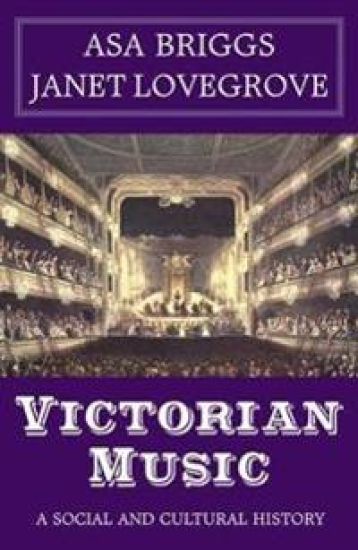
This major new book provides a sparkling and detailed account of classical, modern, and popular music throughout Queen Victoria's long reign. It completes the acclaimed series of classic studies by Professor Briggs, published as Victorian Cities, Victorian People, and Victorian Things. Lord Briggs has written the work with the music specialist Janet Lovegrove. The approach is deliberately chronological. It observes the music scene - both metropolitan and provincial - at twenty-year intervals. It particularly shows how contemporaries themselves perceived music in 1837, 1857, 1877 and 1897. These twenty-year intervals bring out the scale of change and the balance between continuities and contrasts at each point in the story. The intervening decades are more briefly explored. An Epilogue (1901) completes the picture. The authors trace the repertory of opera, of orchestral, choral, chamber and popular music. They show the performers, theatres, halls and rooms. They provide many illuminating stories of the lives and work of the composers, writers and critics, publishers, teachers and lecturers, who were keen to bring music to the many rather the few. London was linked to the provinces by cathedral, church or festival, and education. Key factors were the dissemination of printed music, the musical evangelism of the sight-singing movement, the national distribution achieved by the railways, and the implementation of a national educational system from 1870 onwards. An important element in this was the contribution made to 'progress' by provincial cities, most often through the proliferation of Festivals. No less important were the efforts of English musicians, composers, performers and teachers alike, to achieve status in a country where there was a strong amateur presence. There was also pressure from below, and a difference - often an indifference - in the role and interests of government, local and national. However, the dynamic steps taken to found modern music institutions are traced. Comparisons are made (as did the Victorians) between English and foreign performers and composers, the 'giants' of the past and present. The last chapters show the breaking away, never complete, from 'foreign domination' and the identification of an English musical 'renaissance.' The book is well illustrated. These pictures complete the overwhelming impression of an era teeming with energy and ambition, in music as in all else. The era laid the foundations of the musical heritage and standards we enjoy today.
The Age of Improvement has long established itself as a classic of modern historical writing. Widely read and quoted it has had a unique influence on teaching and research. This second edition draws on the great volume of new research - produced by Lord Briggs amongst others, since its original publication. The book stresses both the underlying unity and the rich variety of the age, and raises fundamental issues about a period of crucial change in British history - industrialisation, war, constitutional change and the attitudes of politicians towards it, political development, and, not least, society and culture. In the background are the new economic powers based on the development of a coal and iron technology; in the foreground, new social and political problems and new ways of tackling them. The author also discusses perceptions of, and reactions to, changing circumstances, the influence of religion and science on national life, and changing styles in art and literature. The story ends, not with a full stop but with a question mark. Could improvement be maintained? Could balance and progress continue to be reconciled?
Now covering the whole of Europe from the French Revolution to the present day, this major new edition has been completely revised and brought up-to-date. The approach embraces the whole continent from both national and regional perspectives, and combines political survey with grass roots 'people' history. Bringing this history vividly to life, the authors use a very broad range of sources including memoirs, archives, letters, songs and newspapers. In particular, there is new treatment of the following themes:Religion and the modern Papacy Immigration in Europe and relationships between minority and majority groups UNESCO The European Bill of Rights The seeds of conflict in Bosnia and Croatia Europe's relations with the wider world, with particular attention to the Middle East and Japan.

The History of Bethlem
Jonathan Andrews; Asa Briggs; Roy Porter; Penny Tucker; Keir Waddington
Routledge
2013
nidottu
Bethlem Hospital, popularly known as "Bedlam", is a unique institution. Now seven hundred and fifty years old, it has been continuously involved in the care of the mentally ill in London since at least the 1400s. As such it has a strong claim to be the oldest foundation in Europe with an unbroken history of sheltering and treating the mentally disturbed. During this time, Bethlem has transcended locality to become not only a national and international institution, but in many ways, a cultural and literary myth. The History of Bethlem is a scholarly history of this key establishment by distinguished authors, including Asa Briggs and Roy Porter. Based upon extensive research of the hospital's archives, the book looks at Bethlem's role within the caring institutions of London and Britain, and provides a long overdue re-evaluation of its place in the history of psychiatry.

First published in 1984, Toynbee Hall, The First Hundred Years is not just a centenary study, but a personal contribution to the continuing history of Toynbee Hall, which is the Universities’ settlement in East London, and an institution that has inspired respect and affection. Its pioneering role as a residential community living and working in the heart of one of London’s most deprived areas has been maintained. Called a ‘social workshop’ by its late chairman John Profumo, Toynbee Hall promotes ventures such as Free Legal Advice, the Workers Educational Association, and the Whitechapel Art Gallery. The book looks at the social changes that have taken place over the 100 years since Toynbee Hall was founded in 1884, but also notes curious parallels, with persistent patterns of poverty, deprivation, squalor and racial separation which characterise the area. Questions about the facts and perceptions of poverty, the nature of community, the visual as well as the social environment, and the roles of voluntary, local and national statutory policy still require answers.

First published in 1984, Toynbee Hall, The First Hundred Years is not just a centenary study, but a personal contribution to the continuing history of Toynbee Hall, which is the Universities’ settlement in East London, and an institution that has inspired respect and affection. Its pioneering role as a residential community living and working in the heart of one of London’s most deprived areas has been maintained. Called a ‘social workshop’ by its late chairman John Profumo, Toynbee Hall promotes ventures such as Free Legal Advice, the Workers Educational Association, and the Whitechapel Art Gallery. The book looks at the social changes that have taken place over the 100 years since Toynbee Hall was founded in 1884, but also notes curious parallels, with persistent patterns of poverty, deprivation, squalor and racial separation which characterise the area. Questions about the facts and perceptions of poverty, the nature of community, the visual as well as the social environment, and the roles of voluntary, local and national statutory policy still require answers.

Marx lived in London as a political exile from 1849 until his death in 1883. This book links the story of Marx's life in London to the places he lived and worked, and is aimed at visitors who are interested in seeing the places with which he was particularly associated. It is fully illustrated with photographs, maps and illustrations, and includes transport details to places of interest. Marx spent most of the first years in London in Soho, before moving to Kentish Town in 1856. Other places of significance to his life include the British Museum Reading Room, where he worked on Capital, Covent Garden, where the meetings of the First International took place, and Hampstead Heath, where Marx and his friends spent family Sundays.
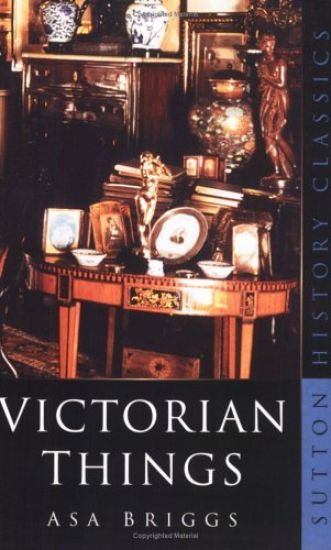
The restless curiosity of the Victorians, their search for higher levels of comfort, their passion for scientific advance and their general obsession with "things" inspired them to search the natural world, the artistic heritage of other cultures and ages and to apply their minds to devising solutions to a host of practical issues. This survey of Victorian material culture brings to life the material culture of one of the most inventive, and acquisitive, societies.
A History of the Royal College of Physicians of London
Asa Briggs
Oxford University Press
2005
sidottu
This is the fourth volume to be published of A History of the Royal College of Physicians, covering the period 1948-1983. Volumes I-III were published in 1964, 1966, and 1972 respectively, and covered the history of the College from its foundation in 1518 to 1947. It is a scholarly study, based on archival and other sources, of a major historical institution, and examines the way in which it adapted to far-reaching changes in medical knowledge, social attitudes, and the organization of health. As such, it is a major contribution to institutional history. At the same time it illuminates the history of the National Health Service and examines controversial public issues such as smoking.
Now covering the whole of Europe from the French Revolution to the present day, this major new edition has been completely revised and brought up-to-date. The approach embraces the whole continent from both national and regional perspectives, and combines political survey with grass roots 'people' history. Bringing this history vividly to life, the authors use a very broad range of sources including memoirs, archives, letters, songs and newspapers. In particular, there is new treatment of the following themes:Religion and the modern Papacy Immigration in Europe and relationships between minority and majority groups UNESCO The European Bill of Rights The seeds of conflict in Bosnia and Croatia Europe's relations with the wider world, with particular attention to the Middle East and Japan.

British Comment on the United States
Ada Nisbet; Asa Briggs
University of California Press
2001
sidottu
This bibliography of more than three thousand entries, often extensively annotated, lists books and pamphlets that illuminate evolving British views on the United States during a period of great change on both sides of the Atlantic. Subjects addressed in various decades include slavery and abolitionism, women's rights, the Civil War, organized labor, economic, cultural, and social behavior, political and religious movements, and the "American" character in general.

As we approach the new millennium, we find ourselves reassessing the past and looking forward to the future. Has the prospect of a new century always provided a "sense of an ending"? In this timely and stimulating book, experts on every century since the fourteenth each explore the characteristics of a different final decade and find that a consciousness of time has indeed influenced the way people perceive their place in history. The writers—Paul Strohm on the 1390s (when signs of a new time consciousness first emerged), Malcolm Vale on the 1490s, Ian Archer on the 1590s, Peter Earle on the 1690s, Roy Porter on the 1790s, and Asa Briggs on the 1890s and 1990s—discuss what is common and what is distinctive to each period. Investigating cultural and intellectual attitudes, economic and technological developments, and artistic, scientific, and political change, they capture the atmosphere of each end of century. As well as the great watersheds of history, the authors explore the daily lives of ordinary citizens, recounting personal histories and subtle shifts in diet, fashion and design, sex and gender roles, and relations between rich and poor, and the emergence of language. Illustrations from both high and popular art provide arresting images of the cultural and social fabric of each community. The year 2000 will be the first millennium humankind has consciously experienced: we look back not a hundred but a thousand years, and in looking back we are better prepared to plan ahead. From the apocalyptic vision of medieval Judgment Day sermons to the decadence of the current fin de siècle, from the invention of printing to cloning and computerization, this book is a pertinent guide to the future as well as to the past.
The Age of Improvement has long established itself as a classic of modern historical writing. Widely read and quoted it has had a unique influence on teaching and research. This second edition draws on the great volume of new research - produced by Lord Briggs amongst others, since its original publication. The book stresses both the underlying unity and the rich variety of the age, and raises fundamental issues about a period of crucial change in British history - industrialisation, war, constitutional change and the attitudes of politicians towards it, political development, and, not least, society and culture. In the background are the new economic powers based on the development of a coal and iron technology; in the foreground, new social and political problems and new ways of tackling them. The author also discusses perceptions of, and reactions to, changing circumstances, the influence of religion and science on national life, and changing styles in art and literature. The story ends, not with a full stop but with a question mark. Could improvement be maintained? Could balance and progress continue to be reconciled?

The History of Bethlem
Jonathan Andrews; Asa Briggs; Roy Porter; Penny Tucker; Keir Waddington
Routledge
1997
sidottu
Bethlem Hospital, popularly known as "Bedlam", is a unique institution. Now seven hundred and fifty years old, it has been continuously involved in the care of the mentally ill in London since at least the 1400s. As such it has a strong claim to be the oldest foundation in Europe with an unbroken history of sheltering and treating the mentally disturbed. During this time, Bethlem has transcended locality to become not only a national and international institution, but in many ways, a cultural and literary myth. The History of Bethlem is a scholarly history of this key establishment by distinguished authors, including Asa Briggs and Roy Porter. Based upon extensive research of the hospital's archives, the book looks at Bethlem's role within the caring institutions of London and Britain, and provides a long overdue re-evaluation of its place in the history of psychiatry.
The History of Broadcasting in the United Kingdom: Volume II: The Golden Age of Wireless
Asa Briggs
Oxford University Press
1995
sidottu
This is the second part of a projected four-volume history of broadcasting in the United Kingdom. This volume covers the period from the beginning of 1927, when the BBC ceased to be a private company and became a public corporation, up to the outbreak of war in 1939. The acceptance of wireless as a part of the homely background of life and the acceptance of the BBC as the `natural' institution for controlling it distinguish this period from that covered in the earlier volume. From 1927 to 1939 the system of public control which had evolved from the early struggles was never seriously in jeopardy and the one big official inquiry, the Ullswater Report, favoured no major constitutional changes. The main theme of the second volume, therefore, may be called the extension and the enrichment of the activity of broadcasting. Different chapters deal with the programmes and programme-makers; the listeners and the ways in which their needs were (or were not) met as the system expanded; public attitudes to the BBC and the increasing complexity of its control and organization; the coming of television and the early experiments of Baird and others; and the retirement of Sir John Reith - not only the end of a regime but the end of an era. The volume ends with preparations for war.

The History of Broadcasting in the United Kingdom: Volume V: Competition
Asa Briggs
Oxford University Press
1995
sidottu
`Competition' continues the monumental history of broadcasting in the UK over a period of 20 years, from 1955 to the mid 1970s. Unlike the previous volumes it chronicles and analyses the history of the BBC in an age of competition, so inevitably contains much fascinating material on the `independent' radio and television companies as well as the BBC. The first chapter deals with the early relationship of the BBC to these new companies, sharing their impact on the types of programmes being broadcast. The second chapter concerns Suez, the first time when there was a conflict between what the Government wanted broadcast and what the BBC felt it ought to broadcast. Chapter 3 compares BBC programmes with their rivals' in the 1960s, and chapter 4 evaluates the effect of the new Director-General, Hugh Greene, the man who - Mary Whitehouse said - was `responsible for the moral collapse which characterized the sixties and seventies'. The remaining chapters debate the changing relationship between politicians and broadcasters, Radio Piracy, the changes to the Third Programme, the introduction of new technologies, and the state of the BBC at the time of the Jubilee and the first meetings of the Annan Committee.
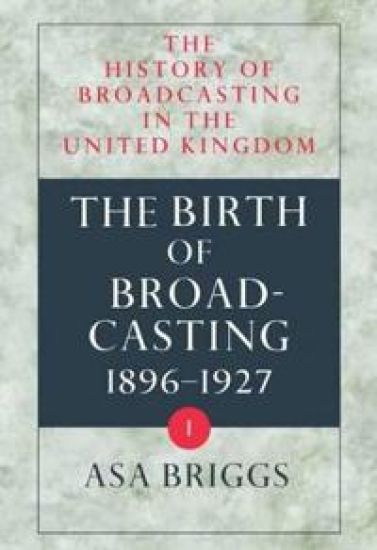
The History of Broadcasting in the United Kingdom: Volume I: The Birth of Broadcasting
Asa Briggs
Oxford University Press
1995
sidottu
This is the first part of a five-volume history of broadcasting in the UK. Together the volumes give an authoritative account of the rise of broadcasting in this country. Though naturally largely concerned with the BBC it does give a general history of broadcasting, not simply an institutional history of the BBC. The Birth of Broadcasting covers early amateur experiments in wireless telephony in America and in England, the pioneer days at Writtle in Essex and elsewhere, and the coming of organized broadcasting and its rapid growth during the first four years of the BBC's existence as a private Company before it became a public Corporation in January 1927. Briggs describes how and why the Company was formed, the scope of its activities and the reasons which led to its conversion from a business enterprise into a national institution. The issues raised between 1923 and 1927 remain pertinent today. The hard bargaining between the Post Office, private wireless interests, and the emergent British Broadcsting Company is discussed in illuminating details, together with the remarkable opposition with which the Company had to contend in its early days. Many sections of the opposition, including a powerful section of the press, seemed able to conceive of broadcasting only as competing with their own interests, never as complementing or enlarging them. One of the main themes of this volume is that of the gradual forging of the instruments of public control, and particular attention is paid to the Crawford Report (1926) from which the Corporation arose. During this period all the characteristics of the Corporation first appeared - particularly its reputation for publc service and impartiality. Briggs also examines the background of wireless as an invention and considers its impact on society. He has much to say about personalities and programmes as well as policies.