Kirjojen hintavertailu – 12 903 732 kirjaa ja 27 kauppaa

Kirjailija

Barry C. Burden

Kirjat ja teokset yhdessä paikassa: 5 kirjaa, julkaisuja vuosilta 2002–2025, suosituimpiin kuuluu Personal Roots of Representation. Vertaile teosten hintoja ja tarkista saatavuus suomalaisista kirjakaupoista.

5 kirjaa

Kirjojen julkaisuvuodet: 2002–2025.

Party Politics in America

Party Politics in America

Marjorie Randon Hershey; Barry C. Burden

TAYLOR FRANCIS LTD
2025
sidottu
Long regarded as the “gold standard” of political parties texts, this new, nineteenth edition of Party Politics in America brings its comprehensive and authoritative coverage of party politics into an age of heightened partisan conflict; threats to the acceptance of democratic institutions; changes in the balance of power among the president, Congress, and the Supreme Court, and judicial rulings that upend long-established precedents. Marjorie Hershey and Barry Burden build on the book’s three-pronged coverage of party organization, party in the electorate, and party in government and incorporate important developments in racial politics, social media use, and battles over access to the vote. The book uses contemporary examples to bring to life the fascinating story of how parties shape our political system. New to the nineteenth edition:Fully updated through the 2022 and 2024 elections, including changes in virtually all the empirical data, boxed materials, and examples throughout the bookDiscusses the transformation of the Republican Party into the Party of Trump, with attendant changes in the parties’ coalitions and electoral prospectsExamines the relevance of party politics and elections to college-age and other young voters in times of intense and off-putting polarizationConsiders the implications of recent changes in both parties to the likelihood that democracy will survive in the USProvides online Instructor’s Resources, including author-written test banks, essay questions, relevant websites with correlated sample assignments, and links to a collection of course syllabi
Party Politics in America

Party Politics in America

Marjorie Randon Hershey; Barry C. Burden

TAYLOR FRANCIS LTD
2025
nidottu
Long regarded as the “gold standard” of political parties texts, this new, nineteenth edition of Party Politics in America brings its comprehensive and authoritative coverage of party politics into an age of heightened partisan conflict; threats to the acceptance of democratic institutions; changes in the balance of power among the president, Congress, and the Supreme Court, and judicial rulings that upend long-established precedents. Marjorie Hershey and Barry Burden build on the book’s three-pronged coverage of party organization, party in the electorate, and party in government and incorporate important developments in racial politics, social media use, and battles over access to the vote. The book uses contemporary examples to bring to life the fascinating story of how parties shape our political system. New to the nineteenth edition:Fully updated through the 2022 and 2024 elections, including changes in virtually all the empirical data, boxed materials, and examples throughout the bookDiscusses the transformation of the Republican Party into the Party of Trump, with attendant changes in the parties’ coalitions and electoral prospectsExamines the relevance of party politics and elections to college-age and other young voters in times of intense and off-putting polarizationConsiders the implications of recent changes in both parties to the likelihood that democracy will survive in the USProvides online Instructor’s Resources, including author-written test banks, essay questions, relevant websites with correlated sample assignments, and links to a collection of course syllabi
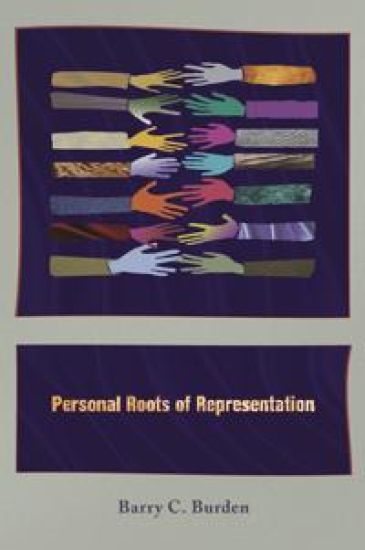
Personal Roots of Representation

Personal Roots of Representation

Barry C. Burden

Princeton University Press
2007
pokkari
Despite heightened partisanship in the U. S. Congress and constituencies split along ideological lines, congressional representatives frequently buck their parties and seldom do precisely what voters ask. In Personal Roots of Representation, Barry Burden challenges standard explanations of legislative preferences to emphasize the important role that personal influences play in representatives' voting behavior. This timely book is the first to examine the extent to which the very same values, experiences, and interests that shape congressional members as individuals and guide their own life choices similarly shape their policymaking decisions. Burden takes a close look at legislative decision making in the areas of tobacco regulation, vouchers and school choice, and religion and bioethics. He finds that personal factors become more significant when legislators are acting proactively rather than reactively, grappling with specific policy issues, and defending rather than challenging the status quo. Marshaling both qualitative and quantitative evidence, Burden reveals that the personal roots of representatives' actions can be as influential as the usual suspects of partisanship and constituency--and that personal factors quite often have the greatest impact when the policymaking stakes are at their highest. Personal Roots of Representation is a provocative book that raises pressing new questions about legislative discretion and the accountability of our elected officials.
Why Americans Split Their Tickets

Why Americans Split Their Tickets

Barry C. Burden; David C. Kimball

The University of Michigan Press
2004
nidottu
Why do some voters split their ballots, selecting a Republican for one office and a Democrat for another? Why do voters often choose one party to control the White House while the other controls the Congress? Barry Burden and David Kimball address these fundamental puzzles of American elections by explaining the causes of divided government and debunking the myth that voters prefer the division of power over one-party control. Why Americans Split Their Tickets links recent declines in ticket-splitting to sharpening policy differences between parties and demonstrates why candidates' ideological positions still matter in American elections." Burden and Kimball have given us the most careful and thorough analysis of split-ticket voting yet. It won't settle all of the arguments about the origins of ticket splitting and divided government, but these arguments will now be much better informed. Why Americans Split Their Tickets is essential reading for anyone interested in understanding the major trends in U. S. electoral politics of the past several decades."-Gary Jacobson, University of California, San Diego"When voters split their tickets or produce divided government, it is common to attribute the outcome as a strategic verdict or a demand for partisan balance. Burden and Kimball strongly challenge such claims. With a thorough and deft use of statistics, they portray ticket-splitting as a by-product of the separate circumstances that drive the outcomes of the different electoral contests. This will be the book to be reckoned with on the matter of ticket splitting."-Robert Erikson, Columbia University"[Burden and Kimball] offset the expansive statistical analysis by delving into the historical circumstances and results of recent campaigns and elections. ... [They] make a scholarly and informative contribution to the understanding of the voting habits of the American electorate-and the resulting composition of American government."-Shant Mesrobian, NationalJournal.com
Why Americans Split Their Tickets

Why Americans Split Their Tickets

Barry C. Burden; David C. Kimball

The University of Michigan Press
2002
sidottu
In Why Americans Split Their Tickets, Barry C. Burden and David C. Kimball argue that divided government is produced unintentionally. Using a new quantitative method to analyze voting in presidential, House, and Senate elections from 1952 to 1996, they reject the dominant explanation for divided government, that ticket splitting is done to balance parties that are far from the center. The ideological positions of candidates do not matter in American elections, but voters favor centrist candidates rather than a mix of extremists. When candidates of opposing parties adopt similar platforms, ticket splitting arises. For voters, ideological differences between the parties blur and other considerations such as candidate characteristics exert a greater influence on their voting decisions. Among their other findings, the authors link changes in congressional campaigns--namely the rise of incumbency advantage and the greater importance of money in the 1960s and 1970s--to ticket splitting and argue, in addition, that the transformation of the South from a Democratic stronghold to a Republican-leaning environment has made regional factors less important. Burden and Kimball draw upon a diverse and unique range of data as evidence for their argument. Their analyses rely on survey data, aggregate election returns, and new ecological inference estimates for every House and Senate election from 1952 to 1996. This approach allows for the examination of divided voting in traditional ways, such as choosing a Democratic presidential candidate and a Republican House candidate on a single ballot, to less traditional forms, such as voting in a midterm House election and choosing a state's Senate delegation. Barry C. Burden is Assistant Professor of Government, Harvard University. David C. Kimball is Assistant Professor of Political Science, University of Missouri, St. Louis.