
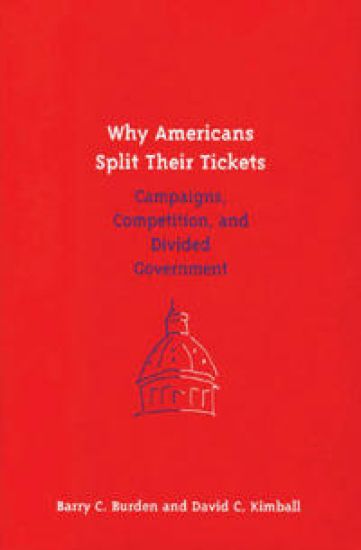
Why Americans Split Their Tickets – hinnat ja saatavuus
Campaigns, Competition, and Divided Government
Kirjafiili on kirjojen hintavertailu. Löydä halvin hinta 27 kirjakaupasta. Hintavertailu koskee ISBN-tunnusta 9780472112869 (sidottu).
Muut painokset ja formaatit
Kirjan kuvaus
In Why Americans Split Their Tickets, Barry C. Burden and David C. Kimball argue that divided government is produced unintentionally. Using a new quantitative method to analyze voting in presidential, House, and Senate elections from 1952… Näytä koko kuvaus Piilota kuvaus
In Why Americans Split Their Tickets, Barry C. Burden and David C. Kimball argue that divided government is produced unintentionally. Using a new quantitative method to analyze voting in presidential, House, and Senate elections from 1952 to 1996, they reject the dominant explanation for divided government, that ticket splitting is done to balance parties that are far from the center. The ideological positions of candidates do not matter in American elections, but voters favor centrist candidates rather than a mix of extremists. When candidates of opposing parties adopt similar platforms, ticket splitting arises. For voters, ideological differences between the parties blur and other considerations such as candidate characteristics exert a greater influence on their voting decisions. Among their other findings, the authors link changes in congressional campaigns--namely the rise of incumbency advantage and the greater importance of money in the 1960s and 1970s--to ticket splitting and argue, in addition, that the transformation of the South from a Democratic stronghold to a Republican-leaning environment has made regional factors less important. Burden and Kimball draw upon a diverse and unique range of data as evidence for their argument. Their analyses rely on survey data, aggregate election returns, and new ecological inference estimates for every House and Senate election from 1952 to 1996. This approach allows for the examination of divided voting in traditional ways, such as choosing a Democratic presidential candidate and a Republican House candidate on a single ballot, to less traditional forms, such as voting in a midterm House election and choosing a state's Senate delegation. Barry C. Burden is Assistant Professor of Government, Harvard University. David C. Kimball is Assistant Professor of Political Science, University of Missouri, St. Louis.
Kirjan tiedot
Vertaa kirjan ”Why Americans Split Their Tickets” hintoja
Vertaa tuotteen hintaa ja arvioitua kokonaishintaa toimitettuna. Kaikki hinnat koskevat ISBN-tunnusta 9780472112869.
Hintoja ei päivitetty automaattisesti. Voit hakea ajantasaiset hinnat painamalla Hae hinnat.

Booky

Suomalainen

Kansallinen Kirjakauppa

Prisma

Finlandia Kirja

Fantasiapelit

Vinhan kirjakauppa

CDON

Kustantamo S&S

Kennys.ie

Kristillinenkirjakauppa.fi

Sacrum

Adlibris

BookOutlet.fi

Kirja.fi

Rosebud
Tälle kirjalle ei ole tällä hetkellä vahvistettua hintaa. Tarkista tilanne myöhemmin uudelleen.
Hintoja ei ole vielä päivitetty.
Hälytys tallennettu!
Ilmoitamme, kun hinta laskee.
Saat sähköpostin, kun hinta laskee asettamaasi rajaan tai sen alle.
Why Americans Split Their Tickets – hintahistoria
Seuraamme kirjan Why Americans Split Their Tickets hintakehitystä kirjakaupoissa. Taulukosta näet viime kuukausien alimmat hinnat.
Alin hinta kauppoittain
Kunkin kaupan alin hinta viimeisten 90 päivän aikana.
Hintahistoriaa ei ole vielä kerätty tälle kirjalle.
Hinnat ilman toimituskuluja.