Kirjojen hintavertailu – 12 859 818 kirjaa ja 27 kauppaa

Kirjailija

Benjamin Franklin

Kirjat ja teokset yhdessä paikassa: 677 kirjaa, julkaisuja vuosilta 1791–2026, suosituimpiin kuuluu The Autobiography of Benjamin Franklin. Vertaile teosten hintoja ja tarkista saatavuus suomalaisista kirjakaupoista.

677 kirjaa

Kirjojen julkaisuvuodet: 1791–2026.

The New England Courant: A Selection of Certain Issues Containing Writings of Benjamin Franklin
""The New England Courant: A Selection Of Certain Issues Containing Writings Of Benjamin Franklin"" is a book that features a collection of writings by one of America's founding fathers, Benjamin Franklin. The book focuses on Franklin's contributions to the New England Courant, a newspaper he wrote for and eventually took over in the early 18th century. The selected issues contain some of Franklin's most famous essays, including his humorous and satirical pieces, as well as his more serious political commentary. The book provides readers with a glimpse into the mind of one of America's most influential thinkers and writers, and offers insights into the social and political climate of colonial America. Overall, ""The New England Courant"" is a must-read for anyone interested in American history, literature, and journalism. Or Published By Him During His Brother's Imprisonment. This scarce antiquarian book is a facsimile reprint of the old original and may contain some imperfections such as library marks and notations. Because we believe this work is culturally important, we have made it available as part of our commitment for protecting, preserving, and promoting the world's literature in affordable, high quality, modern editions, that are true to their original work.

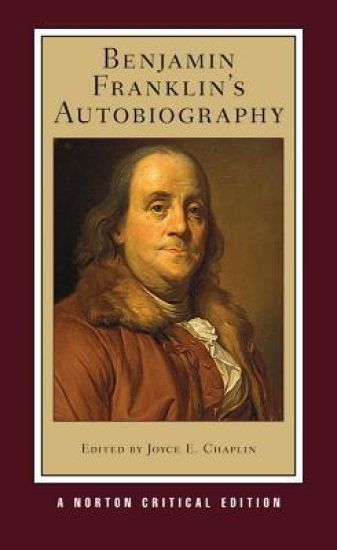
Benjamin Franklin's Autobiography

Benjamin Franklin's Autobiography

Benjamin Franklin

WW Norton Co
2012
nidottu

Halvin toimitettuna 27,30 €

Written during the most eventful years of Benjamin Franklin's life (1771–90), the Autobiography is one of the most influential memoirs in history. This newly edited Norton Critical Edition includes an introduction that explains the history of the Autobiography within the larger history of the life-writing genre as well as within the history of celebrity. The text is accompanied by new and expanded explanatory annotations and by a map, an illustration, and six facsimiles. “Contexts” presents a broader view of Franklin’s life with a journal entry from a 1726 voyage, correspondence, a Poor Richard piece on ambition and fame, Franklin’s views on self-improvement, and his last will (and codicil). “Criticism” draws on a wealth of material that reflects both the wide range of Franklin’s achievements and the global impact of his life and memoirs. New international voices in “Contemporary Opinions” include Immanuel Kant, Honoré Gabriel Riqueti, Comte de Mirabeau, José Antonio de Alzate y Ramírez, and José Francisco Correia da Serra. “Nineteenth-Century Opinions” includes Humphry Davy on Franklin’s discovery of electricity as well as Empress Shoken of Japan’s Franklin-inspired poem. Finally, “Modern Opinions” reprints important pieces: I. B. Cohen on Franklin and the Autobiography's importance to science; Michael Warner’s theoretical interpretation of the practices of writing and printing and what they tell us about Franklin; and Peter Stallybrass’s insightful and engaging history-of-the-book perspective on Franklin’s writing generally and the Autobiography specifically. A Chronology of Franklin’s life, a Selected Bibliography, and an Index are also included.
The Papers of Benjamin Franklin, Vol. 40

The Papers of Benjamin Franklin, Vol. 40

Benjamin Franklin

Yale University Press
2011
sidottu
The fortieth volume of the collected writings and correspondences of the American statesman, ambassador, and Founding Father Benjamin Franklin During the period of this volume, the United States of America completed its transformation into a fully recognized independent nation. In May, Franklin and his fellow American peace commissioners John Adams, John Jay, and Henry Laurens recommenced treaty negotiations with their new British counterpart David Hartley. Those negotiations proved fruitless, as the new British ministry rejected all proposals for additional articles. On September 3, 1783, the commissioners signed the Definitive Treaty of Peace, which was essentially identical to the preliminary articles signed the previous November. While this marked the official end of the War for American Independence, the nations of Europe had long since recognized the United States. In the spring, Franklin, as sole minister plenipotentiary, secretly negotiated draft commercial treaties with Denmark and Portugal. After being recognized by the diplomatic corps in early July, he received overtures from other ambassadors, including a proposal from the papal nuncio concerning American Catholics. Franklin published a French edition of the American state constitutions, which he sent to every monarch in Europe, witnessed the first hot-air balloon ascension, welcomed his grandson Benjamin Franklin Bache back from Geneva, and wrote to his friends that “There never was a good War or a bad Peace.”
The Life of Benjamin Franklin, Written by Himself

The Life of Benjamin Franklin, Written by Himself

Benjamin Franklin

Cambridge University Press
2011
pokkari
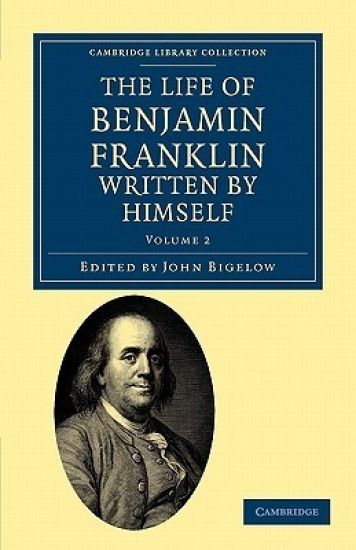
Benjamin Franklin (1706–90) is best known as an American revolutionary politician, but he also excelled as a printer, journalist and natural philosopher despite having little formal education. As a statesman, he was the only person to sign all three major documents of American statehood: the Declaration of Independence, the peace treaty with Britain, and the United States constitution. This three-volume set, first published in 1874, was compiled from Franklin's autobiography (covering the period up to 1857) and autobiographical passages from correspondence and other writings. Using Franklin's own words, it tells his remarkable story, which is integral to the political history of America. Franklin's account of self-discipline and motivation remains one of the most popular autobiographies of all time. Volume 2 of Franklin's Life describes his election as President of the American Philosophical Society and his involvement in drafting the Declaration of Independence and the Treaty of Alliance with France.
The Life of Benjamin Franklin, Written by Himself

The Life of Benjamin Franklin, Written by Himself

Benjamin Franklin

Cambridge University Press
2011
pokkari
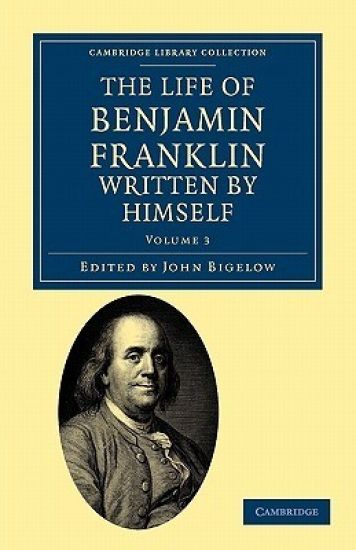
Benjamin Franklin (1706–90) is best known as an American revolutionary politician, but he also excelled as a printer, journalist and natural philosopher despite having little formal education. As a statesman, he was the only person to sign all three major documents of American statehood: the Declaration of Independence, the peace treaty with Britain, and the United States constitution. This three-volume set, first published in 1874, was compiled from Franklin's autobiography (covering the period up to 1857) and autobiographical passages from correspondence and other writings. Using Franklin's own words, it tells his remarkable story, which is integral to the political history of America. Franklin's account of self-discipline and motivation remains one of the most popular autobiographies of all time. Volume 3 of Franklin's Life covers the negotiation for peace with Great Britain, the drafting of the United States constitution, and his retirement from public life, and also contains his will.
The Life of Benjamin Franklin, Written by Himself

The Life of Benjamin Franklin, Written by Himself

Benjamin Franklin

Cambridge University Press
2011
pokkari
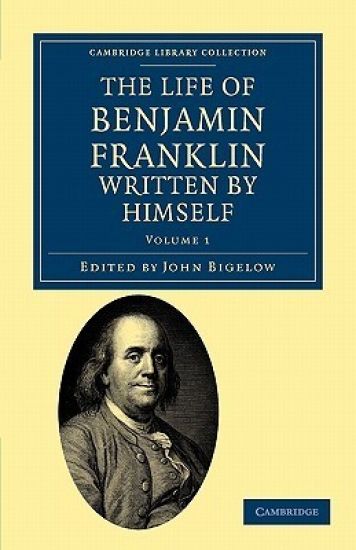
Benjamin Franklin (1706–90) is best known as an American revolutionary politician, but he also excelled as a printer, journalist and natural philosopher despite having little formal education. As a statesman, he was the only person to sign all three major documents of American statehood: the Declaration of Independence, the peace treaty with Britain, and the United States constitution. This three-volume set, first published in 1874, was compiled from Franklin's autobiography (covering the period up to 1857) and autobiographical passages from correspondence and other writings. Using Franklin's own words, it tells his remarkable story, which is integral to the political history of America. Franklin's account of self-discipline and motivation remains one of the most popular autobiographies of all time. Volume 1 of Franklin's Life contains his original autobiography, and also describes his experiments with lightning conductors, his opposition to the Stamp Act, and his examination before the House of Commons.