Kirjojen hintavertailu – 12 859 829 kirjaa ja 27 kauppaa

Kirjailija

Bernard Bolzano

Kirjat ja teokset yhdessä paikassa: 88 kirjaa, julkaisuja vuosilta 1969–2025, suosituimpiin kuuluu Bernard Bolzano Gesamtausgabe / Reihe III: Briefwechsel. Band 1,3: Briefe an Die Familie 1841-1848. Vertaile teosten hintoja ja tarkista saatavuus suomalaisista kirjakaupoista.

88 kirjaa

Kirjojen julkaisuvuodet: 1969–2025.

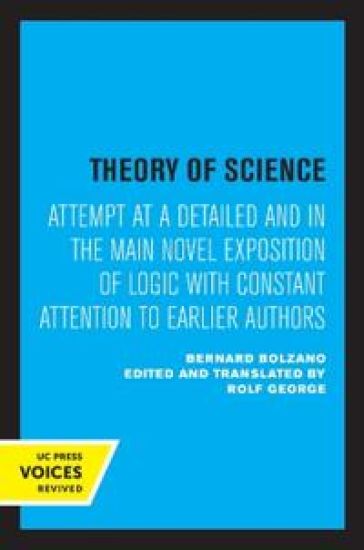
Theory of Science

Theory of Science

Bernard Bolzano

University of California Press
2022
pokkari
This title is part of UC Press's Voices Revived program, which commemorates University of California Press’s mission to seek out and cultivate the brightest minds and give them voice, reach, and impact. Drawing on a backlist dating to 1893, Voices Revived makes high-quality, peer-reviewed scholarship accessible once again using print-on-demand technology. This title was originally published in 1972.
Theory of Science

Theory of Science

Bernard Bolzano

University of California Press
2022
sidottu
This title is part of UC Press's Voices Revived program, which commemorates University of California Press’s mission to seek out and cultivate the brightest minds and give them voice, reach, and impact. Drawing on a backlist dating to 1893, Voices Revived makes high-quality, peer-reviewed scholarship accessible once again using print-on-demand technology. This title was originally published in 1972.
Bernard Bolzano Gesamtausgabe / Einleitungsbande. Band E 3: Bernard Bolzanos System Der Philosophie
English summary: Bernard Bolzano's work as a scholar and scientist was guided by the idea that all the truths of all fields of knowledge constitute an objective order given independently of our thinking and knowledge. This holds also for the truths of the various areas of philosophy such as logic and epistemology, metaphysics and philosophy of religion, ethics and political philosophy. It is the task of philosophy to discover these truths and their order. The result of this endeavour is the system of philosophy: it unites all the philosophical truths in a strict logical order. This system of philosophy is completely different from all the complacent philosophical systems from which Bolzano repeatedly disassociated himself. In his book Edgar Morscher presents a reconstruction of Bernard Bolzano's system of philosophy in accord with the latest developments of Bolzano research and uses all sources now available through the Bernard-Bolzano-Gesamtausgabe. German description: Bernard Bolzanos gesamtes wissenschaftliches Werk war von der grundlegenden Idee geleitet, dass alle Wahrheiten aller Wissensgebiete unabhangig vom menschlichen Denken und Erkennen in einer objektiven Ordnung vorgegeben sind. Das gilt insbesondere auch fur die Wahrheiten der einzelnen philosophischen Teilgebiete - angefangen von Logik und Erkenntnistheorie uber Metaphysik und Religionsphilosophie bis hin zu Ethik und Staatsphilosophie. Die Philosophie hat die Aufgabe, diese Wahrheiten und ihre Ordnung zu entdecken - so wird das System der Philosophie offen gelegt: In ihm werden alle philosophischen Wahrheiten zu einem einheitlichen und streng geordneten Ganzen zusammengefasst. Dieses System der Philosophie unterscheidet sich wesentlich von all den selbstgefalligen philosophischen Systemen, von denen sich Bolzano nachdrucklich distanziert hat. Edgar Morscher rekonstruiert in seinem Buch Bolzanos System der Philosophie nach dem neuesten Forschungsstand und unter Benutzung aller Quellen, die nunmehr durch die Bernard-Bolzano-Gesamtausgabe erschlossen sind.
Briefwechsel Mit Michael Josef Fesl 1831-1836

Briefwechsel Mit Michael Josef Fesl 1831-1836

Bernard Bolzano

Frommann-Holzboog
2020
sidottu
The first volume contains the correspondence between Bolzano and his student and friend M. J. Fesl between 1815 and 1827. Their letters deal mainly with the legal action taken by the church and the state against Fesl and Bolzano. Thus this volume is an important historical source for the so-called Bolzano trial. The correspondence between Bolzano and Fesl during the following years (1828-1848) deals with various subjects and gives important biographical information about Bolzano and Fesl. Furthermore there are some letters written by Bolzano to Fesl which are relevant from a philosophical perspective, in particular in view of Bolzano's theories on aesthetics.
Bernard Bolzano Gesamtausgabe / Reihe II: Nachlass. B. Wissenschaftliche Tagebucher. Band 12,2: Miscellanea Mathematica 22
English summary: The notes of part 22 of the Miscellanea Mathematica were written between July of 1830 and August of 1832. Bolzanos natural philosophy of his later years was based on the assumption that the entire universe had a nuclear particle structure. Unlike the classic atomist, he believed that there was an atom at every point in space. Thus there is no vacuum. This means that no substance is isolated. This made him question the opposite view which he had expressed previously in the Athanasia. His refutation in the second edition of the Athanasia is given in detail in the Miscellanea Mathematica. At the beginning of the Miscellanea Mathematica 22, he dealt with the definition of the concepts of space and time. According to Bolzano, the traditional definitions of the concepts of line, surface and solid were in need of improvement, and this induced him to give a detailed explanation. During the years of his reclusiveness after his dismissal in 1819 from his position as head of the department for religious studies at the University of Prague, Bolzano had been studying the logical foundations of mathematics and the foundations of logic. These studies were reflected in his theory of science. When he returned to pure mathematics after about a decade, he began work on a new encyclopedic work, the Grossenlehre, (Theory of Quantities). The notes in this volume contain a precisely structured plan of this work from the year 1831. In explaining the first arithmetical terms, Bolzano tries to avoid abstract terms. Some abstract terms are imaginary. Referring to contemporary scientific journals, he gives a report on imaginary and irrational quantities in the theory of numbers. On the basis of Legendres discussion of Galois problem of the solvability of algebraic equations, Bolzano suggests a simple method. He gives a detailed account of Gergonnes geometric treatment of Newtons method of finding the roots of a numerical equation by approximation and provides a counterexample for Fouriers assertion that a characteristic of the existence of the real roots of an equation also applies to transcendental roots. Furthermore he tries to find a simpler formulation of Cauchys proof that each polynomial has a complex root. Bolzano studies the proof provided by several famous analytic theorems. He mentions Cauchys simple and strict proof of Taylors theorem and Crelles attempt to expand this within the context of general theory of analytic functions. He studies Cauchys theory of the infinite, examines several theorems and works his way around to the theory of tangency and discusses infinite series. There are no infinite large and small numbers, these terms are meaningless. The pivotal concepts of continuity and continuous functions are dealt with in several places. What is particularly remarkable is the discussion of the determinability of the functions. There was deemed to be a discrepancy between Bolzanos theory of functions and his paradoxes of the infinite. One way to eliminate this discrepancy would be to find an exact definition of the concept of determinability. A continuous function f is exactly determinable when the difference (x+?x) -f(x) retains the same sign within certain values of x irregardless of how close they may be. Thus a determinable function is a continuous, piecewise monotonic function. German description: Die Notizen des Heftes 22 der Miscellanea Mathematica sind zwischen Juli 1830 und August 1832 entstanden. Bolzanos spate Naturphilosophie basiert auf der Annahme, dass das ganze Weltall eine atomare Teilchenstruktur hat. Im Unterschied zu den klassischen Atomisten war er der Ansicht, dass es in jedem Punkt des Raumes ein Atom gebe. Es existieren daher weder Vakuum noch isolierte Substanzen. Diese neuen Erkenntnisse veranlassten ihn, seine fruhere Auffassung zu hinterfragen. Sein Gegenargument wird in der Miscellanea Mathematica ausfuhrlich dargestellt. In seinen Jahren der Zuruckgezogenheit beschaftigte sich Bolzano mit den logischen Grundlagen der Mathematik und der Logik. Diese Untersuchungen haben in seiner Wissenschaftslehre ihren Niederschlag gefunden. Als er nach etwa einem Jahrzehnt zur reinen Mathematik zuruckkehrte, begann er ein neues, enzyklopadisches Werk, die Grossenlehre, zu entwerfen. In den vorliegenden Notizen findet sich ein genau gegliederter Plan dieses Werkes aus dem Jahr 1831.
Bernard Bolzano Gesamtausgabe / Reihe III: Briefwechsel. Band 1,3: Briefe an Die Familie 1841-1848
English summary: The volume I, 1-3 contains 19 letters written by Bolzano to his mother and 542 letters to his brother Johann. The last letter is dated September 7, 1848. Many of the letters deal with ordering and borrowing books and in addition with running everyday errands. Bolzano obviously did not discuss academic subjects with his mother and his brother. These letters do however constitute a significant documentation of his everyday life and his travels and are eloquent evidence of the way he dealt with his brother Johann and the affection with which he treated his mother. German description: Der Band I,1-3 enthalt 19 Briefe Bernard Bolzanos an seine Mutter und 542 Briefe an seinen Bruder Johann. An die Mutter sandte Bolzano seine Briefe 1819 und 1820 aus Raditsch. Der Absendeort von Bolzanos Briefen an seinen Bruder Johann war zwischen 1833 und 1841 Tiechobus und ab 1842 noch gelegentlich Tiechobus sowie Girna, Liboch und Tutschap. Der letzte Brief ist mit 7.9.1848 datiert. In vielen Briefen geht es um die Bestellung und das Entlehnen von Buchern, ausserdem um Alltagsbesorgungen. Naheliegender Weise hat Bolzano mit seiner Mutter und seinem Bruder keine wissenschaftlichen Themen besprochen. Diese Briefe stellen aber eine wichtige Dokumentation zu seinem Alltagsleben und seiner Reisetatigkeit dar, und sie sind beredte Zeugnisse fur seinen personlichen Umgang mit seinem Bruder Johann und fur seine fursorgliche Zuneigung zu seiner Mutter.
Bernard Bolzano Gesamtausgabe / Reihe III: Briefwechsel. Band 1,2: Briefe an Die Familie 1837-1840
English summary: The volume I, 1-3 contains 19 letters written by Bolzano to his mother and 542 letters to his brother Johann. The last letter is dated September 7, 1848. Many of the letters deal with ordering and borrowing books and in addition with running everyday errands. Bolzano obviously did not discuss academic subjects with his mother and his brother. These letters do however constitute a significant documentation of his everyday life and his travels and are eloquent evidence of the way he dealt with his brother Johann and the affection with which he treated his mother. German description: Der Band I,1-3 enthalt 19 Briefe Bernard Bolzanos an seine Mutter und 542 Briefe an seinen Bruder Johann. An die Mutter sandte Bolzano seine Briefe 1819 und 1820 aus Raditsch. Der Absendeort von Bolzanos Briefen an seinen Bruder Johann war zwischen 1833 und 1841 Tiechobus und ab 1842 noch gelegentlich Tiechobus sowie Girna, Liboch und Tutschap. Der letzte Brief ist mit 7.9.1848 datiert. In vielen Briefen geht es um die Bestellung und das Entlehnen von Buchern, ausserdem um Alltagsbesorgungen. Naheliegender Weise hat Bolzano mit seiner Mutter und seinem Bruder keine wissenschaftlichen Themen besprochen. Diese Briefe stellen aber eine wichtige Dokumentation zu seinem Alltagsleben und seiner Reisetatigkeit dar, und sie sind beredte Zeugnisse fur seinen personlichen Umgang mit seinem Bruder Johann und fur seine fursorgliche Zuneigung zu seiner Mutter.
Bernard Bolzano Gesamtausgabe / Reihe III: Briefwechsel. Band 1,1: Briefe an Die Familie 1819-1820 Und 1833-1836
English summary: The volume I,1-3 contains 19 letters written by Bolzano to his mother and 542 letters to his brother Johann. The last letter is dated September 7, 1848. Many of the letters deal with ordering and borrowing books and in addition with running everyday errands. Bolzano obviously did not discuss academic subjects with his mother and his brother. These letters do however constitute a significant documentation of his everyday life and his travels and are eloquent evidence of the way he dealt with his brother Johann and the affection with which he treated his mother. German description: Der Band I,1-3 enthalt 19 Briefe Bernard Bolzanos an seine Mutter und 542 Briefe an seinen Bruder Johann. An die Mutter sandte Bolzano seine Briefe 1819 und 1820 aus Raditsch. Der Absendeort von Bolzanos Briefen an seinen Bruder Johann war zwischen 1833 und 1841 Tiechobus und ab 1842 noch gelegentlich Tiechobus sowie Girna, Liboch und Tutschap. Der letzte Brief ist mit 7.9.1848 datiert. In vielen Briefen geht es um die Bestellung und das Entleihen von Buchern, ausserdem um Alltagsbesorgungen. Naheliegender Weise hat Bolzano mit seiner Mutter und seinem Bruder keine wissenschaftlichen Themen besprochen. Diese Briefe stellen aber eine wichtige Dokumentation zu seinem Alltagsleben und seiner Reisetatigkeit dar, und sie sind beredte Zeugnisse fur seinen personlichen Umgang mit seinem Bruder Johann und fur seine fursorgliche Zuneigung zu seiner Mutter.
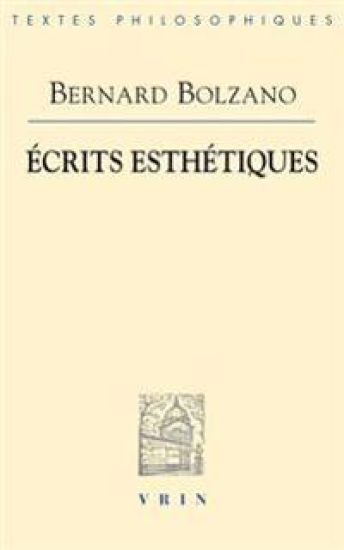
Ecrits Esthetiques

Ecrits Esthetiques

Bernard Bolzano

Librarie Philosophique J. Vrin
2017
nidottu
Bolzano ecrit deux grands textes au soir de sa vie sur l'esthetique et l'art: Du Concept du beau et De la division des beaux arts, ici regroupes et traduits pour la premiere fois. Ces Ecrits esthetiques s'inserent dans la publication des OEuvres choisies de Bolzano deja parues, ils temoignent de la variete des objets philosophiques auxquels il s'est interesse et de la precision conceptuelle a laquelle il les soumet. L'esthetique de Bolzano s'enracine dans le josephisme, s'inscrit dans le cadre de sa Theorie de la science, sans ignorer la profonde transformation de l'esthetique a l'articulation du XVIIIe et du XIXe siecle et les riches debats que cela induit. Les outils conceptuels dont il use le conduisent a penser le concept du beau selon un realisme de la signification couple a une reflexion originale sur l'ontologie de l'oeuvre d'art. La voie autrichienne originale en philosophie comme en esthetique qu'ouvrent ces Ecrits esthetiques, s'opposant a la tradition idealiste et romantique allemande, sera associee au XIXe siecle au formalisme esthetique de l'ecole de J. F. Herbart: ils offrent donc l'opportunite d'enrichir et de nuancer l'histoire de l'esthetique et de la philosophie de l'art de langue allemande en France.
Bernard Bolzano, Briefwechsel Mit Franz Exner

Bernard Bolzano, Briefwechsel Mit Franz Exner

Bernard Bolzano

Frommann-Holzboog
2016
sidottu
English summary: From a scholarly perspective, Bolzano most important correspondence was between 1833 and 1838 with Franz Exner, a professor of philosophy at the University of Prague at that time, who subsequently became the assistant head of the ministry of education and had a decisive influence on the Austrian school and university reforms. Bolzanos answers to Exners persistent questions and objections led to significant clarifications of his theory of propositions and ideas in themselves which provide considerably more information that can be found in Bolzanos publications on this subject. Thus the correspondence is an important source for the interpretation of this theory, which is fundamental to Bolzanos entire work. It was Eduard Winter who managed to have an edition of this correspondence published in 1935. However due to a lack of time this edition was inadequate. A new critical edition as part of the Complete Works of Bolzano has thus been a significant desideratum of Bolzano research for a long time. German description: Seinen wissenschaftlich bedeutsamsten Briefwechsel fuhrte Bolzano zwischen 1833 und 1838 mit Franz Exner, dem damaligen Professor fur Philosophie an der Universitat Prag, der spater als Ministerialrat im Unterrichtsministerium die osterreichische Schul- und Universitatsreform entscheidend mitgestaltete. Bolzanos Antworten auf Exners hartnackige Fragen und Einwande fuhrten zu wichtigen Klarstellungen seiner Lehre von den Satzen und Vorstellungen an sich, die wesentlich uber das hinausgehen, was man in Bolzanos Veroffentlichungen zu diesem Thema findet. Der Briefwechsel ist daher eine bedeutende Quelle fur die Interpretation dieser fur Bolzanos Gesamtwerk so grundlegenden Lehre. Eduard Winter gebuhrt das Verdienst, 1935 eine Edition des Briefwechsels zustandegebracht zu haben. Zeitbedingt blieb diese Edition allerdings mangelhaft. Eine kritische Neuausgabe im Rahmen der Bolzano-Gesamtausgabe ist daher seit Langem ein wichtiges Desiderat der Bolzano-Forschung.
Bernard Bolzano Gesamtausgabe / Reihe II: Nachlass. A. Nachgelassene Schriften. Band 24,2: Erbauungsreden Des Studienjahres 1818/1819. Zweiter Teil
English summary: From 1805 to 1820, Bernard Bolzano was professor of religious doctrine (Religionslehre) at the University of Prague. The lectures he had to deliver were part of the so-called Philosophical Studies that every student of the university had to complete before he entered the higher studies, i.e. the studies of medicine, law or theology. As professor of religious doctrine, Bolzano also had the duty to deliver the homilies on Sundays and holidays during the academic year to all the students of the Philosophical Studies. This explains the enormous influence Bolzano exerted through these homilies on the intellectual and political life of Bohemia in his time, whose offshoots reached even the Charta 77 movement in former Czechoslovakia. The chairs of religious doctrine were established by the Austrian emperor Franz at all universities of the Austrian empire in order to shape the students into good Christians and law-abiding citizens as it was ordered in a decree. The homilies Bolzano had to deliver at the University of Prague (as did all professors of religious doctrine at Austrian universities) were called Erbauungsreden (edifying addresses) or exhortations. There is evidence for 582 Erbauungsreden Bolzano delivered as a professor at the University of Prague of which 414 are extant; of these, 153 have not yet been published at all. The 414 Erbauungsreden that are extant have survived in different form: some of them (70) as autographs, i.e. in Bolzano's own handwriting, others in handwritten copies of Bolzano's manuscripts, others in notes taken by Bolzano's students. Several collections of Bolzano's Erbauungsreden have already appeared in print, some of them during Bolzano's lifetime, while others were published posthumously by his students or other editors. - The new critical edition of Bolzano's Erbauungsreden presents all of them in chronological order. Those which are extant will be edited on the basis of the best version which has remained. Those Erbauungsreden which are not extant will be documented and described according to an index Bolzano himself has prepared. German description: Dieses Studienjahr beginnt mit einem Paukenschlag: Am Ende des vorigen Studienjahres hat Bolzano bereits Zweifel geaussert, ob er im nachsten Jahr uberhaupt noch zu den Studierenden sprechen konne; mittlerweile hat das Verfahren gegen ihn schon begonnen. In der ersten Rede berichtet er seinen Studenten uber die gegen ihn erhobene Anklage. Er zahlt die Vorwurfe auf, die gegen ihn vorgebracht wurden, und fordert seine Schuler auf, diese Vorwurfe unvoreingenommen zu prufen. (Diese Selbstverteidigung wurde ihm im weiteren Verfahren zum Verhangnis und bildete letztlich den Anlass fur seine Absetzung.) Danach setzt er mit dem ublichen Programm fort, das auf wahre Aufklarung abzielt und wahren Glauben mit einschliesst. Er beginnt mit der Erklarung seines Obersten Sittengesetzes, das in der Forderung besteht, das allgemeine Wohl so stark wie nur moglich zu fordern. Danach spricht er uber die Wurde des geistlichen Standes, uber die Pflicht der Fursorge fur Kranke und - in einer langen Serie - uber die Notwendigkeit von Selbstkritik und Selbstreflexion. Er fuhrt nochmals seine originelle Auffassung von Wundern aus und unterstreicht die Vollkommenheit des christlichen Lehrbegriffes. Ferner warnt er vor den Verirrungen des Ehrtriebes und versucht, den schwankenden Begriff von der guten Lebensart zu klaren. Das Jahr endet Mitte August mit einer Erbauungsrede daruber, wie das Gute zu beurteilen ist, das wir schon gestiftet haben oder noch stiften werden; er schliesst mit dem Hinweis, in allem mit grosser Vorsicht zu Werke zu gehen. Er selbst war es freilich, der in der ersten Rede dieses Studienjahres diese Vorsicht nicht walten liess und ganz offen zu den Studierenden gesprochen hat.

Bernard Bolzano Gesamtausgabe / Reihe II: Nachlass. A. Nachgelassene Schriften. Band 24,1: Erbauungsreden Des Studienjahres 1818/1819. Erster Teil
English summary: From 1805 to 1820, Bernard Bolzano was professor of religious doctrine (Religionslehre) at the University of Prague. The lectures he had to deliver were part of the so-called Philosophical Studies that every student of the university had to complete before he entered the higher studies, i.e. the studies of medicine, law or theology. As professor of religious doctrine, Bolzano also had the duty to deliver the homilies on Sundays and holidays during the academic year to all the students of the Philosophical Studies. This explains the enormous influence Bolzano exerted through these homilies on the intellectual and political life of Bohemia in his time, whose offshoots reached even the Charta 77 movement in former Czechoslovakia. The chairs of religious doctrine were established by the Austrian emperor Franz at all universities of the Austrian empire in order to shape the students into good Christians and law-abiding citizens as it was ordered in a decree. The homilies Bolzano had to deliver at the University of Prague (as did all professors of religious doctrine at Austrian universities) were called Erbauungsreden (edifying addresses) or exhortations. There is evidence for 582 Erbauungsreden Bolzano delivered as a professor at the University of Prague of which 414 are extant; of these, 153 have not yet been published at all. The 414 Erbauungsreden that are extant have survived in different form: some of them (70) as autographs, i.e. in Bolzano's own handwriting, others in handwritten copies of Bolzano's manuscripts, others in notes taken by Bolzano's students. Several collections of Bolzano's Erbauungsreden have already appeared in print, some of them during Bolzano's lifetime, while others were published posthumously by his students or other editors. - The new critical edition of Bolzano's Erbauungsreden presents all of them in chronological order. Those which are extant will be edited on the basis of the best version which has remained. Those Erbauungsreden which are not extant will be documented and described according to an index Bolzano himself has prepared. German description: Dieses Studienjahr beginnt mit einem Paukenschlag: Am Ende des vorigen Studienjahres hat Bolzano bereits Zweifel geaussert, ob er im nachsten Jahr uberhaupt noch zu den Studierenden sprechen konne; mittlerweile hat das Verfahren gegen ihn schon begonnen. In der ersten Rede berichtet er seinen Studenten uber die gegen ihn erhobene Anklage. Er zahlt die Vorwurfe auf, die gegen ihn vorgebracht wurden, und fordert seine Schuler auf, diese Vorwurfe unvoreingenommen zu prufen. (Diese Selbstverteidigung wurde ihm im weiteren Verfahren zum Verhangnis und bildete letztlich den Anlass fur seine Absetzung.) Danach setzt er mit dem ublichen Programm fort, das auf wahre Aufklarung abzielt und wahren Glauben mit einschliesst. Er beginnt mit der Erklarung seines Obersten Sittengesetzes, das in der Forderung besteht, das allgemeine Wohl so stark wie nur moglich zu fordern. Danach spricht er uber die Wurde des geistlichen Standes, uber die Pflicht der Fursorge fur Kranke und - in einer langen Serie - uber die Notwendigkeit von Selbstkritik und Selbstreflexion. Er fuhrt nochmals seine originelle Auffassung von Wundern aus und unterstreicht die Vollkommenheit des christlichen Lehrbegriffes. Ferner warnt er vor den Verirrungen des Ehrtriebes und versucht, den schwankenden Begriff von der guten Lebensart zu klaren. Das Jahr endet Mitte August mit einer Erbauungsrede daruber, wie das Gute zu beurteilen ist, das wir schon gestiftet haben oder noch stiften werden; er schliesst mit dem Hinweis, in allem mit grosser Vorsicht zu Werke zu gehen. Er selbst war es freilich, der in der ersten Rede dieses Studienjahres diese Vorsicht nicht walten liess und ganz offen zu den Studierenden gesprochen hat.

Bernard Bolzano Gesamtausgabe / Einleitungsbande. Band 2,3: Bolzano-Gesamtbibliographie 1804-1999
English summary: This bibliography documents all of the works written by Bolzano and published up to December 31, 1999 (some of them anonymously), in chronological order, including all reprints, new editions and translations. In addition all those books and essays published up to this time whose titles establish a connection to Bolzano as well as further books, essays, reviews and articles in lexicons which are relevant for Bolzano research are registered here. Since many of Bolzano's works as well as those of his students and friends and his adversaries were published anonymously, these have been noted and put in chronological order in a section of their own (in many cases it was possible to identify the authors). German description: Diese Bibliographie dokumentiert in chronologischer Reihenfolge samtliche von Bolzano verfassten und bis 31. Dezember 1999 (zum Teil anonym) erschienenen Schriften mit allen Nachdrucken, Neuausgaben und Ubersetzungen. Ausserdem werden samtliche bis zu diesem Datum veroffentlichten Bucher und Aufsatze, deren Titel einen Bezug zu Bolzano herstellen, sowie weitere fur die Bolzano-Forschung relevante Bucher, Aufsatze, Rezensionen und Lexikon-Artikel registriert. Da viele Schriften Bolzanos, seiner Schuler und Freunde sowie seiner Gegner anonym erschienen sind, werden diese Anonyma in einem eigenen Abschnitt in chronologischer Reihenfolge bibliographisch erfasst (in vielen Fallen gelingt es, die Autoren zu identifizieren).
Paradoxes of the Infinite (Routledge Revivals)
Paradoxes of the Infinite presents one of the most insightful, yet strangely unacknowledged, mathematical treatises of the 19th century: Dr Bernard Bolzano’s Paradoxien. This volume contains an adept translation of the work itself by Donald A. Steele S. J., and in addition an historical introduction to the masterpiece, which includes a brief biography as well as an evaluation of Bolzano the mathematician, logician and physicist.