Kirjojen hintavertailu – 12 859 829 kirjaa ja 27 kauppaa

Kirjailija

Bernard Bolzano

Kirjat ja teokset yhdessä paikassa: 88 kirjaa, julkaisuja vuosilta 1969–2025, suosituimpiin kuuluu Bernard Bolzano Gesamtausgabe / Reihe III: Briefwechsel. Band 1,3: Briefe an Die Familie 1841-1848. Vertaile teosten hintoja ja tarkista saatavuus suomalaisista kirjakaupoista.

88 kirjaa

Kirjojen julkaisuvuodet: 1969–2025.

Bernard Bolzano, Erbauungsreden Der Studienjahre 1817/1818. Erster Teil
English summary: On the third Sunday in November of 1817, Bernard Bolzano began the twelfth annual cycle of his edification speeches. In this academic year he began by dealing with the students' responsibility to their parents and teachers but also to the opposite (female) sex and the society of mankind as a whole. In four of his speeches, he paid particular attention to the virtue of unselfishness. For Bolzano, the reasonable substantiation of the Christian religion was just as important, since it transcended natural religion in that it could not be explained completely by reason. Again and again Bolzano drew a new boundaries between natural religion and the Christian religion in a constant effort to ultimately establish these precisely. Bolzano's attempt to combine faith and reason ended in a balancing act. Although this was admired by some, many however viewed it with suspicion, misunderstood it and increasingly rejected it openly. This was one of the reasons for Bolzano to speak also of "the advantages and dangers in the precoccupation with ideals" and to draw up clear rules for the creation and application of ideas. In spite of all these difficulties, Bolzano tried to obtain a view of a better world by developing an appreciation of beauty. German description: Am dritten Sonntag im November 1817 beginnt Bernard Bolzano den nunmehr zwolften Jahreszyklus seiner Erbauungsreden. In diesem Studienjahr geht es zunachst um die Verantwortung der Studierenden gegenuber ihren Eltern und Lehrern, aber auch gegenuber dem anderen (namlich dem weiblichen) Geschlecht und der menschlichen Gesellschaft insgesamt. Der Tugend der 'Uneigennutzigkeit' gilt dabei (in 4 Reden) seine besondere Aufmerksamkeit. Ebenso wichtig ist Bolzano auch die vernunftige Begrundung der christlichen Religion, die uber die naturliche Religion insofern hinausgeht, als sie durch Vernunft nicht restlos erklarbar ist. Die Grenze zwischen naturlicher und christlicher Religion wird von Bolzano immer wieder neu abgesteckt und hinausgeschoben im standigen Bemuhen, sie schliesslich prazise zu ziehen. Bolzanos Versuch, Glaube und Vernunft miteinander zu verbinden, endet in einem Balanceakt. Dieser wird zwar von manchen bewundert, von vielen Seiten aber argwohnisch betrachtet, missverstanden und zunehmend auch offen abgelehnt. Nicht zuletzt deshalb spricht Bolzano dann auch uber 'Vorteile und Gefahren bei der Beschaftigung mit Idealen' und entwirft klare Regeln zur Bildung und Anwendung von Ideen. Uber all diese Schwierigkeiten hinaus bemuht sich Bolzano darum, durch die Entwicklung des 'Sinnes fur das Schone' einen Blick in eine bessere Welt zu gewinnen.

Bernard Bolzano, Erbauungsreden Der Studienjahre 1816/1817. Zweiter Teil
English summary: In this academic year, Bolzano persevered with his series of fundamental reforms. He began by explaining why these were necessary: It was time to replace superstition and error with a sensible faith in God and a religious enlightenment. The aim of this was to create better conditions for human beings in his native country Bohemia and ultimately everywhere on earth. He saw this as a task which could be accomplished with the combined efforts of all those who together were willing to stand up for the "good cause of mankind." Alliances of this nature were however observed with increasing distrust by the Austrian state. This was understandable, since in his work for a better society Bolzano was pressing for social justice in all forms, was calling for a "more reasonable" constitution, wanted to replace hereditary nobility with nobility of mind etc. His statements indicating that anyone who did not make every effort to support the common good did not deserve to live as far as he was concerned show how radical his thinking was in these issues. He condemned the misuse of intelligence such as "deceiving the world because it wanted to be deceived," as well as the abuse of religion. He recognized the excessive enthusiasm with which mainly those who were wise in the ways of the world or the romantics in Germany were afflicted in his time as a dangerous kind of rampant scientific uncertainty. He was not grimly determined in his way of doing things, but rather of a "cheerful disposition." German description: In diesem Studienjahr setzt Bernard Bolzano sein fundamentales Reform-Erziehungswerk konsequent fort. Zuerst begrundet er die Notwendigkeit desselben: Es ist an der Zeit, Aberglauben und Irrtum durch einen vernunftigen Gottesglauben und gewissenhafte Aufklarung zu ersetzen. Dadurch sollten bessere Zustande fur die Menschen konkret in seinem Heimatland Bohmen und schliesslich uberall auf Erden geschaffen werden. Dies sah er als eine Aufgabe, die mit vereinten Kraften jener, die sich gemeinschaftlich fur die 'gute Sache der Menschheit' einsetzten, zu bewaltigen ware. Solche Zusammenschlusse wurden allerdings vom osterreichischen Staat mit zunehmendem Misstrauen verfolgt. Das war auch verstandlich, denn Bolzano drangte bei seiner Arbeit an einer besseren Gesellschaft auf soziale Gerechtigkeit in allen Formen, regte eine 'vernunftigere' Verfassung an, wollte Geburtsadel durch Seelenadel ersetzt wissen usw. Wie radikal er in diesen Belangen war, zeigen seine Ausfuhrungen daruber, dass jemand, der nicht nach Kraften das Gemeinwohl forderte, aus seiner Sicht nicht zu leben verdiente. Er verurteilte Missbrauche der Klugheit, wie 'die Welt zu betrugen, weil sie eben betrogen sein wolle' ebenso wie Missbrauche der Religion. Als gefahrliche Art um sich greifender wissenschaftlicher Unklarheit erkannte er die 'Schwarmerei', von der er vor allem die Weltweisen und Romantiker Deutschlands seiner Zeit stark befallen sah. Das alles betrieb er keineswegs verbissen, sondern 'mit heiterer Sinnesart'.
Bernard Bolzano, Erbauungsreden Der Studienjahre 1816/1817. Erster Teil
English summary: In this academic year, Bolzano persevered with his series of fundamental reforms. He began by explaining why these were necessary: It was time to replace superstition and error with a sensible faith in God and a religious enlightenment. The aim of this was to create better conditions for human beings in his native country Bohemia and ultimately everywhere on earth. He saw this as a task which could be accomplished with the combined efforts of all those who together were willing to stand up for the "good cause of mankind." Alliances of this nature were however observed with increasing distrust by the Austrian state. This was understandable, since in his work for a better society Bolzano was pressing for social justice in all forms, was calling for a "more reasonable" constitution, wanted to replace hereditary nobility with nobility of mind etc. His statements indicating that anyone who did not make every effort to support the common good did not deserve to live as far as he was concerned show how radical his thinking was in these issues. He condemned the misuse of intelligence such as "deceiving the world because it wanted to be deceived," as well as the abuse of religion. He recognized the excessive enthusiasm with which mainly those who were wise in the ways of the world or the romantics in Germany were afflicted in his time as a dangerous kind of rampant scientific uncertainty. He was not grimly determined in his way of doing things, but rather of a "cheerful disposition." German description: In diesem Studienjahr setzt Bernard Bolzano sein fundamentales Reform-Erziehungswerk konsequent fort. Zuerst begrundet er die Notwendigkeit desselben: Es ist an der Zeit, Aberglauben und Irrtum durch einen vernunftigen Gottesglauben und gewissenhafte Aufklarung zu ersetzen. Dadurch sollten bessere Zustande fur die Menschen konkret in seinem Heimatland Bohmen und schliesslich uberall auf Erden geschaffen werden. Dies sah er als eine Aufgabe, die mit vereinten Kraften jener, die sich gemeinschaftlich fur die 'gute Sache der Menschheit' einsetzten, zu bewaltigen ware. Solche Zusammenschlusse wurden allerdings vom osterreichischen Staat mit zunehmendem Misstrauen verfolgt. Das war auch verstandlich, denn Bolzano drangte bei seiner Arbeit an einer besseren Gesellschaft auf soziale Gerechtigkeit in allen Formen, regte eine 'vernunftigere' Verfassung an, wollte Geburtsadel durch Seelenadel ersetzt wissen usw. Wie radikal er in diesen Belangen war, zeigen seine Ausfuhrungen daruber, dass jemand, der nicht nach Kraften das Gemeinwohl forderte, aus seiner Sicht nicht zu leben verdiente. Er verurteilte Missbrauche der Klugheit, wie 'die Welt zu betrugen, weil sie eben betrogen sein wolle' ebenso wie Missbrauche der Religion. Als gefahrliche Art um sich greifender wissenschaftlicher Unklarheit erkannte er die 'Schwarmerei', von der er vor allem die Weltweisen und Romantiker Deutschlands seiner Zeit stark befallen sah. Das alles betrieb er keineswegs verbissen, sondern 'mit heiterer Sinnesart'.
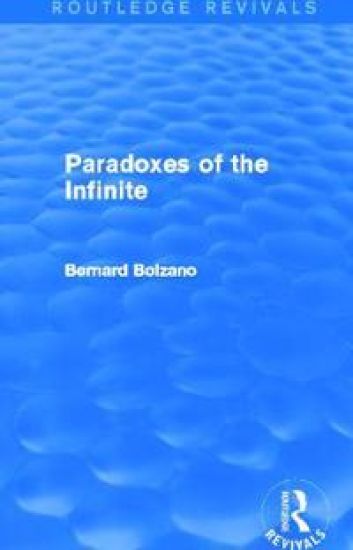
Paradoxes of the Infinite (Routledge Revivals)
Paradoxes of the Infinite presents one of the most insightful, yet strangely unacknowledged, mathematical treatises of the 19th century: Dr Bernard Bolzano’s Paradoxien. This volume contains an adept translation of the work itself by Donald A. Steele S. J., and in addition an historical introduction, which includes a brief biography as well as an evaluation of Bolzano the mathematician, logician and physicist.
Bernard Bolzano, Erbauungsreden Der Studienjahre 1815/1816. Erster Teil
English summary: In the first speech he held after taking a break for two and a half years due to illness, Bernard Bolzano bemoaned the death of his sister Franziska, at whose sick bed his latent lung disease had gotten much worse and became life-threatening. He did however also announce that he was undaunted and would continue his comprehensive series of reforms, pointing out that there were still many new things, and things worth knowing, to be said and that with a combined effort it would certainly be possible to bring about an "improved shape of things." While he was ill, Bolzano himself had begun, along with his friends and students, to organize, collect and transcribe the edification speeches he had held up to that time. The result of this is that all 45 speeches held in that academic year have been preserved, many of them even in several different transcriptions. In these speeches, Bolzano talks about conduct toward the "enemies of the Enlightenment", about theatrical performances, musical art, the relationship between the two tribes in Bohemia and many other subjects. German description: In der ersten Rede nach der zweieinhalbjahrigen krankheitsbedingten Pause beklagt Bernard Bolzano den Tod seiner Schwester Franziska, an deren Krankenbett sich seine latente Lungenkrankheit lebensgefahrlich verschlimmert hat. Er kundigt aber gleich an, sein umfassendes Reformwerk unverdrossen fortzusetzen, und weist darauf hin, dass es noch sehr viel Neues und Wissenswertes zu sagen gebe und dass mit vereinten Kraften sehr wohl eine 'verbesserte Gestalt der Dinge' herbeigefuhrt werden konne. Wahrend der Krankheitsphase haben Bolzano selbst sowie seine Freunde und Schuler begonnen, die bisher gehaltenen Erbauungsreden zu ordnen, zu sammeln und abzuschreiben. Als Ergebnis dieser Tatigkeit sind alle 45 in diesem Studienjahr gehaltenen Reden, grossteils sogar in vielfachen Abschriften, erhalten geblieben. In diesen Reden spricht Bolzano uber das Verhalten gegen die 'Feinde der Aufklarung', uber das Schauspiel, die Tonkunst, das Verhaltnis der beiden Volksstamme in Bohmen und noch vieles mehr.
Bernard Bolzano, Erbauungsreden Des Studienjahres 1811/1812. Erster Teil
English summary: In the academic year 1811/1812, Bolzano held 46 edification speeches. All of these have been preserved completely and in multiple versions, with one exception which has only been preserved in the form of written notes (1812.40). Bolzano's own lecture notes for 10 of the speeches serve as a basis for the edition. 22 speeches were previously unpublished. 16 of the 46 speeches deal with religious issues, the other 30 give secular advice. German description: Im Studienjahr 1811/1812 hat Bolzano 46 Erbauungsreden gehalten. Sie sind alle vollstandig und mehrfach uberliefert - mit einer Ausnahme, die nur in einer Mitschrift vorliegt (1812.40). Bei zehn Reden dienen Bolzanos eigene Vorlesungsunterlagen als Editionsgrundlage; 22 Reden sind bisher unveroffentlicht. Ihrem Inhalt nach sind 16 von den insgesamt 46 Reden religiosen Charakters, die restlichen 30 dienen weltlicher Beratung.
Bernard Bolzano, Erbauungsreden Des Studienjahres 1810/1811. Zweiter Teil
English summary: In the academic year 1810/1811, Bolzano held 49 edification speeches. All of these speeches have been preserved. Bolzano's handwritten drafts of 13 speeches have been preserved, and the edition is based on these. Three of these autographs were rediscovered during the preparations for this edition. Thus among all the edification speeches held in all the academic years, those speeches he held in 1810/1811 have been proven to be the most authentic. Approximately half of the speeches (24) were previously unpublished. The fact that these speeches have been preserved in their entirety and in multiple documents is evidence of the extraordinary success of Bolzano's rhetorical concept. German description: Im Studienjahr 1810/1811 hat Bolzano 49 Erbauungsreden gehalten. Alle Reden dieses Jahres sind erhalten geblieben. Von 13 Reden ist das handschriftliche Konzept Bolzanos erhalten, das der Edition zugrunde gelegt wurde; drei dieser Autographen konnten im Verlauf der Vorbereitungen zu dieser Ausgabe wiederentdeckt werden. Damit sind unter den Erbauungsreden aller Studienjahre diejenigen von 1810/1811 mit der hochsten Authentizitat belegt. Etwa die Halfte der Reden (24) ist bisher unveroffentlicht. Die vollstandige und vielfache Belegung der Reden bestatigt den aussergewohnlichen Erfolg von Bolzanos rhetorischem Konzept.
Bernard Bolzano: Premiers Ecrits: Philosophie, Logique, Mathematique

Bernard Bolzano: Premiers Ecrits: Philosophie, Logique, Mathematique

Bernard Bolzano

Librarie Philosophique J. Vrin
2010
nidottu
Qu'est que la mathematique? Quel role y joue l'intuition? Sur quels principes repose-t-elle? Les Premiers ecrits de Bolzano proposent une reponse. Ils reunissent les oeuvres philosophiques, logiques et mathematiques les plus representatives de la periode de son activite publique, de 1804 a sa revocation de l'universite en 1819, et sont groupes autour de deux textes fondamentaux: les Contributions a un expose mieux fonde de la mathematique (1810) et la Demonstration purement analytique (1817), completee par des extraits de la Theorie des fonctions. Les Contributions, bien que tributaires en partie de Kant, renouvellent l'heritage leibnizien en soulignant le caractere objectif de la science. Accueillies par Goethe - un petit ouvrage distingue par sa valeur et son esprit - et commentees par Husserl, elles constituent une premiere etude moderne des fondements de la mathematique, dont les notions de demonstration et d'organisation deductive du savoir sont les pivots. En annexe, Bolzano offre une critique penetrante de la philosophie de Kant. La Demonstration purement analytique, un petit classique d'histoire et de philosophie de la mathematique, inaugure avant Cauchy l'arithmetisation de l'analyse infinitesimale. Ces ecrits sont precedes d'une Introduction qui les etudie dans leurs contexte politique, culturel et scientifique.
Bernard Bolzano, Philosophische Tagebucher 1803-1810. Zweiter Teil
English summary: The diary entries in volume 15, written between 1808 and 1810, contain the groundwork for the Beytragen zu einer begrundeteren Darstellung der Mathematik (Contributions to a Better Grounded Presentation of Mathematics). In it, Bolzano deals with issues pertaining to the theory of concepts and syllogistics as well as the distinction between a priori and a posteriori judgments and between cause and effect. German description: Bolzanos philosophische Tagebucher erstrecken sich uber den Zeitraum von 1803 bis 1844. Von diesen Handschriften sind die Tagebucher 1811-44 bereits nahezu luckenlos in der Bernard Bolzano-Gesamtausgabe veroffentlicht, hingegen fehlt bislang noch eine editorische Bearbeitung der fruhen Jahre. Mit den Banden II B 14 und II B 15 wird nun eine gravierende Lucke geschlossen. In diesen Tagebucheintragungen von 1803 bis 1810 finden Themen aus Padagogik und Psychologie, Erkenntnistheorie, Ontologie, Logik, Theologie und Moralphilosophie ausfuhrliche Wurdigung. Unter anderem werden Urteile a priori und a posteriori, analytische und synthetische Urteile, die Begriffe der Ursache und Wirkung sowie syllogistische Beweise diskutiert. Daruberhinaus setzt sich Bolzano mit Pflicht, Tugend, Gluckseligkeit und der Unsterblichkeit der Seele auseinander.
Bernard Bolzano, Philosophische Tagebucher 1803-1810. Erster Teil
English summary: In the 14th volume of the diary entries between 1803 and 1808, Bolzano deals in detail with subjects pertaining to education and psychology, epistemology, ontology, logic, theology and moral philosophy. Among other things, he discusses the distinctions between a priori and a posteriori judgments as well as between analytic and synthetic judgments, the concepts of cause and effect, as well as syllogistic proof. In addition Bolzano studies duty, virtue, happiness and the immortality of the soul. German description: Bolzanos philosophische Tagebucher erstrecken sich uber den Zeitraum von 1803 bis 1844. Von diesen Handschriften sind die Tagebucher 1811-44 bereits nahezu luckenlos in der Bernard Bolzano-Gesamtausgabe veroffentlicht, hingegen fehlt bislang noch eine editorische Bearbeitung der fruhen Jahre. Mit den Banden II B 14 und II B 15 wird nun eine gravierende Lucke geschlossen. In diesen Tagebucheintragungen von 1803 bis 1810 finden Themen aus Padagogik und Psychologie, Erkenntnistheorie, Ontologie, Logik, Theologie und Moralphilosophie ausfuhrliche Wurdigung. Unter anderem werden Urteile a priori und a posteriori, analytische und synthetische Urteile, die Begriffe der Ursache und Wirkung sowie syllogistische Beweise diskutiert. Daruber hinaus setzt sich Bolzano mit Pflicht, Tugend, Gluckseligkeit und der Unsterblichkeit der Seele auseinander.
Bernard Bolzano, Erbauungsreden Des Studienjahres 1809/1810. Erster Teil
From 1805 to 1820, Bernard Bolzano was professor of religious doctrine (Religionslehre) at the University of Prague. The lectures he had to deliver were part of the so-called Philosophical Studies that every student of the university had to complete before he entered the higher studies, i.e. the studies of medicine, law or theology. As professor of religious doctrine, Bolzano also had the duty to deliver the homilies on Sundays and holidays during the academic year to all the students of the Philosophical Studies. This explains the enormous influence Bolzano exerted through these homilies on the intellectual and political life of Bohemia in his time, whose offshoots reached even the Charta 77 movement in former Czechoslovakia. The chairs of religious doctrine were established by the Austrian emperor Franz at all universities of the Austrian empire in order to shape the students into good Christians and law-abiding citizens as it was ordered in a decree. The homilies Bolzano had to deliver at the University of Prague (as did all professors of religious doctrine at Austrian universities) were called Erbauungsreden (edifying addresses) or exhortations. There is evidence for 582 Erbauungsreden Bolzano delivered as a professor at the University of Prague of which 414 are extant; of these, 153 have not yet been published at all. The 414 Erbauungsreden that are extant have survived in different form: some of them (70) as autographs, i.e. in Bolzano's own handwriting, others in handwritten copies of Bolzano's manuscripts, others in notes taken by Bolzano's students. Several collections of Bolzano's Erbauungsreden have already appeared in print, some of them during Bolzano's lifetime, while others were published posthumously by his students or other editors. - The new critical edition of Bolzano's Erbauungsreden presents all of them in chronological order. Those which are extant will be edited on the basis of the best version which has remained. Those Erbauungsreden which are not extant will be documented and described according to an index Bolzano himself has prepared. Bolzano held more edification speeches in the academic year 1809/1810 that in any other year in which he was teaching. During this time he held 52 of these speeches. Six speeches have been preserved as autographs, there are only notes for four of the speeches, and only the dates are known for two of the speeches. Most of the others are still in existence as transcripts reproduced in facsimile. In the edification speeches held in the academic year 1809/1810, Bolzano's concept of education, which includes the entire personality, is shown especially clearly. There are twice as many speeches which have a generally advisory content than there are speeches which deal mainly with religious issues. In keinem anderen Jahr seiner Lehrtatigkeit hat Bolzano so viele Erbauungsreden gehalten wie im Studienjahr 1809/1810, in dem er es auf 52 brachte. Sechs Reden sind als Autographen erhalten; von vier Reden haben wir nur Notizen, von zwei ist nur das Datum bekannt. Alle anderen sind grossteils mehrfach in orignalgetreuen Abschriften uberliefert. - In den Erbauungsreden des Studienjahres 1809/1810 wird Bolzanos Erziehungskonzept, das die gesamte Personlichkeit umfasst, besonders deutlich. Den Reden, die hauptsachlich religiose Fragen behandeln, stehen doppelt so viele Reden allgemein beratenden Inhalts gegenuber.
Bernard Bolzano, Erbauungsreden Des Studienjahres 1808/1809. Erster Teil
English summary: From 1805 to 1820, Bernard Bolzano was professor of religious doctrine (Religionslehre) at the University of Prague. The lectures he had to deliver were part of the so-called Philosophical Studies that every student of the university had to complete before he entered the higher studies, i.e. the studies of medicine, law or theology. As professor of religious doctrine, Bolzano also had the duty to deliver the homilies on Sundays and holidays during the academic year to all the students of the Philosophical Studies. This explains the enormous influence Bolzano exerted through these homilies on the intellectual and political life of Bohemia in his time, whose offshoots reached even the Charta 77 movement in former Czechoslovakia. The chairs of religious doctrine were established by the Austrian emperor Franz at all universities of the Austrian empire in order to shape the students into good Christians and law-abiding citizens as it was ordered in a decree. The homilies Bolzano had to deliver at the University of Prague (as did all professors of religious doctrine at Austrian universities) were called Erbauungsreden (edifying addresses) or exhortations. There is evidence for 582 Erbauungsreden Bolzano delivered as a professor at the University of Prague of which 414 are extant; of these, 153 have not yet been published at all. The 414 Erbauungsreden that are extant have survived in different form: some of them (70) as autographs, i.e. in Bolzano's own handwriting, others in handwritten copies of Bolzano's manuscripts, others in notes taken by Bolzano's students. Several collections of Bolzano's Erbauungsreden have already appeared in print, some of them during Bolzano's lifetime, while others were published posthumously by his students or other editors. - The new critical edition of Bolzano's Erbauungsreden presents all of them in chronological order. Those which are extant will be edited on the basis of the best version which has remained. Those Erbauungsreden which are not extant will be documented and described according to an index Bolzano himself has prepared. Due to the increasing popularity of the edification speeches, 41 of the 51 speeches which Bolzano held in the academic year 1808/09 have been handed down as transcripts and 7 of them as written notes, most of them several times. Two of these are autographs. There are only three texts (numbers 1, 2 and 4) which were lost and these are documented in an autographic index. The ratio of homiletic speeches to generally edifying speeches was the opposite of the first four years (and remained this way until the end of Bolzano's professional career): Approximately one third of the speeches dealt with exegesis, primarily on important church holidays, and two thirds dealt with educational, ideological and political subjects. German description: Aufgrund der steigenden Beliebtheit der Erbauungsreden sind von den 51 Reden, die Bolzano im Studienjahr 1808/09 gehalten hat, bereits 41 in Abschriften und sieben in Mitschriften, grossteils sogar mehrfach, uberliefert; zwei davon liegen als Autographen vor. Nur drei Texte (Nr. 1, 2 und 4) sind verschollen und werden mittels autographischem Index dokumentiert. - Das Verhaltnis zwischen homiletischen und allgemein erbaulichen Reden hat sich gegenuber den ersten vier Jahren umgekehrt (und bleibt so bis zum Ende von Bolzanos beruflicher Tatigkeit): Etwa ein Drittel der Reden ist nunmehr, vorwiegend an hohen kirchlichen Feiertagen, der Exegese gewidmet, zwei Drittel beschaftigen sich mit padagogischen, weltanschaulichen und politischen Themen.
Bernard Bolzano, Erbauungsreden Der Studienjahre 1804/05 Bis 1807/08
From 1805 to 1820, Bernard Bolzano was professor of religious doctrine (Religionslehre) at the University of Prague. The lectures he had to deliver were part of the so-called Philosophical Studies that every student of the university had to complete before he entered the higher studies, i.e. the studies of medicine, law or theology. As professor of religious doctrine, Bolzano also had the duty to deliver the homilies on Sundays and holidays during the academic year to all the students of the Philosophical Studies. This explains the enormous influence Bolzano exerted through these homilies on the intellectual and political life of Bohemia in his time, whose offshoots reached even the Charta 77 movement in former Czechoslovakia. The chairs of religious doctrine were established by the Austrian emperor Franz at all universities of the Austrian empire in order to shape the students into good Christians and law-abiding citizens as it was ordered in a decree. The homilies Bolzano had to deliver at the University of Prague (as did all professors of religious doctrine at Austrian universities) were called Erbauungsreden (edifying addresses) or exhortations. There is evidence for 582 Erbauungsreden Bolzano delivered as a professor at the University of Prague of which 414 are extant; of these, 153 have not yet been published at all. The 414 Erbauungsreden that are extant have survived in different form: some of them (70) as autographs, i.e. in Bolzano's own handwriting, others in handwritten copies of Bolzano's manuscripts, others in notes taken by Bolzano's students. Several collections of Bolzano's Erbauungsreden have already appeared in print, some of them during Bolzano's lifetime, while others were published posthumously by his students or other editors. - The new critical edition of Bolzano's Erbauungsreden presents all of them in chronological order. Those which are extant will be edited on the basis of the best version which has remained. Those Erbauungsreden which are not extant will be documented and described according to an index Bolzano himself has prepared. In Bernard Bolzano's first four academic years as a professor at the University of Prague he held 169 edification speeches, of which however only 13 have been preserved. An index which Bolzano compiled himself does however provide information on the content of all the other edification speeches held during this time. This volume contains a complete documentation of all the edification speeches which Bolzano held up to the end of the academic year 1807/08. In den ersten vier Studienjahren, in denen Bernard Bolzano als Professor an der Universitat Prag tatig war, hat er 169 Erbauungsreden gehalten, von denen jedoch nur 13 erhalten sind. Ein von Bolzano selbst verfasstes Verzeichnis gibt aber auch uber den Inhalt aller anderen Erbauungsreden aus dieser Zeit Auskunft. So bietet dieser Band eine vollstandige Dokumentation samtlicher Erbauungsreden, die Bolzano bis zum Ende des Studienjahres 1807/ 08 gehalten hat. 'This first volume of Erbauungsreden] follows the same high scholarly standards as previous volumes of this monumental edition of Bolzano's works.' Albert C. Lewis, Zentralblatt Mathematik
Bernard Bolzano, Katalog Des Bolzano-Nachlasses Im Literaturarchiv Des Museums Der Nationalen Literatur in Prag: A. Einleitung - B. Katalog Des Nachla
English summary: The comprehensive Prague literary estate contains manuscripts with philosophical, theological, scientific and biographical content as well as letters. These manuscripts were amended and arranged by Pavel Krivsky. The description of the contents, which he wrote together with Marie Pavlikova in the Czech language, has been translated into German by Jaromir Louzil. In conjunction with the new complete bibliography and the first section of the second introductory volume, this concludes the complete and exact compilation of Bolzano's published and unpublished works. German description: Der umfangreiche Prager Nachlass enthalt Manuskripte philosophischen, theologischen, naturwissenschaftlichen und biographischen Inhalts sowie Briefe. Diesen Nachlass hat Pavel Krivsky erganzt und geordnet. Die von ihm mit Marie Pavlikova in tschechischer Sprache verfasste Inhaltsbeschreibung wurde von Jaromir Louzil ins Deutsche ubertragen. In Verbindung mit der neuen Gesamtbibliographie und der ersten Abteilung des zweiten Einleitungsbandes ist damit die vollstandige und exakte Erfassung des veroffentlichten und unveroffentlichten Werkes Bolzanos Jabgeschlossen.
Bernard Bolzano, Lehrbuch Der Religionswissenschaft. Dritter Teil. 235-303
English summary: The lectures which Bernard Bolzano held from 1805 up to his dismissal in January of 1820 as a professor for Catholic religious education at the University of Prague in the context of the philosophical studies were published anonymously in 1834 in a four-volume edition with which Bolzano was very unhappy. As part of the collected works of Bolzano there is now for the first time a new critical edition of this work which includes the corrections and variants of a master copy authorized by Bolzano. The textbook is divided into three parts: In the first part Bolzano explains the concept of religion and other terms which are essential for his philosophy of religion and presents the most important theories of natural religion and rational religion, divided into "natural dogmatics" and "natural morality." In the second part, Bolzano studies the miracles which serve as a confirmation of Catholic Christianity. In the third part, he describes the individual individual articles of faith of "Old Catholic dogmatics" and those of "Old Catholic morality." German description: Im dritten Teil seines Lehrbuchs der Religionswissenschaft behandelt Bolzano systematisch die Lehren des Katholizismus, wie er sie in den Jahren 1806 bis 1819 an der philosophischen Fakultat der Karl-Ferdinand-Universitat in Prag vorgetragen hat. Die ganze Dogmatik gliedert er in katholische Theologie - oder die Lehre von Gott - und katholische Kosmologie - oder die Lehre von der Schopfung
Bernard Bolzano, Briefe an Frantisek Prihonsky 1836-1845
English summary: These three volumes from the set provide the complete edition of the 261 letters still in existence written by Bolzanos between 1824 and 1848 to his most important student Frantisek Prihonsky. Annotations, a bibliography and indexes have been added to these. These letters reflect many aspects of Bolzanos personal circumstances and shed light on the relationships to his circle of friends. They also provide information about his work as a writer in the last decades of his life. It was during this time that he wrote most of his scientific works. German description: Die drei Teilbande 3,1 bis 3,3 bieten die vollstandige Edition der 261 erhaltenen Briefe Bolzanos aus den Jahren 1824 bis 1848 an seinen wichtigsten Schuler Frantisek Prihonsky, erganzt um Anmerkungen, eine Bibliographie und Register. Diese Briefe spiegeln viele Aspekte der Lebensumstande Bolzanos wider und erhellen die Beziehungen zu seinem Freundeskreis; sie geben Auskunft uber seine schriftstellerische Tatigkeit in den letzten Jahrzehnten seines Lebens, in denen die meisten seiner wissenschaftlichen Werke entstanden sind.