Kirjojen hintavertailu – 12 859 827 kirjaa ja 27 kauppaa

Kirjailija

Bill McKibben

Kirjat ja teokset yhdessä paikassa: 83 kirjaa, julkaisuja vuosilta 1996–2026, suosituimpiin kuuluu Aldo Leopold's Odyssey, Tenth Anniversary Edition. Vertaile teosten hintoja ja tarkista saatavuus suomalaisista kirjakaupoista.

83 kirjaa

Kirjojen julkaisuvuodet: 1996–2026.

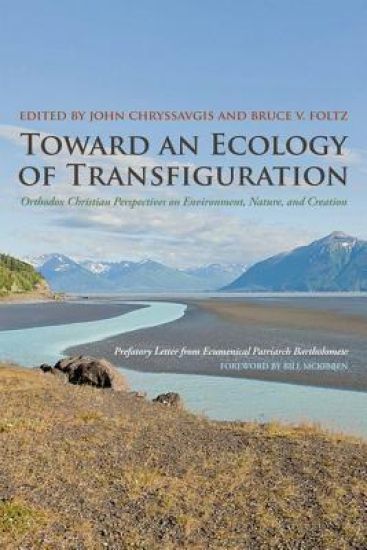
Toward an Ecology of Transfiguration

Toward an Ecology of Transfiguration

Bill McKibben

Fordham University Press
2013
sidottu
Can Orthodox Christianity offer spiritual resources uniquely suited to the environmental concerns of today? This book makes the case emphatically that it can indeed. In addition to being the first substantial and comprehensive collection of essays, in any language, to address environmental issues from the Orthodox point of view, this volume (with contributions from many of the most influential theologians and philosophers in contemporary world Orthodoxy) will engage a wide audience, in academic as well as popular circles—resonating not only with Orthodox audiences but with all those in search of a fresh approach to environmental theory and ethics that can bring to bear the resources of ancient spirituality, often virtually unknown in the West, on modern challenges and dilemmas.
Hundred Dollar Holiday: The Case for a More Joyful Christmas
Too many people have come to dread the approach of the holidays, a season that should -- and can -- be the most relaxed, intimate, joyful, and spiritual time of the year. In this book, Bill McKibben offers some suggestions on how to rethink Christmastime, so that our current obsession with present-buying becomes less important than the dozens of other possible traditions and celebrations. Working through their local churches, McKibben and his colleagues found that people were hungry for a more joyful Christmas season. For many, trying to limit the amount of money they spent at Christmas to about a hundred dollars per family, was a real spur to their creativity -- and a real anchor against the relentless onslaught of commercials and catalogs that try to say Christmas is only Christmas if it comes from a store. McKibben shows how the store-bought Christmas developed and how out of tune it is with our current lives, when we're really eager for family fellowship for community involvement, for contact with the natural world, and also for the blessed silence and peace that the season should offer. McKibben shows us how to return to a simpler and more enjoyable holiday. Christmas is too wonderful a celebration to give up on, too precious a time simply to repeat the same empty gestures from year to year. This book will serve as a road map to a Christmas far more joyful than the ones you've known in the past.
The Zero-Waste Lifestyle

The Zero-Waste Lifestyle

Amy Korst; Bill McKibben

Ten Speed Press
2012
pokkari
A practical guide to generating less waste, featuring meaningful and achievable strategies from the blogger behind The Green Garbage Project, a yearlong experiment in living garbage-free. Trash is a big, dirty problem. The average American tosses out nearly 2,000 pounds of garbage every year that piles up in landfills and threatens our air and water quality. You do your part to reduce, reuse, and recycle, but is it enough? In The Zero-Waste Lifestyle, Amy Korst shows you how to lead a healthier, happier, and more sustainable life by generating less garbage. Drawing from lessons she learned during a yearlong experiment in zero-waste living, Amy outlines hundreds of easy ideas--from the simple to the radical--for consuming and throwing away less, with low-impact tips on the best ways to: - Buy eggs from a local farm instead of the grocery store- Start a worm bin for composting- Grow your own loofah sponges and mix up eco-friendly cleaning solutions- Purchase gently used items and donate them when you're finished- Shop the bulk aisle and keep reusable bags in your purse or car- Bring your own containers for take-out or restaurant leftovers By eliminating unnecessary items in every aspect of your life, these meaningful and achievable strategies will help you save time and money, support local businesses, decrease litter, reduce your toxic exposure, eat well, become more self-sufficient, and preserve the planet for future generations.
Making Peace with the Land – God`s Call to Reconcile with Creation

Making Peace with the Land – God`s Call to Reconcile with Creation

Fred Bahnson; Norman Wirzba; Bill McKibben

Inter-Varsity Press,US
2012
nidottu
God is reconciling all things in heaven and on earth. We are alienated not only from one another, but also from the land that sustains us. Our ecosystems are increasingly damaged, and human bodies are likewise degraded. Most of us have little understanding of how our energy is derived or our food is produced, and many of our current industrialized practices are both unhealthy for our bodies and unsustainable for the planet. Agriculturalist Fred Bahnson and theologian Norman Wirzba declare that in Christ, God reconciles all bodies into a peaceful, life-promoting relationship with one another. Because human beings are incarnated in material, bodily existence, we are necessarily interdependent with plants and animals, land and sea, heaven and earth. The good news is that redemption is cosmic, with implications for agriculture and ecology, from farm to dinner table. Bahnson and Wirzba describe communities that model cooperative practices of relational life, with local food production, eucharistic eating and delight in God's provision. Reconciling with the land is a rich framework for a new way of life. Read this book to start down the path to restoring shalom and experiencing Jesus' kingdom of shared abundance, where neighbors are fed and all receive enough.
The Global Warming Reader: A Century of Writing About Climate Change
Van Jones, Al Gore, Elizabeth Kolbert, Naomi Klein, and other essential voices on global warming, from its 19th-century discovery to the present, in a volume edited by Bill McKibben, our most widely respected environmental writer With the rise of extreme weather events worldwide--witness the devastation wrought by Hurricanes Sandy, Irene, and Katrina, and the sustained drought across the American West--global warming has become increasingly difficult to deny. What is happening to our planet? And what can we do about it? The Global Warming Reader provides more than thirty-five answers to these burning questions, from more than one hundred years of engagement with the topic. Here is Elizabeth Kolbert's groundbreaking essay "The Darkening Sea," Michael Crichton's skeptical view of climate change, George Monbiot's biting indictment of those who are really using up the planet's resources, NASA scientist James Hansen's testimony before the U. S. Congress, and clarion calls for action by Al Gore, Arundhati Roy, Naomi Klein, Van Jones, and many others. The Global Warming Reader is a comprehensive resource, expertly edited by someone who lives and breathes this defining issue of our time.
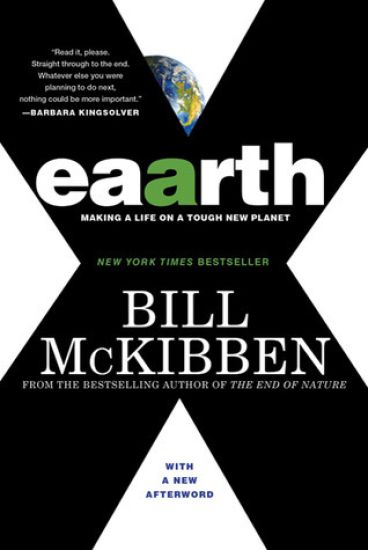
Eaarth: Making a Life on a Tough New Planet

Eaarth: Making a Life on a Tough New Planet

Bill McKibben

St. Martin's Griffin
2011
nidottu
"Read it, please. Straight through to the end. Whatever else you were planning to do next, nothing could be more important." --Barbara Kingsolver Twenty years ago, with The End of Nature, Bill McKibben offered one of the earliest warnings about global warming. Those warnings went mostly unheeded; now, he insists, we need to acknowledge that we've waited too long, and that massive change is not only unavoidable but already under way. Our old familiar globe is suddenly melting, drying, acidifying, flooding, and burning in ways that no human has ever seen. We've created, in very short order, a new planet, still recognizable but fundamentally different. We may as well call it Eaarth. That new planet is filled with new binds and traps. A changing world costs large sums to defend--think of the money that went to repair New Orleans, or the trillions it will take to transform our energy systems. But the endless economic growth that could underwrite such largesse depends on the stable planet we've managed to damage and degrade. We can't rely on old habits any longer. Our hope depends, McKibben argues, on scaling back--on building the kind of societies and economies that can hunker down, concentrate on essentials, and create the type of community (in the neighborhood, but also on the Internet) that will allow us to weather trouble on an unprecedented scale. Change--fundamental change--is our best hope on a planet suddenly and violently out of balance.
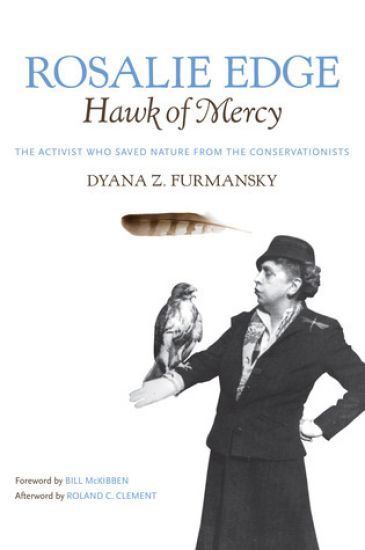
Rosalie Edge, Hawk of Mercy

Rosalie Edge, Hawk of Mercy

Roland C. Clement; Dyana Z. Furmansky; Bill McKibben

University of Georgia Press
2010
pokkari
Rosalie Edge (1877-1962) was the first American woman to achieve national renown as a conservationist. Dyana Z. Furmansky draws on Edge’s personal papers and on interviews with family members and associates to portray an implacable, indomitable personality whose activism earned her the names “Joan of Arc” and “hellcat.” A progressive New York socialite and veteran suffragist, Edge did not join the conservation movement until her early fifties. Nonetheless, her legacy of achievements—called "widespread and monumental" by the New Yorker—forms a crucial link between the eras defined by John Muir and Rachel Carson. An early voice against the indiscriminate use of toxins and pesticides, Edge reported evidence about the dangers of DDT fourteen years before Carson's Silent Spring was published. Today, Edge is most widely remembered for establishing Hawk Mountain Sanctuary, the world's first refuge for birds of prey. Founded in 1934 and located in eastern Pennsylvania, Hawk Mountain was cited in Silent Spring as an "especially significant" source of data. In 1930, Edge formed the militant Emergency Conservation Committee, which not only railed against the complacency of the Bureau of Biological Survey, Audubon Society, U. S. Forest Service, and other stewardship organizations but also exposed the complicity of some in the squandering of our natural heritage. Edge played key roles in the establishment of Olympic and Kings Canyon National Parks and the expansion of Yosemite and Sequoia National Parks. Filled with new insights into a tumultuous period in American conservation, this is the life story of an unforgettable individual whose work influenced the first generation of environmentalists, including the founders of the Wilderness Society, Nature Conservancy, and Environmental Defense Fund.
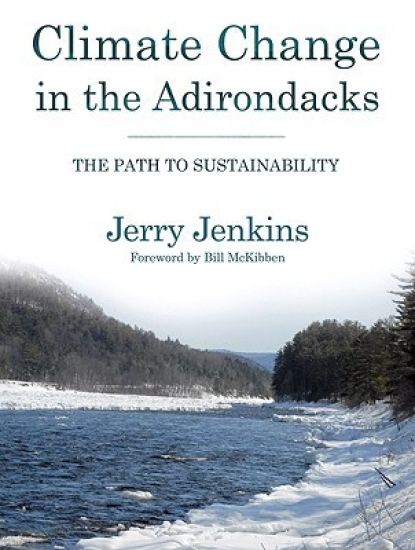
Climate Change in the Adirondacks

Climate Change in the Adirondacks

Jerry Jenkins; Bill McKibben

Comstock Publishing Associates
2010
pokkari
Although global in scale, the impact of climate change will be felt at the local level. Refocusing our attention away from the ice shelves disintegrating in the Antarctic, the flooding of Pacific islands, and carbon inventories measured in billions of tons, Jerry Jenkins turns to changes that are already occurring much closer to home, changes that threaten to transform one of America's great wildernesses, the Adirondack region, into a damaged and unfamiliar landscape. With the aid of comprehensive color illustrations, graphs, charts, and maps, Jenkins demonstrates the fundamental reality of climate change on a local level and presents his analysis and discussion of the available data for the Adirondacks. The region's culture, biology, and economy are already shifting rapidly: boreal species such as the spruce grouse are in decline, pests such as the mountain pine beetle and black-legged tick are moving in, and ski areas are suffering from lack of snow. Jenkins goes on to deliver a critical message: changes in personal energy consumption can fundamentally alter the present trajectory of global warming. Climate Change in the Adirondacks provides a road map for how individuals and communities whether inside the Blue Line or beyond can reduce their reliance on fossil fuels and lead the way toward a more responsible future.
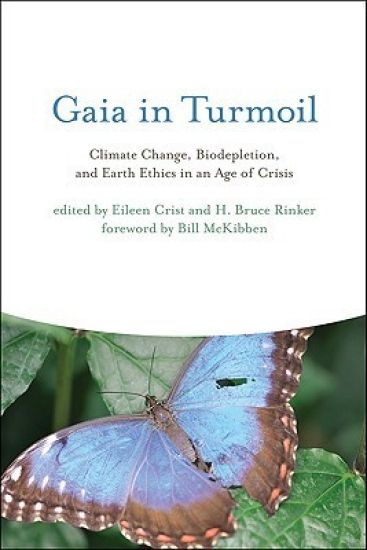
Gaia in Turmoil

Gaia in Turmoil

Bill McKibben

MIT Press
2009
pokkari
Essays link Gaian science to such global environmental quandaries as climate change and biodiversity destruction, providing perspectives from science, philosophy, politics, and technology. Gaian theory, which holds that Earth's physical and biological processes are inextricably bound to form a self-regulating system, is more relevant than ever in light of increasing concerns about global climate change. The Gaian paradigm of Earth as a living system, first articulated by James Lovelock and Lynn Margulis in the 1970s, has inspired a burgeoning body of researchers working across disciplines that range from physics and biology to philosophy and politics. Gaia in Turmoil reflects this disciplinary richness and intellectual diversity, with contributions (including essays by both Lovelock and Margulis) that approach the topic from a wide variety of perspectives, discussing not only Gaian science but also global environmental problems and Gaian ethics and education. Contributors focus first on the science of Gaia, considering such topics as the workings of the biosphere, the planet's water supply, and evolution; then discuss Gaian perspectives on global environmental change, including biodiversity destruction and global warming; and finally explore the influence of Gaia on environmental policy, ethics, politics, technology, economics, and education. Gaia in Turmoil breaks new ground by focusing on global ecological problems from the perspectives of Gaian science and knowledge, focusing especially on the challenges of climate change and biodiversity destruction. ContributorsDavid Abram, Donald Aitken, Connie Barlow, J. Baird Callicott, Bruce Clarke, Eileen Crist, Tim Foresman, Stephan Harding, Barbara Harwood, Tim Lenton, Eugene Linden, Karen Litfin, James Lovelock, Lynn Margulis, Bill McKibben, Martin Ogle, H. Bruce Rinker, Mitchell Thomashow, Tyler Volk, Hywel Williams

Rosalie Edge, Hawk of Mercy

Rosalie Edge, Hawk of Mercy

Roland C. Clement; Dyana Z. Furmansky; Bill McKibben

University of Georgia Press
2009
sidottu
Rosalie Edge (1877-1962) was the first American woman to achieve national renown as a conservationist. Dyana Z. Furmansky draws on Edge’s personal papers and on interviews with family members and associates to portray an implacable, indomitable personality whose activism earned her the names “Joan of Arc” and “hellcat.” A progressive New York socialite and veteran suffragist, Edge did not join the conservation movement until her early fifties. Nonetheless, her legacy of achievements—called "widespread and monumental" by the New Yorker—forms a crucial link between the eras defined by John Muir and Rachel Carson. An early voice against the indiscriminate use of toxins and pesticides, Edge reported evidence about the dangers of DDT fourteen years before Carson's Silent Spring was published. Today, Edge is most widely remembered for establishing Hawk Mountain Sanctuary, the world's first refuge for birds of prey. Founded in 1934 and located in eastern Pennsylvania, Hawk Mountain was cited in Silent Spring as an "especially significant" source of data. In 1930, Edge formed the militant Emergency Conservation Committee, which not only railed against the complacency of the Bureau of Biological Survey, Audubon Society, U. S. Forest Service, and other stewardship organizations but also exposed the complicity of some in the squandering of our natural heritage. Edge played key roles in the establishment of Olympic and Kings Canyon National Parks and the expansion of Yosemite and Sequoia National Parks. Filled with new insights into a tumultuous period in American conservation, this is the life story of an unforgettable individual whose work influenced the first generation of environmentalists, including the founders of the Wilderness Society, Nature Conservancy, and Environmental Defense Fund.
Life's Philosophy

Life's Philosophy

Arne Naess; Bill McKibben

University of Georgia Press
2008
pokkari

Halvin toimitettuna 43,30 €

Now available in English for the first time, Norwegian philosopher Arne Naess's meditation on the art of living is an exhortation to preserve the environment and biodiversity. As Naess approaches his ninetieth year, he offers a bright and bold perspective on the power of feelings to move us away from ecological and cultural degradation toward sound, future-focused policy and action. Naess acknowledges the powerlessness of the intellect without the heart, and, like Thoreau before him, he rejects the Cartesian notion of mind-body separation. He advocates instead for the integration of reason and emotion—a combination Naess believes will inspire us to make changes for the better. Playful and serious, this is a guidebook for finding our way on a planet wrecked by the harmful effects of consumption, population growth, commodification, technology, and globalization. It is sure to mobilize today's philosophers, environmentalists, policy makers, and the general public into seeking—with whole hearts rather than with superficial motives—more effective and timelier solutions. Naess's style is reflective and anecdotal as he shares stories and details from his rich and long life. With characteristic goodwill, wit, and wisdom, he denounces our unsustainable actions while simultaneously demonstrating the unsurpassed wonder, beauty, and possibility our world offers, and ultimately shows us that there is always reason for hope, that everyone is a potential ally in our fight for the future.
Deep Economy: The Wealth of Communities and the Durable Future

Deep Economy: The Wealth of Communities and the Durable Future

Bill McKibben

St. Martin's Griffin
2008
nidottu

Halvin toimitettuna 22,90 €

The bestselling author of The End of Nature issues an impassioned call to arms for an economy that creates community and ennobles our lives In this powerful and provocative manifesto, Bill McKibben offers the biggest challenge in a generation to the prevailing view of our economy. For the first time in human history, he observes, "more" is no longer synonymous with "better"--indeed, for many of us, they have become almost opposites. McKibben puts forward a new way to think about the things we buy, the food we eat, the energy we use, and the money that pays for it all. Our purchases, he says, need not be at odds with the things we truly value. McKibben's animating idea is that we need to move beyond "growth" as the paramount economic ideal and pursue prosperity in a more local direction, with cities, suburbs, and regions producing more of their own food, generating more of their own energy, and even creating more of their own culture and entertainment. He shows this concept blossoming around the world with striking results, from the burgeoning economies of India and China to the more mature societies of Europe and New England. For those who worry about environmental threats, he offers a route out of the worst of those problems; for those who wonder if there isn't something more to life than buying, he provides the insight to think about one's life as an individual and as a member of a larger community. McKibben offers a realistic, if challenging, scenario for a hopeful future. Deep Economy makes the compelling case that the more we nurture the essential humanity of our economy, the more we will recapture our own.
Hope, Human and Wild

Hope, Human and Wild

Bill McKibben

Milkweed Editions
2007
nidottu
Divided into three sections, Hope, Human and Wild profiles the efforts of three caring communities to preserve wilderness and reverse environmental devastation. They include the reforestation of McKibben's home territory, New York's Adirondack Mountains; solving traffic and pollution problems in the densely populated Curitiba, Brazil; and how the citizens of Kerala, India have demonstrated that quality of life doesn't depend on overconsumption of resources. This edition features a new introduction that revisits these places and explores how they've changed over the years.
The End of Nature

The End of Nature

Bill McKibben

Random House Trade
2006
nidottu
Addressing the moral and practical aspects of dealing with environmental issues, this study spells out the tragic consequences of the greenhouse effect and discusses options for avoiding ecological calamity. Reprint. 20,000 first printing.
The Age of Missing Information

The Age of Missing Information

Bill McKibben

Random House Trade
2006
nidottu
"Highly personal and original . . . McKibben goes beyond Marshall McLuhan's theory that the medium is the message."----The New York Times Imagine watching an entire day's worth of television on every single channel. Acclaimed environmental writer and culture critic Bill McKibben subjected himself to this sensory overload in an experiment to verify whether we are truly better informed than previous generations. Bombarded with newscasts and fluff pieces, game shows and talk shows, ads and infomercials, televangelist pleas and Brady Bunch episodes, McKibben processed twenty-four hours of programming on all ninety-three Fairfax, Virginia, cable stations. Then, as a counterpoint, he spent a day atop a quiet and remote mountain in the Adirondacks, exploring the unmediated man and making small yet vital discoveries about himself and the world around him. As relevant now as it was when originally written in 1992-and with new material from the author on the impact of the Internet age-this witty and astute book is certain to change the way you look at television and perceive media as a whole. "By turns humorous, wise, and troubling . . . a penetrating critique of technological society."-Cleveland Plain Dealer "Masterful . . . a unique, bizarre portrait of our life and times."-Los Angeles Times "Do yourself a favor: Put down the remote and pick up this book."-Houston Chronicle
The Comforting Whirlwind

The Comforting Whirlwind

Bill McKibben

Cowley Publications,U.S.
2005
pokkari
In The Comforting Whirlwind, acclaimed environmentalist and writer Bill McKibben turns to the biblical book of Job and its awesome depiction of creation to demonstrate our need to embrace a bold new paradigm for living if we hope to reverse the current trend of ecological destruction. With reference to the consequences of our poorly considered and self-centered environmental practices—global warming, ozone degradation, deforestation—McKibben combines modern science and timeless biblical wisdom to make the case that growth and economic progress are not only undesirable but deadly. If we continue to accelerate the pace of development, we will inevitably complete the “decreation” of our planet and everything on it, including ourselves. In his signature lyrical prose, and using Stephen Mitchell’s powerful translation of Job, McKibben calls readers to truly appreciate both the majesty of creation and humanity’s rightful—and responsible—place in it.
Enough

Enough

Bill McKibben

Bloomsbury Publishing PLC
2004
nidottu
Sometime in the next few years, scientists may reprogramme a human egg or sperm cell, make a change in the genetic instructions carried by that cell, a change that will be passed on down into eternity. The scientific expertise exists to do this, as does the motivation: to erase the chance of inheriting a disease, to improve the intelligence or the stamina or the beauty of a child. On the brink of an era that may be defined by genetic engineering, McKibben asks: should this happen? He argues that genetic engineering and the technologies that lie beyond it will launch us free of our past, of our humanity, of meaning. We are sleepwalking towards a future that will take us far away from all we have known: Enough is our wake-up call.
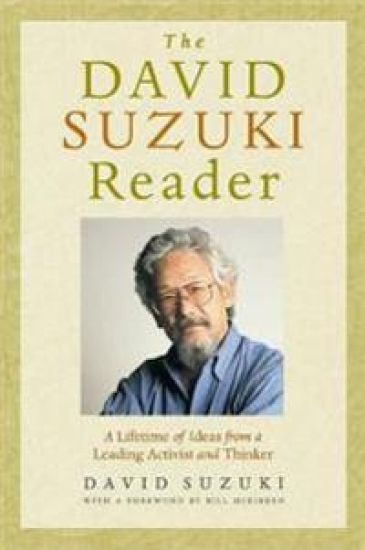
The David Suzuki Reader

The David Suzuki Reader

David Suzuki; Bill McKibben

Greystone Books,Canada
2004
pokkari
David Suzuki’s collected writings on science, nature, technology, economics, politics, and the connectedness of all things. The David Suzuki Reader brings together for the first time the scientific and philosophical thought of North America’s leading environmentalist. Drawing from Suzuki’s published and unpublished writings, this collection reveals the underlying themes that have informed his work for over four decades. In these incisive and provocative essays, Suzuki explores the limits of knowledge and the connectedness of all things; looks unflinchingly at the destructive forces of globalization, political shortsightedness, and greed; cautions against blind faith in science, technology, politics, and economics; and provides inspiring examples of how and where to make those changes that will matter to all of us and to future generations. He also offers a vision of hope based on our love of children and nature. In this time of global unrest and uncertainty, Suzuki provides an important reminder of how we are all connected and of what really matters. Written with clarity, passion, and wisdom, this book is essential reading for anyone who is an admirer of David Suzuki, who wants to understand what science can and can’t do, or who wants to make a difference.
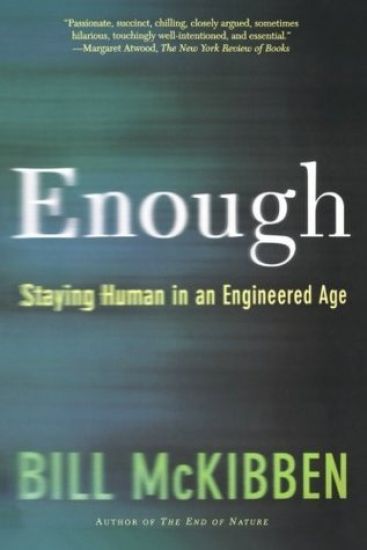
Enough: Staying Human in an Engineered Age

Enough: Staying Human in an Engineered Age

Bill McKibben

St. Martin's Griffin
2004
nidottu
"Passionate, succinct, chilling, closely argued, sometimes hilarious, touchingly well-intentioned, and essential." --Margaret Atwood, The New York Review of Books Nearly fifteen years ago, in The End of Nature, Bill McKibben demonstrated that humanity had begun to irrevocably alter and endanger our environment on a global scale. Now he turns his eye to an array of technologies that could change our relationship not with the rest of nature but with ourselves. He explores the frontiers of genetic engineering, robotics, and nanotechnology--all of which we are approaching with astonishing speed--and shows that each threatens to take us past a point of no return. We now stand, in Michael Pollan's words, "on a moral and existential threshold," poised between the human past and a post-human future. McKibben offers a celebration of what it means to be human, and a warning that we risk the loss of all meaning if we step across the threshold. Instantly acclaimed for its passion and insight, this wise and eloquent book argues that we cannot forever grow in reach and power--that we must at last learn how to say, "Enough."