Kirjojen hintavertailu – 12 859 829 kirjaa ja 27 kauppaa
Kirjailija
Blaise Pascal
Kirjat ja teokset yhdessä paikassa: 251 kirjaa, julkaisuja vuosilta 1830–2027, suosituimpiin kuuluu Pascal's Pensees. Vertaile teosten hintoja ja tarkista saatavuus suomalaisista kirjakaupoista.
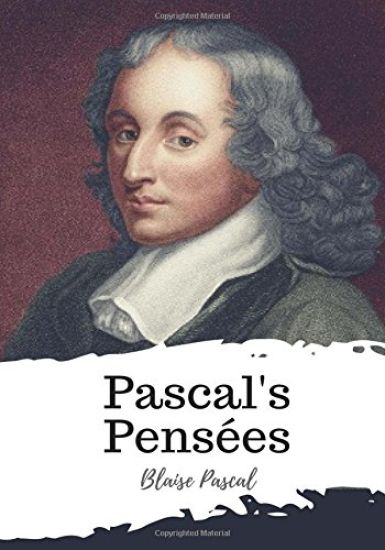
Pens es: Pascal's Pens es by Blaise Pascal and translated by W. F. Trotter. The Pens es ("Thoughts") is a collection of fragments on theology and philosophy written by 17th-century philosopher and mathematician Blaise Pascal. Pascal's religious conversion led him into a life of asceticism, and the Pens es was in many ways his life's work. The Pens es represented Pascal's defense of the Christian religion. The concept of "Pascal's Wager" stems from a portion of this work. 'The difference between the mathematical and the intuitive mind. - In the one, the principles are palpable, but removed from ordinary use; so that for want of habit it is difficult to turn one's mind in that direction: but if one turns it thither ever so little, one sees the principles fully, and one must have a quite inaccurate mind who reasons wrongly from principles so plain that it is almost impossible they should escape notice. But in the intuitive mind the principles are found in common use and are before the eyes of everybody. One has only to look, and no effort is necessary; it is only a question of good eyesight, but it must be good, for the principles are so subtle and so numerous that it is almost impossible but that some escape notice. Now the omission of one principle leads to error; thus one must have very clear sight to see all the principles and, in the next place, an accurate mind not to draw false deductions from known principles.'
Les Trois discours sur la condition des grands sont un ensemble de discours ducatifs tenus par Blaise Pascal au futur duc de Chevreuse Charles-Honor d'Albert, probablement vers 1660. Ils sont reconstitu s et retranscris par Pierre Nicole dans son ouvrage De l' ducation d'un prince, publi en 1670. Dans un premier discours, Pascal affirme que la condition des grands n'est pas li e des qualit s naturelles, mais une suite de hasard tablie par la coutume: un grand doit donc avoir une double-pens e, en se comportant ext rieurement comme le veut son rang, mais en sachant par-devers lui qu'il n'est pas intrins quement sup rieur aux autres hommes. Dans un second, il dit qu'il existe des grandeurs d' tablissement et des grandeurs naturelles: on doit le respect aux grandeurs d' tablissement, m me si elles sont seulement le fruit de la coutume, car le respect des conventions tablies par les hommes est n cessaire; un grand ne peut toutefois pas exiger qu'on admire chez lui des grandeurs naturelles (qui sont le fait du talent ou de la vertu) s'il n'en poss de pas, car cela serait commettre une injustice en confondant les deux sortes de grandeurs. Enfin, dans un troisi me discours, Pascal tablit quelles relations un grand entretient avec son entourage: ce sont celles d'un roi de concupiscence, qui poss de ce que d sire ce dernier; pour ne pas se comporter en tyran, il doit mettre seulement son plaisir satisfaire cette concupiscence. Les Trois discours sur la condition des grands sont le seul texte issu de Pascal, exclusivement consacr la politique. On y retrouve des th mes abord s dans les Pens es, tel le caract re conventionnel des coutumes. En leur d couvrant leur vraie nature, Pascal cherche emp cher les grands de se comporter en tyrans, tout en vitant le chaos qui r sulterait d'une remise en cause de leur rang par le peuple. Il s'agit toutefois seulement pour lui d'un pis-aller: la v ritable grandeur consiste suivre la voie de Dieu Ed
L'Art de persuader est une oeuvre philosophique de Blaise Pascal. R dig vers 1660, ce texte s'inscrit dans un combat th ologique. ce moment-l , pour les Jans nistes, il quivaut au Discours de la m thode, il " t moigne de l'efficacit redoutable de l'argumentation . L'Art de persuader est un art de penser la mesure de la faiblesse et de la grandeur de l'homme. Penser, c'est mettre m thodiquement en balance, en doute et l' preuve, sur deux plateaux, avant d' valuer et juger, les objets de l'exp rience entre eux, et avec soi-m me. L'Art de persuader de Pascal, crit en 1658, texte h ritier de L'Art de conf rer (1580) de Montaigne, suppose une alliance de la raison et de l'intuition, de la logique et des figures rh toriques, qui rend l'esprit capable de toucher juste.
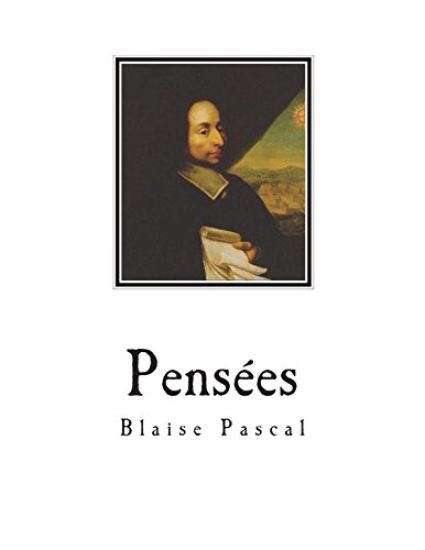
Blaise Pascal was a 17th century French scientist, author, and Christian philosopher who is best known for his work, "Pens es" or "Thoughts." First published posthumously in 1670, "Thoughts" is an edited compilation of the notes that Pascal had prepared for a planned work that scholars refer to as an "Apology for the Christian Religion." Given its incompleteness when Pascal died, the order and composition of the work has been debated and as a result has produced many variant publications. In spite of their incompleteness and frequent incoherence, "Thoughts" has long held a high place among the great classics of the Christian religion. Much of the theological argument implied in these utterances has little appeal to the modern mind, but the acuteness of the observation of human life, the subtlety of the reasoning, the combination of precision and fervid imagination in the expression, make this a book to which the discerning mind can return again and again for insight and inspiration. This edition is printed on premium acid-free paper, follows the translation of W. F. Trotter, with an introduction by Thomas S. Kepler.
"I know of no religious writer more pertinent to our time." -- T. S. Eliot, Introduction to Pens es"Men despise religion. They hate it and are afraid it may be true," declared Pascal in his Pens es. "The cure for this," he explained, "is first to show that religion is not contrary to reason, but worthy of reverence and respect. Next make it attractive, make good men wish it were true, and then show that it is." Motivated by the 17th-century view of the supremacy of human reason, Pascal (1623-62) had intended to write an ambitious apologia for Christianity, in which he argued the inability of reason to address metaphysical problems. His untimely death prevented his completion of the work, but the fragments published posthumously in 1670 form a vital part of religious and philosophical literature. Essential reading for students of history, philosophy, and theology, the Pens es remain among the liveliest and most eloquent defenses of Christianity ever written.
Pascal's Pens es is a masterpiece, and a landmark in French literature. This is Pascal's most influential theological work-in it he surveys several philosophical paradoxes: infinity and nothing; faith and reason; soul and matter; death and life; meaning and vanity-seemingly arriving at no definitive conclusions besides humility, ignorance, and grace.
The purpose in offering the Great Shorter Works is ""to make essential classical Pascalian literature, other than the Provincial Letters and the Pensees, available to discriminating readers who might find the original texts difficult and discouraging."" Preceded by a valuable introduction, forty-five letters are presented, beginning with a letter written when Pascal was a precocious twenty and ending with his will at thirty-eight. These remarkable letters, covering a nineteen-year period of intense activity, reflect the variety of Pascal's interests. For this reason, among others, they are of value, not only to those who are interested in Christianity, but also to those who are interested in physics, or mathematics, or philosophy. Blaise Pascal bequeathed to the world many tangible legacies, including the calculating machine, the barometer, the hydraulic press, and the omnibus. In his letters he has bequeathed that quality of mind and spirit which surpasses the tangible and illumines life. Emile Cailliet was born and educated in France and became an American citizen in 1937. He was on the faculties of the University of Pennsylvania, Scripps College, and Wesleyan University. He had been elected to the chair of Stuart Professor of Christian Philosophy at Princeton Theological Seminary. He held the degrees of Litt. D. cum laude from the University of Montpellier and Th. D. summa cum laude from the University of Strasbourg.
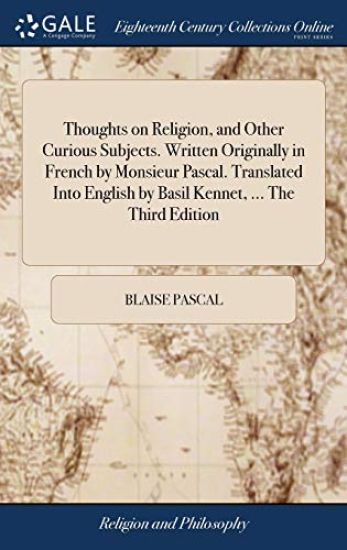
The 18th century was a wealth of knowledge, exploration and rapidly growing technology and expanding record-keeping made possible by advances in the printing press. In its determination to preserve the century of revolution, Gale initiated a revolution of its own: digitization of epic proportions to preserve these invaluable works in the largest archive of its kind. Now for the first time these high-quality digital copies of original 18th century manuscripts are available in print, making them highly accessible to libraries, undergraduate students, and independent scholars. The Age of Enlightenment profoundly enriched religious and philosophical understanding and continues to influence present-day thinking. Works collected here include masterpieces by David Hume, Immanuel Kant, and Jean-Jacques Rousseau, as well as religious sermons and moral debates on the issues of the day, such as the slave trade. The Age of Reason saw conflict between Protestantism and Catholicism transformed into one between faith and logic -- a debate that continues in the twenty-first century.++++The below data was compiled from various identification fields in the bibliographic record of this title. This data is provided as an additional tool in helping to insure edition identification: ++++Bodleian Library (Oxford)N038524With a half-title. The imprint is false; probably printed in Paris. Londres i.e. Paris], 1776. 2], xxix, 1],512p., plate; 8
The 18th century was a wealth of knowledge, exploration and rapidly growing technology and expanding record-keeping made possible by advances in the printing press. In its determination to preserve the century of revolution, Gale initiated a revolution of its own: digitization of epic proportions to preserve these invaluable works in the largest archive of its kind. Now for the first time these high-quality digital copies of original 18th century manuscripts are available in print, making them highly accessible to libraries, undergraduate students, and independent scholars. The Age of Enlightenment profoundly enriched religious and philosophical understanding and continues to influence present-day thinking. Works collected here include masterpieces by David Hume, Immanuel Kant, and Jean-Jacques Rousseau, as well as religious sermons and moral debates on the issues of the day, such as the slave trade. The Age of Reason saw conflict between Protestantism and Catholicism transformed into one between faith and logic -- a debate that continues in the twenty-first century.++++The below data was compiled from various identification fields in the bibliographic record of this title. This data is provided as an additional tool in helping to insure edition identification: ++++Bodleian Library (Oxford)T174604Dublin: re-printed by and for George Faulkner, 1739. xliv,331, 1]p.; 8
The 18th century was a wealth of knowledge, exploration and rapidly growing technology and expanding record-keeping made possible by advances in the printing press. In its determination to preserve the century of revolution, Gale initiated a revolution of its own: digitization of epic proportions to preserve these invaluable works in the largest archive of its kind. Now for the first time these high-quality digital copies of original 18th century manuscripts are available in print, making them highly accessible to libraries, undergraduate students, and independent scholars. The Age of Enlightenment profoundly enriched religious and philosophical understanding and continues to influence present-day thinking. Works collected here include masterpieces by David Hume, Immanuel Kant, and Jean-Jacques Rousseau, as well as religious sermons and moral debates on the issues of the day, such as the slave trade. The Age of Reason saw conflict between Protestantism and Catholicism transformed into one between faith and logic -- a debate that continues in the twenty-first century.++++The below data was compiled from various identification fields in the bibliographic record of this title. This data is provided as an additional tool in helping to insure edition identification: ++++British LibraryT120394With an initial leaf of advertisements. Text is continuous despite pagination. A reissue of the second edition with a cancel titlepage. London: printed for John Pemberton, 1731. 2], xliv,224,209-315, 1]p.; 8
Pascal's Pens es is a masterpiece, and a landmark in French literature. This is Pascal's most influential theological work-in it he surveys several philosophical paradoxes: infinity and nothing; faith and reason; soul and matter; death and life; meaning and vanity-seemingly arriving at no definitive conclusions besides humility, ignorance, and grace.
Preface 5 Pascal's Profession of Faith 16 General Introduction 18 Notes for the General Introduction 30 The Misery of Man Without God 33 Preface to the First Part 33 Man's Disproportion 35 Diversion 57 The Greatness and Littleness of Man 70 Of the Deceptive Powers of the Imagination 79 Of Justice, Customs, and Prejudices 94 The Weakness, Unrest, and Defects of Man 112 The Happiness of Man with God 134 Preface to the Second Part 134 Of the Need of Seeking Truth 139 The Philosophers 154 Thoughts on Mahomet and on China 169 Of the Jewish People 174 The Authenticity of the Sacred Books 181 The Prophecies 188 Of Types in General and of their Lawfulness 231 That the Jewish Law was Figurative 247 Of the True Religion and its Characteristics 263 The Excellence of the Christian Religion 270 Of Original Sin 279 The Perpetuity of the Christian Religion 288 Proofs of the Christian Religion 297 Proofs of the Divinity of Jesus Christ 311 The Mission and Greatness of Jesus Christ 329 The Mystery of Jesus 338 Of the True Righteous Man and of the True Christian 347 The Arrangement 371 Of Miracles in General 376 Jesuits and Jansenists 401 Thoughts on Style 445 Various Thoughts 452 PREFACE. Those to whom the Life of Pascal and the Story of Port Royal are unknown, must be referred to works treating fully of the subject, since it were impossible to deal with them adequately within the limits of a preface. Sainte-Beuve's great work on Port Royal, especially the second and third volumes, and "Port Royal," by Charles Beard, B. A., London, 1863, may best be consulted by any who require full, lucid, and singularly impartial information. But for such as, already acquainted with the time and the man, need a recapitulation of the more important facts, or for those who may find an outline map useful of the country they are to study in detail, a few words are here given. Blaise Pascal was born at Clermont-Ferrand in Auvergne, on June 19, 1623. He sprung from a well-known legal family, many members of which had held lucrative and responsible positions. His father, Etienne Pascal, held the post of intendant, or provincial administrator, in Normandy, where, and at Paris previously, Pascal lived from the age of sixteen to that of twenty-five; almost wholly educated by his father on account of his precarious health. His mother died when he was eight years old. Etienne Pascal was a pious but stern person, and by no means disposed to entertain or allow any undue exaltation in religion, refusing as long as he lived to allow his daughter Jaqueline to take the veil. But he had the usual faiths and superstitions of his time, and believing that his son's ill-health arose from witchcraft, employed the old woman who was supposed to have caused the malady to remove it, by herbs culled before sunrise, and the expiatory death of a cat. This made a great impression on his son, who in the "Thoughts" employs an ingenious argument to prove that wonders wrought by the invocation of the devil are not, in the proper sense of the term, miracles. At any rate the counter-charm was incomplete, as the child's feeble health remained feeble to the end.