Kirjojen hintavertailu – 12 859 819 kirjaa ja 27 kauppaa

Kirjailija

C. G. Jung

Kirjat ja teokset yhdessä paikassa: 359 kirjaa, julkaisuja vuosilta 1954–2026, suosituimpiin kuuluu Kalojen aika. Vertaile teosten hintoja ja tarkista saatavuus suomalaisista kirjakaupoista.

Nimi esiintyy myös muodoissa: C.G. Jung, C G Jung, C.G Jung, C. G Jung

359 kirjaa

Kirjojen julkaisuvuodet: 1954–2026.

Collected Works of C. G. Jung, Volume 9 (Part 2): Aion: Researches Into the Phenomenology of the Self
An investigation of the symbolism of the self Aion, originally published in German in 1951, is one of the major works of Jung's later years. The central theme of the volume is the symbolic representation of the psychic totality through the concept of the Self, whose traditional historical equivalent is the figure of Christ. Jung demonstrates his thesis by an investigation of the Allegoria Christi, especially the fish symbol, but also of Gnostic and alchemical symbolism, which he treats as phenomena of cultural assimilation. The first three chapters--on the ego, the shadow, and the anima and animus--provide a valuable summation of these key concepts in Jung's system of psychology.
The Collected Works of C. G. Jung, Volume 9 (Part 1): Archetypes and the Collective Unconscious
A collection of some of Jung's most important essays on the archetypes and the collective unconscious The Archetypes and the Collective Unconscious features many of Jung's most important essays describing and elaborating on these two central, related concepts. The contents are: Archetypes of the Collective Unconscious (1934)The Concept of the Collective Unconscious (1936)Concerning the Archetypes, with Special Reference to the Anima Concept (1936)Psychological Aspects of the Mother Archetype (1938)Concerning Rebirth (1939)The Psychology of the Child Archetype (1940)The Psychological Aspects of the Kore (1941)The Phenomenology of the Spirit in Fairytales (1945)On the Psychology of the Trickster-Figure (1954)Conscious, Unconscious, and Individuation (1939)A Study in the Process of Individuation (1933)Concerning Mandala Symbolism (1950)
Collected Works of C. G. Jung, Volume 12: Psychology and Alchemy
Jung's landmark account of the connections between alchemy, its symbolism, the collective unconscious, and modern psychology Psychology and Alchemy is one of Jung's most influential works. In a prefatory note, he says: "In this present study of alchemy I have taken a particular example of symbol-formation, extending in all over some seventeen centuries, and have subjected it to intensive examination, linking it at the same time with an actual series of dreams recorded by a modern European not under my direct supervision and having no knowledge of what the symbols appearing in the dream might mean. It is by such intensive comparisons as this (and not one but many) that the hypothesis of the collective unconscious--of an activity in the human psyche making for the spiritual development of the individual human being--may be scientifically established." This is the second, completely revised edition. The book features 270 illustrations, drawn largely from old alchemical books and manuscripts, many of which were in Jung's personal collection.
The I Ching or Book of Changes

The I Ching or Book of Changes

C. G. Jung; Hellmut Wilhelm

PRINCETON UNIVERSITY PRESS
1967
sidottu

Halvin toimitettuna 27,50 €

The bestselling English translation of the ancient classic of Chinese divination that has inspired millions with its timeless insights into the changing nature of all existenceThe I Ching, or Book of Changes, has exerted a living influence in China for thousands of years. Today, it continues to enrich the lives of readers around the world. First set down in the dawn of history as a book of oracles, it grew into a book of wisdom with the inclusion of commentaries on its oracular pronouncements, eventually becoming one of the Five Classics of Confucianism and providing a common source for both Confucianist and Taoist philosophy. This edition of the I Ching is the most authoritative and complete translation available, preserving the spirit of the ancient text while providing a vital key for anyone who seeks to live harmoniously with the immutable law of change. The book presents the sixty-four hexagrams of the I Ching along with their texts and interpretations in a format especially designed for easy reference. Unlike many editions of the I Ching, it also features the Ten Wings, supplemental writings traditionally ascribed to Confucius that provide indispensable insights into the symbolic structure of the hexagrams and their place in a cosmology where change is the only constant. With an illuminating foreword by C. G. Jung and an informative introduction by Richard Wilhelm, this beautiful edition of the I Ching shares the essence of wisdom and a true understanding of life.
Two Essays on Analytical Psychology
This volume from the Collected Works of C. G. Jung has become known as perhaps the best introduction to Jung's work. In these famous essays he presented the essential core of his system. This is the first paperback publication of this key work in its revised and augmented second edition. The earliest versions of the essays are included in an Appendices, containing as they do the first tentative formulations of Jung's concept of archetypes and the collective unconscious, as well as his germinating theory of types.
The Spirit in Man, Art, and Literature.

The Spirit in Man, Art, and Literature.

C. G. Jung; Gerhard (EDT) Adler; R. F. C. (EDT) Hull

Princeton University Press
1966
sidottu
Nine essays, written between 1922 and 1941, on Paracelsus, Freud, Picasso, the sinologist Richard Wilhelm, Joyce's Ulysses, artistic creativity generally, and the source of artistic creativity in archetypal structures.
Civilization in Transition

Civilization in Transition

C. G. Jung

Routledge
1964
sidottu
For this second edition of Civilization in Transition, essential corrections have been made in the text, and the bibliographical references have been brought up to date. This volume contains essays bearing on the contemporary scene and, in particular, on the relation of the individual to society. In the earliest one (1918), Jung advanced the theory that the European conflict was basically a psychological crisis originating in the collective unconscious of individuals. He pursued this theory in papers written during the '20s and '30s, focusing on the upheaval in Germany, and he gave it a much wider application in two major works of his last years ^DDL The Undiscovered Self, concerned with the relation between the individual and a mass society, and Flying Saucers, on the birth of a myth which Jung regarded as compensating the scientistic trends of our technological era. An appendix contains documents relating to Jung's association with the International General Medical Society for Psychotherapy.
Collected Works of C. G. Jung, Volume 4: Freud and Psychoanalysis
The authoritative edition of Jung's essential writings for understanding his early enthusiasm for--and later split with--Freud and psychoanalysis Freud and Psychoanalysis gathers Jung's writings on Freud and psychoanalysis published between 1906 and 1916, along with two later, related papers. The book covers the period of the enthusiastic collaboration between the two pioneers of psychology through the years when Jung's growing appreciation of religious experience, his criticism of Freud's emphasis on pathology, and other differences led to Jung's formal break with his mentor. Part I features brief studies of Freud's theory of hysteria, dream analysis, the psychology of rumor, and other subjects. Parts II and III contain the essentials of the criticism that led to Jung's rupture with Freud, the most important of which is "The Theory of Psychoanalysis." Part IV presents "The Significance of the Father in the Destiny of the Individual." The book's final two pieces, "Freud and Jung: Contrasts" and the introduction to a book by W. M. Kranefeldt, further illuminate Jung's reassessment of psychoanalysis.
Collected Works of C. G. Jung, Volume 3: The Psychogenesis of Mental Disease
The authoritative edition of some of Jung's most important writings on psychiatry The Psychogenesis of Mental Disease presents some of Jung's most important writings on psychiatry, including "On the Psychology of Dementia Praecox," his landmark early study of what is today called schizophrenia. Also featured here are nine other key papers in psychiatry, the earliest being "The Content of the Psychoses," written in 1908, when Jung was a leading member of the early psychoanalytic movement. The latest are two papers written in 1956 and 1958, which embody Jung's conclusions after many years of experience in the psychotherapy of schizophrenia. These writings reflect the original techniques with which Jung is especially associated.
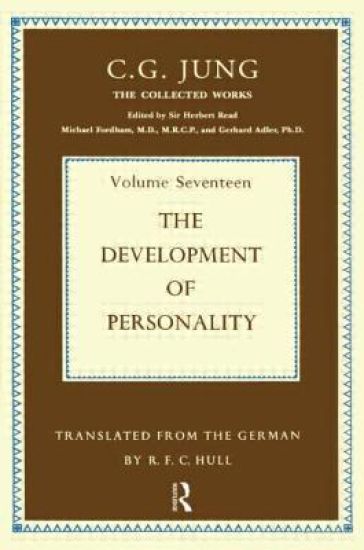
Development of Personality

Development of Personality

C. G. Jung; Gerhard (EDT) Adler; R. F. C. (EDT) Hull

Princeton University Press
1954
sidottu
Papers on child psychology, education, and individuation, underlining the overwhelming importance of parents and teachers in the genesis of the intellectual, feeling, and emotional disorders of childhood. The final paper deals with marriage as an aid or obstacle to self-realization.
The Development of Personality
Though Jung's main researches have centred on the subject of individuation as an adult ideal he has a unique contribution to make to the psychology of childhood. Jung repeatedly underlined the importance of the psychology of parents and teachers in a child's development and he emphasized that an unsatisfactory psychological relationship between parents may be an important cause of disorders in childhood. He maintained that all real education of children needs teachers who not only know how to learn but who can also develop their own personalities. Jung devotes a large part of the book to expounding his views on these important subjects. There is also an outline of the theory of child development, a delightful snapshot from the life of a girl called Anna and her parents, and a stimulating discussion of marriage as a psychological relationship. Finally there is a chapter on child development and individuation.