Kirjojen hintavertailu – 12 859 827 kirjaa ja 27 kauppaa

Kirjailija

Charles Derber

Kirjat ja teokset yhdessä paikassa: 43 kirjaa, julkaisuja vuosilta 1990–2026, suosituimpiin kuuluu Letters to the Resistance. Vertaile teosten hintoja ja tarkista saatavuus suomalaisista kirjakaupoista.

43 kirjaa

Kirjojen julkaisuvuodet: 1990–2026.

Letters to the Resistance

Letters to the Resistance

Charles Derber

TAYLOR FRANCIS LTD
2026
sidottu
Written in the form of letters to the people rallying in the “resistance” for freedom and democracy, Charles Derber details elements of popular action to defeat the authoritarianism of President Trump and his allied corporate oligarchs. Letters to the Resistance draws on Derber’s experience in the Civil Rights movement and mobilization against the war in Vietnam to offer lessons that help protesters sustain resistance. Each letter imparts essential lessons of resistance learned by previous generations, highlighting the necessity of building resistance networks, confronting capitalism, and the use of populism and electoralism – emphasising that true democracy cannot be created by returning to life before Trump. Addressed to students, activists, and the general public, these letters detail the fundamentals of resistance to not only defeat Trump but change the conditions that gave rise to fascism.

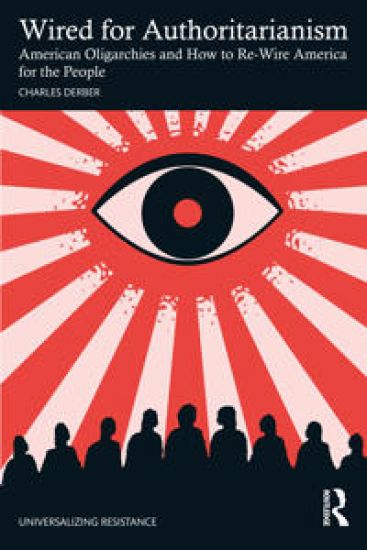
Wired for Authoritarianism

Wired for Authoritarianism

Charles Derber

TAYLOR FRANCIS LTD
2026
sidottu
In contrast to much of the current literature that treats Trump’s authoritarianism as new and singular, this book shows that authoritarianism in the United States instead has a long history that explains the extent to which authoritarianism has been embraced by large sections of US voters. Wired for Authoritarianism combines historical analysis with an innovative conceptual analysis of the “wiring” of power, drawing on the study of the power elite developed by the sociologist C. Wright Mills and neo-Marxist literature. Connecting the social and political culture of the elite to the ideas of state and societal capture, as well as novel concepts of covert and overt wiring of power, this book argues that the Trump era has moved America from a long-standing, mainly covert authoritarian structure toward a more dominant and overt authoritarianism – from a position in which oligarchs exercise power from outside of official government positions, to one in which corporate oligarchs are directly in top government positions. This book offers original insights and sober hope for all those seeking deep and sustainable democracy in America, summarizing strategies drawn from history and current anti-authoritarian movements to defeat this new turn and create a new democratic wiring of America for the people. This book will be of interest to students, scholars and activists with an interest in political sociology, political economy, and social movements in the US.
Wired for Authoritarianism

Wired for Authoritarianism

Charles Derber

TAYLOR FRANCIS LTD
2026
nidottu
In contrast to much of the current literature that treats Trump’s authoritarianism as new and singular, this book shows that authoritarianism in the United States instead has a long history that explains the extent to which authoritarianism has been embraced by large sections of US voters. Wired for Authoritarianism combines historical analysis with an innovative conceptual analysis of the “wiring” of power, drawing on the study of the power elite developed by the sociologist C. Wright Mills and neo-Marxist literature. Connecting the social and political culture of the elite to the ideas of state and societal capture, as well as novel concepts of covert and overt wiring of power, this book argues that the Trump era has moved America from a long-standing, mainly covert authoritarian structure toward a more dominant and overt authoritarianism – from a position in which oligarchs exercise power from outside of official government positions, to one in which corporate oligarchs are directly in top government positions. This book offers original insights and sober hope for all those seeking deep and sustainable democracy in America, summarizing strategies drawn from history and current anti-authoritarian movements to defeat this new turn and create a new democratic wiring of America for the people. This book will be of interest to students, scholars and activists with an interest in political sociology, political economy, and social movements in the US.
Fighting Oligarchy

Fighting Oligarchy

Charles Derber

TAYLOR FRANCIS LTD
2025
nidottu
This book offers a new analysis of why Trump’s Far Right populism helped him win the Presidency twice, and how it enshrined a corporate establishment that he claimed to run against. Charles Derber presents a counter history of positive left populism and argues that populist parties gain power in eras of hard times for working people while mainstream parties lose voter support as they defend the existing system. Fighting Oligarchy: How Positive Populism Can Reclaim America makes the unorthodox case that only a left-leaning positive populist movement is likely to defeat Trump and his corporate regime. Derber highlights the core principles of resistance to build a new and sustainable US democracy.
Fighting Oligarchy

Fighting Oligarchy

Charles Derber

TAYLOR FRANCIS LTD
2025
sidottu
This book offers a new analysis of why Trump’s Far Right populism helped him win the Presidency twice, and how it enshrined a corporate establishment that he claimed to run against. Charles Derber presents a counter history of positive left populism and argues that populist parties gain power in eras of hard times for working people while mainstream parties lose voter support as they defend the existing system. Fighting Oligarchy: How Positive Populism Can Reclaim America makes the unorthodox case that only a left-leaning positive populist movement is likely to defeat Trump and his corporate regime. Derber highlights the core principles of resistance to build a new and sustainable US democracy.
Bonfire

Bonfire

Charles Derber

TAYLOR FRANCIS LTD
2025
nidottu
Charles Derber shows how the US is moving toward sociocide – the erosion of durable, positive social relations in the economy, family, politics, and civil society essential to sustaining society itself – while offering pragmatic solutions. Bonfire: American Sociocide, Broken Relations, and the Quest for Democracy examines how new technologies and financial strategies are part of broader economic, environment, cultural, and political shifts that create tipping points generating more competition, distrust, isolation, and violence. In doing so, Derber spells out the implications for democracy and social cohesion. Importantly, he explores options that could stop the spiral and reconstruct a sustainable and equitable community, civil society, and democracy via emerging movements against neoliberalism capitalism, climate change, war – and in favor of labor solidarity, human rights, and community. This book will be of interest to students, scholars and activists with an interest in political sociology, political economy, and social movements in the US.
Bonfire

Bonfire

Charles Derber

TAYLOR FRANCIS LTD
2025
sidottu
Charles Derber shows how the US is moving toward sociocide – the erosion of durable, positive social relations in the economy, family, politics, and civil society essential to sustaining society itself – while offering pragmatic solutions. Bonfire: American Sociocide, Broken Relations, and the Quest for Democracy examines how new technologies and financial strategies are part of broader economic, environment, cultural, and political shifts that create tipping points generating more competition, distrust, isolation, and violence. In doing so, Derber spells out the implications for democracy and social cohesion. Importantly, he explores options that could stop the spiral and reconstruct a sustainable and equitable community, civil society, and democracy via emerging movements against neoliberalism capitalism, climate change, war – and in favor of labor solidarity, human rights, and community. This book will be of interest to students, scholars and activists with an interest in political sociology, political economy, and social movements in the US.
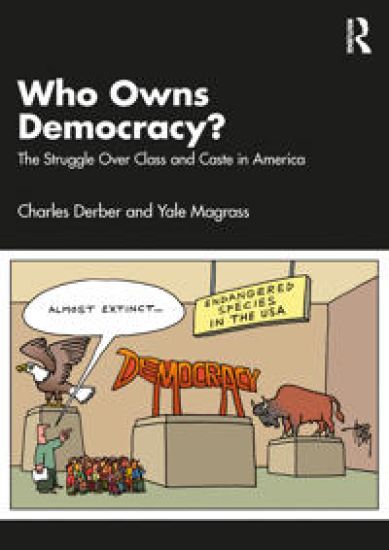
Who Owns Democracy?

Who Owns Democracy?

Charles Derber; Yale R. Magrass

TAYLOR FRANCIS LTD
2024
sidottu
This book uniquely reverses today’s MAGA conspiratorial concept of the deep state to reveal how a very real “deeper state” is evident throughout history, back to the founding of American democracy. Class and caste-based elites and their political allies have held dominant power in the US. Large corporations, Wall Street, and other sectors of the capitalist class outsource day-to-day governance to the mainstream political parties, which can compete vigorously and create a credible veneer of civil liberties and electoral democracy, disguising and legitimating the deep state. But it is a “shallow democracy,” since the deep state sets boundaries on policies and choices to serve itself. It also denies a universal franchise and obstructs the voting rights of people of color, the poor, and other communities threatening to the deep state. Moreover, the deep state constrains civic governance in the workplace and community, denying virtually all working people democratic control over their economic and social life. Shallow democracy has a long history. Two embryonic deep states – a Northern capitalist deep state and a Southern slave-based deep state – came together in a tense and unstable union to create and govern the US. While the Confederate deep state, which we call proto-American fascism, was defeated in the Civil War, it left a deep imprint on the culture and politics of millions of Americans, and has resurged again in Trumpism. The shallow democracy of the capitalist deep state has survived previous challenges, but it lacks the deep roots that guarantees its survival. The authors point to prospects for meaningful change arising from the extreme economic chasm dividing the nation economically and racially, and from existential crises of the survival of democracy and of a sustainable planet. They discuss strategy that might finally move the nation beyond MAGA toward deep democracy.
Who Owns Democracy?

Who Owns Democracy?

Charles Derber; Yale R. Magrass

TAYLOR FRANCIS LTD
2024
nidottu
This book uniquely reverses today’s MAGA conspiratorial concept of the deep state to reveal how a very real “deeper state” is evident throughout history, back to the founding of American democracy. Class and caste-based elites and their political allies have held dominant power in the US. Large corporations, Wall Street, and other sectors of the capitalist class outsource day-to-day governance to the mainstream political parties, which can compete vigorously and create a credible veneer of civil liberties and electoral democracy, disguising and legitimating the deep state. But it is a “shallow democracy,” since the deep state sets boundaries on policies and choices to serve itself. It also denies a universal franchise and obstructs the voting rights of people of color, the poor, and other communities threatening to the deep state. Moreover, the deep state constrains civic governance in the workplace and community, denying virtually all working people democratic control over their economic and social life. Shallow democracy has a long history. Two embryonic deep states – a Northern capitalist deep state and a Southern slave-based deep state – came together in a tense and unstable union to create and govern the US. While the Confederate deep state, which we call proto-American fascism, was defeated in the Civil War, it left a deep imprint on the culture and politics of millions of Americans, and has resurged again in Trumpism. The shallow democracy of the capitalist deep state has survived previous challenges, but it lacks the deep roots that guarantees its survival. The authors point to prospects for meaningful change arising from the extreme economic chasm dividing the nation economically and racially, and from existential crises of the survival of democracy and of a sustainable planet. They discuss strategy that might finally move the nation beyond MAGA toward deep democracy.
Dying for Capitalism

Dying for Capitalism

Charles Derber; Suren Moodliar

TAYLOR FRANCIS LTD
2023
sidottu
This is an original, accessible book for scholars, students, activists, and the general public on the greatest crisis the world has faced. The authors challenge the widespread notion that a green and peaceful set of technological reforms in the current economic and political system – perhaps a “green capitalism” – can prevent disaster. Dying for Capitalism analyzes the “triangle of extinction” that links capitalism, environmental destruction, and militarism as a system that cannot sustain life on the planet. The authors analyze how the extinction triangle evolved historically, how it functions globally as integral to the world capitalist order, and how the United States has become the dominant “extinction nation.” They also show how recent anti-democratic and anti-scientific cultural and political forces intensify denial of the threat and subordinate health and survival to profit and extreme concentrated power. The book offers a “slender path” of social and political transformation that can prevent catastrophe. The path requires moving beyond current ruling systems. But possibilities of survival arise from action at local, state, regional, and global levels through multiple strategies and movements that already exist. The authors draw on the history of abolitionism and emancipation from slavery in the United States to show how a system that appears unchangeable can be transformed, while describing organizations, movements, and practices that are models of hope and a shift from the triangle of extinction to the “circle of creation.”
Dying for Capitalism

Dying for Capitalism

Charles Derber; Suren Moodliar

TAYLOR FRANCIS LTD
2023
nidottu
This is an original, accessible book for scholars, students, activists, and the general public on the greatest crisis the world has faced. The authors challenge the widespread notion that a green and peaceful set of technological reforms in the current economic and political system – perhaps a “green capitalism” – can prevent disaster. Dying for Capitalism analyzes the “triangle of extinction” that links capitalism, environmental destruction, and militarism as a system that cannot sustain life on the planet. The authors analyze how the extinction triangle evolved historically, how it functions globally as integral to the world capitalist order, and how the United States has become the dominant “extinction nation.” They also show how recent anti-democratic and anti-scientific cultural and political forces intensify denial of the threat and subordinate health and survival to profit and extreme concentrated power. The book offers a “slender path” of social and political transformation that can prevent catastrophe. The path requires moving beyond current ruling systems. But possibilities of survival arise from action at local, state, regional, and global levels through multiple strategies and movements that already exist. The authors draw on the history of abolitionism and emancipation from slavery in the United States to show how a system that appears unchangeable can be transformed, while describing organizations, movements, and practices that are models of hope and a shift from the triangle of extinction to the “circle of creation.”
The Nuclear Seduction

The Nuclear Seduction

William A. Schwartz; Charles Derber

University of California Press
2021
sidottu
This title is part of UC Press's Voices Revived program, which commemorates University of California Press’s mission to seek out and cultivate the brightest minds and give them voice, reach, and impact. Drawing on a backlist dating to 1893, Voices Revived makes high-quality, peer-reviewed scholarship accessible once again using print-on-demand technology. This title was originally published in 1990.
The Nuclear Seduction

The Nuclear Seduction

William A. Schwartz; Charles Derber

University of California Press
2021
pokkari
This title is part of UC Press's Voices Revived program, which commemorates University of California Press’s mission to seek out and cultivate the brightest minds and give them voice, reach, and impact. Drawing on a backlist dating to 1893, Voices Revived makes high-quality, peer-reviewed scholarship accessible once again using print-on-demand technology. This title was originally published in 1990.
Chomsky for Activists

Chomsky for Activists

Noam Chomsky; Charles Derber; Suren Moodliar; Paul Shannon

Routledge
2020
sidottu
Those who regard him as a “doom and gloom” critic will find an unexpected Chomsky in these pages. Here the world-renowned author speaks for the first time in depth about his career in activism, and his views and tactics. Chomsky offers new and intimate details about his life-long experience as an activist, revealing him as a critic with deep convictions and many surprising insights about movement strategies. The book points to new directions for activists today, including how the crises of the Coronavirus and the economic meltdown are exploding in the critical 2020 US presidential election year. Readers will find hope and new pathways toward a sustainable, democratic world.
Chomsky for Activists

Chomsky for Activists

Noam Chomsky; Charles Derber; Suren Moodliar; Paul Shannon

Routledge
2020
nidottu
Those who regard him as a “doom and gloom” critic will find an unexpected Chomsky in these pages. Here the world-renowned author speaks for the first time in depth about his career in activism, and his views and tactics. Chomsky offers new and intimate details about his life-long experience as an activist, revealing him as a critic with deep convictions and many surprising insights about movement strategies. The book points to new directions for activists today, including how the crises of the Coronavirus and the economic meltdown are exploding in the critical 2020 US presidential election year. Readers will find hope and new pathways toward a sustainable, democratic world.
Glorious Causes

Glorious Causes

Yale R. Magrass; Charles Derber

Routledge
2019
nidottu
Drawing on historical cases of the American South before and after the Civil War, Europe – especially Germany – between the world wars, and the United States in Vietnam and its aftermath, this book takes a historical approach to explain the problems of capitalism and democratic leadership in western democracies today. Capitalist democracies proclaim equality, material prosperity and comfort but produce extreme differences in wealth and power. They promise security and peace, but deliver frequent wars. The promises broken, elites often turn to other visions- partially borrowed from feudalism- to win public support. Nations turn to honor, nobility and war as a way of winning over workers and legitimating the capitalist system itself. Capitalism’s contradictions often have produced a cultural divide. One side, "cosmopolitans" – urban, see themselves as citizens of the world, not one region or country – identify as secular, preach multi-culturalism, entertain state welfare systems, and are cautious about going to war. Their opponents, "traditionalists," breed among people who feel left behind, anxiousness and insecurity, often embracing community, tradition, God and family. The devastation of the world wars and the Third Reich led Europe to forgo visions of empire, militarism and glory and focus upon improving the quality of life for their own citizens. Although the United States does not need to experience comparable trauma, they should follow Europe’s example- forget glory and instead build a better life for the American people. The last chapter will consider how such a change could emerge in the US and who might help fight for it.
Glorious Causes

Glorious Causes

Yale R. Magrass; Charles Derber

Routledge
2019
sidottu
Drawing on historical cases of the American South before and after the Civil War, Europe – especially Germany – between the world wars, and the United States in Vietnam and its aftermath, this book takes a historical approach to explain the problems of capitalism and democratic leadership in western democracies today. Capitalist democracies proclaim equality, material prosperity and comfort but produce extreme differences in wealth and power. They promise security and peace, but deliver frequent wars. The promises broken, elites often turn to other visions- partially borrowed from feudalism- to win public support. Nations turn to honor, nobility and war as a way of winning over workers and legitimating the capitalist system itself. Capitalism’s contradictions often have produced a cultural divide. One side, "cosmopolitans" – urban, see themselves as citizens of the world, not one region or country – identify as secular, preach multi-culturalism, entertain state welfare systems, and are cautious about going to war. Their opponents, "traditionalists," breed among people who feel left behind, anxiousness and insecurity, often embracing community, tradition, God and family. The devastation of the world wars and the Third Reich led Europe to forgo visions of empire, militarism and glory and focus upon improving the quality of life for their own citizens. Although the United States does not need to experience comparable trauma, they should follow Europe’s example- forget glory and instead build a better life for the American people. The last chapter will consider how such a change could emerge in the US and who might help fight for it.
Moving Beyond Fear

Moving Beyond Fear

Charles Derber; Yale R. Magrass

Routledge
2018
nidottu
While security stories often point to real threats, the narratives of leaders are as much about legitimating the power of rulers and the political and economic system that brought them to power. Derber and Magrass offer a penetrating examination of this phenomenon across history and types of societies. Their analysis reveals the great irony about security stories: they historically increase insecurity, imperiling citizens and nation. In the US today, the contradiction is especially acute, as security stories told by Trump divide US citizens against one another. The book builds from an analysis of the extreme dangers of the prevailing security stories to a new paradigm of true security. The authors develop new approaches as our best hope for avoiding catastrophe and creating a socially just society based on real security for a nation and for humans across the planet.
Moving Beyond Fear

Moving Beyond Fear

Charles Derber; Yale R. Magrass

Routledge
2018
sidottu
While security stories often point to real threats, the narratives of leaders are as much about legitimating the power of rulers and the political and economic system that brought them to power. Derber and Magrass offer a penetrating examination of this phenomenon across history and types of societies. Their analysis reveals the great irony about security stories: they historically increase insecurity, imperiling citizens and nation. In the US today, the contradiction is especially acute, as security stories told by Trump divide US citizens against one another. The book builds from an analysis of the extreme dangers of the prevailing security stories to a new paradigm of true security. The authors develop new approaches as our best hope for avoiding catastrophe and creating a socially just society based on real security for a nation and for humans across the planet.
Bully Nation

Bully Nation

Charles Derber; Yale R. Magrass

University Press of Kansas
2017
nidottu
It's not just the bully in the schoolyard that we should be worried about. The one-on-one bullying that dominates the national conversation, this timely book suggests, is actually part of a larger problem—a natural outcome of the bullying nature of our national institutions. And as long as the United States embraces militarism and aggressive capitalism, systemic bullying and all its impacts—at home and abroad—will persist as a major crisis. Bullying looks very similar on the personal and institutional levels: it involves an imbalance of power and behavior that consistently undermines its victim, securing compliance and submission and reinforcing the bully’s sense of superiority and legitimacy. The similarity, this book tells us, is not a coincidence. Applying the concept of the “sociological imagination,” which links private problems and public issues, authors Charles Derber and Yale Magrass argue that individual bullying is an outgrowth—and a necessary function—of a larger social phenomenon. Bullying is seen here as a structural problem arising from systems organized around steep power hierarchies—from the halls of the Pentagon, Congress, and corporate offices to classrooms and playing fields and the environment. Dominant people and institutions need to create a culture in which violence and aggression are seen as natural and just: one where individuals compete over who will be bully or victim, and each is seen as deserving their fate within this hierarchy. The larger the inequalities of power in society, or among nations, or even across species, the more likely it is that both institutional and personal bullying will become commonplace. The authors see the life-long psychological scars interpersonal bullying can bring, but believe it is almost impossible to reduce such bullying without first challenging the institutions that breed and encourage it. In the United States a system of intertwined corporations, governments, and military institutions carries out “systemic bullying” to create profits and sustain its own power. While acknowledging the diversity and savagery of many other bully nations, the authors contend that America, as the most powerful nation in the world—and one that aggressively promotes its system as a model—merits special attention. It is only by recognizing the bullying built into this model that we can address the real problem, and in this, Bully Nation makes a hopeful beginning.