Kirjojen hintavertailu – 12 903 725 kirjaa ja 27 kauppaa

Kirjailija

Charles Taylor

Kirjat ja teokset yhdessä paikassa: 117 kirjaa, julkaisuja vuosilta 1973–2026, suosituimpiin kuuluu Neutrality and Impartiality. Vertaile teosten hintoja ja tarkista saatavuus suomalaisista kirjakaupoista.

117 kirjaa

Kirjojen julkaisuvuodet: 1973–2026.

Iowans of the Mighty Eighth

Iowans of the Mighty Eighth

Charles Taylor

Turner
2005
sidottu
During WWII, Iowans of the "Mighty Eighth" Air Force were based in England from 1942 to 1946, a year after the end of WWII. Ground crews labored endlessly to keep aircraft flyable by scavenging and often manufacturing parts until supply lines could be established. Aircrews flew in un-pressurized, unheated, piston-engine airplanes where temperatures inside the aircraft reached sixty degrees below zero. Read the experiences of over three hundred Iowa veterans of the greatest air armada ever assembled, "Iowans of the The Might Eighth".
Iowans of the Mighty Eighth

Iowans of the Mighty Eighth

Charles Taylor

Turner
2005
pokkari
During WWII, Iowans of the "Mighty Eighth" Air Force were based in England from 1942 to 1946, a year after the end of WWII. Ground crews labored endlessly to keep aircraft flyable by scavenging and often manufacturing parts until supply lines could be established. Aircrews flew in un-pressurized, unheated, piston-engine airplanes where temperatures inside the aircraft reached sixty degrees below zero. Read the experiences of over three hundred Iowa veterans of the greatest air armada ever assembled, Iowans of the The Might Eighth.
The Rivers North of the Future

The Rivers North of the Future

David Cayley; Charles Taylor

House of Anansi Press Ltd ,Canada
2005
pokkari

Halvin toimitettuna 27,70 €

In The Rivers North of the Future David Cayley has compiled Ivan Illich's moving and insightful thoughts concerning the fate of the Christian Gospel. Illich's view, which could be summed up as "the corruption of the best is the worst," is that Jesus' call to love more abundantly became the basis for new forms of power in the hands of those who organized and administered this New Testament. Illich also explores the invention of technology, the road from hospitality to the hospital, the criminalization of sin, the church as the template of the modern state, and the death of nature. Illich's analysis of contemporary society as a congealed and corrupted Christianity is both a bold historical hypothesis and a call to believers to re-invent the Christian church. With a foreword by Charles Taylor. Ivan Illich (1926-2002) was a brilliant polymath, an iconoclastic thinker, and a prolific writer. He was a priest, vice-rector of a university, founder of the Centre for Intercultural Documentation in Cuernavaca, Mexico, and author of numerous books, including Deschooling Society, Tools for Conviviality, Energy and Equity, and Medical Nemesis.
Modern Social Imaginaries

Modern Social Imaginaries

Charles Taylor

Duke University Press
2003
sidottu
One of the most influential philosophers in the English-speaking world, Charles Taylor is internationally renowned for his contributions to political and moral theory, particularly to debates about identity formation, multiculturalism, secularism, and modernity. In Modern Social Imaginaries, Taylor continues his recent reflections on the theme of multiple modernities. To account for the differences among modernities, Taylor sets out his idea of the social imaginary, a broad understanding of the way a given people imagine their collective social life. Retelling the history of Western modernity, Taylor traces the development of a distinct social imaginary. Animated by the idea of a moral order based on the mutual benefit of equal participants, the Western social imaginary is characterized by three key cultural forms-the economy, the public sphere, and self-governance. Taylor’s account of these cultural formations provides a fresh perspective on how to read the specifics of Western modernity: how we came to imagine society primarily as an economy for exchanging goods and services to promote mutual prosperity, how we began to imagine the public sphere as a metaphorical place for deliberation and discussion among strangers on issues of mutual concern, and how we invented the idea of a self-governing people capable of secular “founding” acts without recourse to transcendent principles. Accessible in length and style, Modern Social Imaginaries offers a clear and concise framework for understanding the structure of modern life in the West and the different forms modernity has taken around the world.
Modern Social Imaginaries

Modern Social Imaginaries

Charles Taylor

Duke University Press
2003
pokkari

Halvin toimitettuna 27,50 €

One of the most influential philosophers in the English-speaking world, Charles Taylor is internationally renowned for his contributions to political and moral theory, particularly to debates about identity formation, multiculturalism, secularism, and modernity. In Modern Social Imaginaries, Taylor continues his recent reflections on the theme of multiple modernities. To account for the differences among modernities, Taylor sets out his idea of the social imaginary, a broad understanding of the way a given people imagine their collective social life. Retelling the history of Western modernity, Taylor traces the development of a distinct social imaginary. Animated by the idea of a moral order based on the mutual benefit of equal participants, the Western social imaginary is characterized by three key cultural forms-the economy, the public sphere, and self-governance. Taylor’s account of these cultural formations provides a fresh perspective on how to read the specifics of Western modernity: how we came to imagine society primarily as an economy for exchanging goods and services to promote mutual prosperity, how we began to imagine the public sphere as a metaphorical place for deliberation and discussion among strangers on issues of mutual concern, and how we invented the idea of a self-governing people capable of secular “founding” acts without recourse to transcendent principles. Accessible in length and style, Modern Social Imaginaries offers a clear and concise framework for understanding the structure of modern life in the West and the different forms modernity has taken around the world.
Varieties of Religion Today

Varieties of Religion Today

Charles Taylor

Harvard University Press
2003
nidottu

Halvin toimitettuna 34,50 €

“Varieties of Religion Today is a provocative, witty, and worthy conversation with James’s timeless work.” —Publishers Weekly A hundred years after William James delivered the celebrated lectures that became The Varieties of Religious Experience, one of the foremost thinkers in the English-speaking world returns to the questions posed in James’s masterpiece to clarify the circumstances and conditions of religion in our day. An elegant mix of the philosophy and sociology of religion, Charles Taylor’s powerful book maintains a clear perspective on James’s work in its historical and cultural contexts, while casting a new and revealing light upon the present. Lucid, readable, and dense with ideas that promise to transform current debates about religion and secularism, Varieties of Religion Today is much more than a revisiting of James‘s classic. Rather, it places James’s analysis of religious experience and the dilemmas of doubt and belief in an unfamiliar but illuminating context, namely the social horizon in which questions of religion come to be presented to individuals in the first place. Taylor begins with questions about the way in which James conceives his subject, and shows how these questions arise out of different ways of understanding religion that confronted one another in James‘s time and continue to do so today. Evaluating James’s treatment of the ethics of belief, he goes on to develop an innovative and provocative reading of the public and cultural conditions in which questions of belief or unbelief are perceived to be individual questions. What emerges is a remarkable and penetrating view of the relation between religion and social order and, ultimately, of what “religion” means.
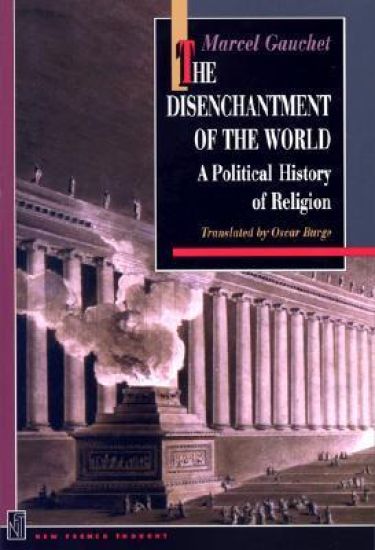
The Disenchantment of the World

The Disenchantment of the World

Marcel Gauchet; Charles Taylor

Princeton University Press
1999
pokkari

Halvin toimitettuna 60,40 €

Marcel Gauchet has launched one of the most ambitious and controversial works of speculative history recently to appear, based on the contention that Christianity is "the religion of the end of religion." In The Disenchantment of the World, Gauchet reinterprets the development of the modern west, with all its political and psychological complexities, in terms of mankind's changing relation to religion. He views Western history as a movement away from religious society, beginning with prophetic Judaism, gaining tremendous momentum in Christianity, and eventually leading to the rise of the political state. Gauchet's view that monotheistic religion itself was a form of social revolution is rich with implications for readers in fields across the humanities and social sciences. Life in religious society, Gauchet reminds us, involves a very different way of being than we know in our secular age: we must imagine prehistoric times where ever-present gods controlled every aspect of daily reality, and where ancestor worship grounded life's meaning in a far-off past. As prophecy-oriented religions shaped the concept of a single omnipotent God, one removed from the world and yet potentially knowable through prayer and reflection, human beings became increasingly free. Gauchet's paradoxical argument is that the development of human political and psychological autonomy must be understood against the backdrop of this double movement in religious consciousness--the growth of divine power and its increasing distance from human activity. In a fitting tribute to this passionate and brilliantly argued book, Charles Taylor offers an equally provocative foreword. Offering interpretations of key concepts proposed by Gauchet, Taylor also explores an important question: Does religion have a place in the future of Western society? The book does not close the door on religion but rather invites us to explore its socially constructive powers, which continue to shape Western politics and conceptions of the state.
Philosophical Arguments

Philosophical Arguments

Charles Taylor

Harvard University Press
1997
nidottu
“Among the leading philosophers of our time, Charles Taylor stands out for the sheer breadth of his interests and influence... Illuminating and rewarding.” —David Miller, Times Literary Supplement Charles Taylor is one of the most important English-language philosophers at work today; he is also unique in the philosophical community in applying his ideas on language and epistemology to social theory and political problems. In this book Taylor brings together some of his best essays, including “Overcoming Epistemology,” “The Validity of Transcendental Argument,” “Irreducibly Social Goods,” and “The Politics of Recognition.” As usual, his arguments are trenchant, straddling the length and breadth of contemporary philosophy and public discourse. The strongest theme running through the book is Taylor’s critique of disengagement, instrumental reason, and atomism: that individual instances of knowledge, judgment, discourse, or action cannot be intelligible in abstraction from the outside world. By developing his arguments about the importance of “engaged agency,” Taylor simultaneously addresses themes in philosophical debate and in a broader discourse of political theory and cultural studies. The thirteen essays in this collection reflect most of the concerns with which he has been involved throughout his career—language, ideas of the self, political participation, the nature of modernity. His intellectual range is extraordinary, as is his ability to clarify what is at stake in difficult philosophical disputes. Taylor’s analyses of liberal democracy, welfare economics, and multiculturalism have real political significance, and his voice is distinctive and wise.

Identitet, frihet och gemenskap : politisk-filosofiska texter
Identitet, frihet och gemenskap syftar till att ge en inblick i Charles taylors politiska filosofi. Men för att förstå den måste man förstå centrala element i hans antropologi, samhällsontologi och moralfilosofi. Samlingen innehåller därför två artiklar där han presenterar grunddragen i antropologin, »Självtolkande djur» och »Begreppet person». Men här återfinns också idag berömda uppsatser som »Atomism» och »Vad är det för fel med negativ frihet?». I övriga uppsatser diskuterar Taylor distributiv rättvisa och redovisar sin position i den moralfilosofiska kontroversen mellan liberaler och kommunitarister. Dessa har, menar Taylor, i hög grad talat förbi varandra, bl a eftersom man inte har skilt tillräckligt klart mellan ontologiska frågor och normativa ställningstaganden. Identitet, frihet och gemenskap inleds med en utförlig introduktion till Taylors tänkande skriven av den norske filosofen Harald Grimen som tillsammans med det fylliga urvalet av Taylors egna texter gör boken till en utmärkt väg in i ett av vår tids väsentliga filosofiska och politiska författarskap.
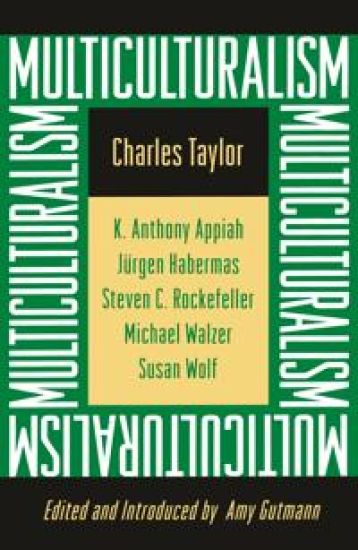
Multiculturalism

Multiculturalism

Charles Taylor

Princeton University Press
1994
pokkari
A new edition of the highly acclaimed book Multiculturalism and "The Politics of Recognition," this paperback brings together an even wider range of leading philosophers and social scientists to probe the political controversy surrounding multiculturalism. Charles Taylor's initial inquiry, which considers whether the institutions of liberal democratic government make room--or should make room--for recognizing the worth of distinctive cultural traditions, remains the centerpiece of this discussion. It is now joined by Jurgen Habermas's extensive essay on the issues of recognition and the democratic constitutional state and by K. Anthony Appiah's commentary on the tensions between personal and collective identities, such as those shaped by religion, gender, ethnicity, race, and sexuality, and on the dangerous tendency of multicultural politics to gloss over such tensions. These contributions are joined by those of other well-known thinkers, who further relate the demand for recognition to issues of multicultural education, feminism, and cultural separatism. Praise for the previous edition:
Reconciling the Solitudes

Reconciling the Solitudes

Charles Taylor

McGill-Queen's University Press
1993
sidottu
Taylor is one of the world's pre-eminent experts on Hegel and brings to his reflections on nationalism and federalism the fruits of a more universal philosophical discourse rooted in the Enlightenment and before. Its hallmarks are terms such as recognition, self-determination, atomism, and modernity. Notwithstanding his long involvement in philosophical reflections, Taylor has avoided the role of the disengaged intellectual, always remaining close to political action and debate in Canada. To his philosophical discourse, therefore, is added a sensitive knowledge of Quebec society from the vantage point of an English-speaking citizen with profound roots within it. Taylor suggests that it will be necessary to think in terms of deep diversity if Canada is to stay together in the twenty-first century. Eight of the essays, published between 1965 and 1992, are drawn from the Queen's Quarterly, edited scholarly books, a research study for the MacDonald Commission on Canada's Economic and Political Future, and an English translation of his submission to Quebec's Belanger-Campeau Commission. The concluding paper was written specially for this volume.
Reconciling the Solitudes

Reconciling the Solitudes

Charles Taylor

McGill-Queen's University Press
1993
nidottu
This collection of essays examines federalism and nationalism in Canada, emphasizing the Canada/Quebec question since 1971. It analyzes the singularity of Quebec within the larger Canadian mosaic, providing a defence for the recognition of Quebec's distinctiveness within a reformed federal system.
Sources of the Self

Sources of the Self

Charles Taylor

Harvard University Press
1992
nidottu

Halvin toimitettuna 46,10 €

“Taylor has taken on the most delicate and exacting of philosophical questions, the question of who we are and how we should live…and he has made this an adventure of self-discovery for his reader.” —Martha Nussbaum, New RepublicIn this extensive inquiry into the sources of modern selfhood, Charles Taylor demonstrates just how rich and precious those resources are. The modern turn to subjectivity, with its attendant rejection of an objective order of reason, has led—it seems to many—to mere subjectivism at the mildest and to sheer nihilism at the worst. Many critics believe that the modern order has no moral backbone and has proved corrosive to all that might foster human good. Taylor rejects this view. He argues that, properly understood, our modern notion of the self provides a framework that more than compensates for the abandonment of substantive notions of rationality. The major insight of Sources of the Self is that modern subjectivity, in all its epistemological, aesthetic, and political ramifications, has its roots in ideas of human good. After first arguing that contemporary philosophers have ignored how self and good connect, the author defines the modern identity by describing its genesis. His effort to uncover and map our moral sources leads to novel interpretations of most of the figures and movements in the modern tradition. Taylor shows that the modern turn inward is not disastrous but is in fact the result of our long efforts to define and reach the good. At the heart of this definition he finds what he calls the affirmation of ordinary life, a value which has decisively if not completely replaced an older conception of reason as connected to a hierarchy based on birth and wealth. In telling the story of a revolution whose proponents have been Augustine, Montaigne, Luther, and a host of others, Taylor’s goal is in part to make sure we do not lose sight of their goal and endanger all that has been achieved. Sources of the Self provides a decisive defense of the modern order and a sharp rebuff to its critics.
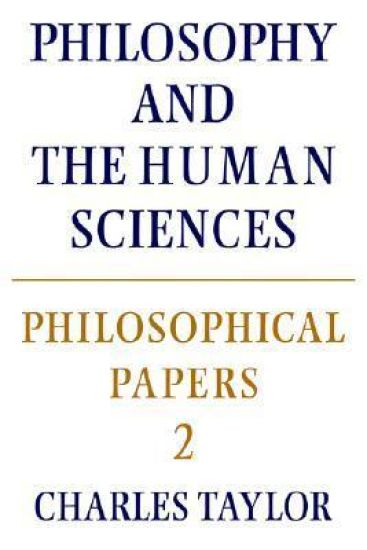
Philosophical Papers: Volume 2, Philosophy and the Human Sciences

Philosophical Papers: Volume 2, Philosophy and the Human Sciences

Charles Taylor

Cambridge University Press
1985
pokkari

Halvin toimitettuna 36,00 €

Charles Taylor has been one of the most original and influential figures in contemporary philosophy: his 'philosophical anthropology' spans an unusually wide range of theoretical interests and draws creatively on both Anglo-American and Continental traditions in philosophy. A selection of his published papers is presented here in two volumes, structured to indicate the direction and essential unity of the work. He starts from a polemical concern with behaviourism and other reductionist theories (particularly in psychology and the philosophy of language) which aim to model the study of man on the natural sciences. This leads to a general critique of naturalism, its historical development and its importance for modern culture and consciousness; and that in turn points, forward to a positive account of human agency and the self, the constitutive role of language and value, and the scope of practical reason. The volumes jointly present some two decades of work on these fundamental themes, and convey strongly the tenacity, verve and versatility of the author in grappling with them. They will interest a very wide range of philosophers and students of the human sciences.
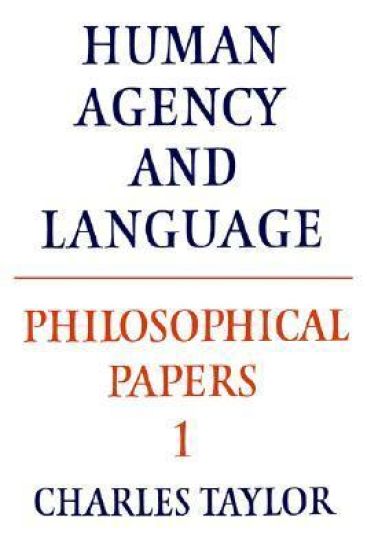
Philosophical Papers: Volume 1, Human Agency and Language

Philosophical Papers: Volume 1, Human Agency and Language

Charles Taylor

Cambridge University Press
1985
pokkari
Charles Taylor has been one of the most original and influential figures in contemporary philosophy: his ‘philosophical anthropology’ spans an unusually wide range of theoretical interests and draws creatively on both Anglo-American and Continental traditions in philosophy. A selection of his published papers is presented here in two volumes, structured to indicate the direction and essential unity of the work. He starts from a polemical concern with behaviourism and other reductionist theories (particularly in psychology and the philosophy of language) which aim to model the study of man on the natural sciences. This leads to a general critique of naturalism, its historical development and its importance for modern culture and consciousness; and that in turn points, forward to a positive account of human agency and the self, the constitutive role of language and value, and the scope of practical reason. The volumes jointly present some two decades of work on these fundamental themes, and convey strongly the tenacity, verve and versatility of the author in grappling with them. They will interest a very wide range of philosophers and students of the human sciences.
Hegel

Hegel

Charles Taylor

Cambridge University Press
1977
pokkari

Halvin toimitettuna 46,80 €

A major and comprehensive study of the philosophy of Hegel, his place in the history of ideas, and his continuing relevance and importance. Professor Taylor relates Hegel to the earlier history of philosophy and, more particularly, to the central intellectual and spiritual issues of his own time. He sees these in terms of a pervasive tension between the evolving ideals of individuality and self-realization on the one hand, and on the other a deeply-felt need to find significance in a wider community. Charles Taylor engages with Hegel sympathetically, on Hegel's own terms and, as the the subject demands, in detail. We are made to grasp the interconnections of the system without being overwhelmed or overawed by its technicality. We are shown its importance and its limitations, and are enabled to stand back from it.