Kirjojen hintavertailu – 12 859 819 kirjaa ja 27 kauppaa

Kirjailija

Charlotte Perkins Gilman

Kirjat ja teokset yhdessä paikassa: 508 kirjaa, julkaisuja vuosilta 1892–2026, suosituimpiin kuuluu Förfärande kvinnor : gotisk skräck från Brontë till Gilman i urval och översättning av KG Johansson. Vertaile teosten hintoja ja tarkista saatavuus suomalaisista kirjakaupoista.

Nimi esiintyy myös muodoissa: Charlotte Perkins-Gilman

508 kirjaa

Kirjojen julkaisuvuodet: 1892–2026.

Herland

Herland

Charlotte Perkins Gilman

Bibliotech Press
2020
sidottu
Herland is a utopian novel from 1915, written by feminist Charlotte Perkins Gilman. The book describes an isolated society composed entirely of women, who reproduce via parthenogenesis (asexual reproduction). The result is an ideal social order: free of war, conflict, and domination. It was first published in monthly installments as a serial in 1915 in The Forerunner, a magazine edited and written by Gilman between 1909 and 1916, with its sequel, With Her in Ourland beginning immediately thereafter in the January 1916 issue. The book is often considered to be the middle volume in her utopian trilogy; preceded by Moving the Mountain (1911), and followed by, With Her in Ourland (1916). It was not published in book form until 1979. (wikipedia.org)
Herland

Herland

Charlotte Perkins Gilman

Bibliotech Press
2020
pokkari
Herland is a utopian novel from 1915, written by feminist Charlotte Perkins Gilman. The book describes an isolated society composed entirely of women, who reproduce via parthenogenesis (asexual reproduction). The result is an ideal social order: free of war, conflict, and domination. It was first published in monthly installments as a serial in 1915 in The Forerunner, a magazine edited and written by Gilman between 1909 and 1916, with its sequel, With Her in Ourland beginning immediately thereafter in the January 1916 issue. The book is often considered to be the middle volume in her utopian trilogy; preceded by Moving the Mountain (1911), and followed by, With Her in Ourland (1916). It was not published in book form until 1979. (wikipedia.org)
Women and Economics

Women and Economics

Charlotte Perkins Gilman

Bibliotech Press
2020
pokkari
Women and Economics - A Study of the Economic Relation Between Men and Women as a Factor in Social Evolution is a book written by Charlotte Perkins Gilman. It is considered by many to be her single greatest work, and as with much of Gilman's writing, the book touched a few dominant themes: the transformation of marriage, the family, and the home, with her central argument: "the economic independence and specialization of women as essential to the improvement of marriage, motherhood, domestic industry, and racial improvement." (wikipedia.org)
Women and Economics

Women and Economics

Charlotte Perkins Gilman

Bibliotech Press
2020
sidottu
Women and Economics - A Study of the Economic Relation Between Men and Women as a Factor in Social Evolution is a book written by Charlotte Perkins Gilman. It is considered by many to be her single greatest work, and as with much of Gilman's writing, the book touched a few dominant themes: the transformation of marriage, the family, and the home, with her central argument: "the economic independence and specialization of women as essential to the improvement of marriage, motherhood, domestic industry, and racial improvement." (wikipedia.org)
The Man-Made World, Or Our Androcentric Culture

The Man-Made World, Or Our Androcentric Culture

Charlotte Perkins Gilman

Bibliotech Press
2020
sidottu
Charlotte Perkins Gilman, in full Charlotte Anna Perkins Stetson Gilman, n e Charlotte Anna Perkins, also called Charlotte Anna Perkins Gilman, (born July 3, 1860, Hartford, Connecticut, U. S.--died August 17, 1935, Pasadena, California), American feminist, lecturer, writer, and publisher who was a leading theorist of the women's movement in the United States. In 1898 Perkins published Women and Economics, a manifesto that attracted great attention and was translated into seven languages. In a radical call for economic independence for women, she dissected with keen intelligence much of the romanticized convention surrounding contemporary ideas of womanhood and motherhood. Her notions of redefining domestic and child-care chores as social responsibilities to be centralized in the hands of those particularly suited and trained for them reflected her earlier interest in the Nationalist clubs advocated by Edward Bellamy, and she expanded on contemporary ideas in Concerning Children (1900) and The Home (1903). In June 1900 she married a cousin, George H. Gilman, with whom she lived in New York City until 1922. Human Work (1904) continued the arguments of Women and Economics. Later books include What Diantha Did (1910), The Man-Made World (1911), in which she distinguished the characteristic virtues and vices of men and women and attributed the ills of the world to the dominance of men, The Crux (1911), Moving the Mountain (1911), His Religion and Hers (1923), and The Living of Charlotte Perkins Gilman: An Autobiography (1935). From 1909 to 1916 Gilman edited and published the monthly Forerunner, a magazine of feminist articles, views, and fiction. She also contributed to other periodicals. Gilman joined Jane Addams in founding the Woman's Peace Party in 1915, but she was little involved in other organized movements of the day. After treatments for the cancer that afflicted her proved ineffective, she took her own life. (britannica.com)

The Man-Made World, Or Our Androcentric Culture

The Man-Made World, Or Our Androcentric Culture

Charlotte Perkins Gilman

Bibliotech Press
2020
pokkari
Charlotte Perkins Gilman, in full Charlotte Anna Perkins Stetson Gilman, n e Charlotte Anna Perkins, also called Charlotte Anna Perkins Gilman, (born July 3, 1860, Hartford, Connecticut, U. S.--died August 17, 1935, Pasadena, California), American feminist, lecturer, writer, and publisher who was a leading theorist of the women's movement in the United States. In 1898 Perkins published Women and Economics, a manifesto that attracted great attention and was translated into seven languages. In a radical call for economic independence for women, she dissected with keen intelligence much of the romanticized convention surrounding contemporary ideas of womanhood and motherhood. Her notions of redefining domestic and child-care chores as social responsibilities to be centralized in the hands of those particularly suited and trained for them reflected her earlier interest in the Nationalist clubs advocated by Edward Bellamy, and she expanded on contemporary ideas in Concerning Children (1900) and The Home (1903). In June 1900 she married a cousin, George H. Gilman, with whom she lived in New York City until 1922. Human Work (1904) continued the arguments of Women and Economics. Later books include What Diantha Did (1910), The Man-Made World (1911), in which she distinguished the characteristic virtues and vices of men and women and attributed the ills of the world to the dominance of men, The Crux (1911), Moving the Mountain (1911), His Religion and Hers (1923), and The Living of Charlotte Perkins Gilman: An Autobiography (1935). From 1909 to 1916 Gilman edited and published the monthly Forerunner, a magazine of feminist articles, views, and fiction. She also contributed to other periodicals. Gilman joined Jane Addams in founding the Woman's Peace Party in 1915, but she was little involved in other organized movements of the day. After treatments for the cancer that afflicted her proved ineffective, she took her own life. (britannica.com)

The Yellow Wallpaper: New Edition - The Yellow Wallpaper by Charlotte Perkins Gilman
The Yellow Wallpaper by Charlotte Perkins Gilman is a real classic. You should grab it and read it to experience it yourself. Here's a simple plot to The Yellow Wallpaper by Charlotte Perkins GilmanThe story details an intricate period in the life of a young woman. Her supportive, though misunderstanding husband, John, believes it is in her best interests to go on a rest cure after experiencing symptoms of "temporary nervous depression" after the birth of their baby. The family spends the summer at a colonial mansion that strikes the narrator as odd. She and her husband move into an upstairs room. Along with the couple, John's sister Jennie is present serving as the housekeeper. At the time, the windows are barred, the wallpaper has been torn, there are metal rings in the walls - the kind that are used for restraints - and the floor is scratched. The narrator blames all these to children having resided there as most of the damage is away to their reach. Ultimately, readers are left to be unsure what is the source of the room's state, leading them to see the ambiguities in the unreliability of the narrator. It is strongly implied however that the room was formerly used as a prison to contain another mentally ill patient, as the bed has been nailed to the floor and there is a gate at the top of the stairs leading to the room. The narrator devotes many journal entries to describing the wallpaper in the room - its "yellow" smell, its "breakneck" pattern, the missing patches, and the way it leaves yellow smears on the skin and clothing of anyone who touches it. She describes how the longer one stays in the bedroom, the more the wallpaper appears to mutate, especially in the moonlight. With no stimulus other than the wallpaper, the pattern and designs become increasingly intriguing to the narrator. She soon begins to see a figure in the design, and eventually comes to believe that a woman is creeping on all fours behind the pattern. Believing she must try to free the woman in the wallpaper, the woman begins to strip the remaining paper off the wall. After many moments of tension between John and his wife, the story climaxes with the final day in the house. On the last day of summer, she locks herself in her room to strip the remains of the wallpaper. When John arrives home, she refuses to unlock the door. When he returns with the key, he finds her creeping around the room, circling the walls and touching the wallpaper. She excitedly exclaims, "I've got out at last... in spite of you and Jane", causing her husband to faint as she continues to circle the room, creeping over his inert body each time she passes it, believing herself to have become the personification of the woman trapped behind the yellow wallpaper....... The Yellow Wallpaper by Charlotte Perkins Gilman
The Yellow Wallpaper and Other Writings

The Yellow Wallpaper and Other Writings

Charlotte Perkins Gilman

Gibbs M. Smith Inc
2019
sidottu
Part of the Gibbs Smith Women's Voices series: A collection of literary voices written by, and for, extraordinary women--to encourage, challenge, and inspire. Charlotte Perkins Gilman (1860-1935) championed women's rights in her prolific fiction, nonfiction, and poetry. Discover three influential works by one of America's first feminists in their unabridged form: the short story The Yellow Wallpaper, a haunting interpretation of postpartum depression; the feminist utopian novel Herland; and Women and Economics, which when published in 1898 established Gilman as a sociologist, philosopher, ethicist, and social critic, and is considered by many to be her greatest work. Continue your journey in the Women's Voices series with Jane Eyre, by Charlotte Bronte (ISBN: 978-1-4236-5099-7), The Feminist Papers, by Mary Wollstonecraft (ISBN: 978-1-4236-5097-3), Hope Is the Thing with Feathers, the complete poems of Emily Dickinson (ISBN: 978-1-4236-5098-0), and Little Women, by Louisa May Alcott (ISBN: 978-1-4236-5211-3).
The Yellow Wallpaper (Legend Classics)

The Yellow Wallpaper (Legend Classics)

Charlotte Perkins Gilman

Legend Press Ltd
2019
nidottu

Halvin toimitettuna 18,90 €

Part of the Legend Classics series'The color is hideous enough, and unreliable enough, and infuriating enough, but the pattern is torturing.'Written with barely controlled fury after she was confined to her room for 'nerves' and forbidden to write, Gilman's pioneering feminist horror story scandalized nineteenth-century readers with its portrayal of a woman who loses her mind because she has literally nothing to do.
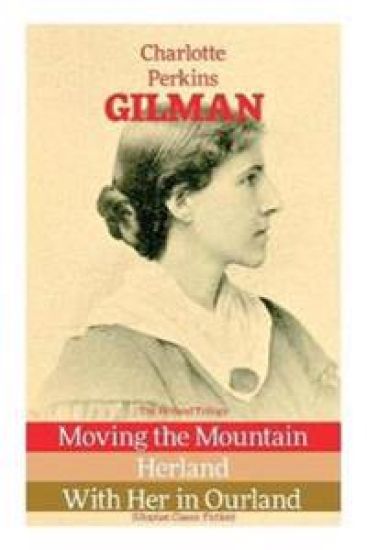
The Herland Trilogy: Moving the Mountain, Herland, with Her in Ourland (Utopian Classic)
Moving the Mountain is a feminist utopian novel. The book was one element in the major wave of utopian and dystopian literature that marked the later nineteenth and early twentieth centuries. Perkins sends a man forward in time to a better world, but gives him deep difficulties in adjusting to it. Herland describes an isolated society composed entirely of women who reproduce via parthenogenesis. The result is an ideal social order, free of war, conflict and domination. The story is told from the perspective of Van Jennings, a student of sociology who, along with two friends, Terry O. Nicholson and Jeff Margrave, forms an expedition party to explore an area of unchartered land where it is rumored lives a society consisting entirely of women. The three friends do not really believe the rumors as they are unable to conceive of how human reproduction could occur without males. The men speculate about what a society of women would be like, each guessing differently based on the stereotype of women which he holds most dear... With Her in Ourland draws a contrast between Gilman's idealized vision of a feminist society in Herland and the darker realities of real, outside, male-dominated world. Charlotte Perkins Gilman (1860-1935) was a prominent American feminist, sociologist, novelist, writer of short stories, poetry, and nonfiction, and a lecturer for social reform.
The Herland Trilogy

The Herland Trilogy

Charlotte Perkins Gilman

E-Artnow
2018
pokkari
Moving the Mountain is the first book in Charlotte Perkins Stetson Gilman's well known trilogy. Moving Mountain delivers Gilman's program for reforming society. She concentrates on measures of rationality and efficiency that could be instituted in her own time, largely with greater social cooperation - equal education and treatment for girls and boys, day-care centers for working women, and other issues still relevant a century later. Herland is a utopian novel. The book describes an isolated society composed entirely of women who reproduce via parthenogenesis. The result is an ideal social order, free of war, conflict and domination. The story is told from the perspective of Van Jennings, a student of sociology who, along with two friends, Terry O. Nicholson and Jeff Margrave, forms an expedition party to explore an area of unchartered land where it is rumored lives a society consisting entirely of women. The three friends do not really believe the rumors as they are unable to conceive of how human reproduction could occur without males. The men speculate about what a society of women would be like, each guessing differently based on the stereotype of women which he holds most dear... With Her in Ourland is the third book in Charlotte Perkins Gilman's utopian trilogy which begins where Moving the Mountain and Herland left off. Gilman masterfully compares our real modern male dominated WORLD with an imaginary perfect society comprised of only woman. Charlotte Perkins Gilman (1860-1935) was a prominent American feminist, sociologist, novelist, writer of short stories, poetry, and nonfiction, and a lecturer for social reform.
The Yellow Wallpaper

The Yellow Wallpaper

Charlotte Perkins Gilman

Simon Brown
2018
pokkari
The story details the descent of a young woman into madness. Her supportive, though misunderstanding husband, John, believes it is in her best interests to go on a rest cure after experiencing symptoms of "temporary nervous depression." The family spends the summer at a colonial mansion that has, in the narrator's words, "something queer about it." She and her husband move into an upstairs room that she assumes was once a nursery. Her husband chooses for them to sleep there due to its multitude of windows, which provide the air so needed in her recovery. In addition to the couple, John's sister Jennie is present; she serves as their housekeeper. Like most nurseries at the time the windows are barred, the wallpaper has been torn, and the floor is scratched. The narrator attributes all these to children, as most of the damage is isolated to their reach. Ultimately, though, readers are left unsure as to the source of the room's state, leading them to see the ambiguities in the unreliability of the narrator.
The Man-Made World

The Man-Made World

Charlotte Perkins Gilman

Createspace Independent Publishing Platform
2018
nidottu
Let us begin, inoffensively, with sheep. The sheep is a beast with which we are all familiar, being much used in religious imagery; the common stock of painters; a staple article of diet; one of our main sources of clothing; and an everyday symbol of bashfulness and stupidity. In some grazing regions the sheep is an object of terror, destroying grass, bush and forest by omnipresent nibbling; on the great plains, sheep-keeping frequently results in insanity, owing to the loneliness of the shepherd, and the monotonous appearance and behavior of the sheep. By the poet, young sheep are preferred, the lamb gambolling gaily; unless it be in hymns, where "all we like sheep" are repeatedly described, and much stress is laid upon the straying propensities of the animal.
The Yellow Wallpaper

The Yellow Wallpaper

Charlotte Perkins Gilman

Createspace Independent Publishing Platform
2018
nidottu
The story details the descent of a young woman into madness. Her supportive, though misunderstanding husband, John, believes it is in her best interests to go on a rest cure after the birth of their child. The family spends the summer at a colonial mansion that has, in the narrator's words, "something queer about it". She and her husband move into an upstairs room that she assumes was once a nursery, having it serve as their bedroom due to its multitude of windows, which provide the air so needed in her recovery. In addition to the couple, John's sister Jennie is present; she serves as their housekeeper. Like most nurseries at the time the windows are barred, the wallpaper has been torn, and the floor is scratched. The narrator attributes all these to children, as most of the damage is isolated to their reach. Ultimately, though, the reader is left unsure as to the source of the room's damage.
The Yellow Wallpaper

The Yellow Wallpaper

Charlotte Perkins Gilman

Createspace Independent Publishing Platform
2018
nidottu
"The Yellow Wallpaper"Yellowwp med.jpg1988 edition coverAuthorCharlotte Perkins GilmanCountryUnited StatesLanguageEnglishGenre(s)Captivity narrative, feminist literaturePublication date1892"The Yellow Wallpaper" (original title: "The Yellow Wall-paper. A Story") is a short story by American writer Charlotte Perkins Gilman, first published in January 1892 in The New England Magazine. It is regarded as an important early work of American feminist literature, illustrating attitudes in the 19th century toward women's health, both physical and mental. Presented in the first person, the story is a collection of journal entries written by a woman whose physician husband (John) has rented an old mansion for the summer. Forgoing other rooms in the house, the couple moves into the upstairs nursery. As a form of treatment, the unnamed woman is forbidden from working, and is encouraged to eat well and get plenty of exercise and air, so she can recuperate from what he calls a "temporary nervous depression - a slight hysterical tendency", a diagnosis common to women in that period.