Kirjojen hintavertailu – 12 859 818 kirjaa ja 27 kauppaa

Kirjailija

Charlotte Perkins Gilman

Kirjat ja teokset yhdessä paikassa: 508 kirjaa, julkaisuja vuosilta 1892–2026, suosituimpiin kuuluu Förfärande kvinnor : gotisk skräck från Brontë till Gilman i urval och översättning av KG Johansson. Vertaile teosten hintoja ja tarkista saatavuus suomalaisista kirjakaupoista.

Nimi esiintyy myös muodoissa: Charlotte Perkins-Gilman

508 kirjaa

Kirjojen julkaisuvuodet: 1892–2026.

What Diantha Did

What Diantha Did

Charlotte Perkins Gilman

Duke University Press
2005
pokkari
This edition of What Diantha Did makes newly available Charlotte Perkins Gilman’s first novel, complete with an in-depth introduction. First published serially in Gilman’s magazine The Forerunner in 1909–10, the novel tells the story of Diantha Bell, a young woman who leaves her home and her fiancé to start a housecleaning business. A resourceful heroine, Diantha quickly expands her business into an enterprise that includes a maid service, cooked food delivery service, restaurant, and hotel. By assigning a cash value to women’s “invisible” work, providing a means for the well-being and moral uplift of working girls, and releasing middle-class and leisure-class women from the burden of conventional domestic chores, Diantha proves to her family and community the benefits of professionalized housekeeping. In her introduction to the novel, Charlotte J. Rich highlights Gilman’s engagement with such hotly debated Progressive Era issues as the “servant question,” the rise of domestic science, and middle-class efforts to protect and aid the working girl. She illuminates the novel’s connections to Gilman’s other feminist works, including “The Yellow Wall-Paper” and Herland; to her personal life; and to her commitment to women’s social and economic freedom. Rich contends that the novel’s engagement with class and race makes it particularly significant to the newly complex understanding of Gilman that has emerged in recent scholarship. What Diantha Did provides essential insight into Charlotte Perkins Gilman’s important legacy of social thought.

What Diantha Did

What Diantha Did

Charlotte Perkins Gilman

Duke University Press
2005
sidottu
This edition of What Diantha Did makes newly available Charlotte Perkins Gilman’s first novel, complete with an in-depth introduction. First published serially in Gilman’s magazine The Forerunner in 1909–10, the novel tells the story of Diantha Bell, a young woman who leaves her home and her fiancé to start a housecleaning business. A resourceful heroine, Diantha quickly expands her business into an enterprise that includes a maid service, cooked food delivery service, restaurant, and hotel. By assigning a cash value to women’s “invisible” work, providing a means for the well-being and moral uplift of working girls, and releasing middle-class and leisure-class women from the burden of conventional domestic chores, Diantha proves to her family and community the benefits of professionalized housekeeping. In her introduction to the novel, Charlotte J. Rich highlights Gilman’s engagement with such hotly debated Progressive Era issues as the “servant question,” the rise of domestic science, and middle-class efforts to protect and aid the working girl. She illuminates the novel’s connections to Gilman’s other feminist works, including “The Yellow Wall-Paper” and Herland; to her personal life; and to her commitment to women’s social and economic freedom. Rich contends that the novel’s engagement with class and race makes it particularly significant to the newly complex understanding of Gilman that has emerged in recent scholarship. What Diantha Did provides essential insight into Charlotte Perkins Gilman’s important legacy of social thought.
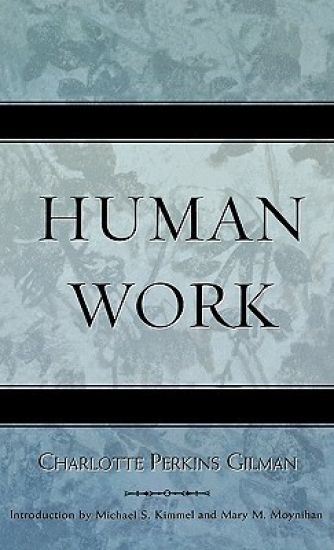
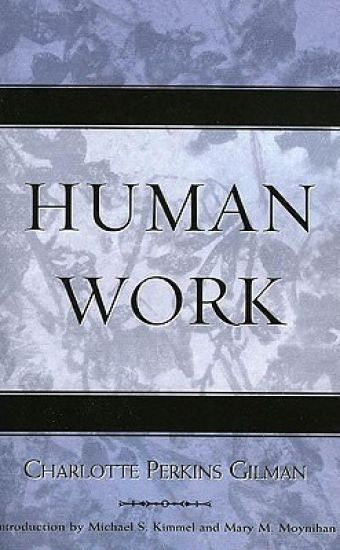
Human Work

Human Work

Charlotte Perkins Gilman; Michael Kimmel; Mary M. Moynihan

AltaMira Press,U.S.
2005
sidottu
Human Work represents the first ground breaking analysis on the equal importance of work in the lives of men and women. Noted feminist Charlotte Perkins Gilman maintains the notion that it was 'sexuo-economic oppression of women' and not women's biology that kept women from achieving in all areas of work. Accusing men of appropriating certain work as 'men's work' and masking the process as a biological locus rather than an exercise in power relations, Gilman asserts that men created an economic dependence that has prevented women from success in the workplace. Introduced by noted scholars Michael Kimmel and Mary Moynihan, Human Work is necessary reading for anyone interested in power and gender structures in the workplace.
Human Work

Human Work

Charlotte Perkins Gilman; Michael Kimmel; Mary M. Moynihan

AltaMira Press,U.S.
2005
nidottu
Human Work represents the first ground breaking analysis on the equal importance of work in the lives of men and women. Noted feminist Charlotte Perkins Gilman maintains the notion that it was "sexuo-economic oppression of women" and not women's biology that kept women from achieving in all areas of work. Accusing men of appropriating certain work as "men's work" and masking the process as a biological locus rather than an exercise in power relations, Gilman asserts that men created an economic dependence that has prevented women from success in the workplace. Introduced by noted scholars Michael Kimmel and Mary Moynihan, Human Work is necessary reading for anyone interested in power and gender structures in the workplace.
Social Ethics

Social Ethics

Charlotte Perkins Gilman

Praeger Publishers Inc
2004
sidottu
First serialized in 1914, Social Ethics attempts to convince readers that individualist ethics have failed to make the world a safe place for children, and that we cannot progress to a fully social ethics unless we understand the morality of collective action from a specifically sociological point of view. Gilman argues that in order to be fully progressive, ethics must shift from its traditional focus on individual behaviors to the structure, morality, and outcomes of social or group actions. The social ills she addresses in her attempt to advocate for a reexamination of our ethics include topics still relevant today: militarism, waste, religious intolerance, conspicuous consumption, greed, graft, environmental degradation, preventable diseases, and patriarchal oppression in its numerous manifestations. Hill and Deegan's purpose in recovering this forcefully argued book from obscurity is to show not only that Gilman's central arguments remain largely valid and cogent today, but also that Gilman is a major and substantive contributor to the shape and importance of sociology in its formative years. Traditional ethics, Gilman argues, fail to resolve the enduring problems facing society because our received ethical systems are invariably and mistakenly founded on individualist rather than social logics. The shape of our collective future, if it is to be progressive and morally responsible, depends fundamentally on adopting a sociological perspective, and our guiding principle must be to make the world a safe and nurturing place for babies and children. Anything less, in Gilman's view, is morally degenerate. In their carefully considered introduction, Hill and Deegan locate Gilman's personal and professional sociological identity within a network of influential and collegial sociologists, and relate Social Ethics to Gilman's interests in evolutionary thought, Fabian economics, feminist pragmatism, and the cognate work of Thorstein Veblen. The publication of Social Ethics in book form recovers an important theoretical treatise for a new generation of students, scholars, and fans of Gilman's Herland/Ourland saga.
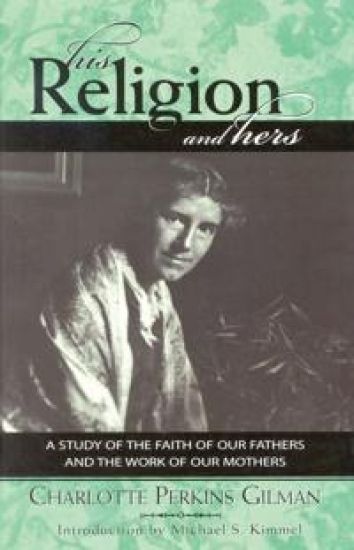
His Religion and Hers

His Religion and Hers

Charlotte Perkins Gilman

AltaMira Press,U.S.
2003
sidottu
Charlotte Perkins Gilman's His Religion and Hers is a brave critique of organized religion and the consequences that a male-constructed religion has on everyday life. She suggests that through the development of secular ethics, religion can be directed not to the anticipation of a mythical afterlife, but instead to the transformation of the present. Courageously questioning why 'neither religion, morality, nor ethics has made us good,' she demonstrates the ways in which a male driven ideology has produced a religion focused on death and discourages any attention to the improvement of life on earth. Offering new thoughts that advocate a collective change of view, this volume delves intensively into religion and the influence of gender. Coming generations will welcome this new edition of His Religion and Hers, now with an introduction by noted scholar Michael S. Kimmel.
His Religion and Hers

His Religion and Hers

Charlotte Perkins Gilman

AltaMira Press,U.S.
2003
nidottu
Charlotte Perkins Gilman's His Religion and Hers is a brave critique of organized religion and the consequences that a male-constructed religion has on everyday life. She suggests that through the development of secular ethics, religion can be directed not to the anticipation of a mythical afterlife, but instead to the transformation of the present. Courageously questioning why 'neither religion, morality, nor ethics has made us good,' she demonstrates the ways in which a male driven ideology has produced a religion focused on death and discourages any attention to the improvement of life on earth. Offering new thoughts that advocate a collective change of view, this volume delves intensively into religion and the influence of gender. Coming generations will welcome this new edition of His Religion and Hers, now with an introduction by noted scholar Michael S. Kimmel.
The Crux

The Crux

Charlotte Perkins Gilman

Duke University Press
2003
sidottu
Long out of print, Charlotte Perkins Gilman’s novel The Crux is an important early feminist work that brings to the fore complicated issues of gender, citizenship, eugenics, and frontier nationalism. First published serially in the feminist journal The Forerunner in 1910, The Crux tells the story of a group of New England women who move west to start a boardinghouse for men in Colorado. The innocent central character, Vivian Lane, falls in love with Morton Elder, who has both gonorrhea and syphilis. The concern of the novel is not so much that Vivian will catch syphilis, but that, if she were to marry and have children with Morton, she would harm the "national stock." The novel was written, in Gilman’s words, as a "story . . . for young women to read . . . in order that they may protect themselves and their children to come." What was to be protected was the civic imperative to produce "pureblooded" citizens for a utopian ideal. Dana Seitler’s introduction provides historical context, revealing The Crux as an allegory for social and political anxieties-including the rampant insecurities over contagion and disease-in the United States at the beginning of the twentieth century. Seitler highlights the importance of The Crux to understandings of Gilman’s body of work specifically and early feminism more generally. She shows how the novel complicates critical history by illustrating the biological argument undergirding Gilman’s feminism. Indeed, The Crux demonstrates how popular conceptions of eugenic science were attractive to feminist authors and intellectuals because they suggested that ideologies of national progress and U. S. expansionism depended as much on women and motherhood as on masculine contest.
The Crux

The Crux

Charlotte Perkins Gilman

Duke University Press
2003
pokkari
This is an important early feminist work which brings to the fore complicated issues of gender, citizenship, eugenics and frontier nationalsim.
The Home

The Home

Charlotte Perkins Gilman

AltaMira Press,U.S.
2002
sidottu
Charlotte Perkins Gilman's The Home is a scathing attack on the domesticity of women in the early 20th century. Her central argument, that "the economic independence and specialization of women is essential to the improvement of marriage, motherhood, domestic industry, and racial improvement" resonates in this work. Throughout, she maintains that the liberation of women—and of children and of men, for that matter—requires getting women out of the house, both practically and ideologically. AltaMira Press is proud to reprint this provocative work and introduce Charlotte Perkins Gilman to a new generation of students and feminist scholars.
The Dress of Women

The Dress of Women

Charlotte Perkins Gilman

Praeger Publishers Inc
2001
sidottu
Originally serialized in 1915 in The Forerunner, and never before published in book form, The Dress of Women presents Gilman's feminist sociological analysis of clothing in modern society. Gilman explores the social and functional basis for clothing, excavates the symbolic role of women's clothing in patriarchal societies, and, among other things, explicates the aesthetic and economic principles of socially responsible clothing design. The introduction, by Hill and Deegan, situates The Dress of Women within Gilman's intellectual work as a sociologist, and relates her sociological ideas to the themes she developed in some of her other works. Although written in 1915, Gilman's treatment of clothing and dress remains relevant. This pioneering effort adds substantially to Gilman's reputation as a sociological theorist and feminist. In addition, it represents one of the earliest full-length specifically sociological analyses of clothing and the fashion industry. Ultimately, the author concludes that harmful and degrading aspects of women's dress are amenable to reform if men and women will work together rationally to change the controlling institutional patterns of the society in which they live. This groundbreaking work will appeal to those interested in Gilman, feminist theory, sociological theory, social psychology, women's literature, and women's studies.
Herland

Herland

Charlotte Perkins Gilman

The Women's Press Ltd
2001
pokkari
Written in 1915, this text is about three male explorers and the utopian female society they stumble upon. This is a community where war, famine and other "man-made" disasters do not exist.
Herland

Herland

Charlotte Perkins Gilman

Dover Publications Inc.
2000
nidottu

Halvin toimitettuna 11,60 €

Delightfully humorous account of a feminist utopia in which three male explorers stumble upon an all-female society isolated in a distant part of the earth. Early 20th-century vehicle for Gilman’s then-unconventional views of male-female behavior, motherhood, individuality, privacy, sense of c
The Yellow Wallpaper

The Yellow Wallpaper

Bernard G. Richards; Charlotte Perkins Gilman

Dover Publications Inc.
2000
nidottu

Halvin toimitettuna 8,90 €

Enjoy 7 thought-provoking stories that employ charm and humor to examine relations between the sexes from a feminist perspective. In addition to the title story, an 1892 classic that recounts a woman's descent into madness, this collection includes such masterful stories as "Cottagette," "Turned," "Mr. Peebles' Heart," and more.
The Charlotte Perkins Gilman Reader

The Charlotte Perkins Gilman Reader

Charlotte Perkins Gilman

University of Virginia Press
1999
nidottu
An anthology of fiction by one of America's important feminist writers, the author of the ""Yellow Wallpaper"", in which a woman is driven mad by chauvinist psychiatry. Collected here, by Lane, are 18 stories and fragments, including a selection from ""Herland"", Gilman's feminist Utopia.
Diaries of Charlotte Perkins Gilman

Diaries of Charlotte Perkins Gilman

Charlotte Perkins Gilman

University of Virginia Press
1998
nidottu
One of the leading intellectuals of first-wave feminism, Charlotte Perkins Gilman (1860-1935) was a prolific socialist writer and lecturer. This representative selection from Gilman's diaries includes entries written between January 1879 and March 1935.