Kirjojen hintavertailu – 12 859 829 kirjaa ja 27 kauppaa

Kirjailija

Chenguang Yang

Kirjat ja teokset yhdessä paikassa: 8 kirjaa, julkaisuja vuosilta 2012–2025, suosituimpiin kuuluu Advanced Control of Wheeled Inverted Pendulum Systems. Vertaile teosten hintoja ja tarkista saatavuus suomalaisista kirjakaupoista.

8 kirjaa

Kirjojen julkaisuvuodet: 2012–2025.

Robot Learning Human Skills and Intelligent Control Design

Robot Learning Human Skills and Intelligent Control Design

Chenguang Yang; Chao Zeng; Jianwei Zhang

TAYLOR FRANCIS LTD
2023
nidottu
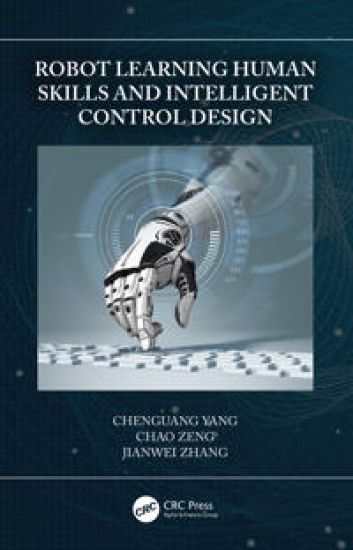
In the last decades robots are expected to be of increasing intelligence to deal with a large range of tasks. Especially, robots are supposed to be able to learn manipulation skills from humans. To this end, a number of learning algorithms and techniques have been developed and successfully implemented for various robotic tasks. Among these methods, learning from demonstrations (LfD) enables robots to effectively and efficiently acquire skills by learning from human demonstrators, such that a robot can be quickly programmed to perform a new task. This book introduces recent results on the development of advanced LfD-based learning and control approaches to improve the robot dexterous manipulation. First, there's an introduction to the simulation tools and robot platforms used in the authors' research. In order to enable a robot learning of human-like adaptive skills, the book explains how to transfer a human user’s arm variable stiffness to the robot, based on the online estimation from the muscle electromyography (EMG). Next, the motion and impedance profiles can be both modelled by dynamical movement primitives such that both of them can be planned and generalized for new tasks. Furthermore, the book introduces how to learn the correlation between signals collected from demonstration, i.e., motion trajectory, stiffness profile estimated from EMG and interaction force, using statistical models such as hidden semi-Markov model and Gaussian Mixture Regression. Several widely used human-robot interaction interfaces (such as motion capture-based teleoperation) are presented, which allow a human user to interact with a robot and transfer movements to it in both simulation and real-word environments. Finally, improved performance of robot manipulation resulted from neural network enhanced control strategies is presented. A large number of examples of simulation and experiments of daily life tasks are included in this book to facilitate better understanding of the readers.
Human-in-the-loop Learning and Control for Robot Teleoperation

Human-in-the-loop Learning and Control for Robot Teleoperation

Chenguang Yang; Jing Luo; Ning Wang

ELSEVIER SCIENCE TECHNOLOGY
2023
nidottu
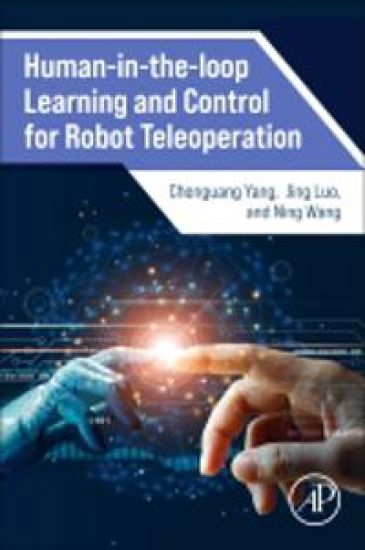
Human-in-the-loop Learning and Control for Robot Teleoperation presents recent, research progress on teleoperation and robots, including human-robot interaction, learning and control for teleoperation with many extensions on intelligent learning techniques. The book integrates cutting-edge research on learning and control algorithms of robot teleoperation, neural motor learning control, wave variable enhancement, EMG-based teleoperation control, and other key aspects related to robot technology, presenting implementation tactics, adequate application examples and illustrative interpretations. Robots have been used in various industrial processes to reduce labor costs and improve work efficiency. However, most robots are only designed to work on repetitive and fixed tasks, leaving a gap with the human desired manufacturing effect.
Robot Learning Human Skills and Intelligent Control Design

Robot Learning Human Skills and Intelligent Control Design

Chenguang Yang; Chao Zeng; Jianwei Zhang

CRC Press
2021
sidottu
In the last decades robots are expected to be of increasing intelligence to deal with a large range of tasks. Especially, robots are supposed to be able to learn manipulation skills from humans. To this end, a number of learning algorithms and techniques have been developed and successfully implemented for various robotic tasks. Among these methods, learning from demonstrations (LfD) enables robots to effectively and efficiently acquire skills by learning from human demonstrators, such that a robot can be quickly programmed to perform a new task. This book introduces recent results on the development of advanced LfD-based learning and control approaches to improve the robot dexterous manipulation. First, there's an introduction to the simulation tools and robot platforms used in the authors' research. In order to enable a robot learning of human-like adaptive skills, the book explains how to transfer a human user’s arm variable stiffness to the robot, based on the online estimation from the muscle electromyography (EMG). Next, the motion and impedance profiles can be both modelled by dynamical movement primitives such that both of them can be planned and generalized for new tasks. Furthermore, the book introduces how to learn the correlation between signals collected from demonstration, i.e., motion trajectory, stiffness profile estimated from EMG and interaction force, using statistical models such as hidden semi-Markov model and Gaussian Mixture Regression. Several widely used human-robot interaction interfaces (such as motion capture-based teleoperation) are presented, which allow a human user to interact with a robot and transfer movements to it in both simulation and real-word environments. Finally, improved performance of robot manipulation resulted from neural network enhanced control strategies is presented. A large number of examples of simulation and experiments of daily life tasks are included in this book to facilitate better understanding of the readers.
Advanced Control of Wheeled Inverted Pendulum Systems

Advanced Control of Wheeled Inverted Pendulum Systems

Zhijun Li; Chenguang Yang; Liping Fan

Springer London Ltd
2014
nidottu
Advanced Control of Wheeled Inverted Pendulum Systems is an orderly presentation of recent ideas for overcoming the complications inherent in the control of wheeled inverted pendulum (WIP) systems, in the presence of uncertain dynamics, nonholonomic kinematic constraints as well as underactuated configurations. The text leads the reader in a theoretical exploration of problems in kinematics, dynamics modeling, advanced control design techniques and trajectory generation for WIPs. An important concern is how to deal with various uncertainties associated with the nominal model, WIPs being characterized by unstable balance and unmodelled dynamics and being subject to time-varying external disturbances for which accurate models are hard to come by. The book is self-contained, supplying the reader with everything from mathematical preliminaries and the basic Lagrange-Euler-based derivation of dynamics equations to various advanced motion control and force control approaches as well as trajectory generation method. Although primarily intended for researchers in robotic control, Advanced Control of Wheeled Inverted Pendulum Systems will also be useful reading for graduate students studying nonlinear systems more generally.
Advanced Control of Wheeled Inverted Pendulum Systems

Advanced Control of Wheeled Inverted Pendulum Systems

Zhijun Li; Chenguang Yang; Liping Fan

Springer London Ltd
2012
sidottu
Advanced Control of Wheeled Inverted Pendulum Systems is an orderly presentation of recent ideas for overcoming the complications inherent in the control of wheeled inverted pendulum (WIP) systems, in the presence of uncertain dynamics, nonholonomic kinematic constraints as well as underactuated configurations. The text leads the reader in a theoretical exploration of problems in kinematics, dynamics modeling, advanced control design techniques and trajectory generation for WIPs. An important concern is how to deal with various uncertainties associated with the nominal model, WIPs being characterized by unstable balance and unmodelled dynamics and being subject to time-varying external disturbances for which accurate models are hard to come by. The book is self-contained, supplying the reader with everything from mathematical preliminaries and the basic Lagrange-Euler-based derivation of dynamics equations to various advanced motion control and force control approaches as well as trajectory generation method. Although primarily intended for researchers in robotic control, Advanced Control of Wheeled Inverted Pendulum Systems will also be useful reading for graduate students studying nonlinear systems more generally.
Advanced Teleoperation and Robot Learning for Dexterous Manipulation

Advanced Teleoperation and Robot Learning for Dexterous Manipulation

Chenguang Yang; Zhenyu Lu; Ning Wang

Springer International Publishing AG
2025
sidottu
This book offers an in-depth exploration of the interdisciplinary field of dexterous robotic manipulation, focusing on advanced methods that enable robots to autonomously learn, adapt, and perform a variety of tasks. It covers key topics such as teleoperation systems, advanced control frameworks, and bio-inspired autonomous learning. The book stands out by providing a comprehensive examination of both the technical and theoretical aspects of dexterous manipulation, with a particular emphasis on integrating advanced control and autonomous learning. The book is primarily aimed at researchers, engineers, and graduate students in the fields of robotics, artificial intelligence, and control systems. It is particularly useful for those interested in robotic manipulation, autonomous learning, and bio-inspired systems. The detailed technical explanations and cutting-edge research make it an essential resource for professionals seeking to push the boundaries of robotic dexterous manipulation. The book’s practical applications make it relevant for many real-world manipulation scenarios, including healthcare and manufacturing.
Advanced Technologies in Modern Robotic Applications

Advanced Technologies in Modern Robotic Applications

Chenguang Yang; Hongbin Ma; Mengyin Fu

Springer Verlag, Singapore
2018
nidottu
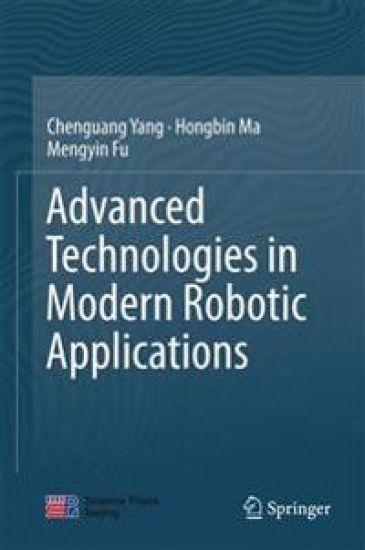
This book presents in a systematic manner the advanced technologies used for various modern robot applications. By bringing fresh ideas, new concepts, novel methods and tools into robot control, robot vision, human robot interaction, teleoperation of robot and multiple robots system, we are to provide a state-of-the-art and comprehensive treatment of the advanced technologies for a wide range of robotic applications. Particularly, we focus on the topics of advanced control and obstacle avoidance techniques for robot to deal with unknown perturbations, of visual servoing techniques which enable robot to autonomously operate in a dynamic environment, and of advanced techniques involved in human robot interaction. The book is primarily intended for researchers and engineers in the robotic and control community. It can also serve as complementary reading for robotics at the both graduate and undergraduate levels.
Advanced Technologies in Modern Robotic Applications

Advanced Technologies in Modern Robotic Applications

Chenguang Yang; Hongbin Ma; Mengyin Fu

Springer Verlag, Singapore
2016
sidottu
This book presents in a systematic manner the advanced technologies used for various modern robot applications. By bringing fresh ideas, new concepts, novel methods and tools into robot control, robot vision, human robot interaction, teleoperation of robot and multiple robots system, we are to provide a state-of-the-art and comprehensive treatment of the advanced technologies for a wide range of robotic applications. Particularly, we focus on the topics of advanced control and obstacle avoidance techniques for robot to deal with unknown perturbations, of visual servoing techniques which enable robot to autonomously operate in a dynamic environment, and of advanced techniques involved in human robot interaction. The book is primarily intended for researchers and engineers in the robotic and control community. It can also serve as complementary reading for robotics at the both graduate and undergraduate levels.