Kirjojen hintavertailu – 12 903 727 kirjaa ja 27 kauppaa

Kirjailija

Christopher Hill

Kirjat ja teokset yhdessä paikassa: 56 kirjaa, julkaisuja vuosilta 1982–2025, suosituimpiin kuuluu Domestic Sources of Foreign Policy. Vertaile teosten hintoja ja tarkista saatavuus suomalaisista kirjakaupoista.

56 kirjaa

Kirjojen julkaisuvuodet: 1982–2025.

The Role of the European Union in Moldova’s Transnistria Conflict

The Role of the European Union in Moldova’s Transnistria Conflict

Florian Küchler; Christopher Hill

Ibidem Press
2008
nidottu
Since 1 January 2007, Moldova has been a direct neighbour of the European Union. Nonetheless, Moldova and the Russia-dominated geopolitics of the Black Sea region receive still relatively little attention in the West. This is all the more surprising as there remain a number of consequential political divisions and unresolved conflicts in the area. One of them is the Transnistria conflict in Moldova. This book is a contribution to the, so far, small research and policy agenda on Moldova, and includes findings of several research trips to Moldova, Transnistria and their neighbouring countries. At first, the study reassesses the Transnistria conflict. Contrary to widely held assumptions, this conflict is found to be mainly based on a clash of elites and geopolitical interests rather than on ethnic tensions. The second part of the book analyses the interests, official position, actual impact and potential role of the EU in Moldova's internal separatist conflict and its related external tensions with Russia. So far, the EU has had a limited involvement in the conflict resolution efforts and in the international relations of Moldova. This book concludes that it is becoming increasingly important and possible for the EU to get effectively involved in this region, but that the scope of EU activities in Moldova and Transnistria depends on the country's relations with, and on the actions in this area of, the United States and Russia. At its end, the study offers recommendations for future EU policies directed at Moldova.
Maritime Law

Maritime Law

Christopher Hill; Yash Kulkarni

Informa Law
2003
sidottu
Maritime Law is an exhaustive introduction to this complex area of law. The book is ideal for newcomers and experienced professionals requiring an update on the general principles and case law. • Charterparties chapter • Passengers chapter • Salvage – includes developments in case law and introduction of new Lloyd’s Open Form Salvage Agreement • Sale of ship and shipbuilding contracts • Collisions • Oil pollution – Convention on bunker spills
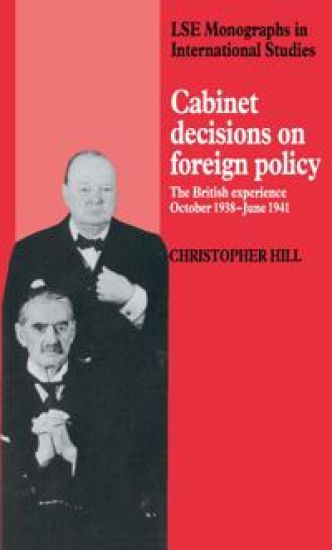
Cabinet Decisions on Foreign Policy

Cabinet Decisions on Foreign Policy

Christopher Hill

Cambridge University Press
2002
pokkari
Although Parliament is the principal source of authority in the British political system, it is the Cabinet which stands at the pinnacle of government. Yet what actually happens at Cabinet meetings? How are decisions made, particularly in the arena of foreign policy? Such questions have hitherto been largely overlooked by both historians and political scientists. In this book, Dr Christopher Hill presents a detailed case-study of the British government and foreign policy, during the dramatic period from the Munich Conference of 1938 to the German invasion of the Soviet Union three years later. Using extensive archival material, he examines how far the strong personalities of Neville Chamberlain and Winston Churchill respectively were really able to dominate their Cabinets in an area of policy where Prime Ministers have traditionally been supposed to exercise considerable freedom. This analysis concentrates on six decisions that were of key importance in committing Britain to the war which began in September 1939 but which changed so sharply in character in June 1940 with the fall of France. An original study of foreign policymaking at the highest level, this book will be widely read by international relations specialists while historians will welcome the close-textured account of key episodes of this period. It will also reinvigorate debates among political scientists on the nature of Cabinet government.
The Century of Revolution

The Century of Revolution

Christopher Hill

Routledge
2001
sidottu
There is an immense range of books about the English Civil War, but one historian stands head and shoulders above all others for the quality of his work on the subject. In 1961 Christopher Hill first published what has come to be acknowledged as the best concise history of the period, Century of Revolution. Stimulating, vivid and provocative, his graphic depiction of the turbulent era examines ordinary English men and women as well as kings and queens.
The Century of Revolution

The Century of Revolution

Christopher Hill

Routledge
2001
nidottu
There is an immense range of books about the English Civil War, but one historian stands head and shoulders above all others for the quality of his work on the subject. In 1961 Christopher Hill first published what has come to be acknowledged as the best concise history of the period, Century of Revolution. Stimulating, vivid and provocative, his graphic depiction of the turbulent era examines ordinary English men and women as well as kings and queens.
PuritanismRevolution

PuritanismRevolution

Christopher Hill

VINTAGE
2001
pokkari
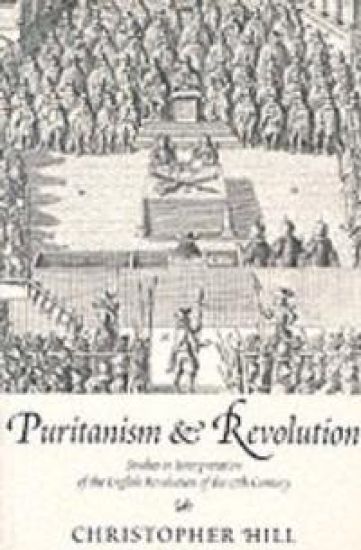
This illuminating collection of essays assesses the seventeenth century, interpreting what used to be called 'The Puritan Revolution', the ideas which helped to produce it and resulted from it, and the relation between these ideas and the political and economic events of the day.
Intellectual Origins of the English Revolution - Revisited
This is a revised edition of Christopher Hill's classic and ground-breaking examination of the motivations behind the English Revolution and Civil War, first published in 1965. In addition to the text of the original, Dr Hill provides thirteen new chapters which take account of other publications since the first edition, bringing his work up-to-date in a stimulating and enjoyable way. This book poses the problem of how, after centuries of rule by King, lords, and bishops, when the thinking of all was dominated by the established church, English men and women found the courage to revolt against Charles I, abolish bishops, and execute the king in the name of his people. The far-reaching effects and the novelty of what was achieved should not be underestimated - the first legalized regicide, rather than an assassination; the formal establishment of some degree of religious toleration; Parliament taking effective control of finance and foreign policy on behalf of gentry and merchants, thus guaranteeing the finance necessary to make England the world's leading naval power; abolition of the Church's prerogative courts (confirming gentry control at a local level); and the abolition of feudal tenures, which made possible first the agricultural and then the industrial revolution. Christopher Hill examines the intellectual forces which helped to prepare minds for a revolution that was much more than the religious wars and revolts which had gone before, and which became the precedent for the great revolutionary upheavals of the future.
The Actors in Europe's Foreign Policy

The Actors in Europe's Foreign Policy

Christopher Hill

Routledge
1996
sidottu
Five years ago observers might have doubted that national foreign policies would continue to be of importance: it seemed inevitable that collective European positions were becoming ever more common and effective. Now the pendulum has swung back with a vengeance. The divided European responses to the prospect of war with Iraq in 1990-91, and to the war in the Balkans have made what happens in the national capitals seem divisive. The Actors in Europe's Foreign Policy is a timely survey of the interplay between the European Union's Common Foreign and Security Policy and the long-established national foreign policies of the Union's Member-States. The book contains a chapter on each country in the Union as well as a chapter on the United States in its role as the `thirteenth seat at the table'. There is also a chapter on the European Commission, whose role in the external relations of the Community steadily grew during the 1980's. This book will be invaluable for students and scholars of the European Union and of international politics. It will also be of great interest to practitioners in all countries concerned with Europe's role in international affairs.
The Actors in Europe's Foreign Policy

The Actors in Europe's Foreign Policy

Christopher Hill

Routledge
1996
nidottu
Five years ago observers might have doubted that national foreign policies would continue to be of importance: it seemed inevitable that collective European positions were becoming ever more common and effective. Now the pendulum has swung back with a vengeance. The divided European responses to the prospect of war with Iraq in 1990-91, and to the war in the Balkans have made what happens in the national capitals seem divisive. The Actors in Europe's Foreign Policy is a timely survey of the interplay between the European Union's Common Foreign and Security Policy and the long-established national foreign policies of the Union's Member-States. The book contains a chapter on each country in the Union as well as a chapter on the United States in its role as the `thirteenth seat at the table'. There is also a chapter on the European Commission, whose role in the external relations of the Community steadily grew during the 1980's. This book will be invaluable for students and scholars of the European Union and of international politics. It will also be of great interest to practitioners in all countries concerned with Europe's role in international affairs.
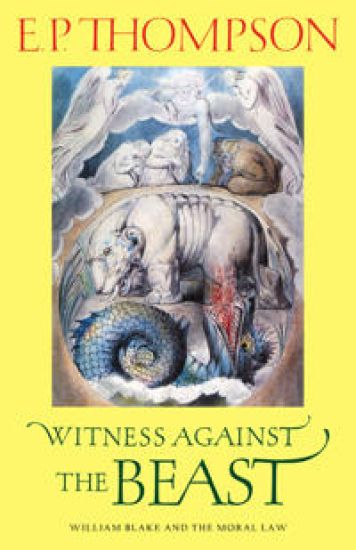
Witness against the Beast

Witness against the Beast

E. P. Thompson; Christopher Hill

Cambridge University Press
1994
pokkari
E. P. Thompson’s long-awaited book on William Blake was published shortly after the historian’s death in August 1993. Acclaimed as one of his best and most deeply felt works, it appears now for the first time in paperback. Written with a vivid passion, and bearing the marks of Thompson’s lifelong struggle against authoritarian and anti-humanitarian politics both at the level of the individual and of the state, Witness Against the Beast: William Blake and the Moral Law is a profound enquiry into the structure of Blake’s thought and the character of his sensibility. Its qualities are among those which place Thompson himself in the same tradition of dissenting values and non-conforming radicalism represented by Blake some two hundred years earlier.
Witness against the Beast

Witness against the Beast

E. P. Thompson; Christopher Hill

Cambridge University Press
1993
sidottu
E. P. Thompson's long-awaited book on William Blake was published shortly after the historian's death in August 1993. Acclaimed as one of his best and most deeply felt works, it appears now for the first time in paperback. Written with a vivid passion, and bearing the marks of Thompson's lifelong struggle against authoritarian and anti-humanitarian politics both at the level of the individual and of the state, Witness Against the Beast: William Blake and the Moral Law is a profound enquiry into the structure of Blake's thought and the character of his sensibility. Its qualities are among those which place Thompson himself in the same tradition of dissenting values and non-conforming radicalism represented by Blake some two hundred years earlier.
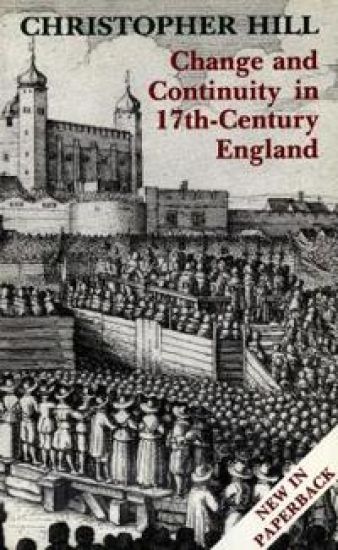
Change and Continuity in Seventeenth-Century England, Revised Edition
In this book, one of England’s most distinguished historians explores the causes and consequences of the English Revolution, the years from 1640 to 1660 when the triumph of Protestantism encouraged a questioning of authority in English political, economic, social, religious, and intellectual life. This was a decisive period in the evolution of the modern world, an essential precondition of England’s becoming the first industrial nation. Hill considers both material and intellectual aspects of the Revolution, discussing, for example, the relationship between Protestantism and the rise of capitalism; the ideological attacks on divinity, law, and medicine; and the entry of the "many-headed monster"—the masses—into politics. First published in 1974 and now available in paper for the first time, the book has been revised by the author to take into account recent scholarship in the field." Like all [Hill’s] work, this . . . volume is not only distinguished and accomplished, but deeply humane."—John Kenyon, The Observer"Hill’s contribution to seventeenth-century English history has been enormous. This book, like his others, is informative, stimulating . . . provocative, and most welcome."—John Miller, Times Higher Education Supplement
Cabinet Decisions on Foreign Policy

Cabinet Decisions on Foreign Policy

Christopher Hill

Cambridge University Press
1991
sidottu
Although Parliament is the principal source of authority in the British political system, it is the Cabinet which stands at the pinnacle of government. Yet what actually happens at Cabinet meetings? How are decisions made, particularly in the arena of foreign policy? Such questions have hitherto been largely overlooked by both historians and political scientists. In this book, Dr Christopher Hill presents a detailed case-study of the British government and foreign policy, during the dramatic period from the Munich Conference of 1938 to the German invasion of the Soviet Union three years later. Using extensive archival material, he examines how far the strong personalities of Neville Chamberlain and Winston Churchill respectively were really able to dominate their Cabinets in an area of policy where Prime Ministers have traditionally been supposed to exercise considerable freedom. This analysis concentrates on six decisions that were of key importance in committing Britain to the war which began in September 1939 but which changed so sharply in character in June 1940 with the fall of France. An original study of foreign policymaking at the highest level, this book will be widely read by international relations specialists while historians will welcome the close-textured account of key episodes of this period. It will also reinvigorate debates among political scientists on the nature of Cabinet government.
Antichrist in Seventeenth-Century England

Antichrist in Seventeenth-Century England

Christopher Hill

Verso Books
1990
nidottu
In the centuries following the Reformation, Antichrist-the biblical Beast, whose coming was to precede the end of the world and the coming of Christ's kingdom-was an intensely real figure. The debate raged as to who this Antichrist, whose downfall was now at hand, might be. Was he the Pope? Bishops? A state church? The monarchy? Or was it just a term of abuse to be hurled at anybody one disliked? Christopher Hill, one of Britain's most distinguished historians, here reconstructs the significance of Antichrist during the revolutionary crises of the early seventeenth century. Radical Protestant sects applied the term-a name synonymous with repression and persecution-to those Establishment institutions of which they disapproved; in particular, the Pope. Then, with that revolution in thought which resulted in the separation of religion from politics, the figure of Antichrist lost its significance.
The Century of Revolution: 1603-1714

The Century of Revolution: 1603-1714

Christopher Hill

W. W. Norton Company
1982
nidottu
During this period modern English society and a modern state began to take shape, and England's position in the world was transformed. The Century of Revolution tries to penetrate below the familiar events to grasp when happened--to ordinary English men and women as well as to kings and queens or abstractions like "society" and "the state." In this new edition, Dr. Hill includes the most important conclusions of recent research and has added postscripts drawing attention to especially significant books.