Kirjailija
CHRISTOPHER HITCHENS
Kirjat ja teokset yhdessä paikassa: 54 kirjaa, julkaisuja vuosilta 1994–2025, suosituimpiin kuuluu THOMAS JEFFERSON. Vertaile teosten hintoja ja tarkista saatavuus suomalaisista kirjakaupoista.
54 kirjaa
Kirjojen julkaisuvuodet: 1994–2025.
The seminal, uncollected essays--lauded as "dazzling" (The New York Times Book Review)--by the late Christopher Hitchens, author of the #1 New York Times bestseller God Is Not Great, showcase the notorious contrarian's genius for rhetoric and his sharp rebukes to tyrants and the ill-informed everywhere. For more than forty years, Christopher Hitchens delivered essays to numerous publications on both sides of the Atlantic that were astonishingly wide-ranging and provocative. His death in December 2011 from esophageal cancer prematurely silenced a voice that was among the most admired of contemporary voices--writers, readers, pundits and critics the world over mourned his loss. At the time of his death, Hitchens left nearly 250,000 words of essays not yet published in book form. "Another great book of essays from a writer who we wish were still alive to produce more copy" (National Review), And Yet... ranges from the literary to the political and is a banquet of entertaining and instructive delights, including essays on Orwell, Lermontov, Chesterton, Fleming, Naipaul, Rushdie, Orhan Pamuk, and Dickens, among others, as well as his laugh-out-loud self-mocking "makeover." The range and quality of Hitchens's essays transcend the particular occasions for which they were originally written, yielding "a bounty of famous scalps, thunder-blasted targets, and a few love letters from the notorious provocateur-in-chief's erudite and scathing assessments of American culture" (Vanity Fair). Often prescient, always pugnacious, formidably learned, Hitchens was a polemicist for the ages. With this posthumous volume, he remains, "America's foremost rhetorical pugilist" (The Village Voice).
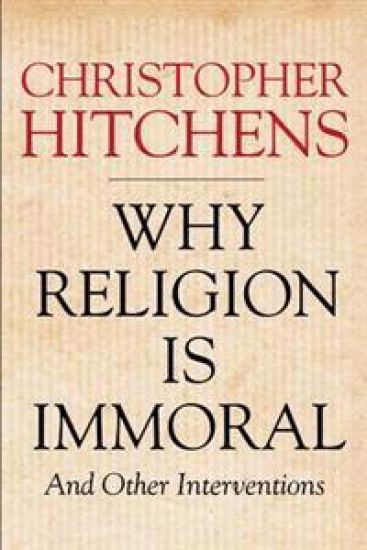
The publication of god Is Not Great (2007), was a worldwide bestseller and established Christopher Hitchens as one of the most famous polemicists in the world. The book caused a firestorm of debate and controversy, with its author at the centre, taking on all comers. Why Religion is Immoral brings together Hitchens' most vigorous and memorable interventions in the debate that followed publication of god is Not Great, including 'Why Religion Poisons Everything', 'Is Islam a Religion of Peace?' and 'The Tyranny of Censorship'. It also includes celebrations of the pleasures of drinking, and of the writers whose lives and work most influenced his own. No matter the subject, all of Hitchens' arguments ultimately point to the same end: freedom from tyranny in any and all forms. Hitchens had a gift for lifting his audiences with his passionate voice, the moral urgency of his attacks, the bite and complexity of his wit, and the swagger of his lyrical soliloquies. He was a literary phenomenon who comes but once in a generation, and in this new collection we see the unequalled public speaker whose arguments continue to provoke public debate. It is essential reading.
Christopher Hitchens (1949-2011) was a matchless writer, debater and humanist. Throughout his life he shone the light of reason and truth into the eyes of charlatans and hucksters, exposing falsehood and decrying hypocrisy wherever he found it. With his passing, the world lost a great soul, the written word one of its finest advocates and those who stand for freedom everywhere have lost one of their clearest voices. Arguably collects Hitchens' writing on politics, literature and religion when he was at the zenith of his career; it is the indispensible companion to the finest English essayist since Orwell.
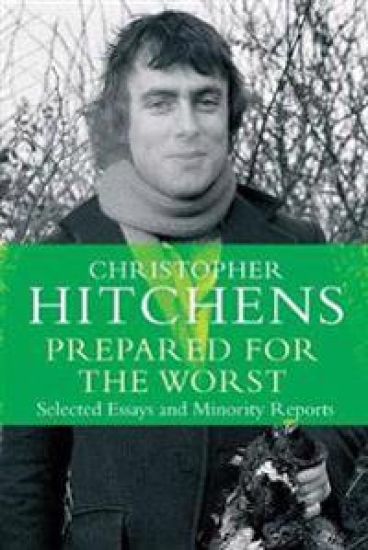
'I suppose that, if this collection has a point, it is the desire of one individual to see the idea of confrontation kept alive' -- Christopher Hitchens, IntroductionChristopher Hitchens is widely recognized as having been one of the liveliest and most influential of contemporary political analysts. Prepared for the Worst is a collection of the best of his essays of the 1980s published on both sides of the Atlantic. These essays confirmed his reputation as a bold commentator combining intellectual tenacity with mordant wit, whether he was writing about the intrigues of Reagan's Washington, a popular novel, the work of Tom Paine, the man George Orwell, or reporting (with sympathy as well as toughness) from Beirut or Bombay, Warsaw or Managua. Hitchens writes clearly, from a well-stocked mind, and is free of the cant that affects many political journalists. - Publishers Weekly
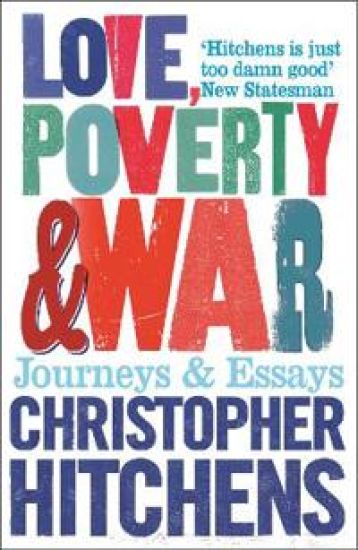
'I did not, I wish to state, become a journalist because there was no other "profession" that would have me. I became a journalist because I did not want to rely on newspapers for information.' Love, Poverty and War: Journeys and Essays showcases Hitchens' rejection of consensus and cliché, whether he was reporting from abroad in Indonesia, Kurdistan, Iraq, North Korea or Cuba, or if his pen was targeted mercilessly at the likes of Bill Clinton, Mother Teresa ('a fanatic, a fundamentalist and a fraud'), the Dalai Lama, Noam Chomsky, Mel Gibson or Michael Bloomberg. Hitchens began the 1990s as a darling of the left, but he became more of an unaffiliated radical whose targets included those on the left who he accused of 'fudging' the issue of military intervention in the Balkans, Afghanistan and Iraq. Yet, as Hitchens showed in his reportage, cultural and literary criticism, and opinion essays in this collection, he did not jump ship and join the right but was faithful to the internationalist, contrarian and democratic ideals that always informed his work.
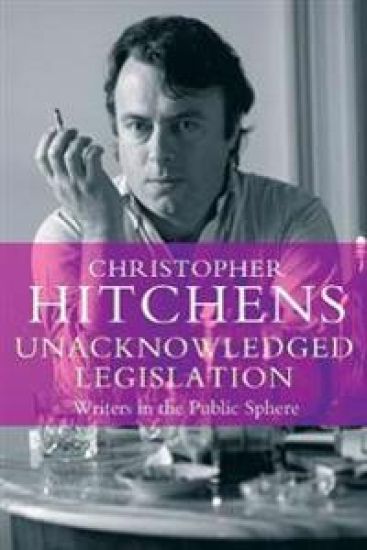
A celebration of writers and their encounters with politics and public life from one of our greatest critics. Unacknowledged Legislation is a celebration of Percy Shelley's assertion that 'poets are the unacknowledged legislators of the world'. In over thirty magnificent essays on writers from Oscar Wilde to Salman Rushdie, and with his trademark wit, rigour and flair, master critic Christopher Hitchens dispels the myth of politics as a stone tied to the neck of literature. Instead, Hitchens argues that when all parties in the state were agreed on a matter, it was the individual pens that created the space for a true moral argument. I have been asked whether I wish to nominate a successor, and inheritor, a dauphin or delfino. I have decided to name Christopher Hitchens. - Gore Vidal
Christopher Hitchens (1949-2011) was a matchless writer, debater and humanist. Throughout his life he shone the light of reason and truth into the eyes of charlatans and hucksters, exposing falsehood and decrying hypocrisy wherever he found it. With his passing, the world has lost a great soul, the written word one of its finest advocates and those who stand for freedom everywhere have lost one of their clearest voices. Arguably collects Hitchens' writing on politics, literature and religion when he was at the zenith of his career; it is the indispensible companion to the finest English essayist since Orwell.
Unacknowledged Legislation is a celebration of Percy Shelley's assertion that 'poets are the unacknowledged legislators of the world'. In over thirty magnificent essays on writers from Oscar Wilde to Salman Rushdie, and with his trademark wit, rigour and flair, master critic Christopher Hitchens dispels the myth of politics as a stone tied to the neck of literature. Instead, Hitchens argues that when all parties in the state were agreed on a matter, it was the individual pens that created the space for a true moral argument.
Christopher Hitchens is widely recognized as having been one of the liveliest and most influential of contemporary political analysts. Prepared for the Worst is a collection of the best of his essays of the 1980s published on both sides of the Atlantic. These essays confirmed his reputation as a bold commentator combining intellectual tenacity with mordant wit, whether he was writing about the intrigues of Reagan's Washington, a popular novel, the work of Tom Paine, the man George Orwell, or reporting (with sympathy as well as toughness) from Beirut or Bombay, Warsaw or Managua.
The global turmoil of the late 1980s and early 1990s severely tested every analyst and commentator. Few wrote with such insight as Christopher Hitchens about the large events - or with such discernment and wit about the small tell-tale signs of a disordered culture. First published in 1993, the writings in For the Sake of Argument range from the political squalor of Washington to the twilight of Stalinizm in Prague, from the Jewish quarter of Damascus in the aftermath of the Gulf War to the embattled barrios of Central America. Hitchens provides re-assessments of Graham Greene, P. G. Woodhouse and C. L. R. James, and his rogues' gallery gives us portraits of Henry Kissinger, Mother Theresa and P. J. O'Rouke. The addition of pieces on political assassination in America, as well as a devastating indictment of the evisceration of politics by pollsters and spin doctors, and an entertaining celebration of booze and fags, complete this outstanding collection from a writer of unequalled talent.
On June 8, 2010, while on a book tour for his bestselling memoir, Hitch-22, Christopher Hitchens was stricken in his New York hotel room with excruciating pain in his chest and thorax. As he would later write in the first of a series of award-winning columns for Vanity Fair, he suddenly found himself being deported from the country of the well across the stark frontier that marks off the land of malady. Over the next eighteen months, until his death in Houston on December 15, 2011, he wrote constantly and brilliantly on politics and culture, astonishing readers with his capacity for superior work even in extremis. Throughout the course of his ordeal battling esophageal cancer, Hitchens adamantly and bravely refused the solace of religion, preferring to confront death with both eyes open. In this riveting account of his affliction, Hitchens poignantly describes the torments of illness, discusses its taboos, and explores how disease transforms experience and changes our relationship to the world around us. By turns personal and philosophical, Hitchens embraces the full panoply of human emotions as cancer invades his body and compels him to grapple with the enigma of death. Mortality is the exemplary story of one man's refusal to cower in the face of the unknown, as well as a searching look at the human predicament. Crisp and vivid, veined throughout with penetrating intelligence, Hitchens's testament is a courageous and lucid work of literature, an affirmation of the dignity and worth of man.
"Hitchens is an opportunity to be delighted or maddened--possibly both--but in any case, not to be missed..." -The New York Times A stylish new paperback edition of ARGUABLY, a greatest hits collection of Hitchens' essays that is fierce, brilliant, and trenchant. ARGUABLY is full of essays in which Hitchens supplies his fresh perceptions of such figures as varied as Charles Dickens, Karl Marx, Rebecca West, George Orwell, J. G. Ballard, and Philip Larkin. They are matched in brilliance by his pungent discussions and intrepid observations, gathered from a lifetime of traveling and reporting from such destinations as Iran, China, and Pakistan. Hitchens's directness, elegance, lightly carried erudition, critical and psychological insight, humor, and sympathy-applied as they are here to a dazzling variety of subjects-all set a standard for the essayist that has rarely been matched in our time. What emerges from this indispensable volume is an intellectual self-portrait of a writer with an exemplary steadiness of purpose and a love affair with the delights and seductions of the English language, a man anchored in a profound and humane vision of the human longing for reason and justice.
On June 8, 2010, while on a book tour for his bestselling memoir, Hitch-22, Christopher Hitchens was stricken in his New York hotel room with excruciating pain in his chest and thorax. As he would later write in the first of a series of award-winning columns for Vanity Fair, he suddenly found himself being deported "from the country of the well across the stark frontier that marks off the land of malady." Over the next eighteen months, until his death in Houston on December 15, 2011, he wrote constantly and brilliantly on politics and culture, astonishing readers with his capacity for superior work even in extremis. Throughout the course of his ordeal battling esophageal cancer, Hitchens adamantly and bravely refused the solace of religion, preferring to confront death with both eyes open. In this riveting account of his affliction, Hitchens poignantly describes the torments of illness, discusses its taboos, and explores how disease transforms experience and changes our relationship to the world around us. By turns personal and philosophical, Hitchens embraces the full panoply of human emotions as cancer invades his body and compels him to grapple with the enigma of death. Mortality is the exemplary story of one man's refusal to cower in the face of the unknown, as well as a searching look at the human predicament. Crisp and vivid, veined throughout with penetrating intelligence, Hitchens's testament is a courageous and lucid work of literature, an affirmation of the dignity and worth of man.
"If the courts and lawyers of this country will not do their duty, we shall watch as the victims and survivors of this man pursue justice and vindication in their own dignified and painstaking way, and at their own expense, and we shall be put to shame." Forget Pinochet, Milosevic, Hussein, Kim Jong-il, or Gaddafi: America need look no further than its own lauded leaders for a war criminal whose offenses rival those of the most heinous dictators in recent history-Henry Kissinger. Employing evidence based on firsthand testimony, unpublished documents, and new information uncovered by the Freedom of Information Act, and using only what would hold up in international courts of law, The Trial of Henry Kissinger outlines atrocities authorized by the former secretary of state in Indochina, Bangladesh, Chile, Cyprus, East Timor, and in the plight of the Iraqi Kurds, "including conspiracy to commit murder, kidnap, and torture." With the precision and tenacity of a prosecutor, Hitchens offers an unrepentant portrait of a felonious diplomat who "maintained that laws were like cobwebs," and implores governments around the world, including our own, to bring him swiftly to justice.
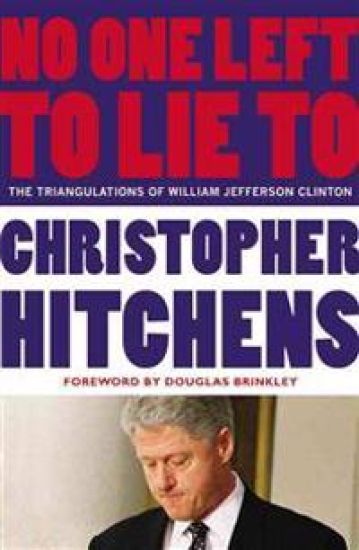
No One Left to Lie to: The Triangulations of William Jefferson Clinton
Christopher Hitchens
Twelve
2012
nidottu
"Just as the necessary qualification for a good liar is a good memory, so the essential equipment of a would-be lie detector is a good timeline, and a decent archive." In No One Left to Lie To, a New York Times bestseller, Christopher Hitchens casts an unflinching eye on the Clinton political machine and offers a searing indictment of a president who sought to hold power at any cost. With blistering wit and meticulous documentation, Hitchens masterfully deconstructs Clinton's abject propensity for pandering to the Left while delivering to the Right, and he argues that the president's personal transgressions were ultimately inseparable from his political corruption. Hitchens questions the president's refusals to deny accusations of rape by reputable women and lambasts, among numerous impostures, his insistence on playing the race card, the shortsightedness of his welfare bill, his ludicrous war on drugs, and his abandonment of homosexuals in the form of the Defense of Marriage Act. Opportunistic statecraft, crony capitalism, "divide and rule" identity politics, and populist manipulations-these are perhaps Clinton's greatest and most enduring legacies.
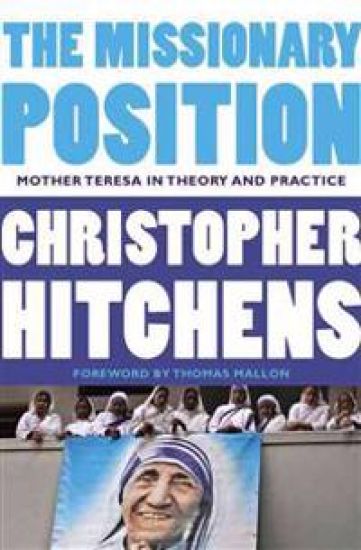
The Missionary Position: Mother Teresa in Theory and Practice
Christopher Hitchens
Twelve
2012
nidottu
Halvin toimitettuna 22,20 €
"A religious fundamentalist, a political operative, a primitive sermonizer, and an accomplice of worldly secular powers. Her mission has always been of this kind. The irony is that she has never been able to induce anybody to believe her. It is past time that she was duly honored and taken at her word." Among his many books, perhaps none have sparked more outrage than The Missionary Position, Christopher Hitchens's meticulous study of the life and deeds of Mother Teresa. A Nobel Peace Prize recipient beatified by the Catholic Church in 2003, Mother Teresa of Calcutta was celebrated by heads of state and adored by millions for her work on behalf of the poor. In his measured critique, Hitchens asks only that Mother Teresa's reputation be judged by her actions-not the other way around. With characteristic lan and rhetorical dexterity, Hitchens eviscerates the fawning cult of Teresa, recasting the Albanian missionary as a spurious, despotic, and megalomaniacal operative of the wealthy who long opposed measures to end poverty, and fraternized, for financial gain, with tyrants and white-collar criminals throughout the world.
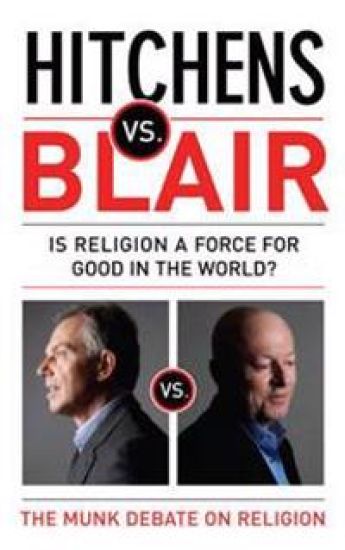
On November 26, 2010, intellectual juggernaut and staunch atheist Christopher Hitchens went head-to-head with former British Prime Minister Tony Blair, one of the Western worlds most openly devout political leaders, on the highly charged topic of religion.