Kirjojen hintavertailu – 12 903 724 kirjaa ja 27 kauppaa

Kirjailija

Cicero

Kirjat ja teokset yhdessä paikassa: 159 kirjaa, julkaisuja vuosilta 1913–2026, suosituimpiin kuuluu Marcus Tullius Cicero: Die Politischen Reden. Band 3. Vertaile teosten hintoja ja tarkista saatavuus suomalaisista kirjakaupoista.

Nimi esiintyy myös muodoissa: Cícero

159 kirjaa

Kirjojen julkaisuvuodet: 1913–2026.
De Imperio

De Imperio

Cicero

Bloomsbury Academic
2013
nidottu
De Imperio Cn. Pompeii (in support of Pompey), or Pro Lege Manilia, (in favour of the Manilian law) was Cicero’s first speech on public affairs. Delivered in 66 BC when Cicero was praetor, he argued in support of a proposal from Manilius, the tribune at that time, to extend Pompey’s command in the East and so take over the command in the war against Mithridates. The speech charts the moment when Cicero was transformed from lawyer to politician, but also effected a decision which led to Rome’s success in the third Mithridatic War and her assertion of supremacy in the East. This edition contains sections 27-45, where Cicero discusses how to choose a general, passionately advocating for a leader with the skills and expertise of Pompey. The introductory essay provides an overview of the historical and political context, and provides detail on the rhetorical and literary devices employed by Cicero in this speech. Detailed commentary notes accompanying the Latin text gloss difficult words and phrases, explain references to Cicero’s contemporary politics, and highlight instances of oratorical usage. This is the prescribed edition of the prose set text for OCR's AS GCE Classics Latin qualification, for examination from 2015 to 2017 inclusive.
Philippische Reden / Philippica

Philippische Reden / Philippica

Cicero; Rainer Nickel

De Gruyter Akademie Forschung
2013
sidottu
Since 1923 the Sammlung Tusculum has published authoritative editions of Greek and Latin works together with a German translation. The original texts are comprehensively annotated, and feature an introductory chapter. In the new volumes, additional essays delve into specific aspects of the works, illuminating their historical context and reception to the present day. The high academic quality of the new editions together with clearly written essays and annotations make the Sammlung Tusculum essential reading for students who are discovering an ancient author for the first time as well as professional scholars who would like to gain a deeper understanding of specific aspects of a given work. Moreover, the series is ideal for lay readers who would like to engage with antiquity through a reliable German translation. The series contains over 270 titles, available in print and eBook editions, making previously out-of-print titles and rarities available again for the first time. In order to celebrate the 90th anniversary of the series, De Gruyter is proud to present Tusculum Online, an eBook package which contains all titles that appeared between 1923 and 2013 - a fitting tribute to an important part of German publishing history. For more information, please see www.degruyter.com/tusculum
On Living and Dying Well

On Living and Dying Well

Cicero

Penguin Classics
2012
pokkari

Halvin toimitettuna 17,00 €

In the first century BCE, Marcus Tullius Cicero, orator, statesman, and defender of republican values, created these philosophical treatises on such diverse topics as friendship, religion, death, fate and scientific inquiry. A pragmatist at heart, Cicero's philosophies were frequently personal and ethical, drawn not from abstract reasoning but through careful observation of the world. The resulting works remind us of the importance of social ties, the questions of free will, and the justification of any creative endeavour. This lively, lucid new translation from Thomas Habinek, editor of Classical Antiquity and the Classics and Contemporary Thought book series, makes Cicero's influential ideas accessible to every reader. This edition also includes additional materials by Siobhán McElduff.
Der Staat / de Re Publica: Lateinisch - Deutsch

Der Staat / de Re Publica: Lateinisch - Deutsch

Cicero

de Gruyter Akademie Forschung
2012
nidottu
Der Philosoph Wilhelm Dilthey nannte Ciceros "Staat" eines der gr ten Kunstwerke in Prosa. Cicero, der die h chsten mter im Staat innehatte und sich mit h chstem Einsatz gegen den Untergang der r mischen Republik stemmte, reflektiert seine praktischen Erfahrungen und verdichtet sie in diesem Werk zu einem umfassenden Wertesystem, das f r das Leben jeder politischen Gemeinschaft bis auf den heutigen Tag g ltig ist. In Anlehnung an Platons "Politeia" legt Cicero in Form eines Dialoges die Vor- und Nachteile der unterschiedlichen Staatsformen dar. Im Gegensatz zu Platon ist sein idealer Staat jedoch keine Fiktion, sondern die r mische Republik. Diese Ausgabe des ber hmten ciceronischen Werkes will dem Leser die Bedeutung und Selbstst ndigkeit des Staatsdenkens Ciceros zug nglich machen. In einer Zeit, die Fragen des gesellschaftlichen Zusammenlebens ein besonderes Interesse entgegenbringt, ist es nicht unwesentlich, sich ein Denken gegenw rtig zu halten, das die menschliche Existenz ganz im Gemeinwesen des Staats begr ndet und bedingt sieht. Die Neuausgabe (2012) enth lt eine Neu bersetzung, eine neue Einf hrung, Anmerkungen, ein Namenregister und Literaturhinweise von Rainer Nickel.
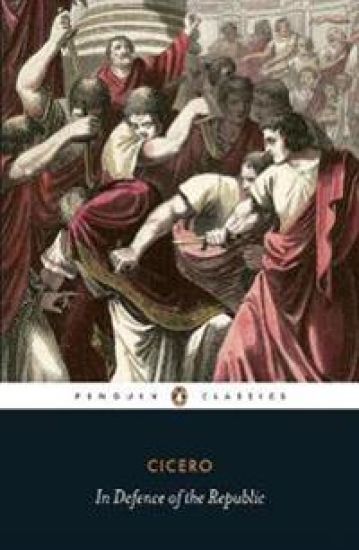
In Defence of the Republic

In Defence of the Republic

Cicero

Penguin Classics
2011
pokkari

Halvin toimitettuna 17,00 €

Cicero (106-43BC) was the most brilliant orator in Classical history. Even one of the men who authorized his assassination, the Emperor Octavian, admitted to his grandson that Cicero was: 'an eloquent man, my boy, eloquent and a lover of his country'. This new selection of speeches illustrates Cicero's fierce loyalty to the Roman Republic, giving an overview of his oratory from early victories in the law courts to the height of his political career in the Senate. We see him sway the opinions of the mob and the most powerful men in Rome, in favour of Pompey the Great and against the conspirator Catiline, while The Philippics, considered his finest achievements, contain the thrilling invective delivered against his rival, Mark Antony, which eventually led to Cicero's death.
Über die Auffindung des Stoffes / De inventione
cicero, der unbestrittene Meister der romischen Beredsamkeit in Theorie und Praxis, hat sich in mehreren Werken mit der Theorie der Rhetorik beschaftigt. Vom geplanten umfassenden Handbuch zur Rhetorik wurden nur zwei Bucher ausgearbeitet, die unter dem Titel "De inventione" uberliefert sind. Unverkennbar ist die Nahe zu der anonymen, lange Zeit ebenso Cicero zugeschriebenen Schrift "Rhetorica ad Herennium." Gegen die zunehmende Verkummerung des Rednerideals durch eine "Versachlichung" der rhetorischen Praxis kampft Cicero in der kleinen Schrift "De optimo genere oratorum." Zwischen dem Abfassen beider Schriften liegt ein Zeitraum von etwa 40 Jahren. "De inventione" (um 85 v. Chr. verfasst) gehort zu den Jugendwerken Ciceros und mit der "Rhetorica ad Herennium" zu den altesten romischen Schriften zur Rhetorik uberhaupt.
Vom rechten Handeln

Vom rechten Handeln

Cicero

Walter de Gruyter
2011
sidottu
Die neue herausragende Ubertragung. Cicero verfasste "De officiis" in den Monaten nach der Ermordung Caesars als Vermachtnis an seinen Sohn. Von allen Werken Ciceros hat es am starksten auf die Nachwelt gewirkt. Es wurde am haufigsten ubersetzt und kommentiert. Voltaire und Friedrich der Groe hielten "De officiis" fur das beste Buch zum Thema moralisches Verhalten.
Gespräche in Tusculum / Tusculanae disputationes
Since 1923 the Sammlung Tusculum has published authoritative editions of Greek and Latin works together with a German translation. The original texts are comprehensively annotated, and feature an introductory chapter. In the new volumes, additional essays delve into specific aspects of the works, illuminating their historical context and reception to the present day. The high academic quality of the new editions together with clearly written essays and annotations make the Sammlung Tusculum essential reading for students who are discovering an ancient author for the first time as well as professional scholars who would like to gain a deeper understanding of specific aspects of a given work. Moreover, the series is ideal for lay readers who would like to engage with antiquity through a reliable German translation. The series contains over 270 titles, available in print and eBook editions, making previously out-of-print titles and rarities available again for the first time. In order to celebrate the 90th anniversary of the series, De Gruyter is proud to present Tusculum Online, an eBook package which contains all titles that appeared between 1923 and 2013 - a fitting tribute to an important part of German publishing history. For more information, please see www.degruyter.com/tusculum
Cicero's Orations - In Latin

Cicero's Orations - In Latin

Cicero

Createspace Independent Publishing Platform
2011
nidottu
Cicero - Orations Catiline, who was running for the consulship a second time after having lost the first time around, tried to ensure his victory by resorting to outlandish, blatant bribery. Cicero, in indignation, issued a law prohibiting machinations of this kind. It was obvious to all that the law was directed specifically at Catiline. Catiline, in turn, conspired with some of his minions to murder Cicero and the key men of the Senate on the day of the election. Cicero discovered the plan and postponed the election to give the Senate time to discuss the attempted coup d' tat. The day after the election was supposed to be held, Cicero addressed the Senate on the matter and Catiline's reaction was immediate and violent. In response to Catiline's behavior, the Senate issued a senatus consultum ultimum, a kind of declaration of martial law invoked whenever the Senate and the Roman Republic were in imminent danger from treason or sedition. Ordinary law was suspended and Cicero, as consul, was invested with absolute power. When the election was finally held, Catiline lost again. Anticipating the bad news, the conspirators had already begun to assemble an army, made up mostly of Sulla's veteran soldiers. The nucleus of conspirators was also joined by senators whose profligate tastes left them perennially without funds. The plan was to initiate an insurrection in all of Italy, put Rome to the torch and to kill as many senators as they could. Through his own investigations, Cicero knew exactly what was being planned. On November 8, Cicero called for a meeting of the Senate in the Temple of Jupiter Stator near the forum, which was used for this purpose only when great danger was imminent. Catiline attended as well. It was in this context that Cicero delivered one of his most famous orations.