Kirjojen hintavertailu – 12 903 725 kirjaa ja 27 kauppaa

Kirjailija

Colin S. Gray

Kirjat ja teokset yhdessä paikassa: 66 kirjaa, julkaisuja vuosilta 1982–2025, suosituimpiin kuuluu Fighting Talk. Vertaile teosten hintoja ja tarkista saatavuus suomalaisista kirjakaupoista.

Nimi esiintyy myös muodoissa: Colin S Gray

66 kirjaa

Kirjojen julkaisuvuodet: 1982–2025.

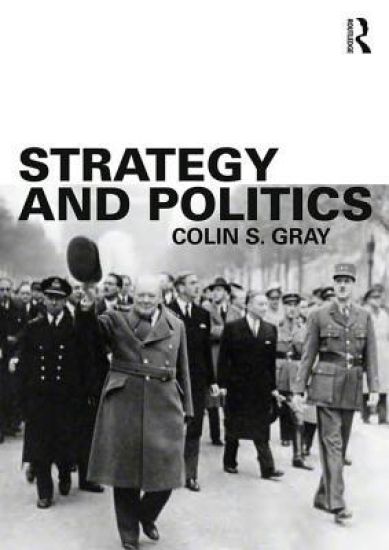
Strategy and Politics

Strategy and Politics

Colin S. Gray

Routledge
2016
nidottu

Halvin toimitettuna 65,10 €

This book examines the subject of strategy and its relationship with politics. Despite the fact that strategy is always the product of political process, the relationship between the two concepts and their ancillary activities has scarcely been touched by scholars. This book corrects that serious deficiency, and explains the high relevance of political factors for matters of general defence. Each chapter aims to show how and why strategy and politics interact and how this interaction has had significant consequences historically. Neither strategy nor politics can make sense if considered alone. Strategy requires direction that can only be provided by political process, while politics cannot be implemented without strategy. In summary, this volume will explain: what strategy is (and is not) why strategy is essential what strategy does and how it does it how strategy is made and executed Written by a leading scholar and former practitioner, this book will be essential reading for all students of military strategy, strategic studies, security studies and war and conflict studies.
Thucydides Was Right: Defining the Future Threat

Thucydides Was Right: Defining the Future Threat

Colin S. Gray; Strategic Studies Institute; U.S. Army War College

Lulu.com
2015
nidottu
To define future threat is, in a sense, an impossible task, yet it is one that must be done. In this monograph, Dr. Colin S. Gray explains that the only sources of empirical evidence accessible to us are the past and the present. We cannot obtain understanding about the future from the future. Dr. Gray draws noticeably upon the understanding of strategic history obtainable from Thucydides' great History of the Peloponnesian War. The monograph advises prudence as the operating light for American definition of future threat, and the author believes that there are historical parallels between the time of Thucydides and our own that can help us avoid much peril. The future must always be unpredictable to us in any detail, but the many and potent continuities in history's great stream of time can serve to alert us to what may well happen in kind.
Always Strategic: Jointly Essential Landpower

Always Strategic: Jointly Essential Landpower

Colin S. Gray; Strategic Studies Institute; U.S. Army War College

Lulu.com
2015
nidottu
The strategic quality of Landpower is widely known, but not widely understood. In this monograph, Dr. Colin S. Gray explores and explains the meaning of strategic Landpower. He is concerned particularly to argue that, although Landpower today must function in a joint environment, typically it is the dominant element in the team for U. S. national security. The monograph lays emphasis upon the place of the human domain that leads in the role played by ground forces in strategy. Because of some widespread conceptual misuse, many people are not used to thinking of Landpower as a strategic instrument for American security policy. Dr. Gray aspires to help reduce the popularity of this important misconception. It is necessary for good policy that American Landpower should be considered and debated properly, which is to say in appropriate strategic terms.
The Future of Strategy

The Future of Strategy

Colin S. Gray

Polity Press
2015
nidottu

Halvin toimitettuna 26,80 €

Strategy is not a modern invention. It is an essential and enduring feature of human history that is here to stay. In this original essay, Colin S. Gray, world-renowned scholar of strategic thought, discusses the meaning of strategy and its importance for politicians and the military as a means of achieving desired outcomes in complex, uncertain conditions. Drawing on a wide range of examples from the Great Peloponnesian War to the Second World War, Vietnam, and the ongoing conflicts in Iraq and Afghanistan, Gray ably shows how great military thinkers of the past and present have acted strategically in their various ideological, political, geographical and cultural contexts. Looking to the future, he argues that strategy will continue to provide a vital tool-kit for survival and security, but that the global threat posed by nuclear weapons remains an on-going challenge without obvious practical solutions. As Gray boldy asserts, there is no promised land ahead, only hard and dangerous times that will require us to master the theory and practice of strategy to secure our own future.
The Future of Strategy

The Future of Strategy

Colin S. Gray

Polity Press
2015
sidottu
Strategy is not a modern invention. It is an essential and enduring feature of human history that is here to stay. In this original essay, Colin S. Gray, world-renowned scholar of strategic thought, discusses the meaning of strategy and its importance for politicians and the military as a means of achieving desired outcomes in complex, uncertain conditions. Drawing on a wide range of examples from the Great Peloponnesian War to the Second World War, Vietnam, and the ongoing conflicts in Iraq and Afghanistan, Gray ably shows how great military thinkers of the past and present have acted strategically in their various ideological, political, geographical and cultural contexts. Looking to the future, he argues that strategy will continue to provide a vital tool-kit for survival and security, but that the global threat posed by nuclear weapons remains an on-going challenge without obvious practical solutions. As Gray boldy asserts, there is no promised land ahead, only hard and dangerous times that will require us to master the theory and practice of strategy to secure our own future.
Defining and Achieving Decisive Victory

Defining and Achieving Decisive Victory

Colin S. Gray; Strategic Studies Institute

Lulu.com
2014
nidottu
The United States was thrust so suddenly into the war on terrorism that it was forced to deal with both immediate operational issues and broad strategic questions simultaneously. Even while the American military is consolidating battlefield success in Afghanistan, strategic thinkers and leaders are developing a long-term strategy. In this process, nothing is more important than defining victory. In this monograph, Dr. Colin Gray, one of the world's leading strategic thinkers, explores the concept of victory in the war in terrorism, but he does so by placing it within the larger currents of change that are sweeping the global security environment. He contends that the time-tested idea of decisive victory is still an important one, but must be designed very carefully in this dangerous new world. To do so correctly can provide the foundation for an effective strategy. To fail to do so could be the first step toward strategic defeat.
Transformation and Strategic Surprise

Transformation and Strategic Surprise

Colin S. Gray; Strategic Studies Institute

Lulu.com
2014
nidottu
The possibility of achieving decisive results from short warning attacks appears to have improved greatly with technological advances. Indeed, strategic surprise offers both golden opportunities and lethal dangers, so it attracts much attention in today's world. In this monograph, Dr. Colin Gray takes a broad view of strategic surprise, and relates it to the current military transformation. He argues that the kind of strategic surprise to which the United States is most at risk and which is most damaging to our national security is the deep and pervasive connection between war and politics. Although America is usually superior at making war, it is far less superior in making peace out of war. Dr. Gray concludes that the current military transformation shows no plausible promise of helping to correct the long-standing U. S. weakness in the proper use of forces as an instrument of policy. This monograph was written under the Strategic Studies Institute's External Research Associates Program (ERAP).
Strategy and Defence Planning

Strategy and Defence Planning

Colin S. Gray

Oxford University Press
2014
sidottu
Strategy and Defence Planning: Meeting the Challenge of Uncertainty explores and examines why and how security communities prepare purposefully for their future defence. The author explains that defence planning is the product of interplay among political process, historical experience, and the logic of strategy. The theory of strategy best reveals both the nature and the working of defence planning. Political 'ends', strategic 'ways', and military 'means' all fed by reigning, if not always recognized, assumptions, organize the subject well with a template that can serve any time, place, and circumstance. The book is designed to help understanding of what can appear to be a forbiddingly complex as well as technical subject. A good part of the problem for officials charged with defence planning duties is expressed in the second part of the book's title. The real difficulty, which rarely is admitted by those tasked with defence planning duty, is that defence planning can only be guesswork. But, because defence preparation is always expensive, not untypically is politically unpopular, yet obviously can be supremely important, claims to knowledge about the truly unknowable persist. In truth, we cannot do defence planning competently, because our ignorance of the future precludes understanding of what our society will be shown by future events to need. The challenge faced by the author was to identify ways in which our problems with the inability to know the future in any detail in advance-the laws of nature, in other words-may best be met and mitigated. Professor Gray argues that our understanding of human nature, of politics, and of strategic history, does allow us to make prudent choices in defence planning that hopefully will prove 'good enough'.
Recognizing and Understanding Revolutionary Change in Warfare: the Sovereignty of Context
Revolution in Military Affairs (RMA) was the most widely used, and abused, acronym in the U. S. defense community in the 1990s. Subsequently, transformation has superceded it as the preferred term of art. For the better part of 2 decades, American defense professionals have been excited by the prospect of effecting a revolutionary change in the conduct and character of warfare. In this monograph, Dr. Colin S. Gray provides a critical audit of the great RMA debate and of some actual RMA behavior. He argues that the contexts of warfare are crucially important. Indeed so vital are the contexts that only a military transformation that allows for flexibility and adaptability will meet future strategic demands. Dr. Gray warns against a transformation that is highly potent only in a narrow range of strategic cases. In addition, he advises that the historical record demonstrates clearly that every revolutionary change in warfare eventually is more or less neutralized by antidotes of one kind...
Irregular Enemies and the Essence of Strategy: Can the American Way of War Adapt?
At present and probably for some years to come, America's enemies are of an irregular character. These irregular enemies necessarily wage war in modes that are largely unconventional. In this monograph, Dr. Colin S. Gray considers irregular warfare in the light of the general theory of strategy and finds that that theory is fully adequate to explain the phenomenon. Rather less adequate, Dr. Gray suggests, is the traditional American way of war. The monograph offers a detailed comparison between the character of irregular warfare, insurgency in particular, and the principal enduring features of "the American way." It concludes that there is a serious mismatch between that "way" and the kind of behavior that is most effective in countering irregular foes. Dr. Gray poses the question, Can the American way of war adapt to a strategic threat context dominated by irregular enemies? He suggests that the answer is "perhaps, but only with difficulty."
The Implications of Preemptive and Preventive War Doctrines: A Reconsideration
If RMA (revolution in military affairs) was the acronym and concept of choice in the U. S. defense community in the 1990s, so preemption has threatened to supercede it in the 2000s. The trouble is that officials and many analysts have confused preemption, which is not controversial, with prevention, which is. In this monograph, Dr. Colin S. Gray draws a sharp distinction between preemption and prevention, and explains that the political, military, moral, and strategic arguments have really all been about the latter, not the former. Dr. Gray provides definitions, reviews the history of the preventive war option, and considers the merit, or lack thereof, in the principal charges laid against the concept when it is proclaimed to be policy. Dr. Gray concludes that there is a place for preventive war in U. S. strategy, but that it is an option that should be exercised only very occasionally. However, there are times when only force seems likely to resolve a maturing danger.
Defense Planning for National Security: Navigation AIDS for the Mystery Tour

Defense Planning for National Security: Navigation AIDS for the Mystery Tour

Colin S. Gray; Strategic Studies Institute

Lulu.com
2014
nidottu
Defense planning unavoidably must be in the nature of a mystery tour. The inability to know the future is a permanent condition for defense planning, but it is one with which we must cope. This monograph by Dr. Colin S. Gray explores and examines the implications of our irreducible ignorance about the future. His purpose is to identify an approach to this critically important subject of security that leans heavily upon what we can and should know about the past and present, in order to anticipate future conditions. The monograph finds that, although the past does not repeat itself in detail, there are profound persisting reasons why it is repeated approximately in the challenges and dangers that security communities must face. Dr. Gray concludes that notwithstanding the facts of contextual change in strategic history, the "great stream of time" from the past, through the present, into the future commands critically significant continuities in history that yield an approach to the future...
After Iraq: The Search for A Sustainable National Security Strategy [Enlarged Edition]
A sustainable national security strategy is feasible only when directed by a sustainable national security policy. In the absence of policy guidance, strategy will be meaningless. The only policy that meets both the mandates of American culture and the challenges of the outside world is one that seeks to lead the necessary mission of guarding and advancing world order. The author considers and rejects a policy that would encourage the emergence of a multipolar structure to global politics. He argues that multipolarity not only would fail to maintain order, it would also promote conflict among the inevitably rival great powers. In addition, he suggests Americans culturally are not comfortable with balance-of-power politics and certainly would not choose to promote the return of such a system. Various "pieces of the puzzle" most relevant to national security strategy are located; leading assumptions held by American policymakers and strategists are identified; alternative national security policies are...
Perspectives on Strategy

Perspectives on Strategy

Colin S. Gray

Oxford University Press
2013
sidottu
Perspectives on Strategy examines in depth five aspects of strategy. Strategic thought and behaviour are explored and explained from the perspectives of intellect, morality, culture, geography, and technology. Each perspective has attracted persisting controversy. Perspectives on Strategy is strongly complementary to the author's previous book, The Strategy Bridge: Theory for Practice (OUP, 2010). This new work takes a notably holistic view of strategic phenomena, which serves as a master framework within which detailed examination of strategic history and issues can usefully be pursued in the light of particular perspectives. Foundational for the argument in Perspectives on Strategy is the proposition that distinctive aspects of strategy (e.g. ethics, culture, inter alia) can only be appreciated properly when they are regarded in context. The author shares this view with T. E. Lawrence (of Arabia), who wrote of the 'whole house of war'. Perspectives on Strategy gratefully adapts Lawrence and writes about the 'whole house of strategy'. The book insists that the nature of strategy is best represented by a Venn diagram that shows overlapping perspectives. Thus, the subject of each chapter is shown as having meaning for, and in turn is influenced by, the subjects of the other chapters. For example, the book explores the importance of strategic ideas relative to the significance of the material weapons of war. The author poses the hardest of questions pertinent to each chosen perspective (e.g. do ideas matter more than muscle?-in practice how robust is the ethical code with which warfare is waged?-is geography destiny, as some theorists have claimed?-and do technically superior weapons win wars? Perspectives on Strategy demonstrates that it is possible to look closely at strategic matters from limited but arguably powerful perspectives, without being captured by them. This book asks and answers the most challenging and rewarding questions that can be posed in order to reveal the persisting universal nature, but ever changing character, of strategy.
The Airpower Advantage in Future Warfare: The Need for Strategy
The U. S. has long suffered from a serious strategy deficit. In short, there is a general crisis of strategic comprehension, a lack of agreement on the most effective organizing ideas. Airpower is by no means lonely in suffering from strategic theoretical uncertainty. The study argues that the United States needs a theory of war and warfare. It claims that future warfare will be diverse and that the tactical, operational, and strategic value of airpower must always be situational. A coherent theory of employment for all of airpower's capabilities, not only the kinetic, is needed. Airpower's potential utility lies within a spectrum of possibilities and is dependent on context. The study advises frank recognition of airpower's situational limitations. (Dr. Colin S. Gray is Professor of International Politics and Strategic Studies at the University of Reading in England. Originally published by the Airpower Research Institute)
Irregular Enemies and the Essence of Strategy: Can the American Way of War Adapt?
Strategist Colin Gray offers a detailed comparison between the character of irregular warfare, insurgency in particular, and the principal enduring features of "the American way." He concludes that there is a serious mismatch between that "way" and the kind of behavior that is most effective in countering irregular foes. The author poses the question, "Can the American way of war adapt to a strategic threat context dominated by irregular enemies?" He suggests that the answer is "perhaps, but only with difficulty."