Kirjojen hintavertailu – 12 903 735 kirjaa ja 27 kauppaa

Kirjailija

Daniel Cohen

Kirjat ja teokset yhdessä paikassa: 36 kirjaa, julkaisuja vuosilta 1976–2026, suosituimpiin kuuluu The Adventures of Gibby and Libby. Vertaile teosten hintoja ja tarkista saatavuus suomalaisista kirjakaupoista.

36 kirjaa

Kirjojen julkaisuvuodet: 1976–2026.

A Brief History of the Economy

A Brief History of the Economy

Daniel Cohen

JOHN WILEY AND SONS LTD
2025
sidottu

Halvin toimitettuna 24,60 €

Economic growth is the religion of the modern world. It promises a solution to the most basic drama of our human existence: wanting what we don’t have. But we live at a time when the frenzied pursuit of economic growth is jeopardising the planet’s viability and our very survival as a species. How did we get to this point in human history? How did we allow the pursuit of growth to become the apotheosis of human development? To answer these questions, the distinguished economist Daniel Cohen takes us on a journey to understand human desire and the different registers on which it has expressed itself throughout history. He brings his panoramic grasp of the subject to bear on the key stages of social and economic development, from the Neolithic Revolution to the digital age. The ideas of the great economists – from Adam Smith and Marx to Schumpeter and Keynes – are situated in their historical contexts and explained clearly and concisely. The result is a triumph of ambition and brevity: a history of the economy in 150 pages. This book – the final work written by Daniel Cohen – will appeal to anyone interested in the economy and in the tension between a limited world and unlimited desires that lies at the heart of the great challenges we face today.
Homo Numericus

Homo Numericus

Daniel Cohen

JOHN WILEY AND SONS LTD
2024
sidottu
From Amazon to Tinder, from Google to Deliveroo, there is no facet of human life that the digital revolution has not streamlined and dematerialized. Its objective was to reduce costs by forgoing face-to-face interactions, and it was a direct result of the free-market shock of the 1980s, which sought to expand the marketplace seamlessly in every possible dimension. Today, we can be algorithmically entertained, educated, cared for, and courted in a way that was impossible in the old industrial society, where institutions structured the social world. Today, these institutions have been replaced by monetized virtual contact. As the industrial revolution did in the past, the digital revolution is creating a new economy and a new sensibility, bringing about a radical revaluation of society and its representations. While obsessed with the search for an efficient management of human relations, the new digital capitalism gives rise to an irrational and impulsive Homo numericus prone to an array of addictive behaviours and subjected to intensive forms of surveillance. Far from producing a new agora, social media produce a radicalization of public debate in which hate-filled speech directed against adversaries becomes the norm. But these outcomes are not inevitable. The digital revolution also offers an exciting path, one that leads to a world in which everyone deserves to be listened to and respected. It explores a new way of living that is historically unprecedented, that of a society based neither on individualism nor on the hierarchical model of earlier civilizations. Are we able to seize the new opportunities opened up by the digital revolution without succumbing to its dark side?
The Inglorious Years

The Inglorious Years

Daniel Cohen

PRINCETON UNIVERSITY PRESS
2023
pokkari
How populism is fueled by the demise of the industrial order and the emergence of a new digital society ruled by algorithmsIn the revolutionary excitement of the 1960s, young people around the world called for a radical shift away from the old industrial order, imagining a future of technological liberation and unfettered prosperity. Industrial society did collapse, and a digital economy has risen to take its place, yet many have been left feeling marginalized and deprived of the possibility of a better life. The Inglorious Years explores the many ways we have been let down by the rising tide of technology, showing how our new interconnectivity is not fulfilling its promise. In this revelatory book, economist Daniel Cohen describes how today's postindustrial society is transforming us all into sequences of data that can be manipulated by algorithms from anywhere on the planet. As yesterday's assembly line was replaced by working online, the leftist protests of the 1960s have given way to angry protests by the populist right. Cohen demonstrates how the digital economy creates the same mix of promises and disappointments as the old industrial order, and how it revives questions about society that are as relevant to us today as they were to the ancients. Brilliant and provocative, The Inglorious Years discusses what the new digital society holds in store for us, and reveals how can we once again regain control of our lives.
The Inglorious Years

The Inglorious Years

Daniel Cohen

PRINCETON UNIVERSITY PRESS
2021
sidottu
How populism is fueled by the demise of the industrial order and the emergence of a new digital society ruled by algorithmsIn the revolutionary excitement of the 1960s, young people around the world called for a radical shift away from the old industrial order, imagining a future of technological liberation and unfettered prosperity. Industrial society did collapse, and a digital economy has risen to take its place, yet many have been left feeling marginalized and deprived of the possibility of a better life. The Inglorious Years explores the many ways we have been let down by the rising tide of technology, showing how our new interconnectivity is not fulfilling its promise. In this revelatory book, economist Daniel Cohen describes how today's postindustrial society is transforming us all into sequences of data that can be manipulated by algorithms from anywhere on the planet. As yesterday's assembly line was replaced by working online, the leftist protests of the 1960s have given way to angry protests by the populist right. Cohen demonstrates how the digital economy creates the same mix of promises and disappointments as the old industrial order, and how it revives questions about society that are as relevant to us today as they were to the ancients. Brilliant and provocative, The Inglorious Years discusses what the new digital society holds in store for us, and reveals how can we once again regain control of our lives.
The Infinite Desire for Growth

The Infinite Desire for Growth

Daniel Cohen

Princeton University Press
2020
pokkari
Why society’s expectation of economic growth is no longer realisticEconomic growth—and the hope of better things to come—is the religion of the modern world. Yet its prospects have become bleak, with crashes following booms in an endless cycle. In the United States, eighty percent of the population has seen no increase in purchasing power over the last thirty years and the situation is not much better elsewhere. The Infinite Desire for Growth spotlights the obsession with wanting more, and the global tensions that have arisen as a result. Daniel Cohen provides a whirlwind tour of the history of economic growth, from the early days of civilization to modern times, underscoring what is so unsettling today. He examines how a future less dependent on material gain might be considered, and how, in a culture of competition, individual desires might be better attuned to the greater needs of society.
Neuroscience, Selflessness, and Spiritual Experience

Neuroscience, Selflessness, and Spiritual Experience

Brick Johnstone; Daniel Cohen

Academic Press Inc.(London) Ltd
2019
nidottu
Neuroscience, Selflessness, and Spiritual Transcendence conveys the manner by which selflessness serves as a neuropsychological and religious foundation for spiritually transcendent experiences. The book combines neurological case studies and neuroscience research with religious accounts of transcendence experiences from the perspective of both the neurosciences and the history of religions. Chapters cover the subjective experience of transcendence, an historical summary of different philosophical and religious perspectives, a review of the neuroscience research that describes the manner by which the brain processes and creates a self, and more. The book presents a model that bridges the divide between neuroscience and religion, presenting a resource that will be critical reading for advanced students and researchers in both fields.
The Infinite Desire for Growth

The Infinite Desire for Growth

Daniel Cohen

PRINCETON UNIVERSITY PRESS
2018
sidottu
Why society’s expectation of economic growth is no longer realisticEconomic growth--and the hope of better things to come—is the religion of the modern world. Yet its prospects have become bleak, with crashes following booms in an endless cycle. In the United States, eighty percent of the population has seen no increase in purchasing power over the last thirty years and the situation is not much better elsewhere. The Infinite Desire for Growth spotlights the obsession with wanting more, and the global tensions that have arisen as a result. Amid finite resources, increasing populations, environmental degradation, and political unrest, the quest for new social and individual goals has never been so critical. Leading economist Daniel Cohen provides a whirlwind tour of the history of economic growth, from the early days of civilization to modern times, underscoring what is so unsettling today. The new digital economy is establishing a "zero-cost" production model, inexpensive software is taking over basic tasks, and years of exploiting the natural world have begun to backfire with deadly consequences. Working hard no longer guarantees social inclusion or income. Drawing on economics, anthropology, and psychology, and thinkers ranging from Rousseau to Keynes and Easterlin, Cohen examines how a future less dependent on material gain might be considered and, how, in a culture of competition, individual desires might be better attuned to the greater needs of society. At a time when wanting what we haven't got has become an obsession, The Infinite Desire for Growth explores the ways we might reinvent, for the twenty-first century, the old ideal of social progress.

Homo Economicus

Homo Economicus

Daniel Cohen

Polity Press
2014
sidottu
The West has long defined the pursuit of happiness in economic terms but now, in the wake of the 2007-8 financial crisis, it is time to think again about what constitutes our happiness. In this wide-ranging new book, the leading economist Daniel Cohen traces our current malaise back to the rise of homo economicus: for the last 200 years, the modern world has defined happiness in terms of material gain. Homo economicus has cast aside its rivals, homo ethicus and homo empathicus, and spread its neo-Darwinian logic far and wide. Yet, instead of bringing happiness, homo economicus traps human beings in a world devoid of any ideals. We are left feeling empty and dissatisfied. Today more and more people are beginning to recognize that competition and material gain are not the only things that matter in life. The central paradox of our era is that we look to the economy to give direction to our world at the very time when social needs are migrating toward sectors that are hard to place within the scope of market logic. Health, education, scientific research, and the world of the Internet form the heart of our post-industrial societies, but none of these belong to the traditional economic mould. While human creativity is higher than ever, homo economicus imposes himself like a sad prophet, a killjoy of the new age. Drawing on a rich array of examples, Cohen explores the new digital and genetic revolutions and examines the limitations of homo economicus in our rapidly transforming world. As human beings have an extraordinary ability to adapt, he argues that we need to rebalance the relation between competition and cooperation in favour of the latter. This thought-provoking analysis of our contemporary predicament will be of great value to anyone interested in the relationship between what happens in our economies and our personal happiness.
Hiram Bingham and the Dream of Gold

Hiram Bingham and the Dream of Gold

Daniel Cohen

M. Evans Co Inc
2014
pokkari
Hiram Bingham was the ideal explorer-adventurer—handsome, rich, intelligent, brave, and tough. His life seems like something out of film hero Indiana Jones’s exploits in Raiders of the Lost Ark. The descendant of strong-willed missionaries, Bingham was born in Hawaii in 1875, At Yale he specialized in South American studies and became a college teacher. Gradually, the romance of the past took hold of his practical soul. Obsessed by the Incas and his dream of uncovering lost cities, Bingham initiated and expedition to Peru that would lead him to uncharted territories. Using quotations from Bingham’s accounts, Cohen describes how in 1911 Bingham made the greatest archaeological find of the century, the rediscovery of Machu Picchu, the abandoned Inca city in the remote Peruvian mountains. On later expeditions he discovered other lost cities, as he continued his research on the mysteries of Machu Picchu and the last of the Incans, despite the physical hardships and dangers of exploration. When World War I broke out, Bingham learned to fly—no small accomplishment in those pioneering days of aviation. He eventually joined the American forces in France as head of the largest Allied flight training base in Europe. After the war, the ambitious and restless Bingham entered a new career, politics, and was elected senator from Connecticut in a landslide victory. But he was too proud an individualist to do well in government. Bingham spent the rest of his life writing and lecturing. Bingham led the kind of action-packed life that most people only dream of. Daniel Cohen has written a story sure to capture the imagination of everyone who likes history enlivened by cliff-hanging adventures.
Henry Stanley and the Quest for the Source of the Nile
Henry Stanley’s physical and mental toughness earned him the nickname Bula Matari, “Rock Breaker.” Although best known for finding the lost Scottish missionary David Livingstone, the explorer and journalist had many other adventures around the world. Born in Wales in 1841, he was placed in a workhouse by his uncle at the age of six. Stanley escaped nine years later and made his way to New Orleans by working as a cabin boy. He fought for the Confederacy and was taken prisoner at Shiloh, one of the Civil War’s bloodiest fights. After the war, Stanley discovered his talent for journalism and traveled thousands of miles to cover battles and other news. His abilities made him the perfect man to lead the New York Herald’s expedition to Africa to find Livingstone. The two men became friends, and when Livingstone died, Stanley felt it was his duty to continue his work, including the search for and confirmation of the Nile’s source. From 1874 to 1877, Stanley embarked on an expedition that mapped huge areas of central Africa. He encountered tribal warfare, exotic illnesses, and dense jungles, but nothing stopped him. On his last African journey, Stanley helped rescue a government official, Emin Pasha, who was trapped in Sudan during a revolt to drive Europeans and Egyptians out of the country. While on this expedition, Stanley located the fabled Mountains of the Moon, the ultimate source for the Nile.
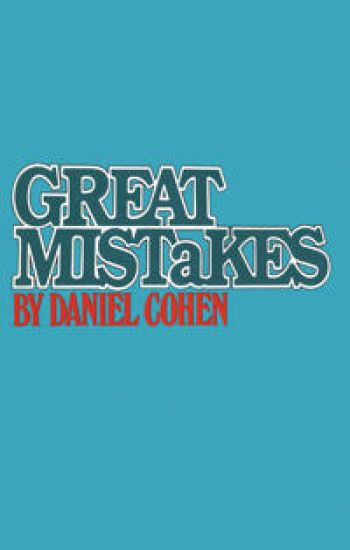
Great Mistakes

Great Mistakes

Daniel Cohen

M. Evans Co Inc
2014
pokkari
Great mistakes make great reading! No area of human endeavor is immune to human error, as these stories of mistakes throughout history clearly show. Some of these mistakes are foolish or funny. Others are serious, terrifying or disastrous. Some are famous. Others are not well known. All of them are marvelously entertaining. Here is the amusing story of a triple double play, the little-known truth about the awesome angle of the Leaning Tower of Pisa, the harrowing tale of the man who was hanged twice. The famous and colorful mayor of New York, Fiorello La Guardia, once said, “I don’t make many mistakes, but when I make one, it’s a beaut.” Everyone makes mistakes—mayors, presidents, kings, generals, police officers, judges, scientists, explorers, millionaires, baseball players, parents and students. So remember when you make a mistake, you are not alone! You are in the company of some of the most powerful and smartest people in history!