Kirjojen hintavertailu – 12 903 725 kirjaa ja 27 kauppaa

Kirjailija

Daniel W. Stroock

Kirjat ja teokset yhdessä paikassa: 22 kirjaa, julkaisuja vuosilta 1987–2024, suosituimpiin kuuluu Markov Processes from K. Itô's Perspective. Vertaile teosten hintoja ja tarkista saatavuus suomalaisista kirjakaupoista.

Nimi esiintyy myös muodoissa: Daniel W Stroock

22 kirjaa

Kirjojen julkaisuvuodet: 1987–2024.

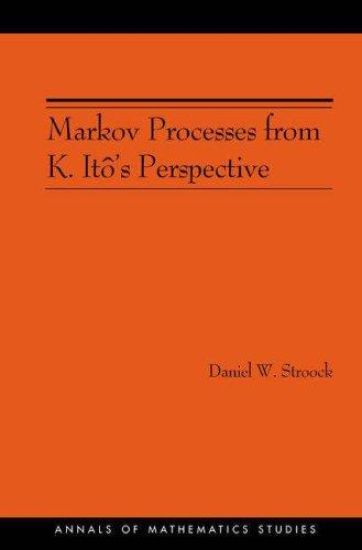
Markov Processes from K. Itô's Perspective

Markov Processes from K. Itô's Perspective

Daniel W. Stroock

Princeton University Press
2003
pokkari
Kiyosi Ito's greatest contribution to probability theory may be his introduction of stochastic differential equations to explain the Kolmogorov-Feller theory of Markov processes. Starting with the geometric ideas that guided him, this book gives an account of Ito's program. The modern theory of Markov processes was initiated by A. N. Kolmogorov. However, Kolmogorov's approach was too analytic to reveal the probabilistic foundations on which it rests. In particular, it hides the central role played by the simplest Markov processes: those with independent, identically distributed increments. To remedy this defect, Ito interpreted Kolmogorov's famous forward equation as an equation that describes the integral curve of a vector field on the space of probability measures. Thus, in order to show how Ito's thinking leads to his theory of stochastic integral equations, Stroock begins with an account of integral curves on the space of probability measures and then arrives at stochastic integral equations when he moves to a pathspace setting. In the first half of the book, everything is done in the context of general independent increment processes and without explicit use of Ito's stochastic integral calculus. In the second half, the author provides a systematic development of Ito's theory of stochastic integration: first for Brownian motion and then for continuous martingales. The final chapter presents Stratonovich's variation on Ito's theme and ends with an application to the characterization of the paths on which a diffusion is supported. The book should be accessible to readers who have mastered the essentials of modern probability theory and should provide such readers with a reasonably thorough introduction to continuous-time, stochastic processes.
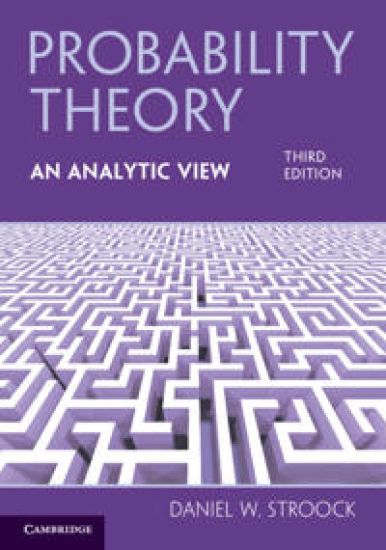
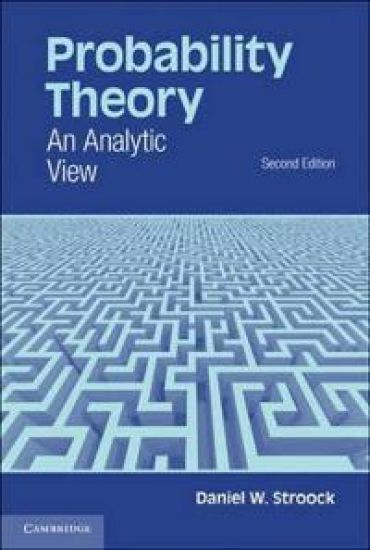
Probability Theory, An Analytic View

Probability Theory, An Analytic View

Daniel W. Stroock

Cambridge University Press
2024
pokkari
The third edition of this highly regarded text provides a rigorous, yet entertaining, introduction to probability theory and the analytic ideas and tools on which the modern theory relies. The main changes are the inclusion of the Gaussian isoperimetric inequality plus many improvements and clarifications throughout the text. With more than 750 exercises, it is ideal for first-year graduate students with a good grasp of undergraduate probability theory and analysis. Starting with results about independent random variables, the author introduces weak convergence of measures and its application to the central limit theorem, and infinitely divisible laws and their associated stochastic processes. Conditional expectation and martingales follow before the context shifts to infinite dimensions, where Gaussian measures and weak convergence of measures are studied. The remainder is devoted to the mutually beneficial connection between probability theory and partial differential equations, culminating in an explanation of the relationship of Brownian motion to classical potential theory.
Gaussian Measures in Finite and Infinite Dimensions

Gaussian Measures in Finite and Infinite Dimensions

Daniel W. Stroock

Springer International Publishing AG
2023
nidottu
This text provides a concise introduction, suitable for a one-semester special topicscourse, to the remarkable properties of Gaussian measures on both finite and infinitedimensional spaces. It begins with a brief resumé of probabilistic results in which Fourieranalysis plays an essential role, and those results are then applied to derive a few basicfacts about Gaussian measures on finite dimensional spaces. In anticipation of the analysisof Gaussian measures on infinite dimensional spaces, particular attention is given to thoseproperties of Gaussian measures that are dimension independent, and Gaussian processesare constructed. The rest of the book is devoted to the study of Gaussian measures onBanach spaces. The perspective adopted is the one introduced by I. Segal and developedby L. Gross in which the Hilbert structure underlying the measure is emphasized. The contents of this bookshould be accessible to either undergraduate or graduatestudents who are interested in probability theory and have a solid background in Lebesgueintegration theory and a familiarity with basic functional analysis. Although the focus ison Gaussian measures, the book introduces its readers to techniques and ideas that haveapplications in other contexts.
Essentials of Integration Theory for Analysis

Essentials of Integration Theory for Analysis

Daniel W. Stroock

Springer Nature Switzerland AG
2021
nidottu
When the first edition of this textbook published in 2011, it constituted a substantial revision of the best-selling Birkhäuser title by the same author, A Concise Introduction to the Theory of Integration. Appropriate as a primary text for a one-semester graduate course in integration theory, this GTM is also useful for independent study. A complete solutions manual is available for instructors who adopt the text for their courses. This second edition has been revised as follows: §2.2.5 and §8.3 have been substantially reworked. New topics have been added. As an application of the material about Hermite functions in §7.3.2, the author has added a brief introduction to Schwartz's theory of tempered distributions in §7.3.4. Section §7.4 is entirely new and contains applications, including the Central Limit Theorem, of Fourier analysis to measures. Related to this are subsections §8.2.5 and §8.2.6, where Lévy's Continuity Theorem and Bochner's characterization of the Fourier transforms of Borel probability on RN are proven. Subsection 8.1.2 is new and contains a proof of the Hahn Decomposition Theorem. Finally, there are several new exercises, some covering material from the original edition and others based on newly added material.
Essentials of Integration Theory for Analysis

Essentials of Integration Theory for Analysis

Daniel W. Stroock

Springer Nature Switzerland AG
2020
sidottu
When the first edition of this textbook published in 2011, it constituted a substantial revision of the best-selling Birkhäuser title by the same author, A Concise Introduction to the Theory of Integration. Appropriate as a primary text for a one-semester graduate course in integration theory, this GTM is also useful for independent study. A complete solutions manual is available for instructors who adopt the text for their courses. This second edition has been revised as follows: §2.2.5 and §8.3 have been substantially reworked. New topics have been added. As an application of the material about Hermite functions in §7.3.2, the author has added a brief introduction to Schwartz's theory of tempered distributions in §7.3.4. Section §7.4 is entirely new and contains applications, including the Central Limit Theorem, of Fourier analysis to measures. Related to this are subsections §8.2.5 and §8.2.6, where Lévy's Continuity Theorem and Bochner's characterization of the Fourier transforms of Borel probability on RN are proven. Subsection 8.1.2 is new and contains a proof of the Hahn Decomposition Theorem. Finally, there are several new exercises, some covering material from the original edition and others based on newly added material.
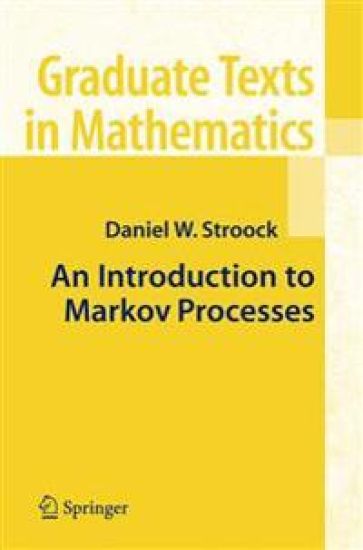
An Introduction to Markov Processes

An Introduction to Markov Processes

Daniel W. Stroock

Springer-Verlag Berlin and Heidelberg GmbH Co. K
2016
nidottu
This book provides a rigorous but elementary introduction to the theory of Markov Processes on a countable state space. It should be accessible to students with a solid undergraduate background in mathematics, including students from engineering, economics, physics, and biology. Topics covered are: Doeblin's theory, general ergodic properties, and continuous time processes. Applications are dispersed throughout the book. In addition, a whole chapter is devoted to reversible processes and the use of their associated Dirichlet forms to estimate the rate of convergence to equilibrium. These results are then applied to the analysis of the Metropolis (a.k.a simulated annealing) algorithm. The corrected and enlarged 2nd edition contains a new chapter in which the author develops computational methods for Markov chains on a finite state space. Most intriguing is the section with a new technique for computing stationary measures, which is applied to derivations of Wilson's algorithm and Kirchoff's formula for spanning trees in a connected graph.
A Concise Introduction to Analysis

A Concise Introduction to Analysis

Daniel W. Stroock

Springer International Publishing AG
2015
nidottu
This book provides an introduction to the basic ideas and tools used in mathematical analysis. It is a hybrid cross between an advanced calculus and a more advanced analysis text and covers topics in both real and complex variables. Considerable space is given to developing Riemann integration theory in higher dimensions, including a rigorous treatment of Fubini's theorem, polar coordinates and the divergence theorem. These are used in the final chapter to derive Cauchy's formula, which is then applied to prove some of the basic properties of analytic functions. Among the unusual features of this book is the treatment of analytic function theory as an application of ideas and results in real analysis. For instance, Cauchy's integral formula for analytic functions is derived as an application of the divergence theorem. The last section of each chapter is devoted to exercises that should be viewed as an integral part of the text. A Concise Introduction to Analysis should appeal to upper level undergraduate mathematics students, graduate students in fields where mathematics is used, as well as to those wishing to supplement their mathematical education on their own. Wherever possible, an attempt has been made to give interesting examples that demonstrate how the ideas are used and why it is important to have a rigorous grasp of them.
Multidimensional Diffusion Processes

Multidimensional Diffusion Processes

Daniel W. Stroock; S.R.S. Varadhan

Springer-Verlag Berlin and Heidelberg GmbH Co. K
2014
nidottu
"This book is an excellent presentation of the application of martingale theory to the theory of Markov processes, especially multidimensional diffusions. This approach was initiated by Stroock and Varadhan in their famous papers. (...) The proofs and techniques are presented in such a way that an adaptation in other contexts can be easily done. (...) The reader must be familiar with standard probability theory and measure theory which are summarized at the beginning of the book. This monograph can be recommended to graduate students and research workers but also to all interested in Markov processes from a more theoretical point of view." Mathematische Operationsforschung und Statistik, 1981
An Introduction to Markov Processes

An Introduction to Markov Processes

Daniel W. Stroock

Springer-Verlag Berlin and Heidelberg GmbH Co. K
2013
sidottu
This book provides a rigorous but elementary introduction to the theory of Markov Processes on a countable state space. It should be accessible to students with a solid undergraduate background in mathematics, including students from engineering, economics, physics, and biology. Topics covered are: Doeblin's theory, general ergodic properties, and continuous time processes. Applications are dispersed throughout the book. In addition, a whole chapter is devoted to reversible processes and the use of their associated Dirichlet forms to estimate the rate of convergence to equilibrium. These results are then applied to the analysis of the Metropolis (a.k.a simulated annealing) algorithm. The corrected and enlarged 2nd edition contains a new chapter in which the author develops computational methods for Markov chains on a finite state space. Most intriguing is the section with a new technique for computing stationary measures, which is applied to derivations of Wilson's algorithm and Kirchoff's formula for spanning trees in a connected graph.
Essentials of Integration Theory for Analysis

Essentials of Integration Theory for Analysis

Daniel W. Stroock

Springer-Verlag New York Inc.
2013
nidottu
‘A Concise Introduction to the Theory of Integration’ was once a best-selling Birkhäuser title which published 3 editions. This manuscript is a substantial revision of the material. Chapter one now includes a section about the rate of convergence of Riemann sums. The second chapter now covers both Lebesgue and Bernoulli measures, whose relation to one another is discussed. The third chapter now includes a proof of Lebesgue's differential theorem for all monotone functions. This is a beautiful topic which is not often covered. The treatment of surface measure and the divergence theorem in the fifth chapter has been improved. Loose ends from the discussion of the Euler-MacLauren in Chapter I are tied together in Chapter seven. Chapter eight has been expanded to include a proof of Carathéory's method for constructing measures; his result is applied to the construction of Hausdorff measures. The new material is complemented by the addition of several new problems based on that material.
Probability Theory

Probability Theory

Daniel W. Stroock

Cambridge University Press
2010
sidottu
This second edition of Daniel W. Stroock's text is suitable for first-year graduate students with a good grasp of introductory, undergraduate probability theory and a sound grounding in analysis. It is intended to provide readers with an introduction to probability theory and the analytic ideas and tools on which the modern theory relies. It includes more than 750 exercises. Much of the content has undergone significant revision. In particular, the treatment of Levy processes has been rewritten, and a detailed account of Gaussian measures on a Banach space is given.
Lectures on Stochastic Analysis: Diffusion Theory

Lectures on Stochastic Analysis: Diffusion Theory

Daniel W. Stroock

Cambridge University Press
1987
pokkari
This book is based on a course given at Massachusetts Institute of Technology. It is intended to be a reasonably self-contained introduction to stochastic analytic techniques that can be used in the study of certain problems. The central theme is the theory of diffusions. In order to emphasize the intuitive aspects of probabilistic techniques, diffusion theory is presented as a natural generalization of the flow generated by a vector field. Essential to the development of this idea is the introduction of martingales and the formulation of diffusion theory in terms of martingales. The book will make valuable reading for advanced students in probability theory and analysis and will be welcomed as a concise account of the subject by research workers in these fields.
Elements of Stochastic Calculus and Analysis

Elements of Stochastic Calculus and Analysis

Daniel W. Stroock

Springer Nature Switzerland AG
2019
nidottu
This book gives a somewhat unconventional introduction to stochastic analysis. Although most of the material coveredhere has appeared in other places, this book attempts to explain the core ideas on which that material is based. As a consequence, the presentation is more an extended mathematical essay than a ``definition,lemma, theorem'' text. In addition, it includes several topics that are not usually treated elsewhere. For example,Wiener's theory of homogeneous chaos is discussed, Stratovich integration is given a novel development and applied to derive Wong and Zakai's approximation theorem, and examples are given of the application ofMalliavin's calculus to partial differential equations. Each chapter concludes with several exercises, some of which are quite challenging. The book is intended for use by advanced graduate students and researchmathematicians who may be familiar with many of the topics but want to broaden their understanding of them.
Elements of Stochastic Calculus and Analysis

Elements of Stochastic Calculus and Analysis

Daniel W. Stroock

Springer International Publishing AG
2018
sidottu
This book gives a somewhat unconventional introduction to stochastic analysis. Although most of the material coveredhere has appeared in other places, this book attempts to explain the core ideas on which that material is based. As a consequence, the presentation is more an extended mathematical essay than a ``definition,lemma, theorem'' text. In addition, it includes several topics that are not usually treated elsewhere. For example,Wiener's theory of homogeneous chaos is discussed, Stratovich integration is given a novel development and applied to derive Wong and Zakai's approximation theorem, and examples are given of the application ofMalliavin's calculus to partial differential equations. Each chapter concludes with several exercises, some of which are quite challenging. The book is intended for use by advanced graduate students and researchmathematicians who may be familiar with many of the topics but want to broaden their understanding of them.
Mathematics of Probability

Mathematics of Probability

Daniel W. Stroock

American Mathematical Society
2013
sidottu
This book covers the basics of modern probability theory. It begins with probability theory on finite and countable sample spaces and then passes from there to a concise course on measure theory, which is followed by some initial applications to probability theory, including independence and conditional expectations. The second half of the book deals with Gaussian random variables, with Markov chains, with a few continuous parameter processes, including Brownian motion, and, finally, with martingales, both discrete and continuous parameter ones. The book is a self-contained introduction to probability theory and the measure theory required to study it.
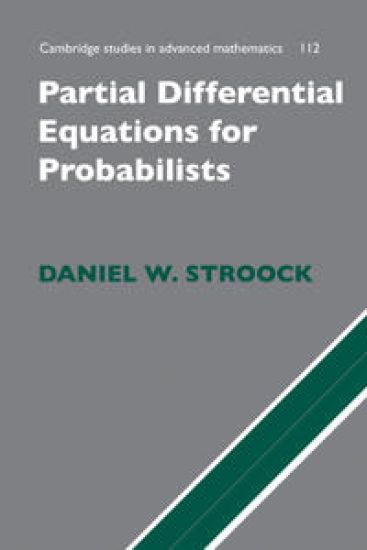
Partial Differential Equations for Probabilists

Partial Differential Equations for Probabilists

Daniel W. Stroock

Cambridge University Press
2012
pokkari
This book deals with equations that have played a central role in the interplay between partial differential equations and probability theory. Most of this material has been treated elsewhere, but it is rarely presented in a manner that makes it readily accessible to people whose background is probability theory. Many results are given new proofs designed for readers with limited expertise in analysis. The author covers the theory of linear, second order, partial differential equations of parabolic and elliptic types. Many of the techniques have antecedents in probability theory, although the book also covers a few purely analytic techniques. In particular, a chapter is devoted to the De Giorgi–Moser–Nash estimates, and the concluding chapter gives an introduction to the theory of pseudodifferential operators and their application to hypoellipticity, including the famous theorem of Lars Hormander.
Malliavin Calculus at Saint-Flour

Malliavin Calculus at Saint-Flour

Nobuyuki Ikeda; David Nualart; Daniel W. Stroock

Springer-Verlag Berlin and Heidelberg GmbH Co. K
2012
nidottu
Stroock, Daniel W.: Some applications of stochastic calculus to partial differential equations.- Ikeda, Nobuyuki: Probabilistic methods in the study of asymptotics.- Nualart, David: Analysis on Wiener space and anticipating stochastic calculus. ?
Partial Differential Equations for Probabilists

Partial Differential Equations for Probabilists

Daniel W. Stroock

Cambridge University Press
2008
sidottu
This book deals with equations that have played a central role in the interplay between partial differential equations and probability theory. Most of this material has been treated elsewhere, but it is rarely presented in a manner that makes it readily accessible to people whose background is probability theory. Many results are given new proofs designed for readers with limited expertise in analysis. The author covers the theory of linear, second order, partial differential equations of parabolic and elliptic types. Many of the techniques have antecedents in probability theory, although the book also covers a few purely analytic techniques. In particular, a chapter is devoted to the De Giorgi–Moser–Nash estimates, and the concluding chapter gives an introduction to the theory of pseudodifferential operators and their application to hypoellipticity, including the famous theorem of Lars Hormander.
An Introduction to Markov Processes

An Introduction to Markov Processes

Daniel W. Stroock

Springer-Verlag Berlin and Heidelberg GmbH Co. K
2005
nidottu
To some extent, it would be accurate to summarize the contents of this book as an intolerably protracted description of what happens when either one raises a transition probability matrix P (i. e. , all entries (P)»j are n- negative and each row of P sums to 1) to higher and higher powers or one exponentiates R(P — I), where R is a diagonal matrix with non-negative entries. Indeed, when it comes right down to it, that is all that is done in this book. However, I, and others of my ilk, would take offense at such a dismissive characterization of the theory of Markov chains and processes with values in a countable state space, and a primary goal of mine in writing this book was to convince its readers that our offense would be warranted. The reason why I, and others of my persuasion, refuse to consider the theory here as no more than a subset of matrix theory is that to do so is to ignore the pervasive role that probability plays throughout. Namely, probability theory provides a model which both motivates and provides a context for what we are doing with these matrices. To wit, even the term "transition probability matrix" lends meaning to an otherwise rather peculiar set of hypotheses to make about a matrix.